
How many calories are in a pear?
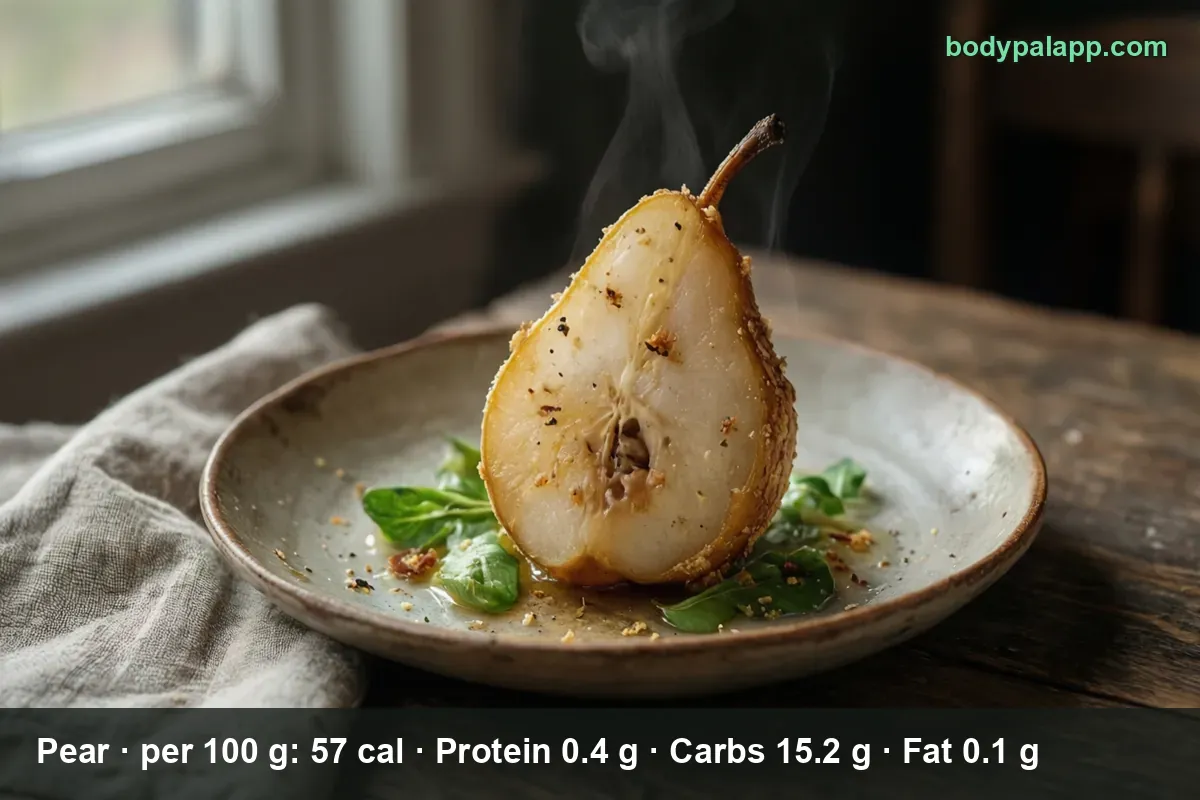
One medium pear weighs 178 g and carries 101 calories. Raw pear runs 57 calories per 100 g, which puts it in the same bracket as a golden delicious apple, gram for gram. The fruit's real headline is the fiber: 5.5 g in that one pear, a fifth of the day's Daily Value.
On this page
- Pear quick facts
- US servings from one ounce to a large pear
- Variety changes the number more than anything else
- Canned and dried pears
- Fiber is the row that pays off
- How does a pear compare?
- Most popular pear brands
- Pear FAQs
Pear quick facts
The record behind every number on this page is SR Legacy 169118, "Pears, raw". Almost nobody searching for pear calories knows which variety is in the fruit bowl, and this is the general entry USDA built by averaging across varieties. It also carries the full set of household measures — small, medium, large and a cup of slices — so the arithmetic below stays inside one record instead of jumping between four.
| Nutrient | Per 100 g | Per 1 medium pear (178 g) | % Daily Value |
|---|---|---|---|
| Calories | 57 | 101 | — |
| Total fat | 0.14 g | 0.2 g | 0% |
| Saturated fat | 0.02 g | 0.0 g | 0% |
| Carbohydrate | 15.23 g | 27.1 g | 10% |
| Dietary fiber | 3.1 g | 5.5 g | 20% |
| Total sugars | 9.75 g | 17.4 g | — |
| Protein | 0.36 g | 0.6 g | 1% |
| Sodium | 1 mg | 2 mg | 0% |
% Daily Value is based on a 2,000-calorie diet.
Verified nutrition data
Numbers on this page come from USDA FoodData Central, the U.S. Department of Agriculture’s food composition database, and from manufacturer labels where a branded product is named. Last verified September 2026. How we verify our data →
There is no added sugars row here, and that is not an omission — the SR Legacy edition does not publish added sugars at all, and a raw pear has none to publish. Every one of those 17.4 g of sugar came with the fruit. Cholesterol is zero. Potassium comes to 206 mg in a medium pear, 4% of the 4,700 mg Daily Value, which is respectable for something this light but nowhere near a banana or a potato.
Two rows are worth staring at before you scroll. Sodium is 2 mg in the whole fruit — you would need roughly a thousand pears to reach the sodium in a teaspoon of table salt. And fat is 0.2 g, which is why the calories sit almost entirely in carbohydrate.
US servings from one ounce to a large pear
| Serving | Weight | Calories |
|---|---|---|
| 1 oz raw | 28 g | 16 kcal |
| 1 cup, slices | 140 g | 80 kcal |
| 1 small pear | 148 g | 84 kcal |
| 1 medium pear | 178 g | 101 kcal |
| 1 large pear | 230 g | 131 kcal |
| Per 100 g | 100 g | 57 kcal |
Small, medium, large and the cup of slices are USDA's own household measures for this record, so those four numbers are as close to official as pear math gets. The 1 oz line is our own arithmetic from the USDA 100 g figure, not a USDA serving — useful if you slice a pear into a salad and only want to log part of it.
The gap between small and large is the one people underestimate. A large pear is 47 calories more than a small one, which is a 56% jump for a fruit that looks about the same on the counter. If you log "one pear" out of habit, you are logging 101, and a big Anjou from a farmers market can quietly be a third more than that.
A cup of slices lands at 80 calories, below a whole medium pear, because 140 g of slices does not fill the same space as a 178 g fruit. Cup measures and whole-fruit measures are not interchangeable, and a cup is the smaller of the two here.
Variety changes the number more than anything else
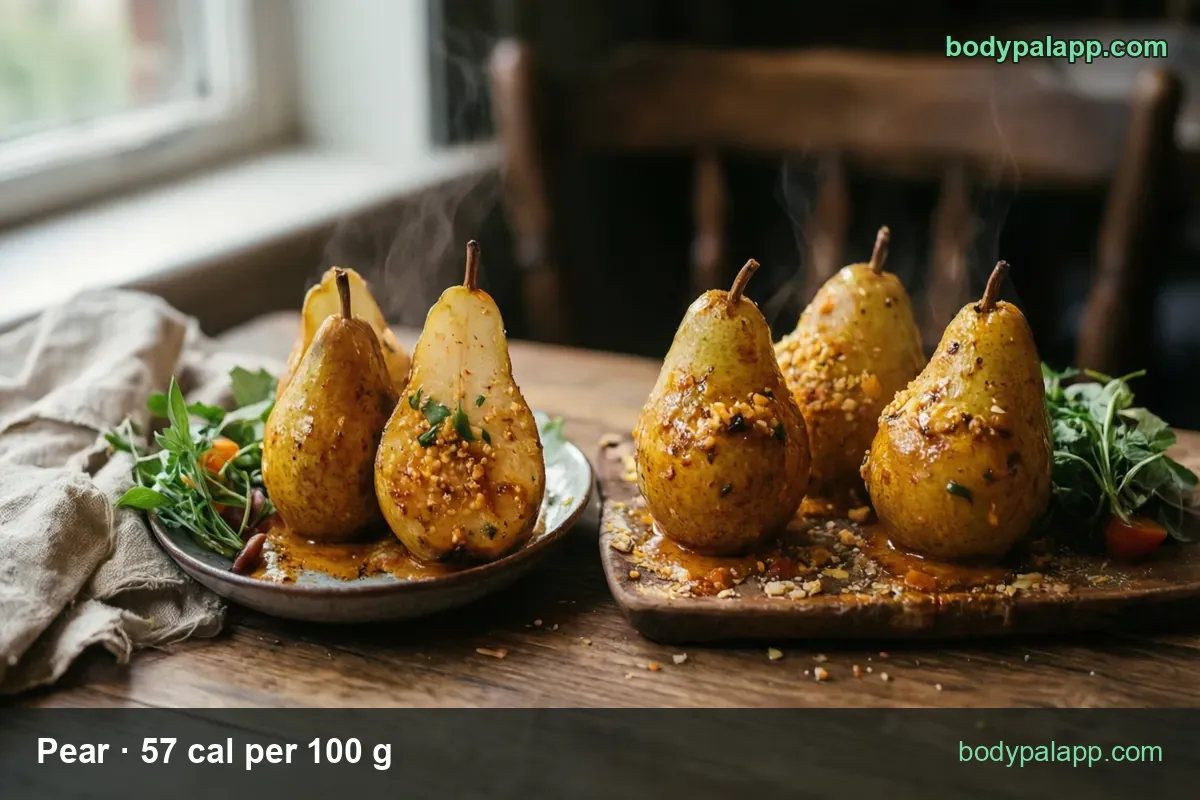
Cooking barely moves a pear. Variety moves it a lot — both because the flesh is denser in some cultivars and because the fruits themselves are different sizes. USDA keeps a separate SR Legacy record for each of the main ones.
| Variety | Per 100 g | Typical fruit | Calories |
|---|---|---|---|
| Bartlett | 63 kcal | 1 medium, 177 g | 112 kcal |
| Bosc | 67 kcal | 1 medium, 179 g | 120 kcal |
| Green Anjou | 66 kcal | 1 medium, 202 g | 133 kcal |
| Red Anjou | 62 kcal | 1 medium, 157 g | 97 kcal |
| Asian pear | 42 kcal | 1 oz, 28 g | 12 kcal |
Bosc is the densest of the five at 67 calories per 100 g — less water, firmer flesh, the pear that holds its shape when you bake it. Asian pear is the outlier in the other direction at 42, so watery that it eats more like a crisp apple than a pear. Between those two extremes there is a 60% spread per gram, which is wider than the spread between chicken breast and chicken thigh.
Then size takes over. A green Anjou at 202 g is the highest-calorie single fruit on this page at 133 calories, even though Bosc beats it per gram. A red Anjou runs smaller at 157 g and comes in at 97 — the only variety here that lands under 100 for a whole fruit. So the honest answer to "which pear is lightest" depends on when you count by weight and when you count by fruit.
The Asian pear line is per ounce because USDA lists no household measure for that record. It is also the highest-fiber raw pear in the set, 3.6 g per 100 g against 3.0 to 3.1 g for the rest, while costing the fewest calories per gram.
Canned and dried pears
| Form | Per 100 g | Typical serving | Calories |
|---|---|---|---|
| Canned in juice | 50 kcal | 1/2 cup, 124 g | 62 kcal |
| Dried, sulfured | 262 kcal | 1 cup halves, 180 g | 472 kcal |
Canned pears in juice are the surprise of this page: 50 calories per 100 g, lower than the raw fruit's 57, because the packing juice is more dilute than pear flesh. Half a cup is 62 calories. The store labels agree — Del Monte pear halves in 100% juice list 60 calories for a 124 g half cup, and Spartan and Wild Harvest slices in juice both post 60 for 125 g.
The cost is fiber, not calories. The juice pack carries 1.6 g of fiber per 100 g where the raw fruit carries 3.1 g, so a canned pear gives up roughly half its fiber to the peeling and the liquid. Syrup is the other trap: swap the juice pack for a heavy syrup pack and the same half cup climbs to 92 calories, a 48% increase for nothing but sweetener.
Dried pears are the same fruit with the water pulled out, and the number follows: 262 calories per 100 g, which is more than four times raw pear. A cup of dried halves is 472 calories, sugars concentrated to 62.20 g per 100 g. Nothing has been added — but a cup of dried pears is not a snack-size portion, it is closer to a meal. Weigh them, or count halves.
Pear also shows up in processed forms that share nothing but the name. A GoGo squeeZ pear pouch is 78 calories per 100 g, 70 for the 90 g pouch, and Rutherford & Meyer pear fruit paste — the block that goes on a cheese board — hits 283 calories per 100 g, though the 6 g label serving is only 17.
Fiber is the row that pays off
One medium pear delivers 5.5 g of fiber, 20% of the FDA Daily Value of 28 g, for 101 calories — about 5% of a 2,000-calorie day. That is the whole argument for the pear in one sentence: it takes four times more of your day's fiber than of your day's calories.
Very few foods do that without cooking, soaking or a supplement aisle. Two pears would put you at 40% of the fiber target for 202 calories, and MyPlate puts most adults at about 1.5 to 2 cups of fruit a day, so that is not an unusual amount to eat.
If you are watching sugar rather than fiber, the honest counterpoint is 17.4 g of total sugars in that pear. Total sugars have no Daily Value on the US label, and these are the sugars that came with the fruit rather than added ones, so the 50 g added-sugars limit does not apply to them. Fiber and water arrive in the same bite, which is the practical difference between a pear and a glass of pear juice.
How does a pear compare?
| Fruit | Per 100 g | US serving | Calories |
|---|---|---|---|
| Pear | 57 kcal | one medium, 178 g | 101 kcal |
| Blueberries | 57 kcal | 1 oz, 28 g | 16 kcal |
| Golden delicious apple | 57 kcal | 1 oz, 28 g | 16 kcal |
| Quince | 57 kcal | 1 oz, 28 g | 16 kcal |
Our take: this is a four-way tie, and that is the point. Pear, blueberries, apple and quince all land on exactly 57 calories per 100 g, so picking between them on calories alone is picking between identical options. Sort them on something else and small gaps appear — blueberries carry just over double the protein at 0.74 g against the pear's 0.36 g, quince edges the pear on carbohydrate at 15.30 g against 15.23 g, and the apple is the lowest-carb of the four at 13.60 g. None of those gaps is big enough to change a meal. What changes the meal is portion size: a pear arrives as a 178 g fruit and an ounce of blueberries arrives as a small handful, so the pear ends up on the log at 101 calories and the berries at 16.
Most popular pear brands in the United States
Ranked by how widely each product appears among foods sold in the United States, from the BodyPal food database of over 3.3 million products. Calories are the figures printed on each Nutrition Facts label, checked against USDA FoodData Central.
| Product | Calories (per 100 g) |
|---|---|
| Rutherford & Meyer Pear Fruit Paste | 283 cal |
| GoGo squeeZ Zippin' Zingin' Pear | 78 cal |
| Spartan Sliced Pears in Pear Juice | 48 cal |
| Del Monte Pear Halves in 100% Juice | 48 cal |
| Wild Harvest Organic Pear Slices | 48 cal |
| Green Acres Pear Slices | 36 cal |
Brand popularity: BodyPal food database. Nutrition: manufacturer labels / USDA FoodData Central.
Pear FAQs
How many calories are in a medium pear?
A medium pear weighing 178 g has 101 calories, based on USDA's raw pear record at 57 calories per 100 g. A small 148 g pear is 84 calories and a large 230 g pear is 131. Those three weights cover almost every pear in a US grocery bin.
How many carbs are in a pear?
One medium pear carries 27.1 g of carbohydrate, 10% of the Daily Value, of which 17.4 g is naturally occurring sugar and 5.5 g is fiber. Per 100 g that works out to 15.23 g of carbohydrate. Nothing is added — a raw pear contains no added sugars at all.
How much fiber is in a pear?
A medium pear delivers 5.5 g of fiber, 20% of the 28 g Daily Value, for 101 calories. Per 100 g the raw fruit runs 3.1 g. A fifth of the day's fiber for about a twentieth of a 2,000-calorie day is the best trade on this page.
How many calories are in a Bartlett, Bosc or Anjou pear?
A medium Bartlett (177 g) is 112 calories, a medium Bosc (179 g) is 120, a green Anjou (202 g) is 133 and a red Anjou (157 g) is 97. Bosc is the densest at 67 calories per 100 g, while the green Anjou wins on size rather than density.
How many calories are in an Asian pear?
An Asian pear is 42 calories per 100 g, the lightest pear USDA lists, and one ounce (28 g) is 12 calories. It also carries more fiber than a regular pear, 3.6 g per 100 g against 3.1 g. USDA publishes no household serving for this record.
How many calories are in canned pears in juice?
Half a cup of pears canned in juice (124 g) is 62 calories, against 101 for a whole medium pear. The catch is not calories, it is fiber: the juice pack has 1.6 g per 100 g where raw pear has 3.1 g. Heavy syrup pushes that half cup to 92.
How many calories are in dried pears?
One cup of dried pear halves (180 g) is 472 calories, because dried pears run 262 calories per 100 g — more than four times raw pear's 57. Only water has been removed. Sugars concentrate to 62.20 g per 100 g, so a small handful is the sensible unit to log.
Are pears good for weight loss?
One medium pear is 101 calories and brings 5.5 g of fiber, 20% of the Daily Value, which is the best fiber-per-calorie ratio on this page. If you are managing calories, the whole fruit beats dried pears at 472 per cup and anything packed in heavy syrup. MyPlate suggests 1.5 to 2 cups of fruit daily.
Similar foods
- Blueberries — 84 cal per cup
- Gala Apple — 98 cal per medium apple
- Fruit cup — 89 cal per cup
- Red Delicious Apple — 125 cal per medium apple
- Honey Mango — 99 cal per cup pieces
- Honeycrisp Apple — 109 cal per medium apple
Count it without the math
Point the camera at the fruit bowl and BodyPal counts the pear for you, variety and all.


How long does it take to burn off a pear?
One medium pear (178 g) is 101 kcal. Enter your weight and the amount you ate to see how long it takes you to burn that off:
lb
| Activity | Time to burn 101 kcal |
|---|---|
| Walking, brisk | 20 min |
| Cycling, moderate | 13 min |
| Swimming, moderate | 14 min |
| Jogging | 12 min |
| Weight training, moderate | 22 min |
Times are for a 155 lb adult at a steady pace; change the weight to see yours. The amount is set to the portion in the text (178 g); change it to what you actually ate. BodyPal works this out from your steps automatically.
Want the bigger picture? Calculate your daily calorie needs — your maintenance figure, a target for losing or gaining, and the date you get there.