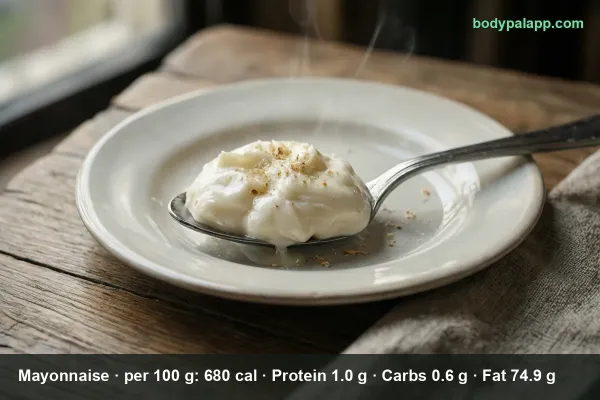
Mayonnaise packet calories come to 68 for one 10 g packet and 680 per 100 g. Almost all of that is fat: 99 percent of the calories, with protein and carbs barely registering. Each packet is small and fixed, so the real swing comes from how many you tear open, not from what is inside any one of them.
68kcal
1 packet · 10 g, regular, ready to use
1%protein
0.1 gProtein
0 gCarbs
7.5 gFat
How to burn off 68 kcal
—Walking, brisk
—Jogging
—Cycling, moderate
—Swimming
Skip the math. BodyPal counts these calories from your steps and workouts automatically.
Nutrition facts
Regular, ready to use · per 10 g
Calories
68 kcal
Protein
0.1 g
Carbohydrate
0.1 g
Fat
7.5 g
Saturated fat
1.2 g
Cholesterol
4 mg
Sodium
64 mg
Potassium
2 mg
Iron
0 mg
Source: USDA FoodData Central
🛡️
Verified nutrition data
Numbers on this page come from USDA FoodData Central, the U.S. Department of Agriculture’s food composition database, and from manufacturer labels where a branded product is named. Last verified September 2026. How we verify our data →
Mayonnaise packet: calories, protein and sodium by serving
Percent of daily value uses the FDA reference of 2,000 kcal a day.
Serving
kcal
Protein
Carbs
Fat
Sodium
% DV kcal
1 packet (10 g)
68
0.1 g
0.1 g
7.5 g
64 mg
3%
1 tablespoon (13.8 g)
94
0.1 g
0.1 g
10.3 g
88 mg
5%
Light, 1 tbsp (15 g)
36
0.1 g
1.4 g
3.3 g
124 mg
2%
100 g
680
1 g
0.6 g
74.9 g
635 mg
34%
3 × 1 packet (10 g)
204
0.3 g
191 mg
5 × 1 packet (10 g)
340
0.5 g
318 mg
Three packets make a 204-calorie side
A single packet holds 10 g of mayo and 68 calories, about 3% of a 2000-calorie daily value. That is less than a level tablespoon, which weighs 13.8 g and lands at 94 calories. If you measure with a spoon at home, the packet is the lighter unit.
The trouble is that packets rarely travel alone. Two come to 136 calories, three reach 204, and five add up to 340 for 50 g of mayonnaise. A sandwich, a burger and a side of fries can each pull in a packet of their own before anyone keeps count.
Counting packets is the simplest fix. Each one is a fixed 68, so tally the empties on the tray instead of guessing how much you squeezed out. If you use only half of one, log half. And a packet you never open is the easiest cut on the table, because the rest of the meal stays exactly the same.
Fat supplies 99 percent of the calories
Per 100 g, regular mayonnaise carries 74.9 g of fat, 1 g of protein and 0.6 g of carbs. In calorie terms, fat supplies 99 percent, protein 1 percent and carbs 0. Few foods on a plate are this one-sided, which is why the label looks nearly empty apart from a single line.
Scaled to one packet, that is 7.5 g of fat next to 0.1 g of protein and 0.1 g of carbs. Sugar is 0.1 g and fiber is 0. A packet adds flavor, creaminess and calories, but no protein or fiber worth counting.
Saturated fat sits at 11.7 g per 100 g, against a daily value of 20 g. Cholesterol is 42 mg per 100 g, against a daily value of 300 mg. At packet size both shrink to small numbers. The headline remains calorie density: at 680 per 100 g, even a thin smear carries real energy, and a heavy hand on a sub roll adds up fast.
Sodium stays modest until packets pile up
One packet carries 64 mg of sodium, about 3% of the 2300 mg daily value. A regular tablespoon lands at 88 mg, or 4%. On its own, that is a minor line on the label, and because sodium per gram is fixed, the total follows the number of packets exactly.
Stack the packets and it climbs. Three bring 191 mg, five bring 318 mg, and a full 100 g of regular mayo holds 635 mg, or 28% of the daily value. If you watch sodium, count the mayo together with the bread, meat, cheese and fries it usually comes with, since the condiment adds to all of them.
Light mayo moves the other way on this row. A 15 g tablespoon of light has 124 mg of sodium, 5% of the daily value, which is more than a regular tablespoon. Cutting calories with the light version does not cut sodium, so pick based on which number you track more closely.
Light mayo cuts a tablespoon to 36 calories
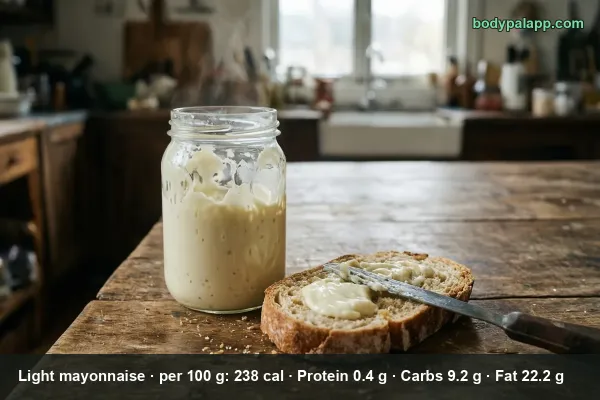
If you like a generous spread, light mayonnaise changes the math more than any portion trick. A 15 g tablespoon of light comes to 36 calories with 3.3 g of fat, against 94 calories and 10.3 g of fat for a regular tablespoon. The trade is a little more carbohydrate, 1.4 g, including 0.5 g of sugar.
Regular packets still work where you control the count. One packet on a wrap or burger adds 68 calories and leaves the meal close to where it started. In tuna, egg or chicken salad, a packet or two goes further when you stretch it with mustard, lemon juice or plain yogurt.
Pair mayo with foods that bring what it lacks: lean meat, beans, vegetables and whole-grain bread supply the protein and fiber. That keeps the packet as flavor on top of a full plate rather than a big share of its calories. If you photograph the meal, BodyPal can log the mayo along with everything else.
How does mayonnaise packet compare?
Here is how a mayonnaise packet stacks up against regular mayo by the tablespoon and teaspoon and against light mayonnaise, per 100 g and per usual serving.
Verdict: Regular mayo is the same 680 calories per 100 g whether it comes in a packet, a tablespoon or a teaspoon, so only the amount changes your total. If calories are the goal, light mayonnaise at 238 per 100 g is the clear pick, but its 827 mg of sodium per 100 g makes regular the better choice if you watch salt.
Mayonnaise packet FAQs
How many calories are in one mayonnaise packet?
A 10 g packet of regular mayonnaise has 68 calories and 7.5 g of fat.
Is a mayonnaise packet a lot of calories for weight loss?
One packet is 68 calories, so two packets on a sandwich add 136 calories. Light mayonnaise has 238 calories per 100 g against 680 for regular.
Is a mayonnaise packet more than a tablespoon of mayo?
No. A tablespoon is 13.8 g and 94 calories, while the packet is 10 g and 68 calories.
How much fat is in a mayonnaise packet?
A 10 g packet has 7.5 g of fat, of which 1.2 g is saturated, plus 64 mg of sodium.
How many calories are in a teaspoon of mayonnaise?
A teaspoon of regular mayonnaise (4.6 g) has 31 calories. A packet holds a little more than two teaspoons' worth, so spreading thinly with a teaspoon uses less than a full packet.
How much mayo is in a packet?
A standard packet holds 10 g of mayonnaise, worth 68 calories. Because the amount is fixed, counting packets is one of the easiest ways to track how much mayo went on your meal.
How many calories are in mayonnaise per 100 g?
Regular mayonnaise has 680 calories per 100 g, with 74.9 g of fat, 1 g of protein and 0.6 g of carbs. That is 34% of a 2000-calorie daily value.
How many calories are in two mayo packets?
Two mayo packets come to 136 calories. Three packets reach 204 and five reach 340, so the count on your tray matters far more than the size of any single packet.
How many calories are in light mayonnaise?
Light mayonnaise has 36 calories in a 15 g tablespoon and 238 per 100 g. That is well below regular mayo at 680 per 100 g, though light carries more sodium, 827 mg per 100 g.