
How many calories are in a tablespoon of mayonnaise?
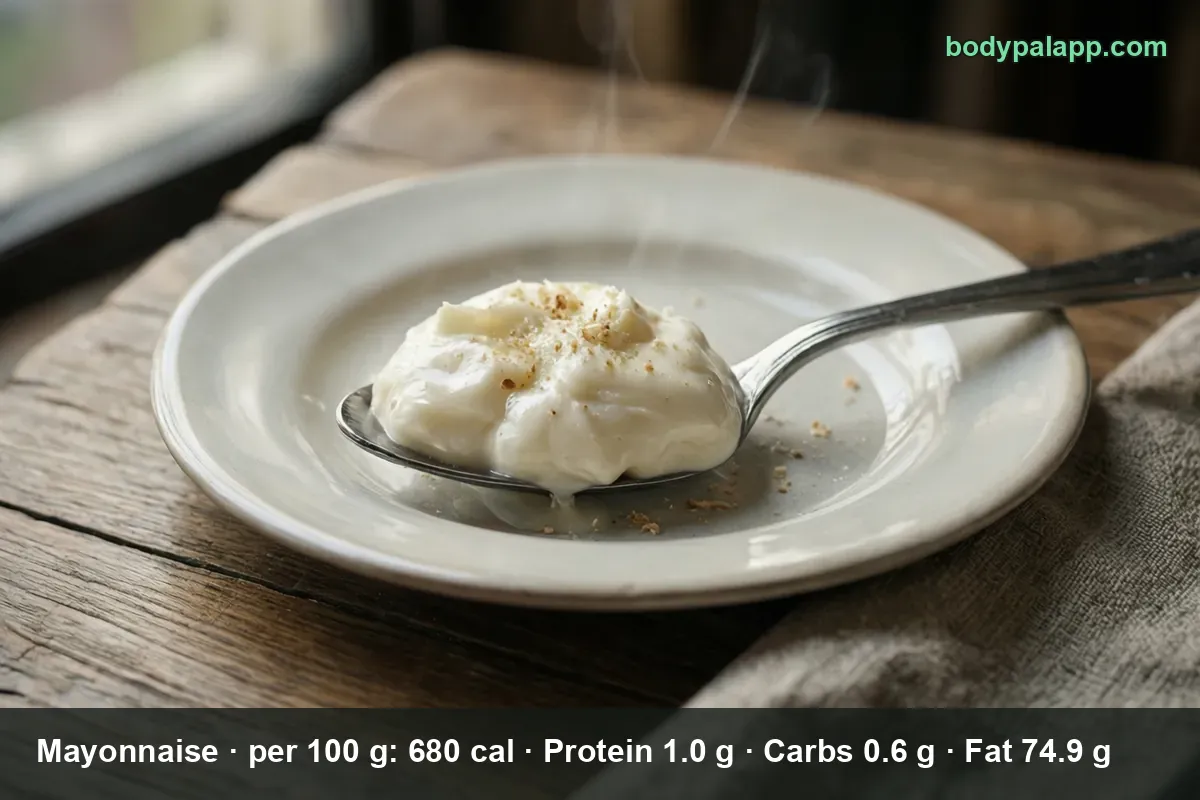
One level tablespoon of regular mayonnaise is 94 calories. Per 100 g the jar runs 680 calories, with 74.85 g of that weight pure fat. Nearly all of it is fat: 10.3 g in that single spoon, with no fiber, no real protein and almost no carbohydrate behind it.
On this page
- Mayonnaise quick facts
- Tablespoon cup and packet servings
- Light fat-free and dressing-style mayonnaise
- Fat is almost the entire label
- How does mayonnaise compare
- Most popular mayonnaise brands
- FAQ
Mayonnaise quick facts
The row on this page is FNDDS 2710204, "Mayonnaise, regular". That is the full-fat spread you scoop out of a jar with a knife or a spoon, and it is the record that carries a household measure of one tablespoon, which is how almost everyone actually portions it. USDA also lists the identical product as SR Legacy 171009 under the older name "Salad dressing, mayonnaise, regular" with the same numbers, so there is nothing to average between them.
Everything below the calorie line is scaled from that record: 13.8 g is the USDA weight of one tablespoon, and the serving column is simply the 100 g figure multiplied by 0.138.
| Nutrient | Per 100 g | Per 1 tablespoon (13.8 g) | % Daily Value |
|---|---|---|---|
| Calories | 680 | 94 | — |
| Total fat | 74.85 g | 10.3 g | 13% |
| Saturated fat | 11.7 g | 1.6 g | 8% |
| Carbohydrate | 0.57 g | 0.1 g | 0% |
| Dietary fiber | 0 g | 0 g | 0% |
| Total sugars | 0.57 g | 0.1 g | — |
| Protein | 0.96 g | 0.1 g | 0% |
| Sodium | 635 mg | 88 mg | 4% |
% Daily Value is based on a 2,000-calorie diet.
Verified nutrition data
Numbers on this page come from USDA FoodData Central, the U.S. Department of Agriculture’s food composition database, and from manufacturer labels where a branded product is named. Last verified September 2026. How we verify our data →
Two rows you would see on a jar label are missing here: added sugars and trans fat. USDA does not publish either value for this generic mayonnaise record, so listing them would mean inventing numbers. Cholesterol is on the record and worth a line of its own: 42 mg per 100 g, which is 6 mg in a tablespoon, or 2% of the Daily Value. Potassium is negligible at 20 mg per 100 g, 3 mg a spoon.
The %DV column comes from the FDA Daily Values used on every US Nutrition Facts panel. Total sugars have no Daily Value, which is why that cell stays empty.
Tablespoon cup and packet servings
| Serving | Weight | Calories |
|---|---|---|
| 1 mayonnaise packet | 12 g | 82 kcal |
| 1 tablespoon | 13.8 g | 94 kcal |
| Spread on a regular sandwich | 14 g | 95 kcal |
| 1 dipping-size container | 28 g | 190 kcal |
| 1 oz | 28.35 g | 193 kcal |
| 1 cup | 220 g | 1496 kcal |
| Per 100 g | 100 g | 680 kcal |
Only the tablespoon is a USDA household measure. The ounce, the packet and the cup are our own arithmetic from the USDA 100 g figure, not USDA servings, and the sandwich line is the guideline amount USDA uses for a single regular sandwich.
The cup is where mayonnaise quietly wrecks a day of logging. A cup weighs 220 g and lands at 1,496 calories, which is close to 16 tablespoons going in at once. Nobody eats a cup of mayonnaise on its own, but a batch of potato salad, coleslaw or tuna salad routinely starts with half to a full cup, and that scoop is 748 to 1,496 calories before a single potato or egg joins it. Divided across eight side portions, a full cup still adds about 187 calories per plate.
At the other end, a takeout packet is small enough to feel free and is not: 12 g works out to 82 calories. Two packets on a burger is 164 calories, nearly two full tablespoons.
Light fat-free and dressing-style mayonnaise
The jars sitting next to the regular one are genuinely different foods, not marketing variations, and USDA gives each its own record with its own tablespoon weight. Lighter versions are also heavier per spoon, because water and starch replace oil.
| Version | Per 100 g | Tablespoon | Calories |
|---|---|---|---|
| Regular mayonnaise | 680 kcal | 13.8 g | 94 kcal |
| Reduced-fat with olive oil | 361 kcal | 13.8 g | 50 kcal |
| Mayonnaise-type salad dressing | 250 kcal | 14.7 g | 37 kcal |
| Light mayonnaise | 238 kcal | 15.6 g | 37 kcal |
| Light mayonnaise-type dressing | 158 kcal | 14.5 g | 23 kcal |
| Fat-free mayonnaise | 64 kcal | 16 g | 10 kcal |
Light mayonnaise cuts the spoon from 94 to 37 calories, a saving of 57, and it does that by cutting fat from 74.85 g to 22.22 g per 100 g. What goes up is sodium: 827 mg per 100 g against 635 mg, which is about 129 mg in that bigger 15.6 g spoon versus 88 mg in the regular one. The lighter jar is the higher-salt jar.
Mayonnaise-type salad dressing, the sweetened style most people know by a brand name, is a separate USDA category at 250 calories per 100 g. It costs 37 calories a spoon like light mayo, but it gets there differently: 10.02 g of sugar per 100 g against 0.57 g in real mayonnaise, and 21.6 g of fat.
Fat-free mayonnaise is the outlier at 64 calories per 100 g, 10 calories a tablespoon. There is no fat at all in it; the body of the spread is starch, and carbohydrate climbs to 15.8 g per 100 g with 6.8 g of that as sugar. Sodium sits at 750 mg per 100 g, about 120 mg a spoon.
Brand jars land close to the generic number. USDA's branded records list Hellmann's Real Mayonnaise at 714 calories per 100 g with a 14 g tablespoon printed as 100 calories, a second label of the same product at 692 per 100 g with a 13 g tablespoon printed as 90, and the single-serve packet at 636 per 100 g, 70 calories for 11 g. The 90-to-100 spread is label rounding and spoon weight, not a different recipe.
Fat is almost the entire label
A tablespoon of mayonnaise is 13% of the Daily Value for total fat and 8% for saturated fat, while contributing 0% of carbohydrate, 0% of fiber and 0% of protein. Very few foods are that lopsided. It is essentially oil and egg yolk held together, which is also why it tastes the way it does and why it makes dry food edible.
That matters for the saturated fat line more than the calorie line. The Dietary Guidelines for Americans put saturated fat at under 10% of daily calories, which is about 22 g on a 2,000-calorie day. Three tablespoons of mayonnaise is 4.8 g of that, roughly a fifth, before anything else on the plate. If saturated fat is the number you are managing, light mayonnaise is the lower of the two swaps at 3.45 g per 100 g against 5.37 g for the reduced-fat olive oil version.
Sodium is worth one honest sentence too. A whole cup carries about 1,397 mg, which is roughly 0.6 teaspoon of table salt, and that is on top of whatever salt the salad itself gets.
Protein is where mayonnaise contributes nothing: 0.96 g per 100 g, effectively zero in a spoon. If you are building a tuna or chicken salad, the protein is coming entirely from the protein foods in the bowl, and the mayonnaise is pure calorie cost added to them.
How does mayonnaise compare
| Spread | Per 100 g | US serving | Calories |
|---|---|---|---|
| Mayonnaise, regular | 680 kcal | 1 tbsp, 13.8 g | 94 kcal |
| Mayonnaise-type salad dressing | 250 kcal | 1 tbsp, 14.7 g | 37 kcal |
| Mayonnaise, light | 238 kcal | 1 tbsp, 15.6 g | 37 kcal |
| Mayonnaise, fat free | 64 kcal | 1 tbsp, 16 g | 10 kcal |
Our take: regular mayonnaise is the most calorie-dense item in this group by a wide margin, more than ten times fat-free per gram, so the biggest win is portion control rather than a jar swap. One measured tablespoon on a sandwich is a fair 94 calories and tastes like mayonnaise; a knife-loaded two or three spoons is 188 to 282 and does not taste three times better. If you make mayonnaise-heavy salads by the bowl, switching that scoop to light mayo saves roughly 57 calories per tablespoon and is the single change that moves the most, as long as you can live with the extra sodium. Fat-free is a different product in texture and sweetness, and it is the right pick only if the calorie gap matters more than the taste.
Most popular mayonnaise brands in the United States
Ranked by how widely each product appears among foods sold in the United States, from the BodyPal food database of over 3.3 million products. Calories are the figures printed on each Nutrition Facts label, checked against USDA FoodData Central.
| Product | Calories (per 100 g) |
|---|---|
| Hellmann's Real Mayonnaise | 714 cal |
| Hellmann's Real Mayonnaise (13 g Tbsp label) | 692 cal |
| Hellmann's Real Mayonnaise Packet | 636 cal |
Brand popularity: BodyPal food database. Nutrition: manufacturer labels / USDA FoodData Central.
Mayonnaise FAQs
How many calories are in 1 tablespoon of mayonnaise?
One level tablespoon of regular mayonnaise is 94 calories, using the USDA weight of 13.8 g and 680 calories per 100 g. Almost all of it is fat: 10.3 g per spoon, with 1.6 g saturated. There is no meaningful protein, fiber or sugar in that spoon.
How much does 1 tbsp of mayonnaise weigh in grams?
USDA puts one tablespoon of mayonnaise at 13.8 g, which is why the spoon lands at 94 calories rather than a round number. Brand labels round differently: Hellmann's prints 14 g on one label and 13 g on another, so the same spoon shows up as 100 or 90 calories.
How many calories in a tablespoon of Hellmann's mayo?
Hellmann's Real Mayonnaise is listed at 100 calories for a 14 g tablespoon, and a second label of the same product prints 90 calories for a 13 g tablespoon. Both sit close to the generic USDA figure of 94 calories per 13.8 g spoon. The gap is label rounding, not a different recipe.
Is light mayo actually lower in calories?
Yes — light mayonnaise runs 238 calories per 100 g against 680 for regular, so a 15.6 g tablespoon is 37 calories instead of 94. The trade is sodium: 827 mg per 100 g versus 635, which works out to about 129 mg a spoon against 88 mg for the regular jar.
How many calories in a cup of mayonnaise?
One cup of mayonnaise weighs 220 g and carries 1,496 calories, our own arithmetic from the USDA 100 g figure rather than a USDA serving. That is close to 16 tablespoons in a single scoop, plus about 1,397 mg of sodium, roughly 0.6 teaspoon of table salt.
Does mayonnaise have carbs or sugar?
Barely — regular mayonnaise has 0.57 g of carbohydrate per 100 g, which rounds to 0.1 g in a tablespoon, and all of it counts as sugar. The lighter versions are the opposite: fat-free mayonnaise carries 15.8 g of carbohydrate per 100 g, because starch replaces the oil.
How much sodium is in a tablespoon of mayo?
A tablespoon of regular mayonnaise has 88 mg of sodium, 4% of the FDA Daily Value of 2,300 mg. Light mayonnaise is higher at about 129 mg a spoon, and fat-free at about 120 mg. The lighter the mayonnaise, the more salt it tends to carry.
Which has fewer calories, mayonnaise or Miracle Whip?
Miracle Whip is a mayonnaise-type salad dressing, and USDA lists that category at 250 calories per 100 g against 680 for real mayonnaise. A 14.7 g tablespoon is 37 calories. The catch is sugar: 10.02 g per 100 g in the dressing versus 0.57 g in mayonnaise.
Similar foods
- Mayo — 94 cal per tablespoon
- Mayo Packet — 68 cal per packet
- Mayonnaise Packet — 68 cal per packet
- Mayonnaise, Teaspoon — 31 cal per teaspoon
- Tahini — 105 cal per tablespoon
- Almond Flour — 170 cal per 1/4 cup
Count it without the math
Point the camera at the sandwich and BodyPal counts the mayonnaise with it, spoon for spoon.


How long does it take to burn off mayonnaise?
One tablespoon (13.8 g) is 94 kcal. Enter your weight and the amount you ate to see how long it takes you to burn that off:
lb
| Activity | Time to burn 94 kcal |
|---|---|
| Walking, brisk | 19 min |
| Cycling, moderate | 12 min |
| Swimming, moderate | 13 min |
| Jogging | 11 min |
| Weight training, moderate | 21 min |
Times are for a 155 lb adult at a steady pace; change the weight to see yours. The amount is set to the portion in the text (13.8 g); change it to what you actually ate. BodyPal works this out from your steps automatically.
One food is easy to picture; a whole day is harder. See how many calories you need a day and what a deficit actually looks like.