
How many calories are in tahini?
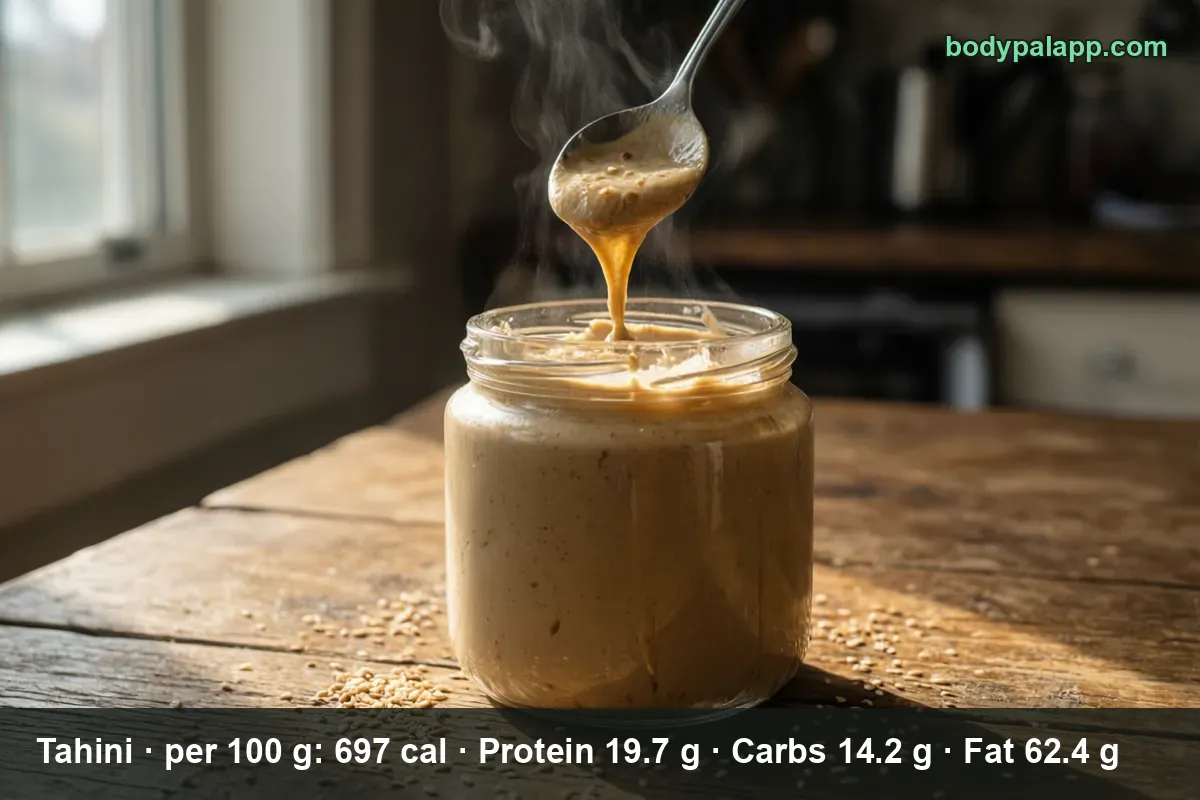
One tablespoon of tahini is 105 calories. Per 100 g the jar runs 697 calories, which makes it one of the densest things on the condiment shelf, and the label serving of two tablespoons doubles the spoon to 209. Fat drives nearly all of it: 62.4 g per 100 g, next to 19.71 g of protein.
On this page
- Tahini quick facts
- US servings, from a bread smear to two tablespoons
- Roasted, unroasted and stone-ground tahini
- Fat and fiber are the rows to watch
- How does tahini compare?
- Most popular tahini brands
- FAQ
Tahini quick facts
The numbers below come from the FNDDS record 2707587, "Tahini", part of the 2021–2023 survey release. That is the ground sesame paste you scoop out of a jar, and its energy value sits inside the range US labels print, 600 to 733 calories per 100 g across the six jars we checked. The older SR Legacy sesame butter records land between 570 and 607, under five of those six jars, so they belong in the variant table further down rather than at the top of the page.
The tablespoon shown here, 15 g, is the USDA household measure attached to that same record, not a number we invented.
| Nutrient | Per 100 g | Per 1 tablespoon (15 g) | % Daily Value |
|---|---|---|---|
| Calories | 697 | 105 | — |
| Total fat | 62.4 g | 9.4 g | 12% |
| Saturated fat | 8.97 g | 1.3 g | 7% |
| Carbohydrate | 14.18 g | 2.1 g | 1% |
| Dietary fiber | 8.4 g | 1.3 g | 4% |
| Total sugars | 0.49 g | 0.1 g | — |
| Protein | 19.71 g | 3.0 g | 6% |
| Sodium | 64 mg | 10 mg | 0% |
% Daily Value is based on a 2,000-calorie diet.
Verified nutrition data
Numbers on this page come from USDA FoodData Central, the U.S. Department of Agriculture’s food composition database, and from manufacturer labels where a branded product is named. Last verified September 2026. How we verify our data →
Two rows you will see on a jar are missing here on purpose. The FNDDS release does not publish added sugars or trans fat for this record, so we left both out rather than guess; with 0.49 g of total sugars per 100 g, plain tahini has essentially nothing sweet in it anyway. Cholesterol is 0 mg, as it is in every plant seed butter, and a tablespoon carries 61 mg of potassium, about 1% of the Daily Value.
US servings, from a bread smear to two tablespoons
| Serving | Weight | Calories |
|---|---|---|
| Thin smear on one slice of bread | 7 g | 49 kcal |
| 1 tablespoon | 15 g | 105 kcal |
| 1 oz | 28.35 g | 198 kcal |
| Portion size not specified (USDA) | 28 g | 195 kcal |
| 2 tablespoons, the label serving | 30 g | 209 kcal |
| Per 100 g | 100 g | 697 kcal |
The tablespoon, the 7 g bread-slice amount and the 28 g "quantity not specified" line are all USDA household measures for record 2707587. The ounce and the two-tablespoon line are our own arithmetic from the USDA 100 g figure, scaled from 28.35 g and 30 g, not USDA servings. That is worth knowing, because two tablespoons is what almost every American jar prints as one serving, and it is double what most people picture when they read "a spoonful of tahini."
The gap between the ounce and the "quantity not specified" row is the rounding, nothing else: 28.35 g against a flat 28 g. Three calories.
Store labels track the USDA record closely. Woodstock's unsalted organic jar declares 210 calories per 2 Tbsp (30 g), Wegmans organic 200 per 2 tbsp (28 g), and Peloponnese 110 per single tablespoon, which works out to 733 per 100 g and makes it the heaviest of the six US jars we checked.
Roasted, unroasted and stone-ground tahini
Sesame paste is one ingredient, so the only thing that moves the calories is how the seeds were treated before grinding: roasted or raw, hulled or not, stone mill or steel. USDA keeps a separate record for each.
| Version | Per 100 g | Typical spoon | Calories |
|---|---|---|---|
| Jar tahini, the everyday product (FNDDS) | 697 kcal | 1 tbsp (15 g) | 105 kcal |
| From unroasted kernels | 607 kcal | 1 tbsp (14 g) | 85 kcal |
| From roasted and toasted kernels | 595 kcal | 1 tbsp (15 g) | 89 kcal |
| Kernel type unspecified | 592 kcal | 1 tbsp (15 g) | 89 kcal |
| Raw, stone-ground kernels | 570 kcal | 1 tbsp (15 g) | 86 kcal |
The spread from top to bottom is 127 calories per 100 g, and it comes entirely from fat: 62.4 g in the jar record against 48 g in the stone-ground one. Protein barely notices the difference, 19.71 g against 17.81 g. So if you buy raw stone-ground tahini for the taste, you are also buying about 18% fewer calories per gram, but not meaningfully more protein.
One number in that table deserves a warning. The raw stone-ground record carries 26.19 g of carbohydrate per 100 g, nearly double the 14.18 g in the jar record, which is a big swing for a food made of one ingredient. It reflects a different analysis from a different decade, not a different seed. Log what your own label says when the jar disagrees.
Fiber splits the field too. Most of these records sit at 9.3 g per 100 g, but the "kernel type unspecified" one lists 4.7 g, roughly half. Unhulled sesame keeps more of the seed coat, and that is where the fiber lives.
Fat and fiber are the rows to watch
The label serving of two tablespoons carries 18.7 g of fat, 24% of the FDA Daily Value of 78 g. Put that on a sandwich and you have spent a quarter of a day's fat allowance before the filling. Only 2.7 g of it is saturated, though, about 13% of the 20 g DV, which is the row that usually matters more.
Fiber is the pleasant surprise. Two tablespoons give 2.5 g, 9% of the 28 g Daily Value, from a food most people file under "sauce." A quarter cup of hummus made mostly of chickpeas and tahini gets a real chunk of its fiber from the sesame, not just the beans.
Protein is the row that gets oversold. Two tablespoons carry 5.9 g, 12% of the DV, respectable for a condiment but far from a protein source in the MyPlate sense. You would eat 1,000 calories of tahini, about 143 g, to get 28 g of protein. Treat it as a fat with benefits.
Sodium is where the brand matters more than the food. USDA lists 64 mg per 100 g, so a tablespoon is 10 mg, statistically zero. Unsalted jars from Woodstock and Wegmans declare 0 mg. Peloponnese declares 333 mg per 100 g, five times the USDA figure, or about 100 mg in a 2-tablespoon serving. If you are working to the sodium advice in the Dietary Guidelines, read the jar rather than the food database.
How does tahini compare?
| Food | Per 100 g | US serving | Calories |
|---|---|---|---|
| Tahini | 697 kcal | 1 oz (28.35 g) | 198 kcal |
| Pine nuts | 673 kcal | 1 oz (28.35 g) | 191 kcal |
| Brazil nuts | 659 kcal | 1 oz (28.35 g) | 187 kcal |
| Peanut butter, lower sugar | 650 kcal | 1 oz (28.35 g) | 184 kcal |
Our take: tahini is the heaviest of the four per gram, and the gap to peanut butter, 47 calories per 100 g, is smaller than most people expect. If you are choosing a spread for weight loss, peanut butter wins narrowly on calories and clearly on protein, 24.8 g per 100 g against 19.71 g. If you are choosing for fullness in a dressing or a bowl sauce, tahini wins on fiber and thins out with water and lemon in a way peanut butter does not, so a tablespoon covers more food. The honest answer is that they are close enough that the spoon size decides your day, not the jar you picked. All four ounce servings above are our own arithmetic from the USDA 100 g figures.
Most popular tahini brands in the United States
Ranked by how widely each product appears among foods sold in the United States, from the BodyPal food database of over 3.3 million products. Calories are the figures printed on each Nutrition Facts label, checked against USDA FoodData Central.
| Product | Calories (per 100 g) |
|---|---|
| Woodstock Unsalted Organic Sesame Tahini | 700 cal |
| Woodstock Unsalted Tahini | 600 cal |
| Wegmans Organic Tahini | 714 cal |
| Seed + Mill Organic Tahini | 672 cal |
| Peloponnese Tahini | 733 cal |
| Achva Sesame Tahini | 679 cal |
Brand popularity: BodyPal food database. Nutrition: manufacturer labels / USDA FoodData Central.
Tahini FAQs
How many calories are in 1 tablespoon of tahini?
One tablespoon of tahini is 105 calories, based on the USDA weight of 15 g and 697 calories per 100 g. That spoon carries 9.4 g of fat, 3.0 g of protein and 2.1 g of carbohydrate. A thinner smear on a slice of bread, about 7 g, is 49 calories.
How many calories are in 2 tablespoons of tahini?
Two tablespoons come to 209 calories at 30 g, our own arithmetic from the USDA 100 g figure rather than a USDA serving. That is the amount most American jars print as one label serving, and it brings 18.7 g of fat, 24% of the Daily Value, plus 5.9 g of protein and 2.5 g of fiber.
How much protein is in tahini?
Tahini has 19.71 g of protein per 100 g, which is 3.0 g in a tablespoon and 5.9 g in the two-tablespoon label serving, or 12% of the Daily Value. That is good for a condiment and modest as a protein source. Peanut butter beats it at 24.8 g per 100 g.
Is tahini healthier than peanut butter?
Tahini runs 697 calories per 100 g against 650 for lower-sugar peanut butter, so peanut butter is slightly lighter and has more protein, 24.8 g against 19.71 g. Tahini brings 8.4 g of fiber per 100 g and almost no sugar, 0.49 g. Neither is a clear winner; portion size decides.
Does tahini have carbs?
Tahini has 14.18 g of carbohydrate per 100 g, which is only 2.1 g in a tablespoon, or 1% of the Daily Value. More than half of that is fiber, 8.4 g per 100 g. Total sugars are 0.49 g per 100 g, so a spoonful rounds to 0.1 g of sugar.
How much fiber is in tahini?
Tahini has 8.4 g of fiber per 100 g, so a tablespoon gives 1.3 g and the two-tablespoon serving 2.5 g, about 9% of the 28 g Daily Value. Older USDA sesame butter records list 9.3 g, except the one with unspecified kernels, which drops to 4.7 g.
Is tahini high in sodium?
No, tahini has 64 mg of sodium per 100 g in USDA data, which is 10 mg in a tablespoon, effectively 0% of the Daily Value. Brands vary far more than the food does: unsalted jars declare 0 mg, while one salted import declares 333 mg per 100 g. Check the label if sodium matters to you.
Do raw and roasted tahini have different calories?
Yes, by 127 calories per 100 g at the extremes. The jar record sits at 697, tahini from roasted and toasted kernels at 595, and raw stone-ground at 570. The difference is fat, 62.4 g against 48 g per 100 g, while protein hardly moves, 19.71 g against 17.81 g.
Similar foods
- Mayo — 94 cal per tablespoon
- Mayo Packet — 68 cal per packet
- Mayonnaise Packet — 68 cal per packet
- Mayonnaise — 94 cal per tbsp
- Mayonnaise, Teaspoon — 31 cal per teaspoon
- Almond Flour — 170 cal per 1/4 cup
Count it without the math
Point the camera at the bowl and BodyPal counts the tahini for you, spoon by spoon.


How long does it take to burn off tahini?
One tablespoon (15 g) is 105 kcal. Enter your weight and the amount you ate to see how long it takes you to burn that off:
lb
| Activity | Time to burn 105 kcal |
|---|---|
| Walking, brisk | 21 min |
| Cycling, moderate | 13 min |
| Swimming, moderate | 15 min |
| Jogging | 12 min |
| Weight training, moderate | 23 min |
Times are for a 155 lb adult at a steady pace; change the weight to see yours. The amount is set to the portion in the text (15 g); change it to what you actually ate. BodyPal works this out from your steps automatically.
One food is easy to picture; a whole day is harder. See how many calories you need a day and what a deficit actually looks like.