
How many calories are in mayo?
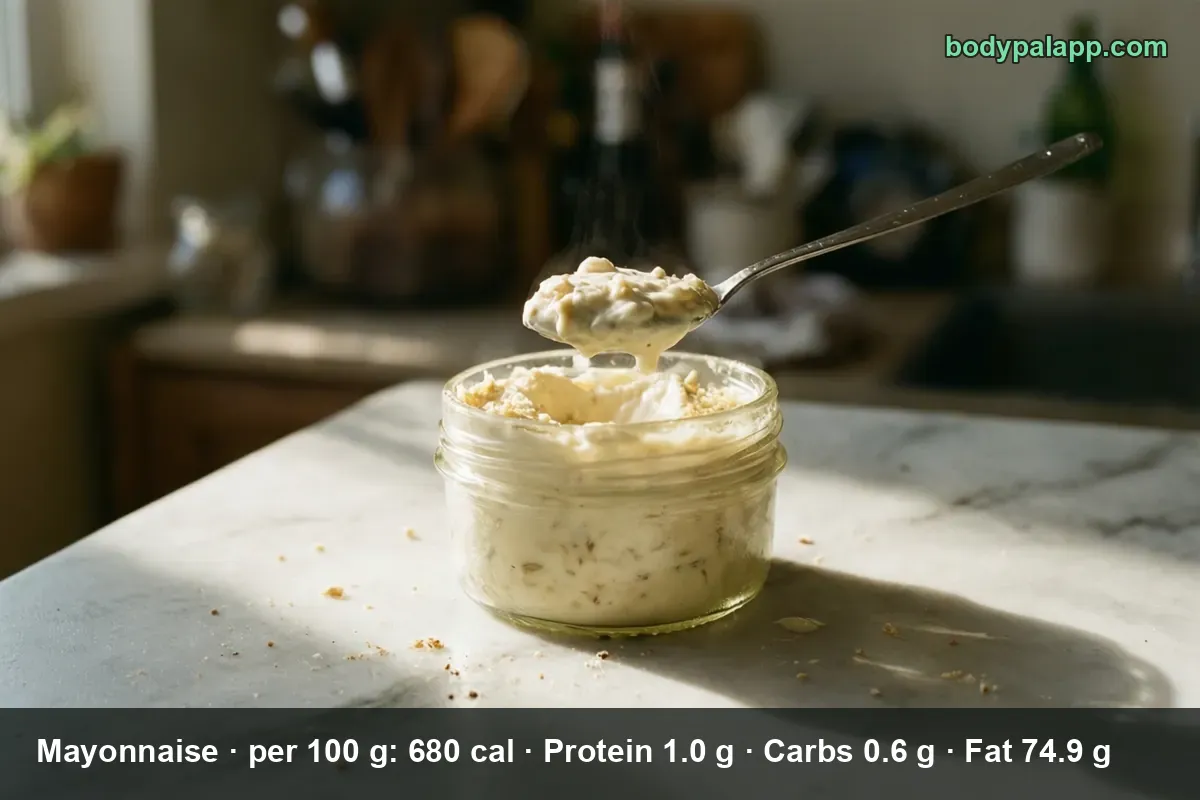
One level tablespoon of regular mayonnaise weighs 13.8 g and carries 94 calories. Per 100 g the jar runs 680 calories, and nearly all of that is fat — 74.85 g per 100 g. It is the densest thing most people keep in the refrigerator door, and it goes onto bread without anyone measuring it.
On this page
- Mayo quick facts
- US servings from a packet to a cup
- Light and fat-free mayo
- Vegan and olive oil mayo
- Fat and sodium are the rows to watch
- How does mayo compare?
- Most popular mayonnaise brands
- FAQ
Mayo quick facts
The row that matches the jar in your refrigerator is FNDDS 2710204, "Mayonnaise, regular". That is full-fat mayonnaise made with oil and egg yolk, the kind sold in a wide-mouth jar and squeezed from a bottle. USDA also keeps an older SR Legacy entry for the same food, 171009, with identical numbers; the FNDDS edition is simply the newer publication, so this page uses it throughout.
The tablespoon column below is USDA's own household measure for that record, 13.8 g. It is a level spoon, not the heaped one most sandwiches actually get.
| Nutrient | Per 100 g | Per 1 tablespoon (13.8 g) | % Daily Value |
|---|---|---|---|
| Calories | 680 | 94 | — |
| Total fat | 74.85 g | 10.3 g | 13% |
| Saturated fat | 11.7 g | 1.6 g | 8% |
| Carbohydrate | 0.57 g | 0.1 g | 0% |
| Dietary fiber | 0 g | 0 g | 0% |
| Total sugars | 0.57 g | 0.1 g | — |
| Protein | 0.96 g | 0.1 g | 0% |
| Sodium | 635 mg | 88 mg | 4% |
% Daily Value is based on a 2,000-calorie diet.
Verified nutrition data
Numbers on this page come from USDA FoodData Central, the U.S. Department of Agriculture’s food composition database, and from manufacturer labels where a branded product is named. Last verified September 2026. How we verify our data →
Two rows you will see on a store label are missing here on purpose: added sugars and trans fat. USDA does not publish either one for this record, so guessing at them would be worse than leaving them out. Cholesterol comes in at 42 mg per 100 g, which is 6 mg per tablespoon, or 2% of the Daily Value. Potassium is negligible — 20 mg per 100 g, 3 mg on the spoon.
The Daily Value figures used in that last column are FDA's, based on a 2,000-calorie day.
US servings from a packet to a cup
| Serving | Weight | Calories |
|---|---|---|
| 1 packet, deli or takeout | 12 g | 82 kcal |
| 1 tablespoon | 13.8 g | 94 kcal |
| 1 dipping container, also the salad guideline amount | 28 g | 190 kcal |
| 1 oz | 28.35 g | 193 kcal |
| 1 cup | 220 g | 1496 kcal |
| Per 100 g | 100 g | 680 kcal |
The packet, the tablespoon and the 28 g container are USDA household measures for this record. The 1 oz line is our own arithmetic from the USDA 100 g figure, not a USDA serving — useful only because deli scales and recipes talk in ounces.
The jump worth staring at is the third row. A sandwich spread gets you a tablespoon at 94 calories. The amount USDA treats as a portion in a salad is 28 g, which is 190 calories — double, and you never picked up the spoon a second time. That is the difference between mayo on bread and mayo mixed into tuna, egg or macaroni, where it stops being a coating and becomes the sauce.
Brand labels shift the math slightly, because they round the spoon down. Hellmann's Real Mayonnaise and Kraft Real Mayo both list 90 calories per 1 Tbsp, but their labeled spoon is 13 g rather than USDA's 13.8 g. Chosen Foods Classic Keto Mayo lists 100 calories per 14 g. Kraft Light Mayo lists 35 per 15 g. Same shelf, three different spoon weights — which is why a logged "tablespoon" is never quite the same number twice.
Light and fat-free mayo
Every lighter jar works the same way: oil comes out, water or starch goes in, and salt goes up to keep the flavor from collapsing.
| Version | Per 100 g | Serving | Calories |
|---|---|---|---|
| Regular mayo | 680 kcal | 1 tablespoon, 13.8 g | 94 kcal |
| Reduced-fat with olive oil | 361 kcal | 1 tablespoon, 13.8 g | 50 kcal |
| Mayonnaise-type dressing | 250 kcal | 1 tablespoon, 14.7 g | 37 kcal |
| Light mayo | 238 kcal | 1 tablespoon, 15.6 g | 37 kcal |
| Vegan mayo | 232 kcal | 1 oz, 28.35 g | 66 kcal |
| Light mayonnaise-type dressing | 158 kcal | 1 tablespoon, 14.5 g | 23 kcal |
| Fat-free mayo | 64 kcal | 1 tablespoon, 16 g | 10 kcal |
Light mayonnaise is 238 calories per 100 g against 680 for regular, and a spoonful lands at 37. That is a real saving, 57 calories per tablespoon. What the front label does not advertise is the sodium: light mayo carries 827 mg per 100 g where regular has 635 mg. Per tablespoon that works out to roughly 129 mg against 88 mg, our arithmetic from the two 100 g figures. The calories fall and the salt rises.
Fat-free mayo is the extreme end — 64 calories per 100 g, 10 on a spoon, the lightest mayonnaise record USDA publishes. The oil is replaced with starch, so carbohydrate goes from 0.57 g per 100 g to 15.8 g and total sugars from 0.57 g to 6.8 g. Sodium sits at 750 mg per 100 g. It is a different food wearing the same lid.
Mayonnaise-type salad dressing, the sweeter tangy style, is 250 calories per 100 g and 37 per tablespoon. It gets there differently from light mayo: 10.02 g of total sugars per 100 g, against 0.57 g in the regular jar. Two spoons that cost the same 37 calories, built from opposite ingredients.
Vegan and olive oil mayo
Egg-free mayo made on a soy base is 232 calories per 100 g — an ounce of it is 66 calories, our arithmetic from the 100 g figure. It is close to light mayo per gram, with 16 g of carbohydrate per 100 g and 497 mg of sodium, the lowest sodium of any jar on this page. No cholesterol, since there is no yolk.
The reduced-fat olive oil version sits higher than most people assume: 361 calories per 100 g, 50 per tablespoon. "Olive oil" on the front does not mean less oil overall — this record still runs 40 g of fat per 100 g, which is more than half of what regular mayo carries, and 800 mg of sodium. If the goal is fewer calories, the light and fat-free jars do far more work than the oil swap does. If the goal is the fat profile, MyPlate's guidance on oils is the better place to start than the front of the jar.
Fat and sodium are the rows to watch
A tablespoon of mayo is 13% of the Daily Value for total fat and 8% for saturated fat. Alone that is unremarkable. The problem is that nobody eats mayonnaise alone.
Run it up to a cup — the amount a potato salad or coleslaw recipe asks for — and you are at 220 g, 1,496 calories, and about 164.7 g of fat, our arithmetic from the 74.85 g per 100 g figure. That is 211% of the fat Daily Value in one measuring cup, before the potatoes. Sodium in that cup comes to roughly 1,397 mg by the same arithmetic, or 61% of the Daily Value.
Saturated fat is the row the Dietary Guidelines for Americans put a ceiling on: less than 10% of daily calories, about 22 g on a 2,000-calorie day. A cup of mayo is 25.7 g of saturated fat by our arithmetic — past the whole day's ceiling on its own. On a sandwich, at 1.6 g a spoon, it barely registers.
That is the honest summary of mayonnaise. It is not a problem on bread. It is a problem in a mixing bowl.
How does mayo compare?
| Spread | Per 100 g | US serving | Calories |
|---|---|---|---|
| Mayonnaise | 680 kcal | 1 oz, 28.35 g | 193 kcal |
| Salad dressing for sandwiches | 594 kcal | 1 oz, 28.35 g | 168 kcal |
| Sandwich spread | 389 kcal | 1 oz, 28.35 g | 110 kcal |
| Tartar sauce | 211 kcal | 1 oz, 28.35 g | 60 kcal |
All four ounce servings are our arithmetic from the USDA 100 g figures, so the comparison is apples to apples.
Our take: mayonnaise is the heaviest of the four per gram, and tartar sauce — the one that feels like the indulgent choice — is under a third of it at 211 calories per 100 g. If you are cutting calories on a sandwich, swapping regular mayo for the light jar keeps the same texture and loses 57 calories per spoon, though tartar sauce is lighter still per gram — 211 calories per 100 g against the light jar’s 238. If you are watching sodium instead, the swap goes the other way: regular mayo is the lower-salt option, and vegan mayo at 497 mg per 100 g is the lowest on this page. Pick the number you are actually managing, because these jars do not move together.
Most popular mayonnaise brands in the United States
Ranked by how widely each product appears among foods sold in the United States, from the BodyPal food database of over 3.3 million products. Calories are the figures printed on each Nutrition Facts label, checked against USDA FoodData Central.
| Product | Calories (per 100 g) |
|---|---|
| Hellmann's Real Mayonnaise | 692 cal |
| Kraft Real Mayo | 692 cal |
| Kraft Light Mayo | 233 cal |
| Kraft Homestyle Mayo | 692 cal |
| Chosen Foods Avocado Oil Mayo | 643 cal |
| Chosen Foods Classic Keto Mayo | 714 cal |
Brand popularity: BodyPal food database. Nutrition: manufacturer labels / USDA FoodData Central.
Mayo FAQs
How many calories are in 1 tablespoon of mayo?
94 calories in one level tablespoon of regular mayonnaise, 13.8 g on the USDA scale. That tablespoon brings 10.3 g of fat, 1.6 g of it saturated, and 88 mg of sodium. Carbohydrate is 0.1 g, so the calories are fat and almost nothing else.
How many calories are in a cup of mayonnaise?
A full cup weighs 220 g and comes to 1,496 calories. That is about 164.7 g of fat, or 211% of the Daily Value, in one measuring cup. A potato salad recipe calling for a cup is putting two days' worth of the fat Daily Value into the bowl.
How many calories does mayo add to a sandwich?
One tablespoon adds 94 calories. Spread both slices with a heavier hand and you reach the 28 g USDA amount, which is 190 calories — double the spread without a second spoonful going in. A thin scrape of about 7 g works out to 48 calories, our arithmetic from the 100 g figure.
Is mayo keto friendly?
Regular mayonnaise has 0.57 g of carbohydrate per 100 g and 0.1 g per tablespoon, so it fits a very low-carb pattern on the carb count alone. Light and fat-free jars are the opposite: fat-free carries 15.8 g of carbohydrate per 100 g, most of it starch and sugar.
Does light mayo have less sodium than regular mayo?
No — light mayo has more: USDA lists 827 mg of sodium per 100 g for light mayonnaise against 635 mg for regular. Calories drop hard, from 680 to 238 per 100 g, but the salt goes up. Per tablespoon that is roughly 129 mg against 88 mg, our arithmetic.
How many calories are in fat-free mayo?
10 calories per tablespoon (16 g), and 64 per 100 g — the lightest mayonnaise record USDA publishes. The fat is replaced with starch, so carbohydrate climbs to 15.8 g per 100 g and sodium sits at 750 mg. It saves about 84 calories per tablespoon against the regular jar.
Mayo vs Miracle Whip: which has fewer calories?
The mayonnaise-type dressing category, which is where Miracle Whip sits, runs 250 calories per 100 g and 37 per tablespoon (14.7 g). Regular mayonnaise is 680 and 94. The dressing is much sweeter, though: 10.02 g of total sugars per 100 g against 0.57 g in mayo.
Is mayonnaise high in cholesterol?
One tablespoon has 6 mg of cholesterol, 2% of the Daily Value, and 100 g has 42 mg. The egg yolk carries it, but the amount per spoonful is small. Saturated fat is the bigger number here: 1.6 g per tablespoon, 8% of the Daily Value, and 11.7 g per 100 g.
Similar foods
- Mayo Packet — 68 cal per packet
- Mayonnaise Packet — 68 cal per packet
- Mayonnaise — 94 cal per tbsp
- Mayonnaise, Teaspoon — 31 cal per teaspoon
- Tahini — 105 cal per tablespoon
- Almond Flour — 170 cal per 1/4 cup
Count it without the math
Point the camera at the plate and BodyPal counts the mayo along with everything under it.


How long does it take to burn off mayo?
A 1-tablespoon (13.8 g) serving is 94 kcal. Enter your weight and the amount you ate to see how long it takes you to burn that off:
lb
| Activity | Time to burn 94 kcal |
|---|---|
| Walking, brisk | 19 min |
| Cycling, moderate | 12 min |
| Swimming, moderate | 13 min |
| Jogging | 11 min |
| Weight training, moderate | 21 min |
Times are for a 155 lb adult at a steady pace; change the weight to see yours. The amount is set to the portion in the text (13.8 g); change it to what you actually ate. BodyPal works this out from your steps automatically.
Want the bigger picture? Calculate your daily calorie needs — your maintenance figure, a target for losing or gaining, and the date you get there.