
How many calories are in molasses?
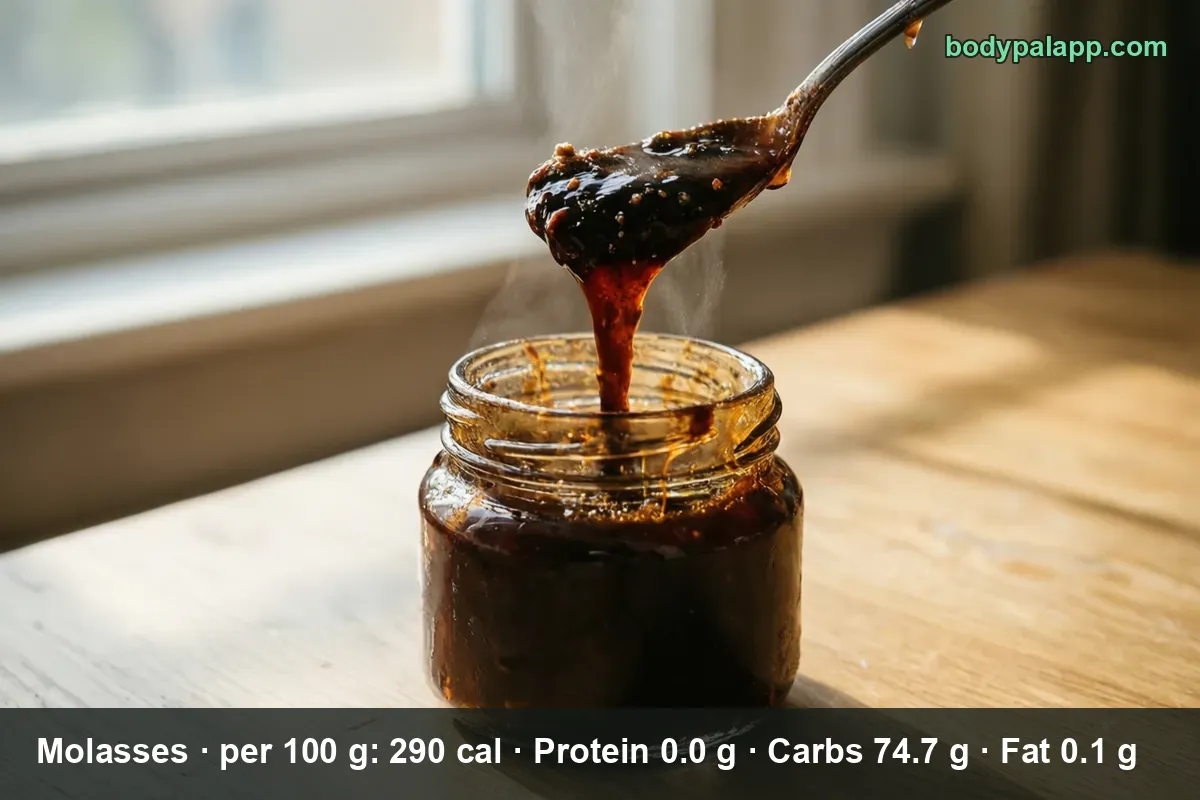
One tablespoon of molasses holds 58 calories, and 100 g of the syrup runs 290 calories. Nearly all of it is sugar: 74.72 g per 100 g, with no fat to speak of and no fiber at all. What changes the math is the measure. A cup weighs 337 g.
On this page
- Molasses quick facts
- From a tablespoon to a full cup
- Blackstrap molasses and the baked versions
- Potassium is the row that stands out
- How does molasses compare to other syrups?
- Most popular molasses brands
- Molasses FAQs
Molasses quick facts
The row behind these numbers is SR Legacy 168820, "Molasses" — the plain syrup in the jar, not a cookie or a glaze made with it. It is the only clean reference entry USDA keeps for the product itself; the FNDDS edition, record 2710283, repeats the same values line for line. Everything else filed under "molasses" in the database is a baked good.
The serving column below is one tablespoon, 20 g, because that is the measure on the jar and the measure in most recipes that use molasses as a flavor rather than a bulk sweetener.
| Nutrient | Per 100 g | Per 1 tbsp (20 g) | % Daily Value |
|---|---|---|---|
| Calories | 290 | 58 | — |
| Total fat | 0.1 g | 0.0 g | 0% |
| Saturated fat | 0.02 g | 0.0 g | 0% |
| Carbohydrate | 74.73 g | 14.9 g | 5% |
| Dietary fiber | 0 g | 0.0 g | 0% |
| Total sugars | 74.72 g | 14.9 g | — |
| Protein | 0 g | 0.0 g | 0% |
| Sodium | 37 mg | 7 mg | 0% |
| Cholesterol | 0 mg | 0 mg | 0% |
| Potassium | 1464 mg | 293 mg | 6% |
% Daily Value is based on a 2,000-calorie diet.
Verified nutrition data
Numbers on this page come from USDA FoodData Central, the U.S. Department of Agriculture’s food composition database, and from manufacturer labels where a branded product is named. Last verified September 2026. How we verify our data →
Two rows you would expect on a jar label are missing here: added sugars and trans fat. USDA does not publish either value for this reference record, so rather than guess at them the rows come out. The gap matters, because 74.72 of the 74.73 g of carbohydrate are sugar — a molasses jar is a sugar jar with minerals in it. The Daily Value for added sugars is 50 g, and the Dietary Guidelines treat syrups stirred into a recipe as added sugars, so two tablespoons of molasses — 29.9 g of sugar by our arithmetic from the 100 g figure — is a real share of a day even though USDA's own record leaves that line blank.
Cholesterol is zero and fat is close enough to zero that a tablespoon rounds to 0.0 g. Protein is a flat 0 g, which is worth remembering if you have seen molasses described as a health food.
From a tablespoon to a full cup
| Serving | Weight | Calories |
|---|---|---|
| 1 tbsp | 20 g | 58 kcal |
| 2 tbsp | 40 g | 116 kcal |
| 1/4 cup | 84.3 g | 244 kcal |
| 1 cup | 337 g | 977 kcal |
| 1 oz | 28.35 g | 82 kcal |
| Per 100 g | 100 g | 290 kcal |
The tablespoon and the cup are USDA household measures with USDA weights. The 2 tbsp, quarter-cup and 1 oz lines are our own arithmetic from the USDA 100 g figure, not USDA servings — molasses is dense, so the gram weights do not track water-based conversions.
That density is the trap. A cup of molasses weighs 337 g, more than a cup of most liquids you pour, and it lands at 977 calories. That is almost 17 times a single tablespoon. Nutrition labels talk in spoons; gingerbread, baked beans, shoofly pie and barbecue sauce recipes talk in cups. A recipe that calls for one cup has put close to a thousand calories and roughly 252 g of sugar into the bowl before the flour, and if that batch makes 16 cookies, the molasses alone is about 61 calories per cookie.
A quarter cup, the amount a lot of bean and rib recipes use, is 84.3 g and 244 calories. Cut it to two tablespoons and you are at 116 — the single easiest edit in any molasses recipe, and one most people never make because they are thinking in spoons while measuring in cups.
Blackstrap molasses and the baked versions
There is no separate USDA reference row for blackstrap. What exists are branded label entries, and they scatter: US blackstrap jars run from 200 to 286 calories per 100 g, which works out to 42 to 60 calories on the 1 Tbsp (21 g) serving printed on the jar. Holiday Blackstrap and both Plantation Unsulphured jars sit at the label figures in that band, and Wholesome Organic lists 273 and 300 per 100 g on two different package sizes of what is essentially the same syrup. In other words, blackstrap is not reliably lighter than the 290 per 100 g reference row — the label rounding moves it more than the product does.
Baked goods made with molasses are a different food, and their numbers show it.
| Version | Per 100 g | Typical piece | Calories |
|---|---|---|---|
| Molasses cookie, large | 430 kcal | one large cookie, 32 g | 138 kcal |
| Molasses cookie, medium | 430 kcal | one medium cookie, 30 g | 129 kcal |
| Archway Iced Molasses cookie | 420 kcal | 1 oz, 28.35 g | 119 kcal |
| Cornmeal and molasses bread | 285 kcal | one medium slice, 32 g | 91 kcal |
| Cornmeal and molasses bread, toasted | 313 kcal | one medium slice, 29 g | 91 kcal |
The molasses cookie row is 430 calories per 100 g, well above the syrup, because flour and fat come with it: 12.8 g of fat and 3.21 g of saturated fat per 100 g against the syrup's 0.1 g and 0.02 g. Sodium jumps too, from 37 mg per 100 g in the jar to 459 mg in the cookie. Iced Archway cookies run 420 per 100 g with 38.43 g of sugar, the highest sugar figure of any baked molasses record here.
The toasted bread line is the one worth pausing on. Toasted cornmeal and molasses bread reads 313 calories per 100 g against 285 untoasted, which looks like toasting adds calories. It does not. The slice loses water, so it weighs 29 g instead of 32 g, and both slices land on 91 calories. Per 100 g went up; the slice on your plate did not move.
Potassium is the row that stands out
One tablespoon of molasses delivers 293 mg of potassium, 6% of the 4,700 mg Daily Value, from 1,464 mg per 100 g. That is the single line that separates molasses from clear syrups on a label, and it is the reason molasses keeps showing up in "mineral-rich sweetener" lists.
Read it honestly, though. That 6% arrives attached to 58 calories and 14.9 g of sugar, with 0 g of fiber and 0 g of protein alongside it. MyPlate puts sweeteners in the same bucket regardless of what minerals ride along, and if you are chasing potassium there are cheaper routes than a syrup that is 74.72% sugar by weight. Where molasses genuinely wins is flavor per calorie: one tablespoon carries a whole gingerbread profile for 58 calories, which almost no other sweetener manages.
Sodium is a non-issue at 7 mg a tablespoon — 0% of the Daily Value, well under a hundredth of a teaspoon of table salt. If you are watching sodium, the molasses is not the problem; the barbecue sauce it goes into usually is.
How does molasses compare to other syrups?
| Syrup | Per 100 g | US serving | Calories |
|---|---|---|---|
| Molasses | 290 kcal | 1 oz, 28.35 g | 82 kcal |
| Sorghum syrup | 290 kcal | 1 oz, 28.35 g | 82 kcal |
| Dark corn syrup | 286 kcal | 1 oz, 28.35 g | 81 kcal |
| Honey | 304 kcal | 1 oz, 28.35 g | 86 kcal |
Our take: on calories these four are the same product. The whole spread is 286 to 304 per 100 g, five calories an ounce from lightest to heaviest, and dark corn syrup — the one nobody thinks of as the healthy choice — is technically the lowest of the group. Picking a sweetener on calories alone is picking between 81 and 86, which is noise. Pick on what you get for the sugar instead: molasses and sorghum tie at 290 with molasses carrying the mineral line, honey costs four more calories an ounce and brings the most carbohydrate at 82.4 g per 100 g, and corn syrup brings the least of anything but sweetness. For weight loss, the honest answer is that the measuring spoon matters far more than the jar you pick.
Most popular molasses brands in the United States
Ranked by how widely each product appears among foods sold in the United States, from the BodyPal food database of over 3.3 million products. Calories are the figures printed on each Nutrition Facts label, checked against USDA FoodData Central.
| Product | Calories (per 100 g) |
|---|---|
| Holiday Blackstrap Molasses | 286 cal |
| Plantation Unsulphured Blackstrap Molasses | 200 cal |
| Plantation Organic Unsulphured Blackstrap Molasses | 286 cal |
| Wholesome Organic Molasses | 273 cal |
Brand popularity: BodyPal food database. Nutrition: manufacturer labels / USDA FoodData Central.
Molasses FAQs
How many calories are in a tablespoon of molasses?
58 calories in one tablespoon (20 g), from the USDA reference row at 290 calories per 100 g. That spoonful carries 14.9 g of carbohydrate, almost all of it sugar, plus 293 mg of potassium and 7 mg of sodium. Fat, fiber and protein are all effectively zero.
How many calories are in a cup of molasses?
977 calories in one cup, which USDA weighs at 337 g. That is almost 17 times a tablespoon. A gingerbread or baked-bean recipe calling for a full cup is adding close to a thousand calories and about 252 g of sugar before the flour, butter or beans go in.
How many calories are in blackstrap molasses?
US labels put blackstrap at 200 to 286 calories per 100 g, because USDA keeps no separate reference row for it. That works out to 42 to 60 calories on the 1 Tbsp (21 g) serving printed on the jar. Most sit near the top of that band, close to regular molasses at 290.
How much sugar is in molasses?
74.72 g of total sugar per 100 g, which is 14.9 g in one tablespoon. Carbohydrate is 74.73 g, so essentially every carb in molasses is sugar. USDA does not split added from naturally occurring sugars for this record, and the Daily Value for added sugars is 50 g.
Does molasses have potassium?
Yes — 1,464 mg per 100 g, or 293 mg in a tablespoon, which is 6% of the 4,700 mg Daily Value. That mineral line is what sets molasses apart from clear syrups. It comes attached to 58 calories and 14.9 g of sugar, with no fiber and no protein.
Molasses vs honey: which has fewer calories?
Molasses, barely: 290 calories per 100 g against 304 for honey, or 82 versus 86 per ounce. The gap is four calories an ounce, small enough that flavor should decide. Honey carries more carbohydrate, 82.4 g per 100 g against 74.73 g for molasses, and neither has fiber.
Is molasses healthier than sugar?
A tablespoon is still 58 calories and 14.9 g of sugar, so molasses is a sweetener first. What it adds is 293 mg of potassium, 6% of the Daily Value. Dietary Guidelines count syrups like molasses as added sugars in a recipe, so the swap changes the mineral line, not the sugar line.
Is molasses keto friendly?
No — one tablespoon brings 14.9 g of carbohydrate with 0 g of fiber, so all 14.9 g count as net carbs — more than a strict 20 g keto day allows in a single spoon. A quarter cup reaches 63.0 g of carbohydrate. There is no low-carb version of the syrup.
Similar foods
- Honeycomb — 83 cal per oz
- Wonton wrapper — 23 cal per wonton wrapper
- Mozzarella Cheese Stick — 83 cal per stick
- Cheeseburger — 488 cal per cheeseburger
- Double Cheeseburger — 607 cal per double cheeseburger
- Corn Syrup — 62 cal per tablespoon
Count it without the math
Point the camera at the jar or the plate and BodyPal counts the molasses for you, spoon or cup.


How long does it take to burn off molasses?
One tablespoon (20 g) is 58 kcal. Enter your weight and the amount you ate to see how long it takes you to burn that off:
lb
| Activity | Time to burn 58 kcal |
|---|---|
| Walking, brisk | 12 min |
| Cycling, moderate | 7 min |
| Swimming, moderate | 8 min |
| Jogging | 7 min |
| Weight training, moderate | 13 min |
Times are for a 155 lb adult at a steady pace; change the weight to see yours. The amount is set to the portion in the text (20 g); change it to what you actually ate. BodyPal works this out from your steps automatically.
Burning it off is one side of it. The other is knowing your number: work out how many calories you need a day, with macros and a goal date.