
How many calories are in a double cheeseburger?
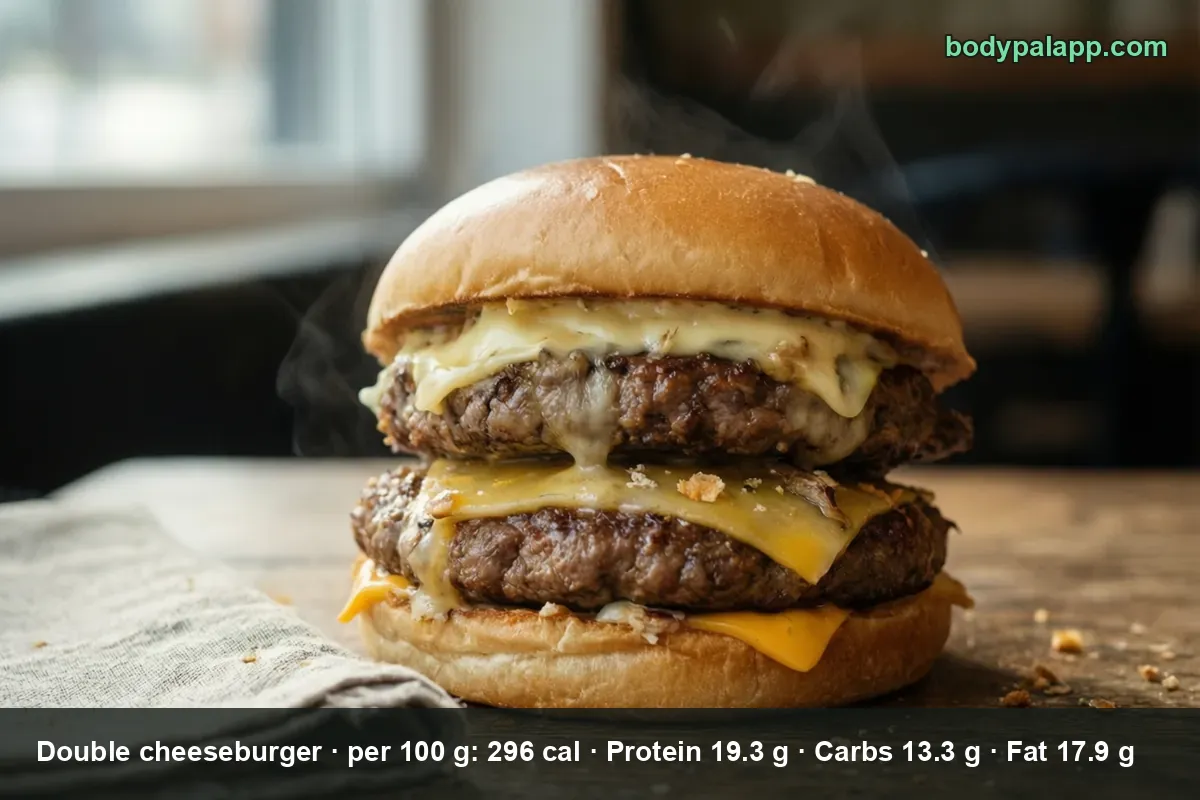
A standard double cheeseburger on a white bun weighs 205 g and carries 607 calories. Gram for gram it runs 296 calories per 100 g, which is not extreme for a sandwich. The size is what does the damage: two patties, two slices of cheese and a bun add up fast, and 39.6 g of protein rides along with them.
On this page
- Double cheeseburger quick facts
- US servings, from one ounce to the whole burger
- Patty size moves this more than anything else
- Chain versions are smaller, not lighter
- Saturated fat and sodium beat the calories here
- How does a double cheeseburger compare?
- Most popular double cheeseburger brands
- FAQ
Double cheeseburger quick facts
The record behind every number on this page is FNDDS 2706905, "Double cheeseburger, on white bun, 2 small patties". It is the generic build most people mean when they type the search: two patties, melted cheese, a plain white bun, and a documented serving weight of 205 g for one whole sandwich. Chain recipes exist in USDA too, and they get their own section further down rather than being averaged into this one.
Two rows you would see on a wrapper are missing here. USDA does not publish added sugars or trans fat for FNDDS mixed dishes, so those lines are left out instead of being guessed at.
| Nutrient | Per 100 g | Per 1 double cheeseburger (205 g) | % Daily Value |
|---|---|---|---|
| Calories | 296 | 607 | — |
| Total fat | 17.86 g | 36.6 g | 47% |
| Saturated fat | 7.52 g | 15.4 g | 77% |
| Carbohydrate | 13.31 g | 27.3 g | 10% |
| Dietary fiber | 0.5 g | 1.0 g | 4% |
| Total sugars | 2.15 g | 4.4 g | — |
| Protein | 19.31 g | 39.6 g | 79% |
| Sodium | 412 mg | 845 mg | 37% |
| Cholesterol | 63 mg | 129 mg | 43% |
| Potassium | 241 mg | 494 mg | 11% |
% Daily Value is based on a 2,000-calorie diet.
Verified nutrition data
Numbers on this page come from USDA FoodData Central, the U.S. Department of Agriculture’s food composition database, and from manufacturer labels where a branded product is named. Last verified September 2026. How we verify our data →
US servings, from one ounce to the whole burger
| Serving | Weight | Calories |
|---|---|---|
| 1 oz | 28.4 g | 84 kcal |
| Half a double cheeseburger | 102.5 g | 303 kcal |
| One double cheeseburger | 205 g | 607 kcal |
| Per 100 g | 100 g | 296 kcal |
Only the 205 g line is a USDA household measure. The half burger and the ounce are our own arithmetic from the USDA 100 g figure, not USDA servings, which matters if you are splitting one with somebody and want the log to be honest.
Halving is the most useful trick on this list. Half a burger is 303 calories and still delivers 19.8 g of protein, which is more than most protein bars, for the price of a light snack. The ounce column is there for a different reason: it lets you scale a burger that clearly is not 205 g. Chain doubles run lighter, at 140 to 165 g, and packaged ones run heavier, up to 430 g, and weight is the variable that moves the total.
Patty size moves this more than anything else
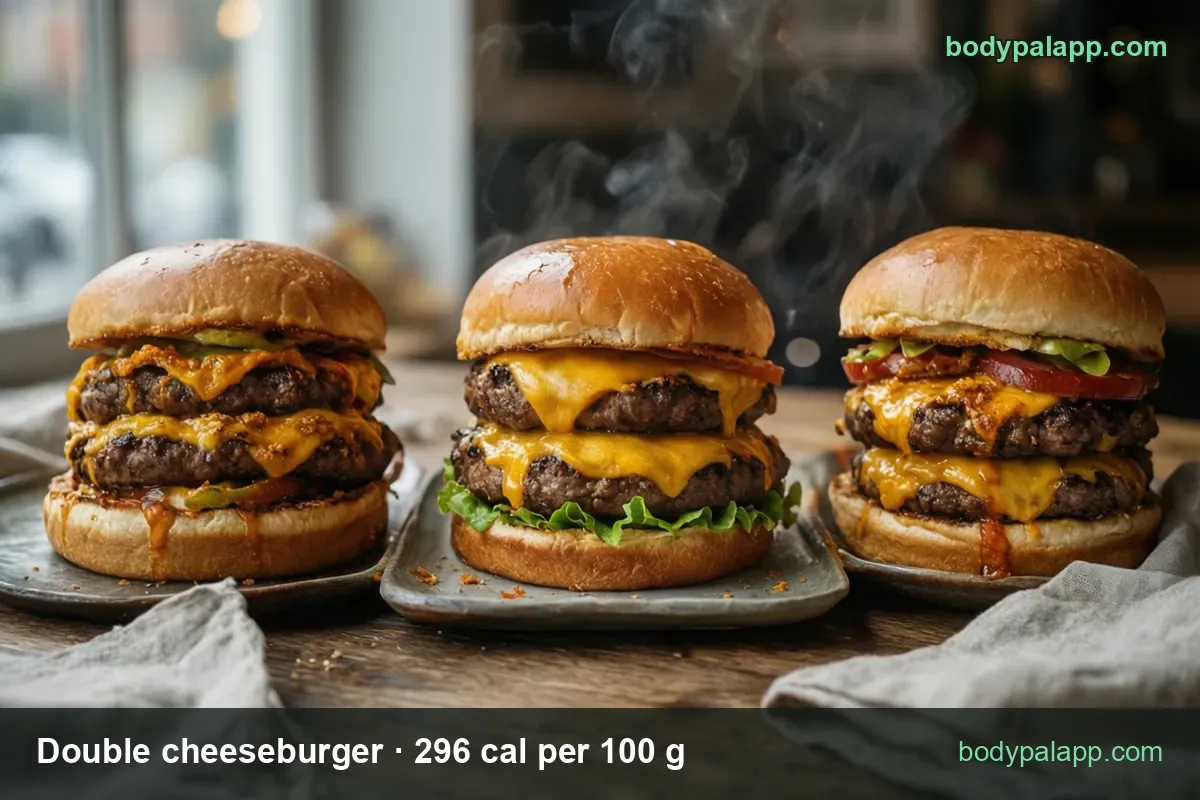
Here is the finding that surprised us. Per 100 g, every version of this sandwich is nearly the same food. Across the six builds below the range is 278 to 299 calories per 100 g, a spread of 21 calories. Per sandwich, the same six run from 389 to 987 calories, a gap of 598. Density tells you almost nothing; weight tells you everything.
| Version | Per 100 g | Whole sandwich | Calories |
|---|---|---|---|
| White bun, 2 small patties (main record) | 296 kcal | 205 g | 607 kcal |
| White bun, 2 large patties | 299 kcal | 330 g | 987 kcal |
| Wheat bun, 2 small patties | 292 kcal | 205 g | 599 kcal |
| Wheat bun, 2 large patties | 296 kcal | 330 g | 977 kcal |
| McDonald's Double Cheeseburger | 282 kcal | 165 g | 465 kcal |
| Burger King Double Cheeseburger | 278 kcal | 140 g | 389 kcal |
The large-patty build is the one to watch. At 330 g it is 987 calories, and by our own arithmetic from its USDA 100 g figures it carries about 66.8 g of protein (134% of the Daily Value) and about 27.4 g of saturated fat (137%). That is a whole day of saturated fat inside one sandwich, before the fries.
A medium-patty record also exists at 300 calories per 100 g, a hair above the small-patty 296. USDA has no serving weight for it in our extract, so we have not put a per-sandwich number on it.
The wheat bun is a smaller swap than people hope. It saves 8 calories on a 205 g burger, 599 against 607. What it actually buys is fiber: 1.4 g per 100 g against 0.5 g, almost triple, which works out to roughly 2.9 g for the whole sandwich by our own scaling, or 10% of the Daily Value instead of 4%.
Packaged doubles sit at the heavy end. USDA's branded data lists a Walmart Marketside Angus double at 880 calories for one 275 g sandwich, and a 7-Eleven double cheeseburger package at 1,221 calories for 430 g. The 7-Eleven is ordinary per 100 g at 284; the Walmart one is denser at 320. Both are mainly bigger sandwiches than the generic record.
Chain versions are smaller, not lighter
The most common mistake we see in food logs is treating a fast-food double as the light option. It is not lighter per gram. McDonald's double cheeseburger is 282 calories per 100 g against 296 for the generic build, and the Burger King record is 278, the lowest per-gram figure in the whole set. The reason those sandwiches total 465 and 389 calories is weight: 165 g and 140 g against 205 g at home.
Sodium runs the opposite direction. The chain recipe is 617 mg of sodium per 100 g where the generic burger is 412 mg, which works out to roughly 1,018 mg for the McDonald's sandwich by our own arithmetic from the USDA 100 g figure. An older SR Legacy edition of the same McDonald's item is denser still on salt at 668 mg per 100 g, with identical calories at 282. So the chain double is the smaller sandwich and the saltier one at the same time.
Cheese is a smaller lever than the second patty. USDA's double hamburger on a wheat bun, same two small patties and no cheese, is 285 calories per 100 g against 292 for the cheeseburger version. Seven calories per 100 g is the whole difference cheese makes gram for gram.
Saturated fat and sodium beat the calories here
If you are budgeting one number on this page, make it saturated fat. One 205 g double cheeseburger has 15.4 g, or 77% of the FDA Daily Value of 20 g, while supplying about 30% of a 2,000-calorie day. The Dietary Guidelines recommend keeping saturated fat under 10% of daily calories, and this sandwich uses most of that allowance on its own.
Sodium is the second row. 845 mg is 37% of the 2,300 mg Daily Value, about a third of a teaspoon of table salt, and that is before fries or a sauce cup. If you are watching sodium, the homemade build beats the chain version clearly, because you control the salt on the patty and the cheese slice.
The protein is the honest upside. 39.6 g in one sandwich is 79% of the Daily Value, and MyPlate puts most adults near 5 to 6.5 ounce-equivalents of protein foods a day. A double cheeseburger covers a serious share of that in one hand. Cholesterol comes with it at 129 mg, 43% of the Daily Value.
How does a double cheeseburger compare?
| Sandwich | Per 100 g | Protein | Carbohydrate | Fat |
|---|---|---|---|---|
| Double cheeseburger, white bun, 2 small patties | 296 kcal | 19.31 g | 13.31 g | 17.86 g |
| McDouble (McDonald's) | 282 kcal | 16.24 g | 17.97 g | 16.18 g |
| Double hamburger, wheat bun, 2 small patties | 285 kcal | 19.65 g | 12.93 g | 16.66 g |
| Hamburger, wheat bun, 1 large patty | 283 kcal | 18.99 g | 15.52 g | 15.66 g |
USDA does not publish gram weights for those three neighbor servings in our extract, so the table compares them gram for gram rather than sandwich for sandwich. One detail worth knowing: the McDouble record carries the same per-100-g profile as the McDonald's double cheeseburger record, so treat them as one number when you log them.
Our take: all four sit inside 14 calories of each other per 100 g, so choosing between them on density is a waste of attention. The double cheeseburger is the densest of the four at 296, and the McDouble has the most carbohydrate at 17.97 g and the least protein at 16.24 g, which makes it the weakest trade of the group. For weight loss, the move is the half burger at 303 calories or the 140 g chain double at 389, not a swap to a different name. For appetite control at a fixed calorie cost, the full 205 g burger at 607 calories and 39.6 g of protein is a stronger buy than most 600-calorie lunches.
Most popular double cheeseburger brands in the United States
Ranked by how widely each product appears among foods sold in the United States, from the BodyPal food database of over 3.3 million products. Calories are the figures printed on each Nutrition Facts label, checked against USDA FoodData Central.
| Product | Calories (per 100 g) |
|---|---|
| Marketside Angus Double Cheeseburger | 320 cal |
| Ball Park Flame Grilled Double Cheeseburger | 296 cal |
| 7-Eleven Double Cheeseburger | 284 cal |
| Pierre Drive Thru Double Cheeseburger | 278 cal |
Brand popularity: BodyPal food database. Nutrition: manufacturer labels / USDA FoodData Central.
Double cheeseburger FAQs
How many calories are in a double cheeseburger?
607 calories for a standard 205 g double cheeseburger on a white bun with two small patties, or 296 calories per 100 g. Half of one is 303. Swap in two large patties and the same sandwich weighs 330 g and carries 987 calories, which is where most of the surprise sits.
How much protein is in a double cheeseburger?
39.6 g of protein in the 205 g burger, which is 79% of the Daily Value on a 2,000-calorie diet. Per 100 g it is 19.31 g. The large-patty version reaches about 66.8 g by our own arithmetic from the USDA 100 g figure, more than a full day's Daily Value in one sandwich.
How many carbs are in a double cheeseburger?
27.3 g of carbohydrate per 205 g burger, 10% of the Daily Value, and 13.31 g per 100 g. Almost all of it is the bun. USDA's large-patty record drops to 9.66 g per 100 g because the meat crowds out the bread, not because the bun got smaller.
How much sodium is in a double cheeseburger?
845 mg of sodium in a 205 g double cheeseburger, 37% of the 2,300 mg Daily Value, or about a third of a teaspoon of table salt. McDonald's version runs 617 mg per 100 g against 412 mg for the generic record, so the chain sandwich is the saltier build gram for gram.
Is a double cheeseburger healthy?
15.4 g of saturated fat, 77% of the Daily Value, is the number that decides it. The Dietary Guidelines put a cap of 10% of daily calories on saturated fat, and one burger uses most of that while supplying about 30% of a 2,000-calorie day. The protein is genuinely strong at 39.6 g.
How many calories are in a McDonald's double cheeseburger?
465 calories for the 165 g McDonald's record, at 282 calories per 100 g. It is lighter than the generic 205 g burger because the sandwich is smaller, not because it is leaner. Sodium goes the other way: 617 mg per 100 g, roughly 1,018 mg for the burger by our own arithmetic.
How many calories are in a bacon double cheeseburger?
607 calories is the plain 205 g burger, and USDA publishes no generic bacon double cheeseburger record, so we are not going to invent one. Two slices of bacon are a real addition, and any single number you see for a bacon double is somebody's estimate rather than a USDA measurement.
How many calories are in a double cheeseburger without the bun?
13.31 g of carbohydrate per 100 g is the bun's fingerprint, and USDA publishes no bun-free record for this dish, so there is no honest single number. The trend is visible: carbohydrate falls to 9.66 g per 100 g in the large-patty version as the meat crowds out the bread.
Similar foods
- Cheeseburger — 488 cal per cheeseburger
- Mozzarella Cheese Stick — 83 cal per stick
- Queso Fresco — 84 cal per ounce
- Honeycomb — 83 cal per oz
- Wonton wrapper — 23 cal per wonton wrapper
- Molasses — 58 cal per tbsp
Count it without the math
Point the camera at the plate and BodyPal counts the burger for you, second patty and all.


How long does it take to burn off 607 kcal of double cheeseburger?
One double cheeseburger (205 g) is 607 kcal. Enter your weight and the amount you ate to see how long it takes you to burn that off:
lb
| Activity | Time to burn 607 kcal |
|---|---|
| Walking, brisk | 2 hr 1 min |
| Cycling, moderate | 1 hr 16 min |
| Swimming, moderate | 1 hr 27 min |
| Jogging | 1 hr 11 min |
| Weight training, moderate | 2 hr 15 min |
Times are for a 155 lb adult at a steady pace; change the weight to see yours. The amount is set to the portion in the text (205 g); change it to what you actually ate. BodyPal works this out from your steps automatically.
Want the bigger picture? Calculate your daily calorie needs — your maintenance figure, a target for losing or gaining, and the date you get there.