
How many calories are in a cheeseburger?
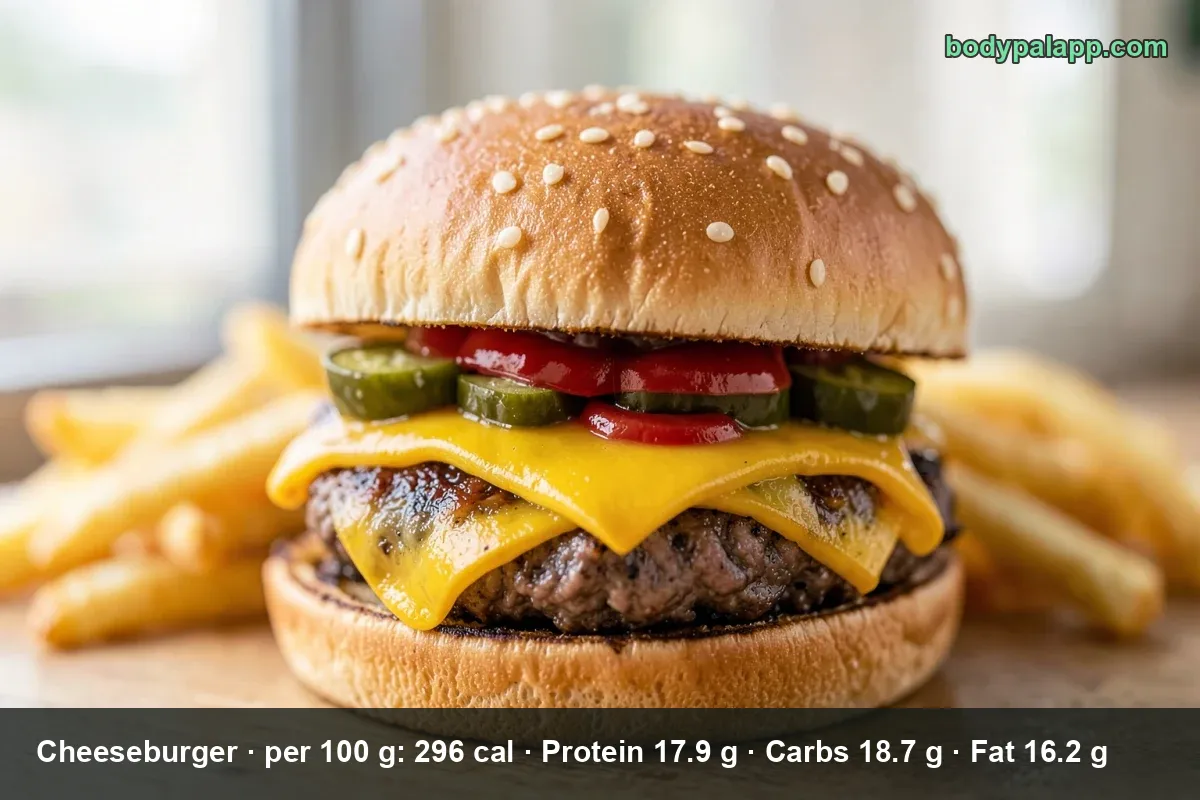
A plain cheeseburger weighs 165 g and carries 488 calories. Per 100 g it runs 296 calories, with 29.5 g of protein and 26.6 g of fat in the sandwich. That is one medium patty, a slice of melted cheese, a white bun, ketchup and pickles — nothing fancy on it yet.
On this page
- Cheeseburger quick facts
- US servings, from one ounce to two burgers
- Sliders, school lunch and the drive-thru
- Saturated fat and sodium run ahead of the calories
- How does a cheeseburger compare?
- Most popular cheeseburger brands
- FAQ
Cheeseburger quick facts
The row used here is FNDDS 2706888, "Cheeseburger, NFS" — the USDA entry for the ordinary cheeseburger somebody is actually holding: one medium patty, a slice of cheese, a white bun, and the usual ketchup and pickles. It comes with a household serving already attached, 1 cheeseburger at 165 g, so no scaling is needed for the headline number.
The other cheeseburger records in FoodData Central differ by build rather than by source: a bigger patty, a wheat bun, a school-lunch spec, a chain sandwich. Those are covered further down as their own numbers, never blended into an average.
| Nutrient | Per 100 g | Per 1 cheeseburger (165 g) | % Daily Value |
|---|---|---|---|
| Calories | 296 | 488 | — |
| Total fat | 16.15 g | 26.6 g | 34% |
| Saturated fat | 6.86 g | 11.3 g | 57% |
| Carbohydrate | 18.71 g | 30.9 g | 11% |
| Dietary fiber | 0.6 g | 1.0 g | 4% |
| Total sugars | 2.98 g | 4.9 g | — |
| Protein | 17.87 g | 29.5 g | 59% |
| Sodium | 438 mg | 723 mg | 31% |
| Cholesterol | 54 mg | 89 mg | 30% |
| Potassium | 219 mg | 361 mg | 8% |
% Daily Value is based on a 2,000-calorie diet.
Verified nutrition data
Numbers on this page come from USDA FoodData Central, the U.S. Department of Agriculture’s food composition database, and from manufacturer labels where a branded product is named. Last verified September 2026. How we verify our data →
Two rows are missing on purpose. USDA does not publish added sugars or trans fat for this mixed-dish record, so printing either one would mean inventing it. Total sugars are listed instead, and they have no Daily Value of their own — the 4.9 g in a cheeseburger sit mostly in the bun and the ketchup, and they are not the same thing as added sugars.
US servings, from one ounce to two burgers
| Serving | Weight | Calories |
|---|---|---|
| 1 oz | 28.3 g | 84 kcal |
| Half a cheeseburger | 82.5 g | 244 kcal |
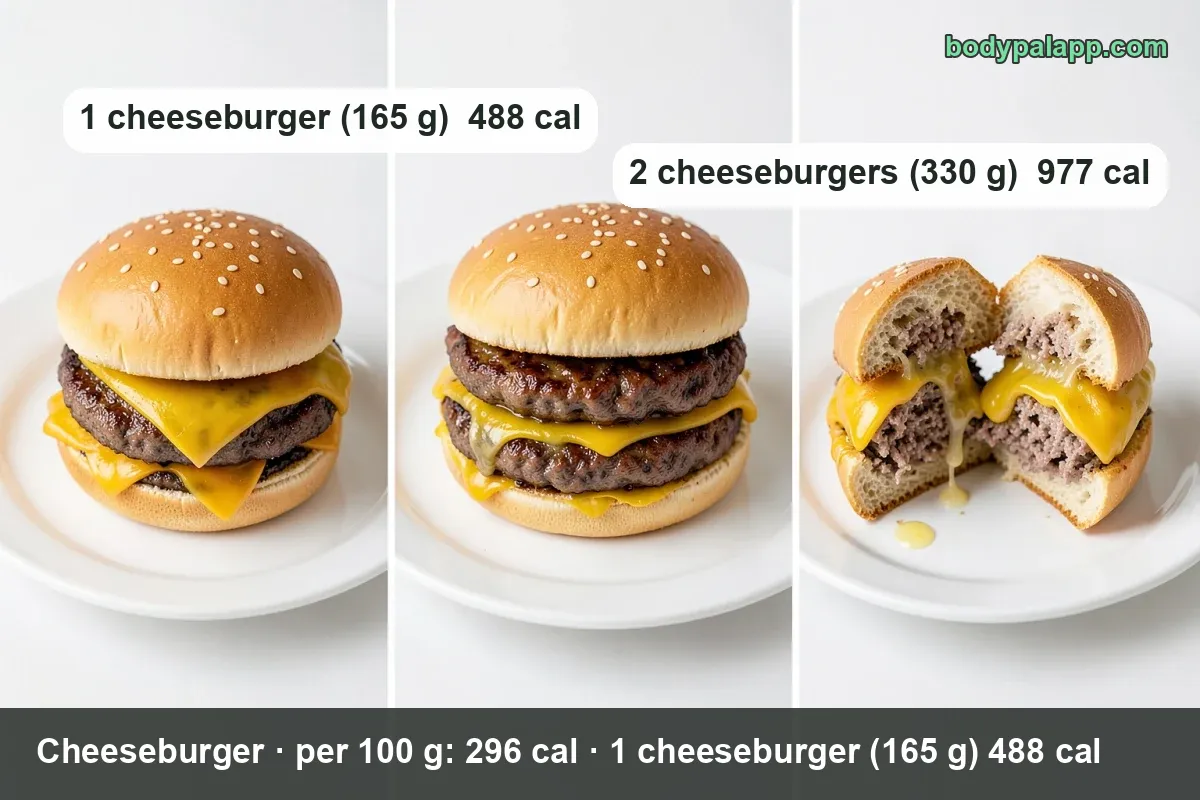
| One cheeseburger | 165 g | 488 kcal |
| Two cheeseburgers | 330 g | 977 kcal |
| Per 100 g | 100 g | 296 kcal |
Only the 165 g line is a USDA household measure. The ounce, the half burger and the two-burger row are our own arithmetic from the USDA 100 g figure, not USDA servings — useful when you split one with a kid or order the two-for-one, but they are scaled, not measured.
The two-burger row is the one worth staring at. At 977 calories, a pair of plain cheeseburgers is more than a full day's saturated fat and about half of the calories in a 2,000-calorie day, before fries or a soda enter the picture. One burger at 488 fits a normal lunch. Two does not fit anything except a very light dinner afterwards.
Weight is also where home cooking drifts. A quarter-pound patty cooks down to roughly 3 oz, but a hand-formed burger with two slices of cheese and a brioche bun can hit 220 g easily, which is 651 calories by the same per-gram math. If you build your own, weigh the finished sandwich rather than trusting the 165 g standard.
Sliders, school lunch and the drive-thru
| Version | Per 100 g | Typical piece | Calories |
|---|---|---|---|
| Cheeseburger slider | 297 kcal | 1 miniature, 80 g | 238 kcal |
| Fast-food slider | 298 kcal | 1 miniature, 60 g | 179 kcal |
| School cafeteria cheeseburger | 250 kcal | 1 cheeseburger, 100 g | 250 kcal |
| McDonald's cheeseburger | 270 kcal | 1 cheeseburger, 110 g | 297 kcal |
| Burger King cheeseburger | 265 kcal | 1 cheeseburger, 110 g | 292 kcal |
| Double cheeseburger, two medium patties | 300 kcal | 100 g | 300 kcal |
Sliders are the same food in smaller clothes. At 297 calories per 100 g the slider is denser than the standard burger, yet a single 80 g miniature is only 238 calories, and the 60 g fast-food version is 179. Two sliders land at 476, which is within a dozen calories of one full cheeseburger — the plate looks busier, the total barely moves.
The chain sandwiches are the useful surprise. A McDonald's cheeseburger is 270 calories per 100 g and a Burger King one is 265, both lighter per gram than the 296 of the generic record. They still come to 297 and 292 calories because they weigh 110 g against 165 g. The drive-thru burger is not a leaner recipe; it is a smaller one, and the same math applies the moment you order two.
The school cafeteria row is the only genuinely leaner build in the set: 8.64 g of fat per 100 g against 16.15 g, from a patty made to a lean USDA spec. A whole 100 g burger comes to 250 calories with 18.73 g of protein and 2.7 g of fiber. That is a better protein-per-calorie deal than anything else on this page.
The double cheeseburger has no household weight in FoodData Central, only a per-100-g figure of 300 calories. That is four calories per 100 g above the single — the extra patty changes the total because it adds mass, not because it changes the density. Any whole-sandwich number for a double would be a guess, so there isn't one here.
Frozen retail sliders track the same range: the USDA Branded rows for supermarket cheeseburger sliders run 259 to 300 calories per 100 g, with a typical two-slider box landing between 280 and 340 calories.
Saturated fat and sodium run ahead of the calories
One cheeseburger is 24% of a 2,000-calorie day. It is 57% of the day's saturated fat and 31% of the sodium. That gap is the whole nutrition story of this sandwich: the calories are ordinary for a lunch, the two rows the FDA Daily Value list flags for limiting are not.
The sodium figure, 723 mg, is roughly a third of a teaspoon of table salt in one sandwich. If you are watching sodium, the slider or the school-style burger is the better pick — 431 and 313 mg per 100 g respectively, against 438 for the standard and 628 for the McDonald's record.
Protein is the row that argues the other way. At 29.5 g, one cheeseburger covers 59% of the 50 g Daily Value, which is more than most sandwiches manage and enough to make it a legitimate protein food rather than just a treat. Fiber is where it falls flat at 1.0 g, 4% of the day — swapping to a wheat bun more than triples the fiber per 100 g, from 0.6 g to 2.0 g, and saves you four calories.
How does a cheeseburger compare?
| Burger | Per 100 g | US serving | Calories |
|---|---|---|---|
| Cheeseburger, NFS | 296 kcal | 1 cheeseburger, 165 g | 488 kcal |
| Cheeseburger slider | 297 kcal | 1 miniature, 80 g | 238 kcal |
| School cafeteria cheeseburger | 250 kcal | 1 cheeseburger, 100 g | 250 kcal |
| McDonald's cheeseburger | 270 kcal | 1 cheeseburger, 110 g | 297 kcal |
Our take: per gram these four are close, and two of them — the school burger at 250 and the McDonald's one at 270 — sit below the standard 296. What separates the finished sandwiches is weight, not recipe. If you want the burger and the smaller number, order the small one rather than hunting for a lighter build; if you want the protein, the 165 g burger at 29.5 g is the one to log. And if the sodium column is what you track, the school-spec patty at 313 mg per 100 g wins outright.
Most popular cheeseburger brands in the United States
Ranked by how widely each product appears among foods sold in the United States, from the BodyPal food database of over 3.3 million products. Calories are the figures printed on each Nutrition Facts label, checked against USDA FoodData Central.
| Product | Calories (per 100 g) |
|---|---|
| PICK FIVE Cheeseburger Sliders | 272 cal |
| Signature Select Cheeseburger Sliders | 259 cal |
| Banquet Cheeseburger Sliders | 300 cal |
Brand popularity: BodyPal food database. Nutrition: manufacturer labels / USDA FoodData Central.
Cheeseburger FAQs
How many calories are in a cheeseburger?
A standard cheeseburger weighs 165 g and carries 488 calories, from the USDA record Cheeseburger, NFS at 296 calories per 100 g. That is one medium patty, a slice of cheese, a white bun and the usual ketchup and pickles. Bacon, a second patty or a special sauce push the number higher.
How many calories in a McDonald's cheeseburger?
The USDA record for a McDonald's cheeseburger is 270 calories per 100 g, and the 110 g sandwich comes to 297 calories. It reads far lighter than the 488-calorie generic burger mainly because it is smaller: 110 g against 165 g. Per 100 g the two sit only 26 calories apart.
How much protein is in a cheeseburger?
One 165 g cheeseburger delivers 29.5 g of protein, 59% of the 50 g Daily Value, or 17.87 g per 100 g. That is the strongest column on the label. The trade is that the same sandwich brings 11.3 g of saturated fat, 57% of the day, along with it.
How many calories in a double cheeseburger?
USDA lists a double cheeseburger on a white bun with two medium patties at 300 calories per 100 g, four above the single at 296. No household weight is published for that record, so a whole-sandwich figure would be our guess rather than a USDA serving, and we do not print one.
Is a cheeseburger high in sodium?
One cheeseburger carries 723 mg of sodium, 31% of the 2,300 mg Daily Value, from a sandwich that is only 24% of a 2,000-calorie day. That is roughly a third of a teaspoon of table salt. The McDonald's record is saltier per gram still, at 628 mg per 100 g.
How many calories in a cheeseburger slider?
A cheeseburger slider is 238 calories for one 80 g miniature, at 297 calories per 100 g. The smaller fast-food slider, 60 g, comes to 179 calories. Per gram a slider is the same food as a full burger, so two of them land at 476, near one whole cheeseburger.
Does a wheat bun change the calories?
Barely: 292 calories per 100 g on a wheat bun against 296 on white, a gap of four calories that no food diary will notice. Fiber is the real change, 2.0 g per 100 g against 0.6 g, more than three times as much. Sodium stays flat at 439 mg.
How many calories in a cheeseburger without the bun?
No USDA record covers a bunless cheeseburger, so any number would be subtraction rather than measurement. The closest published row is the large-patty burger at 299 calories per 100 g with 15.26 g of carbohydrate against 18.71 g for the standard build: more meat, less bread, nearly identical density.
Similar foods
- Double Cheeseburger — 607 cal per double cheeseburger
- Mozzarella Cheese Stick — 83 cal per stick
- Queso Fresco — 84 cal per ounce
- Honeycomb — 83 cal per oz
- Wonton wrapper — 23 cal per wonton wrapper
- Molasses — 58 cal per tbsp
Count it without the math
Point the camera at the plate and BodyPal counts the burger for you, bun and all.


How long does it take to burn off a cheeseburger?
One cheeseburger (165 g) is 488 kcal. Enter your weight and the amount you ate to see how long it takes you to burn that off:
lb
| Activity | Time to burn 488 kcal |
|---|---|
| Walking, brisk | 1 hr 38 min |
| Cycling, moderate | 1 hr 1 min |
| Swimming, moderate | 1 hr 10 min |
| Jogging | 57 min |
| Weight training, moderate | 1 hr 48 min |
Times are for a 155 lb adult at a steady pace; change the weight to see yours. The amount is set to the portion in the text (165 g); change it to what you actually ate. BodyPal works this out from your steps automatically.
This table assumes you know your daily total. If you do not, the daily calorie calculator works it out from five numbers.