
How many calories in a mooncake?
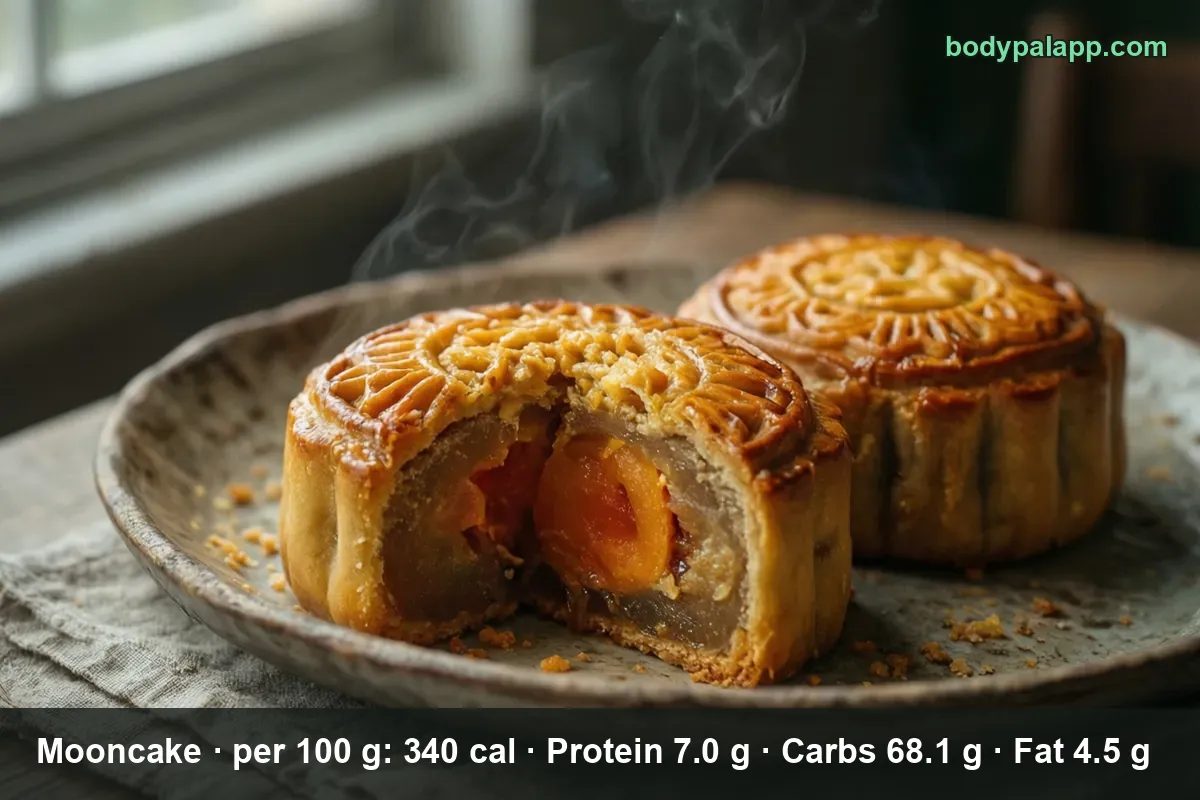
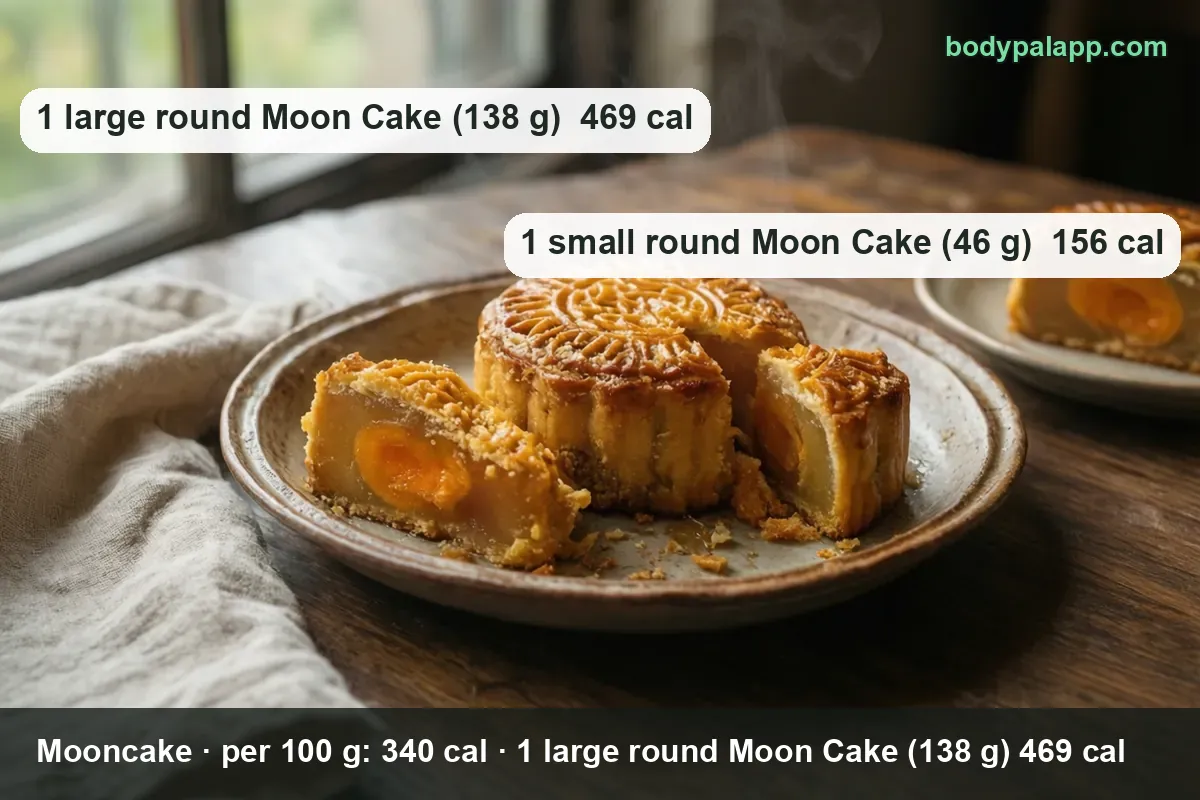
One large round mooncake of 138 g is 469 calories, and the figure per 100 g is 340. A small round one of 46 g is 156. Almost nothing about that spread is the recipe: the same USDA density produces 156 calories or 694 depending only on which size the box holds.
On this page
- Mooncake quick facts
- US servings, from one cubic inch to a large square
- The sugar is the number, not the fat
- Cholesterol is the %DV nobody checks
- Mini, half and large square mooncakes
- The boxed mooncake is not the USDA mooncake
- How does a mooncake compare?
- Most popular mooncake brands
- FAQ
Mooncake quick facts
Every number here comes from FNDDS 2708048, "Pastry, made with bean or lotus seed paste filling, baked", which USDA files under doughnuts, sweet rolls and pastries. That record is not an approximation borrowed from a nearby pastry. Its own household measures are written out as "1 small round Moon Cake", "1 large round Moon Cake", "1 small square Moon Cake" and "1 large square Moon Cake", so USDA built the line for this food specifically.
The serving column is the large round cake at 138 g, the classic Cantonese size that holds a whole salted yolk.
| Nutrient | Per 100 g | Per 1 large round mooncake (138 g) | % Daily Value |
|---|---|---|---|
| Calories | 340 | 469 | — |
| Total fat | 4.45 g | 6.1 g | 8% |
| Saturated fat | 0.841 g | 1.2 g | 6% |
| Carbohydrate | 68.1 g | 94.0 g | 34% |
| Dietary fiber | 2.7 g | 3.7 g | 13% |
| Total sugars | 36.49 g | 50.4 g | — |
| Protein | 6.99 g | 9.6 g | 19% |
| Sodium | 87 mg | 120 mg | 5% |
% Daily Value is based on a 2,000-calorie diet.
Verified nutrition data
Numbers on this page come from USDA FoodData Central, the U.S. Department of Agriculture’s food composition database, and from manufacturer labels where a branded product is named. Last verified September 2026. How we verify our data →
Two rows a packaged label would carry are absent, and for one reason. USDA publishes no added sugars and no trans fat value for this survey record, because survey foods are modelled from recipes rather than read off a wrapper. Filling those cells from a store label would mix two foods into one table, so they stay out. Total sugars carry no Daily Value on a US label either, which is why that cell is blank rather than zero.
Two figures sit outside the standard label block and both come from the same record. Cholesterol is 49 mg per 100 g, or 68 mg in one cake. Potassium is 125 mg per 100 g, 173 mg per cake, about 4% of the day.
US servings, from one cubic inch to a large square
| Serving | Weight | Calories |
|---|---|---|
| 1 cubic inch | 19 g | 65 |
| 1 oz | 28 g | 95 |
| 1 small round mooncake | 46 g | 156 |
| 1 small square mooncake | 51 g | 173 |
| Half a large round mooncake | 69 g | 235 |
| 1 large round mooncake | 138 g | 469 |
| 1 large square mooncake | 204 g | 694 |
Every row but one is a USDA household measure for this record; the half is our own scaling of the 138 g cake. All of them describe the same food at the same density. The word "mooncake" spans 156 calories to 694, a factor of 4.4, and nothing but the object's weight moves between them. Logging "one mooncake" without a size is therefore close to logging nothing at all; it is the single largest source of error on this food, larger than any difference between fillings.
The cubic-inch row is USDA's own measure and it is the useful one at a table. A mooncake is cut into wedges and passed around, and one cubic inch is 65 calories. Three small wedges over an evening is roughly 195, which is a snack. The whole cake in front of you is a meal.
Half a large round cake deserves its own line because "I only had half" gets said constantly. Half is 69 g and 235 calories — more than a whole medium croissant and within twenty of a whole yeast doughnut. It is a portion in the sense that it is smaller; it is not a small portion.
Raw against cooked does not apply here. USDA describes the record as baked, mooncakes are only ever eaten baked, and every figure on this page is the finished cake.
The sugar is the number, not the fat
Split the 340 calories in 100 g by where they come from and the mooncake stops resembling the pastry case it sits in.
Carbohydrate supplies about 272 of the 340 calories. Fat supplies about 40. Protein rounds it out near 28. Inside that carbohydrate, sugars alone account for roughly 146 calories — more than three times what the fat contributes. This is a confection built from sweetened bean or lotus paste wrapped in a thin skin, not a laminated dough soaked in butter.
The percentage column reads accordingly. One cake is 34% of the day's carbohydrate and only 8% of its total fat, with saturated fat at 6%. If you came here expecting a fat problem, the table quietly says no.
What it says loudly is sugar. One large round mooncake carries 50.4 g of total sugars. The FDA Daily Value for added sugars is 50 g, and USDA does not publish an added-sugars split for this record, so the two are not the same measurement and the table shows no percentage. The scale still lands: a single cake carries as much total sugar as the entire label allowance for added sugar, and the Dietary Guidelines for Americans keep added sugars under 10% of daily calories. Whatever share of those 50.4 g arrived from the sugar bag rather than the beans, it is not a small share.
The fiber row is the small consolation. Bean and lotus paste bring 3.7 g of fiber, 13% of the Daily Value, and it comes from the filling rather than the pastry. Protein is 9.6 g, 19% of the day, which is genuinely respectable for something eaten as dessert.
Sodium is the row that behaves. 120 mg per cake, 5% of the Daily Value — for context, that is a fraction of what most fried or baked sweet goods carry, and roughly a twentieth of a teaspoon of table salt. Salted egg yolk gets blamed for it, and on this record the blame does not stick.
Cholesterol is the %DV nobody checks
Here is the figure that outruns everything else on the label. One large round mooncake holds 68 mg of cholesterol, 23% of the 300 mg Daily Value — nearly three times its 8% share of total fat.
The yolk is the reason, and USDA's record includes it: a classic cake is built around one whole salted duck egg yolk, which is close to pure cholesterol with very little of the fat mass you would expect to come with it. That mismatch is why a cake that looks light on the fat line is heavy on this one.
It gets sharper on a boxed cake. The double-yolk lotus seed paste cake in USDA's label database declares 207 mg of cholesterol per 100 g. Its own serving size is one third of a cake, 58 g, which works out at 120 mg — 40% of the Daily Value from a third of one cake. Eat the whole thing over an afternoon and you have passed the day's figure entirely.
Federal advice no longer sets a numeric cholesterol cap, and MyPlate frames grain-based sweets as occasional food rather than a daily category. Still, if cholesterol is a number your doctor watches, this is the row on the page that matters, and it is the one no mooncake calorie chart prints.
Mini, half and large square mooncakes
| Version | Per 100 g | Serving | Calories |
|---|---|---|---|
| Large round, USDA record (this page) | 340 | 138 g | 469 |
| Large square, USDA record | 340 | 204 g | 694 |
| Small round mini | 340 | 46 g | 156 |
| Half a large round | 340 | 69 g | 235 |
| Boxed lotus paste with double yolk | 431 | 58 g, one third of a cake | 250 |
| Boxed bean paste, no yolk | 350 | 60 g, one piece | 210 |
The mini is the row worth acting on. At 46 g it delivers 156 calories, 3.2 g of protein, 31.3 g of carbohydrate, 2.0 g of fat and 16.8 g of sugars. It is a third of the large round cake in every column, which makes the mini box the honest way to eat mooncake at all: one small cake is a dessert, one large cake is a third of a day's carbohydrate.
The large square goes the other way. 204 g brings 694 calories, 14.3 g of protein, 138.9 g of carbohydrate and 9.1 g of fat. That is more carbohydrate than a person eating to a 2,000-calorie label is meant to have in half a day, from one object that fits in a palm.
The last two rows are store cakes with their own labels, and they are worth reading side by side. The double-yolk lotus version is 250 calories in a 58 g third of a cake, with 3.0 g of protein, 37.0 g of carbohydrate and 10.0 g of fat. The bean paste cake with no yolk is 210 calories in a 60 g piece, with 5.0 g of protein, 30.0 g of carbohydrate, 8.0 g of fat and zero cholesterol. Same festival, same shape, and a 40-calorie gap in a similar weight — plus the whole cholesterol difference.
The boxed mooncake is not the USDA mooncake
If your cake came out of a gift tin, the 340 figure is the wrong one to log.
USDA's own label records for Cantonese-style cakes run 431 to 438 calories per 100 g against 340 for the survey record, about 27% higher. The gap is not a disagreement between sources; it is a different recipe. Fat is where it shows: the boxed cakes carry 17.24 to 25.0 g of fat per 100 g against 4.45 g, because commercial Cantonese pastry is enriched with peanut or soybean oil and built around one or two salted yolks. Cholesterol tracks it, 104 to 207 mg per 100 g against 49 mg.
The exception proves the rule. A festival mooncake with mung or white bean paste and no yolk sits at 350 calories per 100 g, almost exactly on top of the USDA record — because it is almost exactly the same food.
So the rule for logging is simple. Bakery or homemade cake with bean or lotus paste: use 340 per 100 g. Cake from a printed box with a yolk inside: use the box, and expect something near 430. Do not average the two. A number halfway between describes no cake anyone is holding.
How does a mooncake compare?
| Item | Per 100 g | Serving | Calories | Protein / Carbs / Fat |
|---|---|---|---|---|
| Mooncake (this page) | 340 | 1 large round (138 g) | 469 | 9.6 / 94.0 / 6.1 g |
| Danish pastry, plain | 403 | 1 medium (113 g) | 455 | 7.9 / 50.4 / 25.3 g |
| Doughnut, yeast type | 421 | 1 doughnut (60 g) | 253 | 3.7 / 28.8 / 13.6 g |
| Croissant | 406 | 1 medium (57 g) | 231 | 4.7 / 26.1 / 12.0 g |
All four are USDA survey records from the same pastry family, so the comparison is like for like. Per 100 g the mooncake is the lightest of the four at 340 against 403 to 421. Per piece it is the heaviest, at 469 against 231 to 455. Both facts are true and they point in opposite directions, which is exactly why per-100 g charts mislead on this food.
The macro columns explain the trick. A mooncake is 6.1 g of fat and 94.0 g of carbohydrate; a Danish is 25.3 g of fat and 50.4 g of carbohydrate. Sugar and paste are less calorie-dense per gram than butter, so the mooncake wins on density and loses on size — it is simply a much bigger object, 138 g against 57 g for a croissant.
Our take: if you want the smallest number on the tray, the croissant is it at 231 calories, and the yeast doughnut is close behind at 253. If you want the most protein per piece, the mooncake wins outright — 9.6 g against 4.7 g for the croissant, on top of 3.7 g of fiber. And if you want to eat mooncake without eating 469 calories, take the small round at 156 or cut the large one into cubic inches at 65 apiece. Cutting the cake is a better lever than choosing a different pastry.
Most popular mooncake brands in the United States
Ranked by how widely each product appears among foods sold in the United States, from the BodyPal food database of over 3.3 million products. Calories are the figures printed on each Nutrition Facts label, checked against USDA FoodData Central.
| Product | Calories (per 100 g) |
|---|---|
| Wei-Chuan Festival Mooncake | 350 cal |
| Emperor Double Egg Yolk Mooncake with Lotus Seed Paste | 431 cal |
| KGC Super Deluxe Moon Cake | 438 cal |
Brand popularity: BodyPal food database. Nutrition: manufacturer labels / USDA FoodData Central.
Mooncake FAQs
How many calories are in a mooncake?
469 calories in one large round mooncake of 138 g, which is 340 calories per 100 g. A small round mooncake of 46 g is 156 calories, and a large square one of 204 g reaches 694. That 138 g serving carries 94.0 g of carbohydrate, 50.4 g of sugars, 9.6 g of protein and 6.1 g of fat.
How many calories are in half a mooncake?
235 calories for half a large round cake, which weighs 69 g — USDA lists only the whole 138 g cake, so the half is our own scaling of it. That is more than a whole medium croissant at 231 and only 18 under a yeast doughnut at 253. Half also brings 47.0 g of carbohydrate, 4.8 g of protein and 3.1 g of fat.
How many calories are in a mini mooncake?
156 calories for a small round mooncake of 46 g, with 3.2 g of protein, 31.3 g of carbohydrate, 16.8 g of sugars and 2.0 g of fat. A small square mini is 51 g and 173 calories. Minis are the only serving of this food that behaves like a dessert rather than a meal.
How many calories are in a mooncake with egg yolk?
250 calories for one third of a boxed double-yolk lotus seed paste cake, a 58 g piece at 431 calories per 100 g. The same piece holds 120 mg of cholesterol, 40% of the Daily Value. USDA's survey record, which includes a yolk, is lower at 340 per 100 g because the pastry around it carries far less oil.
How many calories are in a lotus seed paste mooncake?
340 calories per 100 g for the USDA record, which covers bean and lotus seed paste fillings together, so a large round cake is 469. A boxed lotus paste cake with double yolk runs higher at 431 per 100 g. The filling type moves the number far less than the size of the cake does.
How much sugar is in a mooncake?
50.4 g of total sugars in one large round cake of 138 g, from 36.49 g per 100 g. Sugars supply roughly 146 of the 340 calories in 100 g, more than three times what fat contributes. USDA publishes no added sugars figure for this record, so the split between recipe sugar and fruit or bean sugar is not available.
Are mooncakes healthy?
One large round cake is 469 calories with 94.0 g of carbohydrate, 34% of the Daily Value, and 50.4 g of sugars. It is better than its reputation on two rows: 9.6 g of protein at 19% and 3.7 g of fiber at 13%, both from the bean or lotus paste. Sodium is low at 120 mg, cholesterol high at 68 mg or 23%.
Is a mooncake worse than a doughnut?
Per 100 g no: a mooncake is 340 calories against 421 for a yeast doughnut, and carries a quarter of the fat. Per piece yes: 469 calories for a 138 g cake against 253 for a 60 g doughnut. Size decides it, and a mooncake is more than twice the object.
Similar foods
- Pretzel Bun — 389 cal per bun
- Chocolate Cake — 604 cal per slice, 2-layer cake
- Pretzel — 414 cal per medium soft pretzel
- Soft Pretzel — 414 cal per medium pretzel
- Wetzel Pretzel — 414 cal per medium pretzel
- Beer Bread — 90 cal per mix serving
Count it without the math
Point the camera at the cut cake and BodyPal logs the wedge, the mini and the half somebody left on the plate without a scale.


How long does it take to burn off a mooncake?
A large round mooncake (138 g) is 469 kcal. Enter your weight and the amount you ate to see how long it takes you to burn that off:
lb
| Activity | Time to burn 469 kcal |
|---|---|
| Walking, brisk | 1 hr 34 min |
| Cycling, moderate | 59 min |
| Swimming, moderate | 1 hr 7 min |
| Jogging | 55 min |
| Weight training, moderate | 1 hr 44 min |
Times are for a 155 lb adult at a steady pace; change the weight to see yours. The amount is set to the portion in the text (138 g); change it to what you actually ate. BodyPal works this out from your steps automatically.
This table assumes you know your daily total. If you do not, the daily calorie calculator works it out from five numbers.