
How Many Calories in Onigiri?
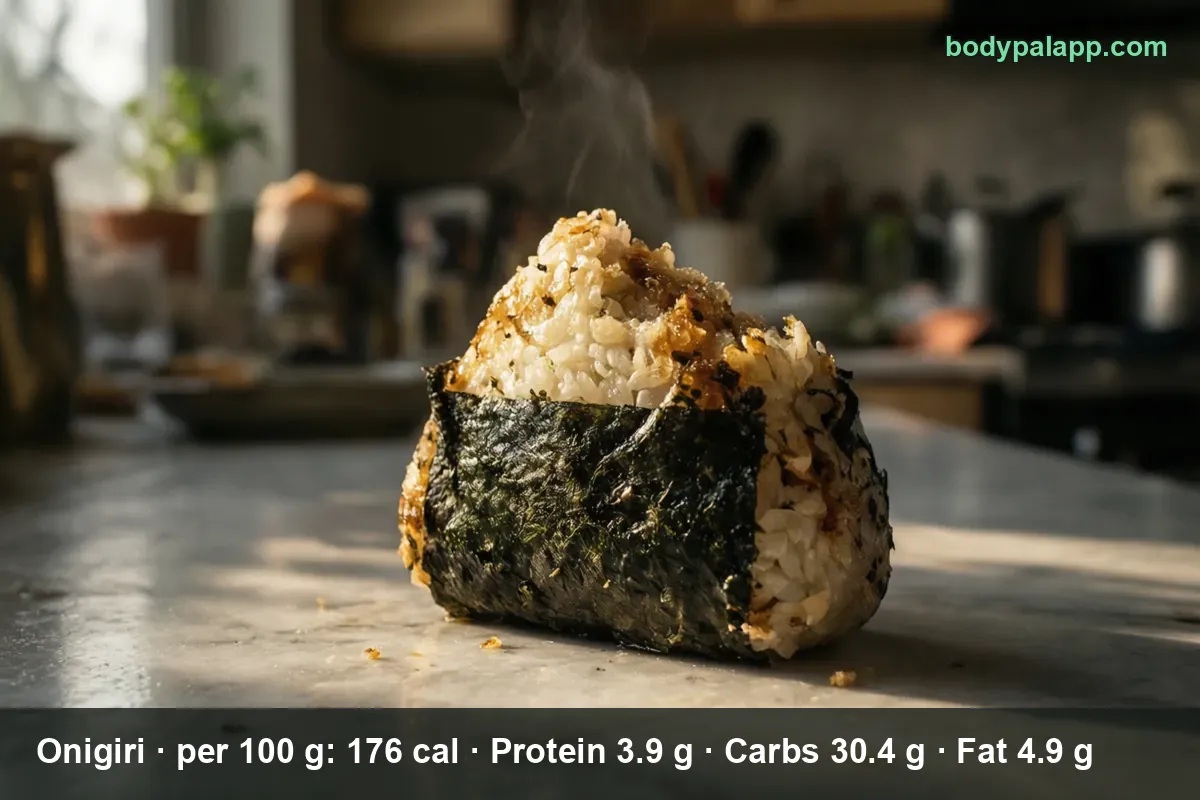
One onigiri is 180 calories — a single 102 g triangle out of the chilled case, running 176 calories per 100 g. Break one open and share it and you are at 90. Eat two and you are at 359. The calories in onigiri live in the rice, not in the spoonful of tuna or kale sitting in the middle of it.
On this page
- Onigiri quick facts
- Why one piece is a moving target
- Onigiri portions, piece by piece
- Tuna, kale and the spicy combo
- The rice is where the calories live
- Sodium is the number to watch
- How does onigiri compare?
- Most popular onigiri brands
- FAQ
Onigiri quick facts
Start with something most calorie pages will not tell you: USDA has no generic entry for onigiri. Not in Foundation Foods, not in SR Legacy, not in FNDDS. Search the survey data for onigiri, rice ball or musubi and what comes back is sesame tangyuan and Italian arancini — different foods wearing a similar shape.
So the reference here is a label, and a carefully chosen one: USDA 2652494, the Konscious kale gomae onigiri, whose package writes its serving size as one onigiri, 102 g. Of the three American onigiri labels in the database, it is the only one whose serving is literally one onigiri, and it reports the whole panel — added sugars and potassium included.
| Nutrient | Per 100 g | Per 1 onigiri (102 g) | % Daily Value |
|---|---|---|---|
| Calories | 176 | 180 | — |
| Total fat | 4.9 g | 5.0 g | 6% |
| Saturated fat | 0.5 g | 0.5 g | 3% |
| Carbohydrate | 30.4 g | 31.0 g | 11% |
| Dietary fiber | 1.0 g | 1.0 g | 4% |
| Total sugars | 3.9 g | 4.0 g | — |
| Added sugars | 2.9 g | 3.0 g | 6% |
| Protein | 3.9 g | 4.0 g | 8% |
| Sodium | 265 mg | 270 mg | 12% |
% Daily Value is based on a 2,000-calorie diet.
Verified nutrition data
Numbers on this page come from USDA FoodData Central, the U.S. Department of Agriculture’s food composition database, and from manufacturer labels where a branded product is named. Last verified September 2026. How we verify our data →
Two rows carry the item. Carbohydrate at 31.0 g is 11% of the FDA Daily Value, which is exactly what a fist of seasoned rice should look like. Sodium at 270 mg is 12% — a bigger share of the day than the calories are, and that is the surprise on this label.
The rest of the panel is quiet. One onigiri brings 159 mg of potassium (3% DV), zero cholesterol and zero trans fat. Fiber is a rounding error at 1.0 g, because white rice is white rice.
There is a way to sanity-check a label instead of trusting it, and this one passes. Run the macros through the Atwater factors — 4 × 3.92 g protein, 4 × 30.39 g carbohydrate, 9 × 4.9 g fat — and you get 181 calories per 100 g against the 176 printed on the package. Three percent apart. The panel is internally consistent, which is more than can be said for one of its competitors below.
Why one piece is a moving target
Here is the trap, and it is specific to this food. Onigiri is sold by the piece, so people log it by the piece. The piece is not a fixed thing.
Three American onigiri labels sit in USDA's branded data, and all three call their serving "one." Okami Fresh calls 99 g one container. Konscious calls 102 g one onigiri. Sushic calls 154 g one piece. Same word, three different objects.
The calorie consequence is brutal: 90 calories, 180 calories, 220 calories — all of them one piece of onigiri. The recipe barely moved. The weight did, and so did what got mixed into the rice.
That 154 g Sushic combo is the clearest case. Its carbohydrate reads 24.68 g per 100 g against 30.39 g for the plain rice-and-filling version, because avocado, mayonnaise and imitation crab have diluted the rice. Lighter per gram, heavier on the plate — a bigger object made of softer stuff.
The fix takes two seconds at the register. Read the grams on the package, not the count. A convenience-store onigiri is usually near 100 g and near 180 calories; anything sold as a "combo" or with a sauce in it is a different size of meal.
Onigiri portions, piece by piece
| Portion | Weight | Calories |
|---|---|---|
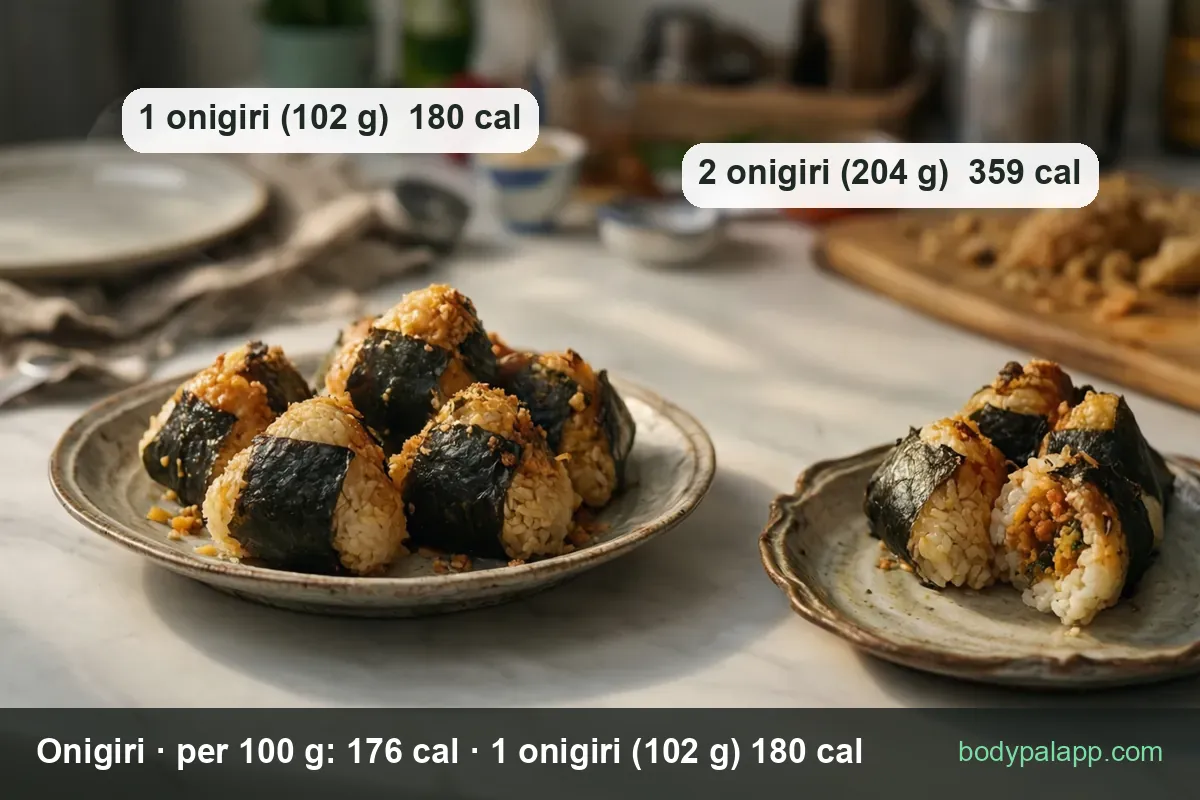
| One onigiri (the package serving) | 102 g | 180 cal |
| Two onigiri | 204 g | 359 cal |
| Half an onigiri | 51 g | 90 cal |
| One ounce | 28 g | 49 cal |
| 100 g of onigiri | 100 g | 176 cal |
The two-piece row is the one worth memorizing, because two is how onigiri is actually eaten. Nobody buys one and calls it lunch. At 359 calories, a pair delivers 8.0 g of protein and 62 g of carbohydrate — a real, portable, room-temperature meal that happens to weigh less than half a pound.
The ounce row is a trap dressed as convenience. Forty-nine calories per ounce sounds trivial, and it is, until you notice that an onigiri is about 3.6 oz. Ounces are the wrong unit for a food that comes in one pre-decided lump; the piece and its gram weight are the only measures that mean anything here.
Half an onigiri is worth listing for one reason: at 90 calories it is the cheapest way to test whether you actually want the second one.
Tuna, kale and the spicy combo
Three labels, three different objects. Okami Fresh's spicy tuna is 91 calories per 100 g and 90 for its 99 g container, with 7.0 g of protein and 260 mg of sodium; Konscious kale gomae is 176 per 100 g and 180 for one 102 g onigiri, with 4.0 g of protein and 270 mg of sodium; Sushic's spicy combo is 143 per 100 g and 220 for a 154 g piece, with 7.0 g of protein and 779 mg of sodium.
The tuna row deserves a caveat rather than a headline, and this is where reading numbers beats copying them. Okami Fresh's label reports 14.14 g of carbohydrate per 100 g. Plain cooked white rice runs 28.0 g, and even the wettest form USDA lists — cooked glutinous rice — sits at 20.97 g. A food that is mostly rice cannot come in below the rice it is made of. The label is self-consistent internally, but its basis does not describe 100 g of the product in the package, which is why this page does not lead with 91 calories.
The Sushic combo is honest and simply bigger. Its 154 g piece works out to 38.0 g of carbohydrate, 3.5 g of fat and 7.0 g of protein — the avocado and the crab stick earn their keep on the protein line and charge for it everywhere else.
Filling changes the picture less than anyone expects. Rice is the bulk of the mass in every one of these, so a swap from tuna to kale to salmon moves the total by tens of calories, not hundreds. Pick the filling you like. Watch the grams.
The rice is where the calories live
Plain cooked white rice, FNDDS 2708408, is 129 calories per 100 g. Onigiri is 176. That 47-calorie gap per 100 g is not the filling — it is the seasoning.
Sushi rice is dressed with vinegar, sugar and oil before it is ever shaped, and the label shows it: 2.9 g of added sugars per 100 g, 3.0 g in a single onigiri, 6% of the day's Daily Value from something nobody thinks of as sweet. The 4.9 g of fat per 100 g comes from the same place, since plain rice carries almost none.
Run it at portion scale and the gap widens. A full cup of cooked white rice (158 g) is 204 calories. Two onigiri are 359 for 204 g — 155 calories more, and the difference went in before the rice was shaped.
This is also why onigiri outweighs sushi rolls per gram. A tuna roll is 97 calories per 100 g and holds 15.3 g of carbohydrate; onigiri holds 30.4 g. The roll is half rice and half fish, cucumber and air. The onigiri is rice with a spoonful in the middle. Per 100 g, onigiri carries about 80% more calories than a tuna roll — not because it is richer, but because there is more grain per bite. MyPlate counts it in the grain group for the same reason.
Sodium is the number to watch
Calories bring people to this page. Sodium is the number that should keep them here.
- One onigiri, 102 g: 270 mg — 12% DV
- Two onigiri, 204 g: 540 mg — 24% DV
- One Sushic spicy combo, 154 g: 779 mg — 34% DV
The Daily Value is 2,300 mg, roughly a teaspoon of table salt. A two-piece lunch spends a quarter of it before anything else on the desk, and the Dietary Guidelines for Americans flag sodium as one of the nutrients most Americans already overshoot.
Two details make it worse than the table looks. Salted rice and a strip of nori are salty before the filling arrives, so the sodium does not scale with how "light" the filling is — the 90-calorie tuna piece still carries 260 mg. And onigiri is dipped. A tablespoon of soy sauce is not on any of these labels, and it moves the number a long way.
The counter-argument in the food's favor is real. At 180 calories, one onigiri costs about 9% of a 2,000-calorie day and 12% of the sodium — a tight ratio, but not a bad one for a chilled convenience food. Compare that with a sandwich from the same shelf and onigiri usually wins on calories while losing on protein.
How does onigiri compare?
| Item | Per 100 g | US serving | Calories | Protein |
|---|---|---|---|---|
| Onigiri | 176 cal | 1 onigiri (102 g) | 180 cal | 4.0 g |
| Tuna sushi roll | 97 cal | 1 cup (150 g) | 146 cal | 11.1 g |
| California sushi roll | 94 cal | 1 cup (150 g) | 141 cal | 4.4 g |
| Salmon nigiri | 107 cal | 1 piece (35 g) | 37 cal | 3.1 g |
| Cooked white rice | 129 cal | 1 cup (158 g) | 204 cal | 4.2 g |
Per 100 g, onigiri is the heaviest thing in the list. Per serving only a full cup of cooked rice tops it, and the one true single piece to compare it with is nigiri — a 35 g slab of rice under a slice of salmon is 37 calories, so one onigiri equals about five of them.
Our take: if protein per calorie is what you are after, the tuna roll wins outright — a cup of it delivers 11.1 g for 146 calories, nearly triple the protein of an onigiri for fewer calories. If you want the thing that survives four hours in a bag and still counts as lunch, onigiri does that and the sushi roll does not; 359 calories for two pieces is a defensible meal. The California roll is the one to skip on these numbers, since it costs almost the same as the tuna roll and returns 4.4 g of protein for it.
Most popular onigiri brands in the United States
Ranked by how widely each product appears among foods sold in the United States, from the BodyPal food database of over 3.3 million products. Calories are the figures printed on each Nutrition Facts label, checked against USDA FoodData Central.
| Product | Calories (per 100 g) |
|---|---|
| Okami Fresh Onigiri Spicy Tuna | 91 cal |
| Konscious Plant-Based Kale Gomae Onigiri | 176 cal |
| Sushic Spicy Onigiri Combo | 143 cal |
Brand popularity: BodyPal food database. Nutrition: manufacturer labels / USDA FoodData Central.
Onigiri FAQs
How many calories are in onigiri?
180 calories for one 102 g onigiri, which is 176 calories per 100 g. Two pieces come to 359 calories and half of one is 90. American labels vary in size, so weigh the piece rather than counting it: the same word covers 99 g, 102 g and 154 g products.
How many calories are in two onigiri?
359 calories for two pieces, 204 g of rice ball in total. That pair carries 62 g of carbohydrate, 8.0 g of protein and 540 mg of sodium, which is 24% of the Daily Value. It is more calories than a full cup of plain cooked white rice, which is 204.
How many carbs are in onigiri?
31.0 g in one 102 g onigiri, or 30.4 g per 100 g — 11% of the Daily Value. That is more carbohydrate per gram than plain cooked white rice at 28.0 g, because sushi rice is seasoned with vinegar and sugar before it is shaped. Fiber is only 1.0 g.
How much protein is in onigiri?
4.0 g in one onigiri, which is 8% of the Daily Value. Protein is not the reason to eat this food: the same 100 g as a tuna sushi roll would give 7.4 g, nearly double, for fewer calories. A tuna-filled onigiri does better at about 7.0 g per package.
How many calories are in a tuna onigiri?
90 calories per 99 g container on the Okami Fresh label, with 7.0 g of protein and 260 mg of sodium. Treat that figure with caution: its 14.14 g of carbohydrate per 100 g falls below plain cooked rice, so the label does not describe 100 g of the finished product.
Onigiri or a sushi roll — which has fewer calories?
The sushi roll, at 97 calories per 100 g against 176 for onigiri. A full cup of tuna roll is 146 calories against 180 for one rice ball. The roll also brings 11.1 g of protein, where an onigiri brings 4.0 g.
Is onigiri healthy?
It is a 180-calorie grain food with one number to watch. Fat is low at 5.0 g and calories are modest, but a single piece supplies 270 mg of sodium (12% DV) and 3.0 g of added sugars (6% DV), while returning 4.0 g of protein and 1.0 g of fiber.
How much sodium is in an onigiri?
270 mg in one 102 g piece, 12% of the 2,300 mg Daily Value, before any soy sauce. Two pieces reach 540 mg. A 154 g spicy combo is far higher at 779 mg, or 34% of the day, because the sauce and the crab filling are salted as well as the rice.
Similar foods
- BBQ Chicken — 149 cal per 3 oz
- Stuffed pepper — 265 cal for 1/2 pepper with filling
- Taco Salad — 564 cal per medium taco salad
- Spaghetti And Meatballs — 961 cal per plate
- Pork Chop — 220 cal per regular chop
- Gyro — 368 cal per sandwich
Count it without the math
Point the camera at the rice ball and BodyPal logs the calories, the carbs and the sodium in one shot.


How long does it take to burn off onigiri?
One onigiri (102 g) is 180 kcal. Enter your weight and the amount you ate to see how long it takes you to burn that off:
lb
| Activity | Time to burn 180 kcal |
|---|---|
| Walking, brisk | 36 min |
| Cycling, moderate | 22 min |
| Swimming, moderate | 26 min |
| Jogging | 21 min |
| Weight training, moderate | 40 min |
Times are for a 155 lb adult at a steady pace; change the weight to see yours. The amount is set to the portion in the text (102 g); change it to what you actually ate. BodyPal works this out from your steps automatically.
One food is easy to picture; a whole day is harder. See how many calories you need a day and what a deficit actually looks like.