
How many calories are in spaghetti and meatballs?
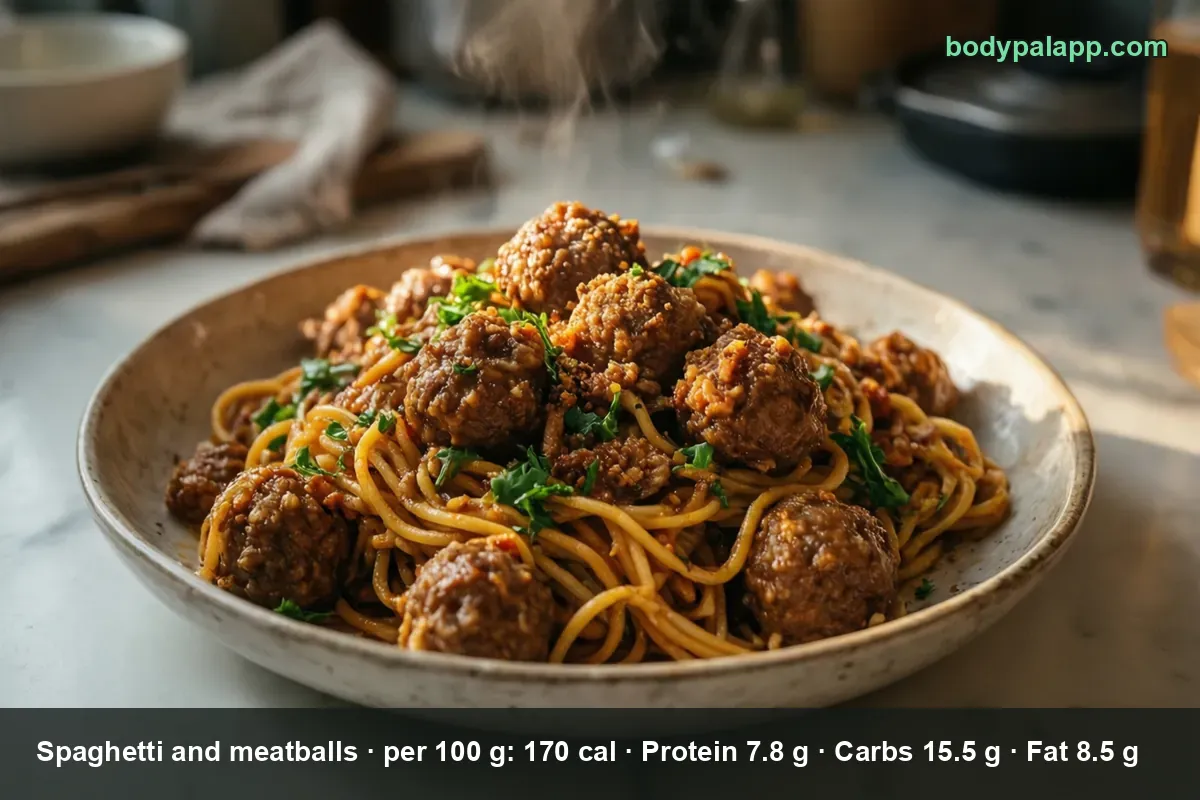
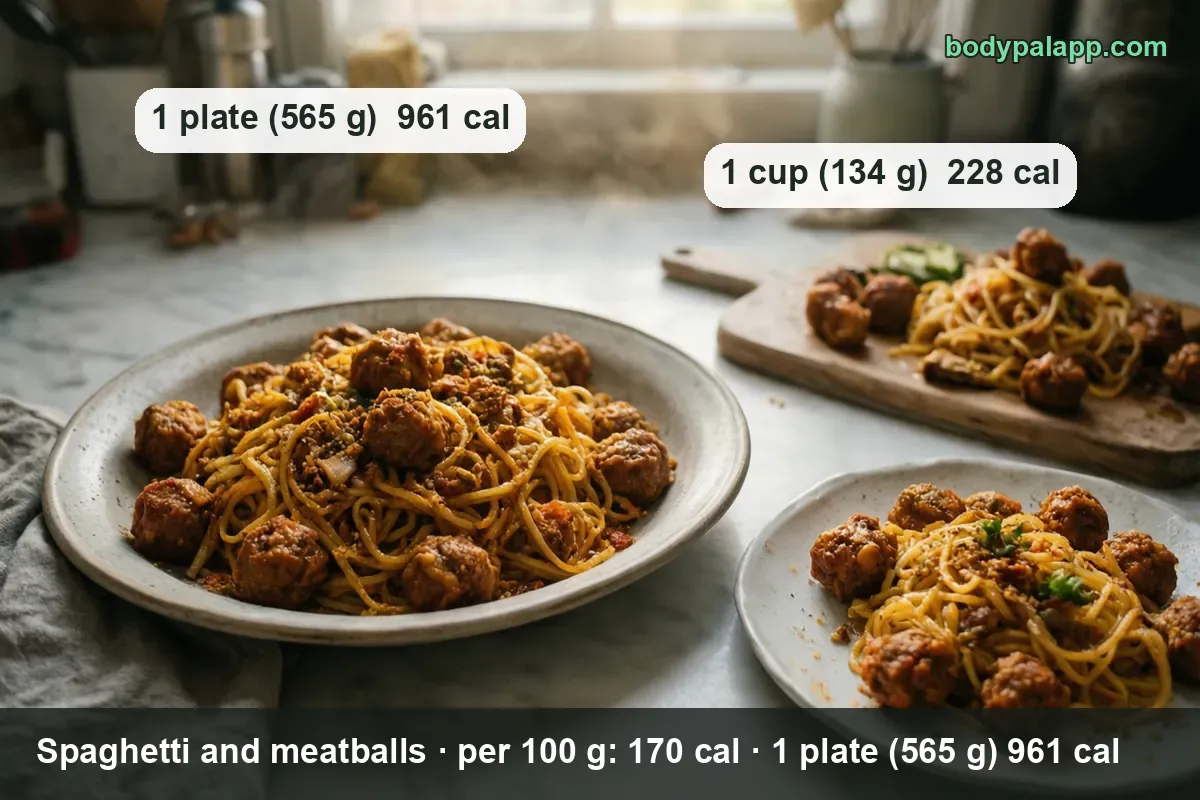
A 1-cup serving of spaghetti and meatballs weighs 134 g and carries 228 calories. Per 100 g the dish runs 170 calories, which is modest for a pasta plate, but almost nobody eats one cup. The restaurant-size portion USDA measures is 565 g, and that one comes to 961 calories.
On this page
- Spaghetti and meatballs quick facts
- US servings, from one ounce to a full restaurant plate
- Canned, frozen and store-bowl versions
- Sodium is the row that decides this dish
- How does spaghetti and meatballs compare?
- Most popular spaghetti and meatballs brands
- Spaghetti and meatballs FAQs
Spaghetti and meatballs quick facts
The record used here is SR Legacy 169029, "Restaurant, family style, spaghetti and meatballs". It describes the plate people actually search for: cooked pasta, meatballs and meat sauce, plated at home or in a sit-down restaurant. It is not a can and not a freezer tray, and those two versions are genuinely different foods on the label, so they get their own section further down.
One quirk worth knowing. USDA also lists a DENNY'S spaghetti and meatballs record, 169845, with values identical to the generic restaurant row down to the last decimal. A chain name on the record does not always mean chain-specific lab work, which is a good reason to read the numbers rather than the brand.
| Nutrient | Per 100 g | Per 1 cup (134 g) | % Daily Value |
|---|---|---|---|
| Calories | 170 | 228 | — |
| Total fat | 8.52 g | 11.4 g | 15% |
| Saturated fat | 3.1 g | 4.2 g | 21% |
| Carbohydrate | 15.51 g | 20.8 g | 8% |
| Dietary fiber | 1.5 g | 2.0 g | 7% |
| Total sugars | 2.03 g | 2.7 g | — |
| Protein | 7.84 g | 10.5 g | 21% |
| Sodium | 351 mg | 470 mg | 20% |
% Daily Value is based on a 2,000-calorie diet.
Verified nutrition data
Numbers on this page come from USDA FoodData Central, the U.S. Department of Agriculture’s food composition database, and from manufacturer labels where a branded product is named. Last verified September 2026. How we verify our data →
There is no added sugars row above because USDA does not publish added sugars for this restaurant record. Cholesterol works out to 25 mg per cup, 8% of the Daily Value, and potassium to 276 mg, about 6%. The sugars that are there, 2.7 g per cup, come mostly from the tomato in the sauce rather than from anything spooned in.
Two rows stand out for a plate that looks like plain comfort food. Protein at 21% of the Daily Value per cup is good value for a pasta dish, and saturated fat at 21% is high for a single cup, which tells you where the meatballs sit in the arithmetic. The FDA Daily Value reference sets those benchmarks at 50 g of protein and 20 g of saturated fat a day.
US servings, from one ounce to a full restaurant plate
| Serving | Weight | Calories |
|---|---|---|
| 1 oz | 28 g | 48 kcal |
| Half a cup | 67 g | 114 kcal |
| 1 cup | 134 g | 228 kcal |
| 2 cups | 268 g | 456 kcal |
| 1 restaurant plate | 565 g | 961 kcal |
| Per 100 g | 100 g | 170 kcal |
Only two of those are USDA household measures: the 1-cup serving at 134 g and the full restaurant plate at 565 g. The half cup, the two cups and the ounce are our own arithmetic from the USDA 100 g figure, not USDA servings.
That gap between the two official measures is the single most useful number on this page. The same record, the same recipe, the same fdc_id gives 228 calories for a cup and 961 for a plate. That is 4.2 times as much food, and it is why "a serving of spaghetti and meatballs" is close to meaningless as a logging entry. A cup of cooked pasta with sauce and two meatballs is a side. What arrives at a family-style table is usually two cups or more, which is 456 calories before the bread basket.
If you are eyeballing it at home, a standard dinner plate covered edge to edge is far closer to the 565 g figure than to a cup. Weigh the bowl once and you will not have to guess again.
Canned, frozen and store-bowl versions
| Version | Per 100 g | Typical serving | Calories |
|---|---|---|---|
| Restaurant, family-style plate | 170 kcal | 1 plate, 565 g | 961 kcal |
| Restaurant style, one cup | 170 kcal | 1 cup, 134 g | 228 kcal |
| Canned in tomato sauce | 100 kcal | 1 cup, 246 g | 246 kcal |
| Canned, whole can | 100 kcal | 1 can, 411 g | 411 kcal |
| Frozen dinner | 113 kcal | 1 meal, 354 g | 400 kcal |
| Store bowl, Wegmans meal | 135 kcal | 1 bowl, 312 g | 421 kcal |
Canned spaghetti with meatballs is the lightest of the group per gram at 100 calories per 100 g, and that is the number most calorie sites stop at. It is misleading on its own. A cup of the canned stuff weighs 246 g, nearly double the 134 g of the restaurant cup, because it is thinner and wetter. Cup for cup, the can wins nothing: 246 calories against 228.
What the can does change is the rest of the label. That same cup carries 3.6 g of saturated fat instead of 4.2 g, 18% of the Daily Value against 21%, and 6.6 g of fiber, which is 24% of the Daily Value against 7% for the restaurant cup. Protein comes out almost level, 10.7 g canned versus 10.5 g restaurant, purely because the canned cup is heavier. Those per-cup values are our own arithmetic scaled from the USDA 100 g rows.
The frozen dinner record runs 113 calories per 100 g, so a 354 g tray is 400 calories with 19.8 g of protein and 53.3 g of carbohydrate. Frozen sits between the can and the restaurant plate for a simple reason: less meat than a plated portion, more sauce, and a fixed tray size that stops the portion from creeping.
Store-made bowls land higher again. A Wegmans spaghetti and meatballs meal is listed at 135 calories per 100 g, and the 312 g bowl comes to 421 calories, which is just above the 400-calorie frozen dinner tray. Refrigerated deli bowls tend to be built like restaurant plates, not like freezer trays.
Sodium is the row that decides this dish
Calories are not the interesting problem with spaghetti and meatballs. Sodium is. The full restaurant plate delivers 1,983 mg, which is 86% of the 2,300 mg Daily Value, and it arrives before anyone reaches for grated cheese or a slice of garlic bread. That is close to a full teaspoon of table salt in one meal.
A single cup is a different story at 470 mg, or 20% of the Daily Value, which fits comfortably into a day. The frozen tray sits in between at 1,044 mg, about 45%, and a canned cup lands at 689 mg, roughly 30%. CDC guidance on sodium puts most American adults well over the daily limit already, mainly from restaurant and packaged foods, and this dish is a textbook example of both.
Saturated fat follows the same pattern. Per cup it is 4.2 g, 21% of the Daily Value, but the 565 g plate reaches 17.5 g, which is 88%. If you are watching either number, the fix is not to swap the recipe. It is to serve the pasta into a measured bowl and keep the pot in the kitchen.
On the plus side, this is a legitimately protein-forward pasta plate. The MyPlate protein guidance treats meat and grains as separate groups, and spaghetti and meatballs quietly covers both: 44.3 g of protein in a full plate and 87.6 g of carbohydrate, with 8.5 g of fiber from the pasta and the tomato sauce.
How does spaghetti and meatballs compare?
| Dish | Per 100 g | US serving | Calories |
|---|---|---|---|
| Spaghetti and meatballs, restaurant style | 170 kcal | 1 cup, 134 g | 228 kcal |
| Frozen spaghetti and meatballs dinner | 113 kcal | 1 meal, 354 g | 400 kcal |
| Canned spaghetti and meatballs | 100 kcal | 1 cup, 246 g | 246 kcal |
| Spaghetti with meat sauce, diet frozen meal | 113 kcal | 1 meal, 298 g | 337 kcal |
The restaurant record is the densest of the four per gram at 170 calories per 100 g, and the canned one the lightest at 100. Yet the smallest calorie total in the table belongs to the restaurant version, because its 134 g cup is the smallest serving in the table. The 298 g weight for the diet frozen meal is our own arithmetic from the 10.5 oz package size, since USDA does not give grams for that row.
Our take: for weight loss, the restaurant recipe is fine and the restaurant portion is the problem. Serve one to two cups, 228 to 456 calories, and you have a normal dinner with 10.5 to 21 g of protein. For fullness on a fixed budget, the canned cup is the sleeper pick at 246 calories with 6.6 g of fiber, nearly a quarter of the Daily Value, though you pay 689 mg of sodium for it. Skip the freezer tray only if sodium is your concern, not calories, because 400 calories for a whole dinner is honest value. The one order that does not fit any plan is the untouched family-style plate at 961 calories and 86% of a day's sodium.
Most popular spaghetti and meatballs brands in the United States
Ranked by how widely each product appears among foods sold in the United States, from the BodyPal food database of over 3.3 million products. Calories are the figures printed on each Nutrition Facts label, checked against USDA FoodData Central.
| Product | Calories (per 100 g) |
|---|---|
| Wegmans Spaghetti & Meatballs Meal | 135 cal |
Brand popularity: BodyPal food database. Nutrition: manufacturer labels / USDA FoodData Central.
Spaghetti and meatballs FAQs
How many calories are in spaghetti and meatballs?
228 calories for a 1-cup serving of 134 g, based on the USDA restaurant-style record at 170 calories per 100 g. A full restaurant plate of 565 g comes to 961 calories. Canned versions run 100 calories per 100 g, frozen dinners 113, so the plate size decides more than the recipe.
How many calories in 1 cup of spaghetti and meatballs?
A 1-cup serving weighs 134 g and holds 228 calories, with 10.5 g of protein, 20.8 g of carbohydrate and 11.4 g of fat. Sodium is 470 mg, or 20% of the Daily Value. Two cups double it to 456 calories, which is closer to what most plates actually hold.
How many calories in a restaurant plate of spaghetti and meatballs?
961 calories for the 565 g plate USDA measures for family-style restaurants. That plate carries 44.3 g of protein, 48.1 g of fat, 17.5 g of saturated fat, 88% of the Daily Value, and 1,983 mg of sodium. Garlic bread and grated cheese sit on top of that.
How much protein is in spaghetti and meatballs?
7.84 g per 100 g, so a 1-cup serving gives 10.5 g of protein and the full 565 g plate gives 44.3 g. That cup covers 21% of the Daily Value. Per gram, the restaurant version carries about 80% more protein than the canned one, which runs 4.37 g per 100 g.
How much sodium is in spaghetti and meatballs?
470 mg in a 1-cup serving, 20% of the 2,300 mg Daily Value. The 565 g restaurant plate reaches 1,983 mg, or 86%, close to a full teaspoon of table salt. A canned cup is gentler at 689 mg, and a frozen dinner sits at 1,044 mg.
Are canned spaghetti and meatballs lower in calories?
Per 100 g, yes: 100 calories against 170 for the restaurant version. Per cup, no. A canned cup is 246 g and 246 calories, slightly more than the 228-calorie restaurant cup, because the sauce makes it heavier. It does bring 6.6 g of fiber, 24% of the Daily Value.
How many calories in frozen spaghetti and meatballs?
400 calories for a 354 g frozen dinner, at 113 calories per 100 g. The frozen version is lighter per gram than restaurant-style pasta because it carries less meat and more sauce, but the tray still delivers 1,044 mg of sodium and 19.8 g of protein.
Is spaghetti and meatballs good for weight loss?
At 170 calories per 100 g, a 1-cup serving of 228 calories with 10.5 g of protein fits a 350 to 450-calorie lunch alongside a salad. The 961-calorie restaurant plate does not. Protein is 21% of the Daily Value per cup, which helps with fullness; portion size is the whole decision here.
Similar foods
- Steelhead trout — 143 cal for 3 oz cooked
- Roast Beef — 142 cal per 3 oz
- BBQ Chicken — 149 cal per 3 oz
- Onigiri — 180 cal per onigiri
- Stuffed pepper — 265 cal for 1/2 pepper with filling
- Taco Salad — 564 cal per medium taco salad
Count it without the math
Point the camera at the bowl and BodyPal counts the pasta, the meatballs and the sauce together.


How long does it take to burn off 228 kcal of spaghetti meatball?
A 1-cup (134 g) serving is 228 kcal. Enter your weight and the amount you ate to see how long it takes you to burn that off:
lb
| Activity | Time to burn 228 kcal |
|---|---|
| Walking, brisk | 46 min |
| Cycling, moderate | 28 min |
| Swimming, moderate | 33 min |
| Jogging | 27 min |
| Weight training, moderate | 51 min |
Times are for a 155 lb adult at a steady pace; change the weight to see yours. The amount is set to the portion in the text (134 g); change it to what you actually ate. BodyPal works this out from your steps automatically.
This table assumes you know your daily total. If you do not, the daily calorie calculator works it out from five numbers.