
How Many Calories in Steelhead Trout?
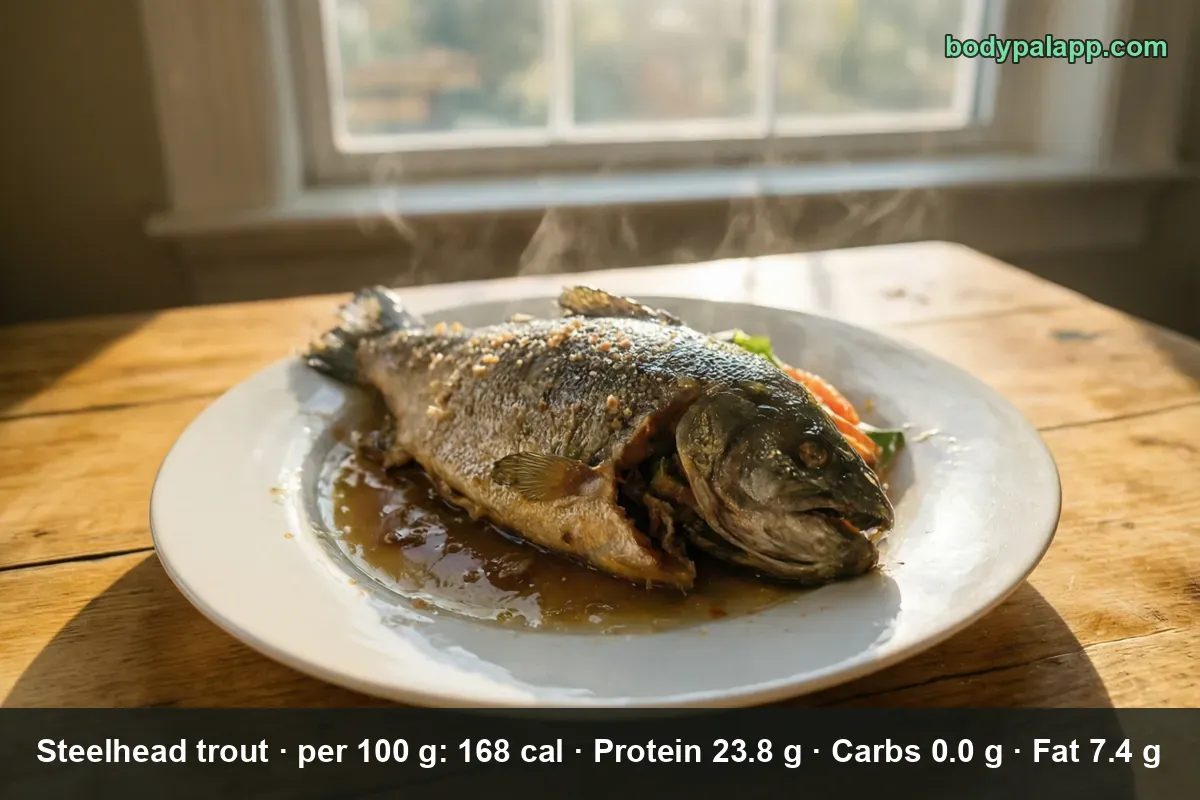
A 3 oz cooked serving of steelhead trout, 85 g on the plate, is 143 calories, or 168 calories per 100 g. A restaurant-size 6 oz piece comes to 286. The 4 oz raw fillet in the case at the fish counter is 159 calories, and it leaves the pan weighing about 3 oz.
On this page
- Steelhead trout quick facts
- Steelhead is rainbow trout under another name
- Farmed or wild: where the 18 calories live
- US portions, from half a fillet to a whole fish
- The label weighs raw, your plate weighs cooked
- Smoked, canned and dried are three other foods
- How does steelhead trout compare?
- Most popular steelhead trout brands
- FAQ
Steelhead trout quick facts
The reference here is the fish the way most people eat it: farmed, cooked with dry heat, no batter and no sauce. That is USDA SR Legacy entry 173718, and the serving is the standard American fish portion, 3 oz cooked.
| Nutrient | Per 100 g | Per 3 oz cooked (85 g) | % Daily Value |
|---|---|---|---|
| Calories | 168 kcal | 143 kcal | — |
| Total fat | 7.4 g | 6.3 g | 8% |
| Saturated fat | 1.7 g | 1.4 g | 7% |
| Total carbohydrate | 0 g | 0 g | 0% |
| Dietary fiber | 0 g | 0 g | 0% |
| Total sugars | 0 g | 0 g | — |
| Protein | 23.8 g | 20.2 g | 40% |
| Sodium | 61 mg | 52 mg | 2% |
% Daily Value is based on a 2,000-calorie diet.
Verified nutrition data
Numbers on this page come from USDA FoodData Central, the U.S. Department of Agriculture’s food composition database, and from manufacturer labels where a branded product is named. Last verified September 2026. How we verify our data →
Two rows carry the whole story. Protein is 40% of the day in one 3 oz piece, which is the number that makes this fish worth its calories. Sodium is 52 mg, about 2% of the FDA Daily Value of 2,300 mg — as close to unsalted as protein gets, and the reason the smoked version further down looks so different.
Two numbers sit outside the label block. Cholesterol is 70 mg per 100 g, so 60 mg in the serving, 20% of the Daily Value. Potassium is 450 mg per 100 g, about 10%. There is no added sugars row on this page because USDA's entry does not carry one for this fish and nothing is added to a trout fillet; printing a zero that nobody measured would be inventing data.
Steelhead is rainbow trout under another name
Search USDA for steelhead trout and you get two entries, neither of which is what you cooked.
Steelhead is Oncorhynchus mykiss — the same species as rainbow trout, in its sea-run form. A rainbow trout that goes to the ocean and comes back is a steelhead; a rainbow trout that stays in fresh water is a rainbow trout. Fish markets use the name for the big pink-fleshed fillets that look like salmon, but genetically the counter is selling you a trout.
That matters here because it decides which numbers are honest. The two USDA rows that actually carry the word steelhead are traditional preparations: boiled canned fish from an Alaska Native recipe at 159 calories per 100 g, and Shoshone Bannock dried flesh at 382. Neither is a fillet you would recognize. The fresh, farmed, cooked fish in the photograph is covered by the rainbow trout entries, which is where every number on this page comes from.
So when a calorie app shows "rainbow trout" for the steelhead you scanned, that is not a mismatch. It is the same fish.
Farmed or wild: where the 18 calories live
Cooked farmed steelhead is 168 calories per 100 g. Cooked wild is 150. An 18-calorie gap on a food this lean is 12%, and nearly all of it is fat.
| Cooked, dry heat | Calories per 100 g | 3 oz (85 g) | Protein per 100 g | Fat per 100 g |
|---|---|---|---|---|
| Farmed | 168 kcal | 143 cal | 23.8 g | 7.38 g |
| Wild | 150 kcal | 128 cal | 22.92 g | 5.82 g |
Farmed fish carries 7.38 g of fat per 100 g against 5.82 g wild — about 26% more fat, from a diet of feed pellets rather than whatever a river offers. Protein barely moves: 23.8 g against 22.92 g. You are not buying more fish with the farmed fillet, you are buying a fattier one.
Which number should you log? Almost certainly 168. Steelhead reaches American stores as a farmed fish, raised in pens in Norway, Chile and the Pacific Northwest, and the labels at the counter reflect it. Wild steelhead is largely a catch-and-release sport fish in the lower 48. If you did not catch it yourself, use the farmed row.
Raw, the same split holds and the numbers drop: 141 calories per 100 g farmed, 119 wild.
US portions, from half a fillet to a whole fish
| Portion | Weight | Calories |
|---|---|---|
| 1 oz, cooked | 28 g | 48 cal |
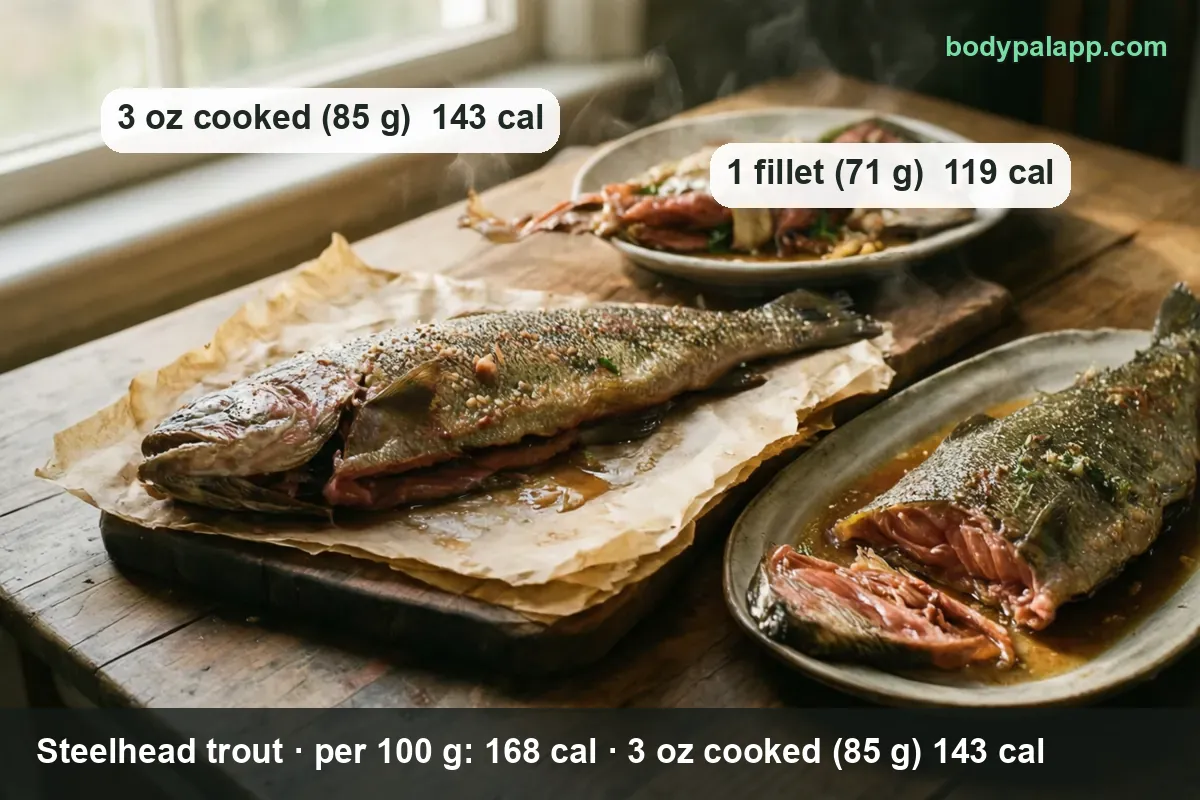
| 1 fillet, cooked (USDA) | 71 g | 119 cal |
| 3 oz, cooked | 85 g | 143 cal |
| 100 g, cooked | 100 g | 168 cal |
| 6 oz, cooked | 170 g | 286 cal |
Only the fillet row is a USDA portion — the ounce rows are our own scaling of USDA's 168 calories per 100 g. And the fillet row is the trap. USDA's "1 fillet" for cooked farmed rainbow trout weighs just 71 g — that is a fillet off a small farm-raised pan trout, not the slab of steelhead sold as a center-cut portion. Log a supermarket fillet as "1 fillet" and you may be recording less than half of what is on the plate.
Work from the ounce instead: 48 calories per cooked ounce. Three ounces is 143, six is 286, and a whole small baked fish like the one in the photograph lands around that 6 oz mark. A restaurant entrée portion of steelhead is usually 6 to 8 oz before cooking, which is why a plated fillet runs closer to 300 calories than to the 143 most charts quote.
The wild fillet is a different size again: USDA puts it at 143 g cooked, which is 215 calories at the wild rate.
The label weighs raw, your plate weighs cooked
Here is the mistake that costs people the most calories on this fish, and it runs in one direction.
The package at the fish counter is weighed raw. A 4 oz raw portion is 113 g at 141 calories per 100 g, so 159 calories. That is the number printed on the sticker, and it is correct.
Then you roast it. Water leaves, the piece shrinks to roughly 3 oz, and what remains is more concentrated: 141 calories per 100 g becomes 168. Eat that whole piece and you have eaten 143 calories. The fish did not lose calories in the oven; it lost water, and the same calories now sit in less weight.
The error appears when the two get crossed. Put the cooked fillet on a scale, read 4 oz, and log it against the raw entry and you record 159. The truth is 113 g at the cooked rate, or 190 calories — 31 more than you wrote down. Do that three times a week and it is a meal's worth of untracked food a month.
The rule is short: raw weight against a raw number, cooked weight against a cooked number, never one against the other. If you weigh before cooking, use 141. If you weigh after, use 168.
Smoked, canned and dried are three other foods
Steelhead has a habit of showing up preserved, and preservation changes the arithmetic in ways calories alone do not capture.
Smoked is the common one, and the calories are almost a non-event: store-bought smoked trout runs 143 to 158 calories per 100 g, essentially the same food. Sodium is the story. Fresh steelhead is 61 mg per 100 g. Smoked runs 754 to 768 mg — more than twelve times as much, and about a third of the day's sodium in 100 g against roughly 3% for the fresh fish. CDC puts most American adults over the sodium limit already, largely through cured and packaged food, and smoked fish is a textbook entry on that list.
Canned, in the boiled Alaska Native preparation USDA records, is 159 calories per 100 g with 21.11 g of protein, 8.26 g of fat and 118 mg of sodium. Close to fresh on calories, double on sodium, still a low-sodium food by canned-fish standards.
Dried is a different category entirely: 382 calories per 100 g, 77.27 g of protein and 2,850 mg of sodium. That is 124% of the sodium Daily Value in 100 g of fish jerky. Water comes out and salt goes in — dry the fish and what is left concentrates hard, protein and salt alike.
How does steelhead trout compare?
Every row below is a USDA entry measured at the same 3 oz (85 g) serving, so the numbers are directly comparable; all of them are cooked except the raw row, which is there to show the gap.
| Fish (3 oz, 85 g) | Calories | Per 100 g | Protein | Fat |
|---|---|---|---|---|
| Steelhead trout, farmed | 143 cal | 168 kcal | 20.2 g | 6.3 g |
| Rainbow trout, wild | 128 cal | 150 kcal | 19.5 g | 4.9 g |
| Steelhead trout, farmed, raw | 120 cal | 141 kcal | 16.9 g | 5.3 g |
| Pollock, Atlantic | 100 cal | 118 kcal | 21.2 g | 1.1 g |
| Grouper | 100 cal | 118 kcal | 21.1 g | 1.1 g |
The spread across the whole table is 43 calories a serving. That is the entire cost of choosing the richest fish here over the leanest, and it is less than a slice of bread.
Our take: if calories are the only thing you are counting, pollock or grouper wins outright — 100 calories for 21 g of protein is the best ratio on the table, and neither has any fat worth logging. But steelhead earns its extra 43 calories. Those calories are fat, and the Dietary Guidelines for Americans ask for 8 oz of seafood a week partly for that reason, while MyPlate counts all of it toward the protein group. For a dinner you actually look forward to, 143 calories with 20 g of protein and no carbohydrate is a bargain. Save the pollock for the days when the plate is already crowded.
Most popular steelhead trout brands in the United States
Ranked by how widely each product appears among foods sold in the United States, from the BodyPal food database of over 3.3 million products. Calories are the figures printed on each Nutrition Facts label, checked against USDA FoodData Central.
| Product | Calories (per 100 g) |
|---|---|
| Sea Best Steelhead Trout | 143 cal |
| Marine Harvest Steelhead Trout Portion | 150 cal |
| Gorton's Steelhead Trout | 133 cal |
| Beaver Street Fisheries Premium Fillets Steelhead Trout | 133 cal |
| ShopRite Norwegian Steelhead Trout | 214 cal |
Brand popularity: BodyPal food database. Nutrition: manufacturer labels / USDA FoodData Central.
Steelhead trout FAQs
How many calories in steelhead trout?
143 calories in a 3 oz cooked serving, 85 g, at 168 calories per 100 g. A 6 oz piece is 286 calories and a single cooked ounce is 48. The raw 4 oz fillet sold at the fish counter is 159 calories.
How many calories in 4 oz of steelhead trout?
159 calories if the 4 oz is raw, which is how the package is weighed: 113 g at 141 calories per 100 g. If you weigh 4 oz after cooking, it is 190 calories, because the fish loses water and concentrates to 168 per 100 g. Weigh raw, log raw.
Is steelhead trout the same as rainbow trout?
Yes — both are Oncorhynchus mykiss at 168 calories per 100 g cooked and farmed, and steelhead is the sea-run form of the same species. That is why every calorie number here comes from USDA's rainbow trout entries. The two USDA rows labeled steelhead are traditional canned and dried preparations, not fresh fillets.
How much protein is in steelhead trout?
20.2 g in a 3 oz cooked serving, which is 40% of the Daily Value, at 23.8 g per 100 g. A 6 oz piece carries about 40 g. Wild trout is fractionally lower at 22.92 g per 100 g, and raw farmed fillet reads 19.94 g because of its water content.
Farmed or wild steelhead — which has fewer calories?
Wild, by 18 calories per 100 g: 150 against 168 cooked, or 128 against 143 in a 3 oz serving. The difference is fat, 5.82 g against 7.38 g per 100 g, and protein is almost identical. Nearly all steelhead sold in US stores is farmed, so 168 is the number to use.
How many calories in smoked steelhead trout?
143 to 158 calories per 100 g, so barely different from fresh at 168. Sodium is what changes: 754 to 768 mg per 100 g against 61 mg for the fresh fish, which is about a third of the day's Daily Value in 100 g. Log smoked trout for the salt, not the calories.
Is steelhead trout healthy?
It is one of the leaner ways to get 20.2 g of protein for 143 calories, with no carbohydrate and only 52 mg of sodium per serving. Trout sits in the FDA and EPA Best Choices list for fish, the group they recommend eating two to three times a week.
How big is a steelhead trout fillet?
USDA's cooked fillet weighs 71 g and comes to 119 calories, but that is a small pan-size trout. A center-cut steelhead portion from a supermarket is usually 4 to 6 oz raw, which is 159 to 240 calories by our own scaling of the raw entry, and the wild fillet USDA lists runs 143 g cooked, or 215 calories.
Similar foods
- Tilapia — 144 cal per fillet
- Cuttlefish — 134 cal per 3 oz
- Cooked Salmon — 242 cal per fillet
- Grilled Calamari — 209 cal per cup
- Calamari Steak — 175 cal per steak
- Shrimp In Lobster Sauce — 279 cal per cup
Count it without the math
Point the camera at the plate and BodyPal works out whether that fillet is 3 oz or 6 oz, then logs the calories and the 20 g of protein for you.


How long does it take to burn off steelhead trout?
A 3 oz cooked serving (85 g) is 143 kcal. Enter your weight and the amount you ate to see how long it takes you to burn that off:
lb
| Activity | Time to burn 143 kcal |
|---|---|
| Walking, brisk | 29 min |
| Cycling, moderate | 18 min |
| Swimming, moderate | 20 min |
| Jogging | 17 min |
| Weight training, moderate | 32 min |
Times are for a 155 lb adult at a steady pace; change the weight to see yours. The amount is set to the portion in the text (85 g); change it to what you actually ate. BodyPal works this out from your steps automatically.
One food is easy to picture; a whole day is harder. See how many calories you need a day and what a deficit actually looks like.