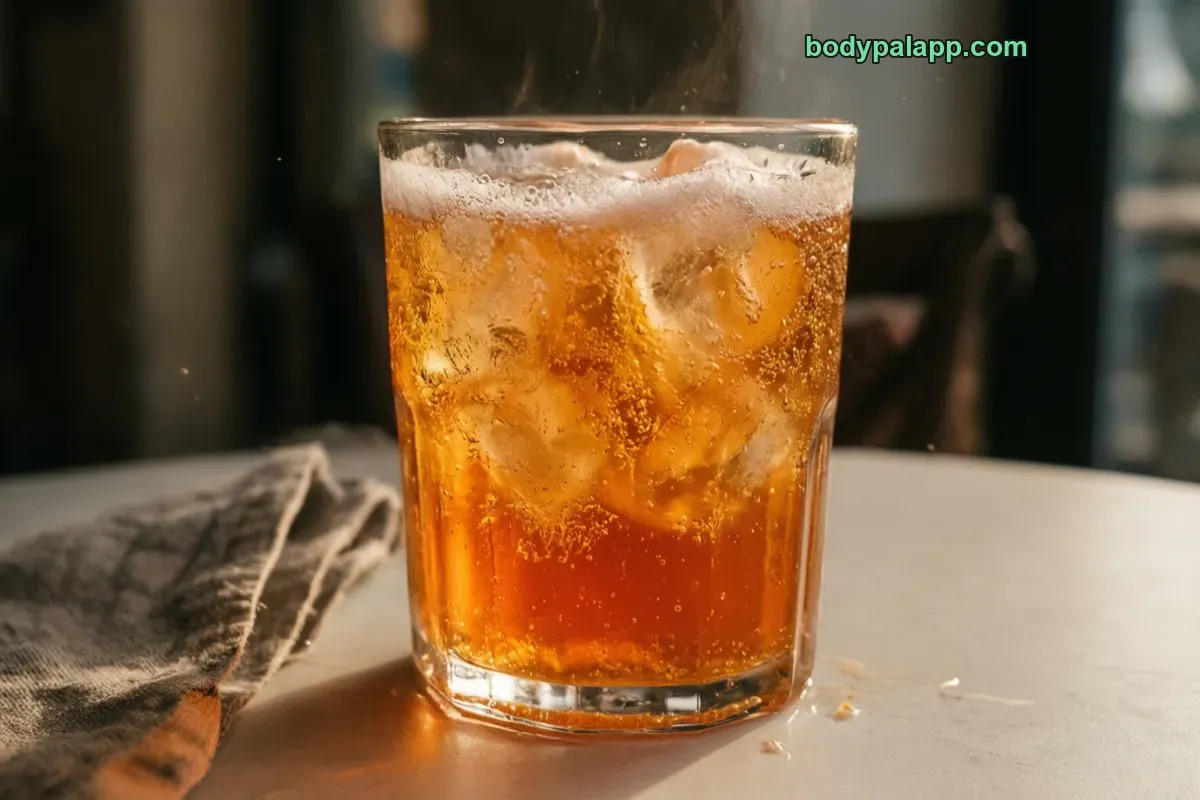
Orange Fanta calories come to 160 for a 12 oz can (340 g) and 47 per 100 g. Every one of those calories comes from carbohydrate, and nearly all of that carbohydrate is sugar: 41.7 g in a single can, with no protein, no fat and just 54 mg of sodium to go with it.
160kcal
1 12 oz can · 340 g, packaged, per label
0%protein
0 gProtein
43 gCarbs
0 gFat
How to burn off 160 kcal
—Walking, brisk
—Jogging
—Cycling, moderate
—Swimming
Skip the math. BodyPal counts these calories from your steps and workouts automatically.
Nutrition facts
Packaged, per label · per 340 g
Calories
160 kcal
Protein
0 g
Carbohydrate
43 g
Fat
0 g
Sodium
54 mg
Source: USDA FoodData Central
🛡️
Verified nutrition data
Numbers on this page come from USDA FoodData Central, the U.S. Department of Agriculture’s food composition database, and from manufacturer labels where a branded product is named. Last verified September 2026. How we verify our data →
Orange Fanta: calories, protein and sodium by serving
Percent of daily value uses the FDA reference of 2,000 kcal a day.
Serving
kcal
Protein
Carbs
Fat
Sodium
% DV kcal
12 oz can (340 g)
160
0 g
43 g
0 g
54 mg
8%
8.55 fl oz bottle (253 g)
119
0 g
32 g
0 g
40 mg
6%
Zero sugar can (340 g)
10
0 g
1.7 g
0 g
0 mg
1%
100 g
47
0 g
12.7 g
0 g
16 mg
2%
3 × 12 oz can (340 g)
479
0 g
163 mg
5 × 12 oz can (340 g)
799
0 g
272 mg
One can is 160 calories, three cans are 479
A standard 12 oz can (340 g) holds 160 calories, about 8% of the daily calorie value used on food labels. The smaller 8.55 fl oz bottle (253 g) comes in at 119 calories, so picking the bottle trims roughly a quarter of the energy without changing what you are drinking. If you just want a taste, a 100 g pour, about a small glass, is 47 calories.
Soda totals climb quietly because nothing in the drink slows you down. Two cans make 320 calories, three cans reach 479, and five cans, the kind of total a long afternoon at a desk can produce, add up to 799 calories. That last figure is 1,700 g of liquid carrying no protein at all.
The practical move is to count every can or bottle on its own instead of thinking of soda as a background drink. A single can is easy to fit into most days. The second and third cans are where the number starts to look like a meal that never filled you up.
Every calorie is sugar-driven carbohydrate
The calorie split is as simple as it gets: 100% carbohydrate, 0% protein, 0% fat. Per 100 g, orange Fanta has 12.7 g of carbohydrate, and 12.3 g of that is sugars. In other words, the carbohydrate line and the sugar line are almost the same number.
Scale that to the can and you get 43 g of carbohydrate with 41.7 g of sugars. The 8.55 fl oz bottle carries 32 g of carbohydrate and 31 g of sugars. There is no fiber, fat or protein in the mix to stretch out how long those calories keep you satisfied, which is why a can of soda rarely replaces anything else you eat.
These values are packaged figures taken from the label, so they hold steady from can to can. That makes orange Fanta easy to log accurately. The hard part is not the math; it is remembering that a drink with zero protein and zero fat still counts the same as food on your daily total.
The zero sugar can drops to 10 calories
If the orange flavor is what you are after, the zero sugar version changes the picture almost completely. A zero sugar can (340 g) has 10 calories, 1.7 g of carbohydrate and 1.7 g of sugars, which is about 1% of the daily calorie value. Compared with 160 calories and 41.7 g of sugars in the regular can, it is a different drink on paper.
Fanta Zero Orange Soda is the swap that makes sense if you drink soda daily and want to keep the habit while cutting the sugar row. It also lists 0 mg of sodium per can. For an occasional can, the regular version is a fair treat; for several cans a day, the zero sugar can is the clear pick.
Sodium is not the row to watch in either version. The regular can has 54 mg, about 2% of the daily value, and even five cans only reach 272 mg. Sugar is the number that matters here, and it is the one the zero sugar can removes.
Treat a can like dessert, not like water
The easiest way to fit orange Fanta into a day of eating is to file it with sweets rather than with drinks. A 160-calorie can sits in the same range as a small dessert, and it brings the same thing: sugar and flavor, little else. Thinking of it that way makes it easier to decide when it is worth it.
If you enjoy it with a meal, let the plate supply what the soda lacks, such as protein and fiber from the food itself. Keeping water nearby for thirst means the can is there for taste, not for hydration, so one tends to stay one. The 8.55 fl oz bottle is a sensible middle ground when a full can feels like too much.
Tracking it is quick: BodyPal can log a can or bottle from a photo, and because the values come straight from the label, what you log matches what you drank.
How does orange Fanta compare?
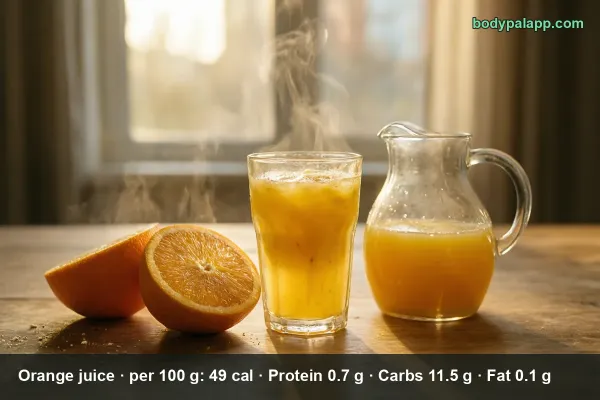
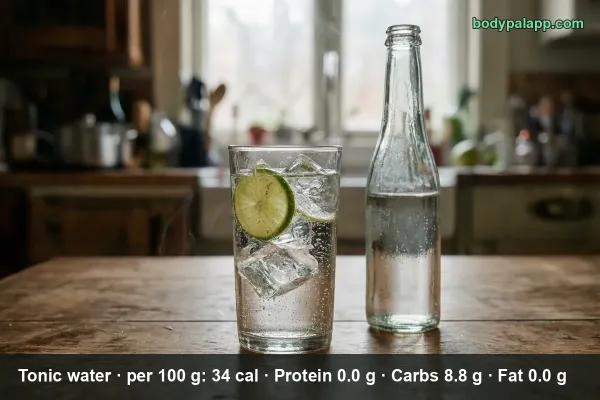
Here is how orange Fanta stacks up against orange juice, tonic and Gatorade, per 100 g and per usual serving.
Verdict: Orange juice lands about even with orange Fanta at 49 calories per 100 g against 47, but it brings 0.7 g of protein while Fanta brings none, so if you want orange flavor with something besides sugar, pick the juice. For fewer calories per sip pick Gatorade at 26 per 100 g or tonic at 34, though a full 1 bottle (609 g) of Gatorade still reaches 158 calories, close to a can of Fanta.
Most popular orange Fanta brands in the United States
Ranked by popularity in the BodyPal database
# Productkcal / 100 g
1Fanta Orange Soda8.55 fl oz · 253 g47 kcal
2Fanta Orange Soda, Small Bottle7.5 fl oz · 222 g45 kcal
A 12 oz can is about 160 calories, based on 47 calories per 100 g. An 8.55 fl oz bottle is 119.
Is orange Fanta good for weight loss?
One 12 oz can adds 160 calories and 42 g of sugar with 0 g of protein. The zero sugar version is 10 calories per can.
Orange Fanta vs orange juice: which has fewer calories?
Fanta has 47 calories per 100 g and orange juice 49, so a 12 oz serving is 160 versus 167.
How much sugar is in orange Fanta?
There are 12.3 g of sugar per 100 g, so about 42 g in a 12 oz can and 31 g in an 8.55 fl oz bottle.
How many calories are in a small bottle of orange Fanta?
An 8.55 fl oz bottle (253 g) has 119 calories, all from 32 g of carbohydrate, 31 g of which is sugars. That is about 6% of the daily calorie value, noticeably less than the 160 in a 12 oz can.
How many calories are in Fanta Zero orange?
A zero sugar can (340 g) has 10 calories, with 1.7 g of carbohydrate and 1.7 g of sugars. It lists 0 mg of sodium, no fat and no protein, against 160 calories in the regular can.
How much sodium is in orange Fanta?
A 12 oz can has 54 mg of sodium, about 2% of the daily value. Even five cans add up to only 272 mg, so sodium is not the number to worry about here; sugar is.
How many calories are in two cans of orange Fanta?
Two 12 oz cans (680 g) contain 320 calories, all from carbohydrate. Three cans reach 479 calories and five cans reach 799, with 0 g of protein at every step.
Does orange Fanta have any protein or fat?
No. Orange Fanta has 0 g of protein and 0 g of fat per 100 g, so 100% of its 47 calories per 100 g come from carbohydrate, mostly the 12.3 g of sugars.