Orange slice candy calories come to 150 for 3 pieces (43 g) and 349 per 100 g, with 2 pieces at 100. Every one of those calories comes from carbohydrate. There is no protein, no fat and no sodium, so the only thing that changes the total is how many slices you eat.
150kcal
1 3-piece serving · 43 g, packaged, per label
0%protein
0 gProtein
37 gCarbs
0 gFat
How to burn off 150 kcal
—Walking, brisk
—Jogging
—Cycling, moderate
—Swimming
Skip the math. BodyPal counts these calories from your steps and workouts automatically.
Nutrition facts
Packaged, per label · per 43 g
Calories
150 kcal
Protein
0 g
Carbohydrate
37 g
Fat
0 g
Saturated fat
0 g
Cholesterol
0 mg
Sodium
0 mg
Source: USDA FoodData Central
🛡️
Verified nutrition data
Numbers on this page come from USDA FoodData Central, the U.S. Department of Agriculture’s food composition database, and from manufacturer labels where a branded product is named. Last verified September 2026. How we verify our data →
Orange slice candy: calories, protein and sodium by serving
Percent of daily value uses the FDA reference of 2,000 kcal a day.
Serving
kcal
Protein
Carbs
Fat
Sodium
% DV kcal
3 pieces (43 g)
150
0 g
37 g
0 g
0 mg
8%
2 pieces (29 g)
100
0 g
25 g
0 g
0 mg
5%
100 g
349
0 g
86.1 g
0 g
0 mg
17%
3 × 3 pieces (43 g)
450
0 g
0 mg
5 × 3 pieces (43 g)
750
0 g
0 mg
Three slices are a 150-calorie snack
The label serving is 3 pieces (43 g) for 150 calories, about 8 percent of a typical daily calorie budget. Drop to 2 pieces (29 g) and you land at 100 calories, or 5 percent. Those are small, predictable numbers, which is the one real advantage of a candy sold in uniform pieces.
The trouble is that orange slices rarely stop at one serving. A double serving of 6 slices weighs 86 g and reaches 300 calories. Three servings, 129 g, add up to 450. Five servings from a bag on the couch come to 215 g and 750 calories, which is a meal's worth of energy with nothing but sugar behind it.
If you want a ceiling, count slices instead of guessing by handful. The pieces are dense and chewy, so a bowl of them looks smaller than it is. Pour out 2 or 3 pieces, close the bag, and the math stays at 100 or 150.
Every calorie is carbohydrate
The calorie split is as lopsided as food gets: 100 percent carbs, 0 percent protein, 0 percent fat. Per 100 g the candy carries 86.1 g of carbohydrate and nothing else that counts toward calories. In a 3-piece serving that works out to 37 g of carbs; in 2 pieces, 25 g.
That profile explains both the appeal and the limit. Pure carbohydrate hits fast and tastes bright, but with no protein and 0 g of fiber there is nothing to slow it down or keep you full. People often find they want more soon after finishing a serving.
Zero fat also means zero saturated fat and zero cholesterol, so the label reads clean on those rows. That is not the same as light. At 349 calories per 100 g, the candy is energy-dense, and all of that energy arrives as sugar and starch.
Sugar is the row to watch
Sugars run 55.8 g per 100 g. A 3-piece serving carries 24 g of sugar and a 2-piece serving carries 16 g. The label counts the rest of the carbohydrate outside the sugar line, but for practical purposes this is a sugar snack coated in more sugar.
Scale it up and the sugar climbs quickly. A double serving of 3 pieces doubles the 24 g as well, and the 5-serving bag session pushes sugar well past anything a single treat should hold. If you track added sugar, decide on the portion before you open the bag, not after.
Sodium is the one row that works in its favor: 0 mg in every serving, 0 percent of the daily value of 2300 mg. If you watch salt, this candy will not move that number at all. It is sugar, and only sugar, you are budgeting for.
Treat it as a planned dessert
Because the slices bring no protein or fiber, they fit best next to foods that do. Two or three pieces after a meal with lean protein and vegetables lands differently than the same candy eaten alone on an empty stomach in the afternoon.
Store-brand bags such as Topco, Safeway, Giant Eagle and Weis Quality Orange Slices Candy all sell the same style of gummy slice. Pick whichever you like and keep the portion the same; the serving size, not the brand, is what controls the total.
If you are counting, logging 100 or 150 calories is easy because the pieces are uniform. BodyPal can log the candy from a photo, which helps on days when a handful turns into a second handful. The best plan is simple: decide on 2 or 3 pieces, enjoy them, and put the bag away.
How does orange slice candy compare?
Here is how orange slice candy stacks up against other sweets on our site, per 100 g and per usual serving.
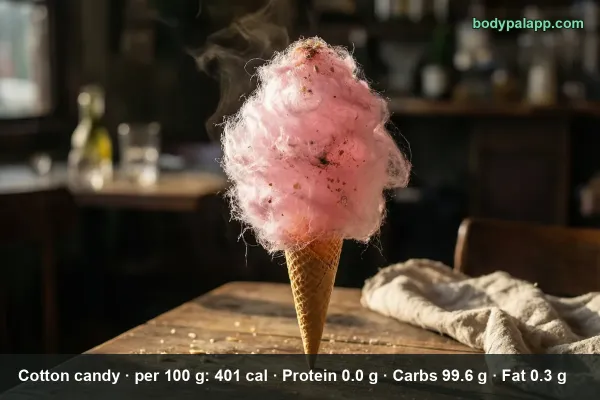
Verdict: For the fewest calories per 100 g, orange slice candy wins at 349, below coffee candy at 375, cotton candy at 401 and chocolate turtle candy at 470. If you want a small portion, 4 pieces of coffee candy at 60 or 1 turtle at 66 keep the total lower than 3 orange slices at 150.
Most popular orange slice candy brands in the United States
A 3-piece serving (43 g) has 150 calories, and 100 g has 349 calories.
Is orange slice candy good for weight loss?
A 3-piece serving has 150 calories with 0 g protein, 0 g fat and 0 g fiber, so nearly all of it comes from 37.0 g of carbs.
Orange slice candy vs coffee candy: which has fewer calories?
Orange slice candy has 349 calories per 100 g, coffee candy has 375.
How much sugar is in orange slice candy?
A 3-piece serving (43 g) has 24.0 g of sugar, or 55.8 g per 100 g.
How much protein does orange slice candy have?
Orange slice candy has 0 g of protein, whether you eat 2 pieces, 3 pieces or 100 g. All 150 calories in a 3-piece serving come from carbohydrate, so it will not help you reach a protein target.
How many calories are in 2 orange slice candies?
Two pieces (29 g) of orange slice candy have 100 calories, about 5 percent of a typical daily budget. That serving carries 25 g of carbs, including 16 g of sugar, and no fat or protein.
Does orange slice candy have any fat?
No. Orange slice candy has 0 g of fat and 0 g of saturated fat per 100 g, with 0 mg of cholesterol. Its 349 calories per 100 g come entirely from carbohydrate.
How many calories are in a bag's worth of orange candy slices?
Five servings of 3 pieces, 215 g in total, come to 750 calories. Three servings (129 g) are 450 and two servings (86 g) are 300, so totals climb by 150 calories per serving.
Is orange slice candy high in sodium?
No. Orange slice candy has 0 mg of sodium in every serving, 0 percent of the daily value. Sugar, at 24 g per 3 pieces, is the number to watch instead.