Coffee candy calories come to 60 for 4 pieces (16 g) and 375 per 100 g. Every one of those calories comes from carbohydrate, and most of that is sugar: 62.5 g per 100 g, with zero protein, zero fat and zero fiber. The total depends on how many pieces you unwrap, not on the candy itself.
60kcal
1 4 pieces · 16 g, packaged, per label
0%protein
0 gProtein
15 gCarbs
0 gFat
How to burn off 60 kcal
—Walking, brisk
—Jogging
—Cycling, moderate
—Swimming
Skip the math. BodyPal counts these calories from your steps and workouts automatically.
Nutrition facts
Packaged, per label · per 16 g
Calories
60 kcal
Protein
0 g
Carbohydrate
15 g
Fat
0 g
Saturated fat
0 g
Cholesterol
0 mg
Sodium
20 mg
Source: USDA FoodData Central
🛡️
Verified nutrition data
Numbers on this page come from USDA FoodData Central, the U.S. Department of Agriculture’s food composition database, and from manufacturer labels where a branded product is named. Last verified September 2026. How we verify our data →
Coffee candy: calories, protein and sodium by serving
Percent of daily value uses the FDA reference of 2,000 kcal a day.
Serving
kcal
Protein
Carbs
Fat
Sodium
% DV kcal
4 pieces (16 g)
60
0 g
15 g
0 g
20 mg
3%
1 oz portion (28 g)
105
0 g
26.3 g
0 g
35 mg
5%
100 g
375
0 g
93.8 g
0 g
125 mg
19%
3 × 4 pieces (16 g)
180
0 g
60 mg
5 × 4 pieces (16 g)
300
0 g
100 mg
Five servings of coffee candy reach 300 calories
A label serving of 4 pieces (16 g) is 60 calories, about 3% of the daily value. That is a small number, and it is meant to be. The trouble with hard candy is that the wrappers pile up on a desk or in a car without anyone counting them.
Double the serving to 32 g and you are at 120 calories. Three servings, or 48 g, come to 180. A 1 oz portion (28 g) sits in between at 105 calories, or 5% of the daily value. Five servings, 80 g, reach 300 calories, which is the size of a small meal delivered as sugar alone.
If you snack on coffee candy through a long afternoon, count servings rather than pieces. Each group of 4 pieces adds another 60 calories, and the math stays that simple. A full 100 g bag works out to 375 calories, or 19% of the daily value.
Every calorie in coffee candy is carbohydrate
The calorie split is 100% carbohydrate, 0% protein and 0% fat. Per 100 g that means 93.8 g of carbs and nothing else that carries energy. Few foods are this one-sided; even other candies often bring a little fat from milk or chocolate.
The serving numbers follow the same pattern. Four pieces give 15 g of carbohydrate, and a 1 oz portion gives 26.3 g. Protein is 0 g at every size, so the protein column of the daily value never moves off 0%.
With no fiber, no protein and no fat, coffee candy does very little to keep you full. That is not a flaw for a sweet on the tongue after lunch. It does mean the calories count fully toward the day without taking the edge off hunger, so treat them as an extra rather than a snack that replaces food.
Sugar is the row to watch
Of the 93.8 g of carbohydrate in 100 g, 62.5 g is sugar. The rest is other carbohydrate from the candy base. In a single serving of 4 pieces that is 10 g of sugar, and a 1 oz portion carries 17.5 g.
Because each piece dissolves slowly, the sugar arrives over several minutes rather than in one bite. That can make a few pieces feel like a long-lasting treat, which works in your favor if you stop at one serving.
Brands sell sugar-free versions, such as Coffee Rio Sugar Free Premium Coffee Candy, alongside regular lines like Kafe Premium Coffee Candy and Coffee Rio Caffe Latte Espresso Premium Coffee Candy. Check the label on whichever bag you buy, since the numbers on this page describe the regular sugared candy.
A serving of coffee candy fits easily into most days
Sodium is low: 20 mg for 4 pieces, or 1% of the daily value, and 125 mg per 100 g. Saturated fat and cholesterol are both 0. So the only real cost of coffee candy is calories from sugar, and those are easy to track by the serving.
If you want something sweet after a meal, one serving of 60 calories is a modest add-on. Pairing it with a meal that already has protein and fiber means the candy is not doing the job of filling you up, which it cannot do anyway.
Keep the bag out of reach if you know you graze. Logging is quick: snap a photo of the wrappers and BodyPal can log the food for you, which makes those extra servings visible before they turn into 180 or 300 calories.
How does coffee candy compare?
Here is how coffee candy stacks up against other candies, per 100 g and per usual serving.
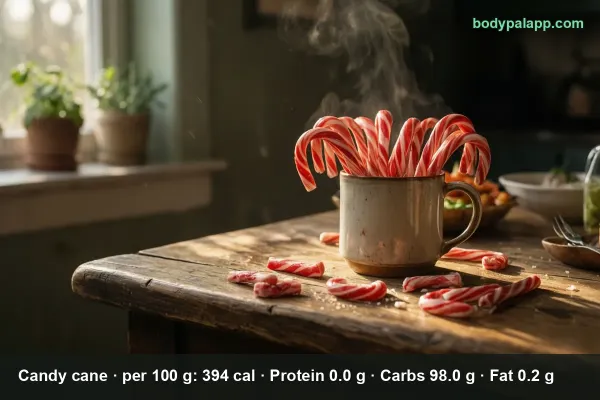
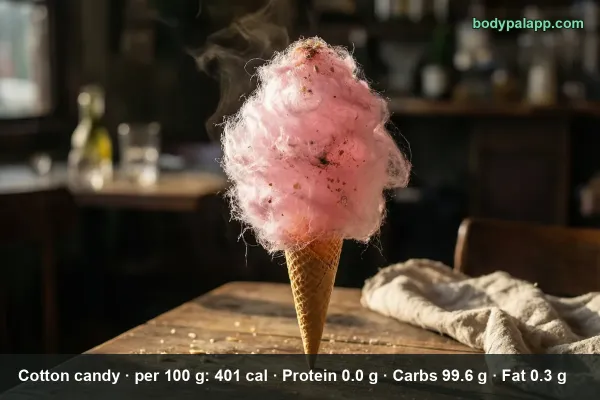
Verdict: For the fewest calories per gram, coffee candy wins at 375 per 100 g, below candy cane at 394, cotton candy at 401 and mixed candy at 429. If portion control is the goal, a single piece of candy at 21 calories is the smallest unit, but a 4-piece serving of coffee candy at 60 is still a modest treat.
Most popular coffee candy brands in the United States
Ranked by popularity in the BodyPal database
# Productkcal / 100 g
1Oneg Coffee Candy4 pieces · 11 g336 kcal
2Kafe Premium Coffee Candy5 pieces · 15 g400 kcal
3Coffee Rio Premium Coffee Candy, Original Roast4 pieces · 15 g400 kcal
Four pieces (16 g) have about 60 calories. Per 100 g coffee candy has 375 calories.
Is coffee candy good for weight loss?
A 4 piece serving adds 60 calories and 10 g of sugar, so it stays small inside a daily target, while 100 g reaches 375 calories.
Coffee candy vs candy cane: which has fewer calories?
Coffee candy has 375 calories per 100 g and candy cane about 394, a difference of 19 calories per 100 g.
How much sugar is in coffee candy?
Per 100 g there are 62.5 g of sugar and 93.8 g of total carbs; 4 pieces (16 g) give 10 g of sugar.
How many calories are in an ounce of coffee candy?
A 1 oz portion (28 g) of coffee candy has 105 calories, about 5% of the daily value. All of it comes from carbohydrate: 26.3 g, including 17.5 g of sugar.
Does coffee candy have any protein or fat?
No. Coffee candy has 0 g of protein and 0 g of fat per 100 g, so 100% of its calories come from carbohydrate. It also has 0 g of fiber.
How many calories are in five servings of coffee candy?
Five servings of 4 pieces, or 80 g, add up to 300 calories. Three servings (48 g) come to 180, and two servings (32 g) come to 120.
How much sodium is in coffee candy?
Coffee candy has 20 mg of sodium per 4 pieces (16 g), about 1% of the daily value. Per 100 g it has 125 mg, still only 5% of the daily value.
How many carbs are in 4 pieces of coffee candy?
Four pieces (16 g) of coffee candy contain 15 g of carbohydrate, of which 10 g is sugar. Per 100 g that rises to 93.8 g of carbs and 62.5 g of sugar.