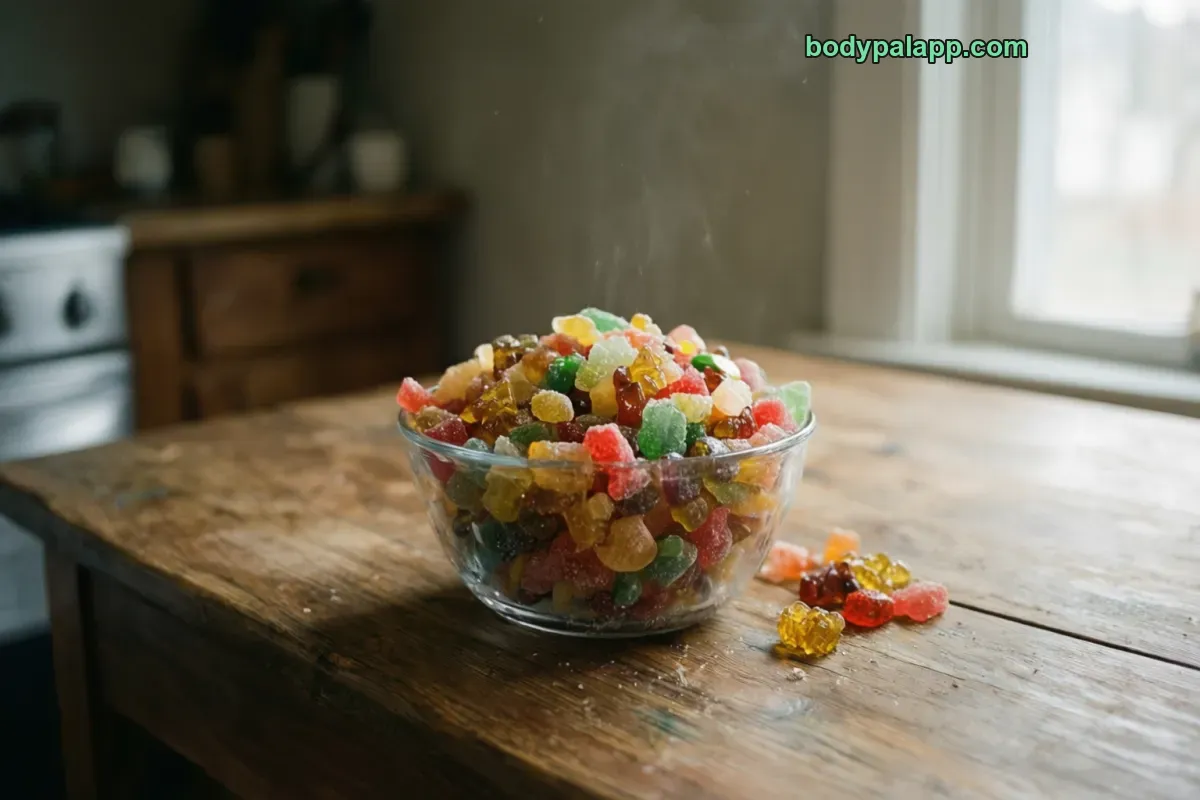
Candy calories come to 21 for one 5 g piece and 429 per 100 g of assorted candy. The number to notice is sugar: 61.3 g in every 100 g, with carbs supplying 81% of the calories. One piece barely registers. A king size bag at 515 calories is a different story.
21kcal
1 piece · 5 g, assorted, ready to eat
2%protein
0.1 gProtein
4 gCarbs
0.4 gFat
How to burn off 21 kcal
—Walking, brisk
—Jogging
—Cycling, moderate
—Swimming
Skip the math. BodyPal counts these calories from your steps and workouts automatically.
Nutrition facts
Assorted, ready to eat · per 5 g
Calories
21 kcal
Protein
0.1 g
Carbohydrate
4.3 g
Fat
0.4 g
Saturated fat
0.3 g
Cholesterol
0 mg
Sodium
2 mg
Potassium
5 mg
Iron
0 mg
Source: USDA FoodData Central
🛡️
Verified nutrition data
Numbers on this page come from USDA FoodData Central, the U.S. Department of Agriculture’s food composition database, and from manufacturer labels where a branded product is named. Last verified September 2026. How we verify our data →
Candy: calories, protein and sodium by serving
Percent of daily value uses the FDA reference of 2,000 kcal a day.
Serving
kcal
Protein
Carbs
Fat
Sodium
% DV kcal
1 piece (5 g)
21
0.1 g
4.3 g
0.4 g
2 mg
1%
Fun size (15 g)
64
0.3 g
13 g
1.2 g
6 mg
3%
King size (120 g)
515
2.3 g
103.9 g
9.9 g
52 mg
26%
100 g
429
2 g
86.6 g
8.3 g
43 mg
21%
3 × 1 piece (5 g)
64
0.3 g
6 mg
5 × 1 piece (5 g)
107
0.5 g
11 mg
One piece is 21 calories, a king size bag is 515
A single 5 g piece of assorted candy holds 21 calories, about 1% of the daily value. That is small enough to ignore once. The catch is that candy rarely stops at one: 2 pieces bring 43 calories, 3 pieces reach 64, and 5 pieces land at 107.
Packaging does the counting for you, in both directions. A fun size pack weighs 15 g and carries 64 calories, the same as three loose pieces, with 9.2 g of sugar. The king size format jumps to 120 g and 515 calories, which is 26% of the daily value in one wrapper, along with 73.6 g of sugar.
The practical move is to pick the format before you open anything. A fun size pack has a built-in stopping point. A bowl of loose pieces or a king size bag does not, and the gap between 64 and 515 calories comes down to weight alone. Same candy, eight times the grams, eight times the calories.
Carbs supply 81% of the calories
Carbs account for 81% of the calories in candy, fat for 17%, and protein for just 2%. Per 100 g that works out to 86.6 g of carbs, 8.3 g of fat and 2 g of protein. Of those carbs, 61.3 g are sugars, while fiber sits at 0.9 g.
The fat share is small but not nothing. Of the 8.3 g of fat per 100 g, 5.4 g is saturated, so most of the fat that is there is the saturated kind. Cholesterol is low at 6 mg per 100 g, and potassium comes in at 96 mg.
What candy lacks matters as much as what it has. With so little protein and fiber, a handful adds calories without adding much bulk, which is why the count climbs quietly. A king size bag delivers 103.9 g of carbs next to only 2.3 g of protein and 1.1 g of fiber. That is a lopsided trade for 515 calories.
Sugar is the row to watch, not sodium
Sugar is the number on this label that moves fastest. One piece has 3.1 g, a fun size pack 9.2 g, and a king size bag 73.6 g. Per 100 g the figure is 61.3 g, which means well over half of what you eat by weight is sugar.
Sodium, by contrast, is a non-issue. Even the king size bag holds just 52 mg, 2% of the daily value of 2300 mg, and a single piece has 2 mg. If you watch salt, candy is not where your total comes from.
If you track sugar, count candy by grams rather than by pieces. Piece sizes vary across products like Swedish Fish or Fritt chewy candy, and the 5 g piece here is an average for assorted candy, not a promise about any single bag. Weighing a handful once or twice gives you a far better sense of what a typical serving really is.
Plan candy by the pack, not the handful
Candy fits into most days when you treat it as a planned item instead of a background habit. A fun size pack at 64 calories, or a few pieces at 43 to 107 calories, is a small line in a food log. A king size bag at 515 calories takes 26% of the daily value and brings almost nothing else with it.
Pairing candy with a meal that already has protein and fiber makes the treat part of something more filling, since candy itself contributes almost none of either: 0.1 g of protein and 0 g of fiber per piece. Eaten alone between meals, it is pure extra.
Logging is where most candy slips through. The loose pieces from a desk bowl or a checkout aisle rarely make it into a food diary, yet 5 pieces already add 107 calories. BodyPal can log candy from a photo, which makes those small, easy-to-forget handfuls easier to count honestly.
How does candy compare?
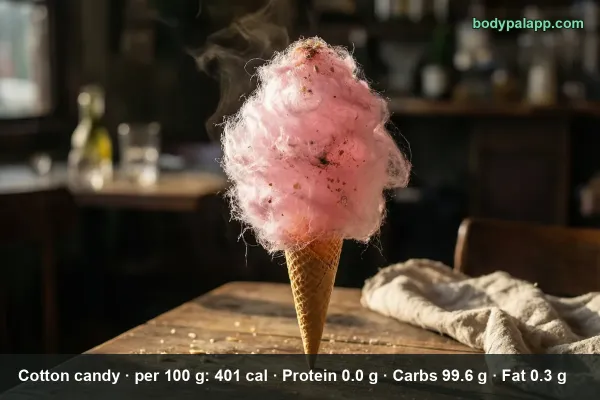
Here is how assorted candy stacks up against coffee candy, cotton candy and Takis, per 100 g and per usual serving.
Verdict: For the fewest calories per serving, pick coffee candy at 60 for 4 pieces, while cotton candy at 401 per 100 g is almost pure carbs at 99.6 g. Takis are the outlier at 500 calories and 1,393 mg of sodium per 100 g, so if you watch sodium, any of the sweets is the better pick.
5Swedish Fish Mini Soft & Chewy Candy12 pieces · 30 g367 kcal
6Swedish Fish Fruit Mix Mini Soft & Chewy Candy12 pieces · 30 g367 kcal
Each label is per that one recipe, so fat free chewy candies read lower than the mixed average above and candy bars with chocolate read higher. Source: manufacturer labels / USDA FoodData Central.
Candy FAQs
How many calories are in one piece of candy?
One piece (5 g) is about 21 calories and a fun size piece (15 g) is 64. A king size 120 g serving comes to 515 calories.
Is candy good for weight loss?
Candy averages 429 calories per 100 g, of which 61.3 g is sugar and 1.95 g is protein. Even a 15 g fun size piece is 64 calories.
Candy or cotton candy: which has fewer calories?
Cotton candy has 401 calories per 100 g and assorted candy 429, a gap of 28 calories per 100 g.
How much sugar is in candy?
Assorted candy has 61.3 g of sugar per 100 g, so a 15 g fun size piece holds about 9.2 g and a 5 g piece about 3.1 g.
What are the macros in candy?
Per 100 g, candy has 86.6 g of carbs, 8.3 g of fat and 2 g of protein. That puts 81% of the calories on carbs, 17% on fat and 2% on protein, with 61.3 g of sugars.
How many calories are in 100 g of candy?
100 g of assorted candy has 429 calories, 21% of the daily value. The same 100 g carries 61.3 g of sugars, 8.3 g of fat and only 43 mg of sodium.
How many calories are in a small fun size candy?
A fun size candy of 15 g has 64 calories, about 3% of the daily value. It holds 13 g of carbs, 9.2 g of sugars and 1.2 g of fat, the same as three loose pieces.
How many calories are in several pieces of candy?
5 pieces of candy (25 g) add up to 107 calories. Two pieces come to 43 and three pieces to 64, so each extra piece adds roughly 21 calories to your total.