
How many calories are in cotton candy?
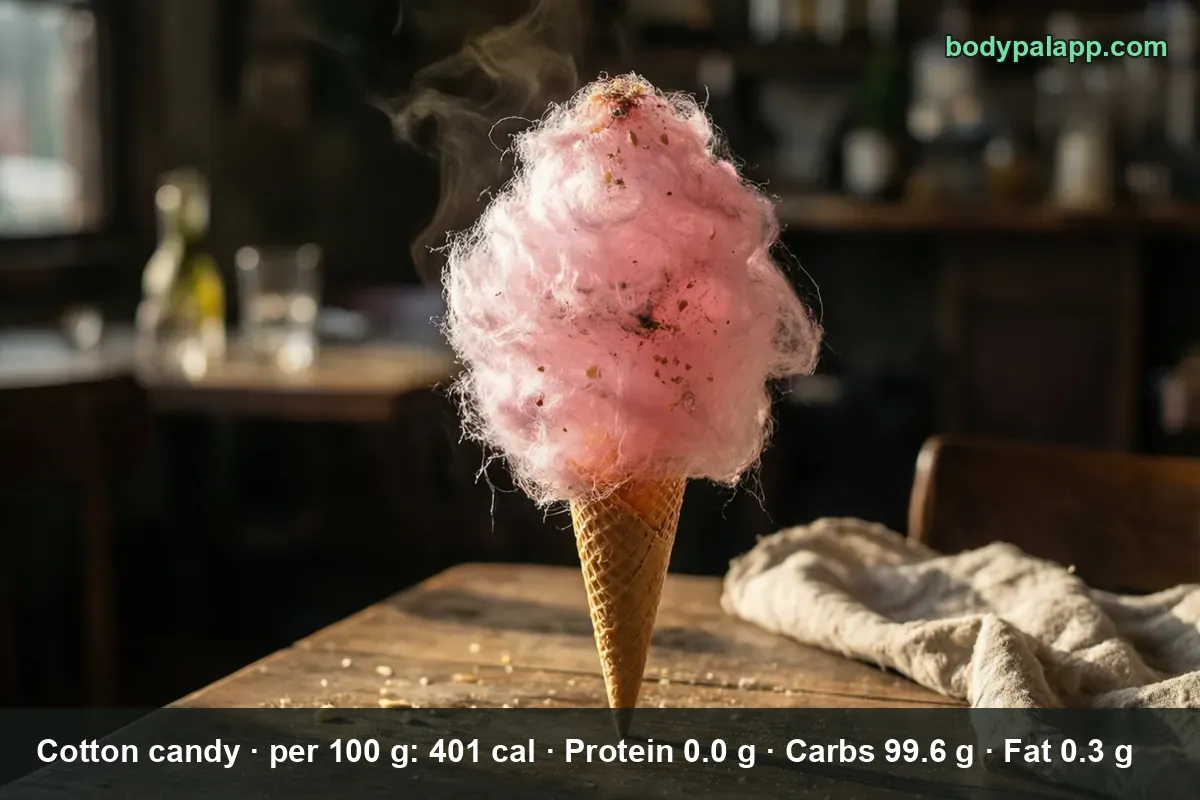
A 30 g package of cotton candy carries 120 calories. Spun sugar is light, so per 100 g the number climbs to 401 calories, above hard candy, gummies and lollipops. The whole thing is sugar: 29.9 g of carbohydrate in that package, no fat worth counting, no protein at all.
On this page
- Cotton candy quick facts
- US servings from one cup to a full package
- Cotton candy flavored ice cream and soda
- Sugar is the only row that moves
- How does cotton candy compare?
- Most popular cotton candy brands
- FAQ
Cotton candy quick facts
The record behind every number here is FNDDS 2710363, "Candy, cotton". It is the one USDA entry for spun sugar itself, and spun sugar is what a person actually holds — a paper cone at a ballpark, a plastic tub from the candy aisle, a cellophane bag at a birthday table. Cotton candy flavored products are a different food and get their own section further down.
USDA's household measure for this record is one package of any size, set at 30 g. That is the serving the calorie count below is built on.
| Nutrient | Per 100 g | Per 1 package (30 g) | % Daily Value |
|---|---|---|---|
| Calories | 401 | 120 | — |
| Total fat | 0.32 g | 0.1 g | 0% |
| Saturated fat | 0 g | 0 g | 0% |
| Carbohydrate | 99.6 g | 29.9 g | 11% |
| Dietary fiber | 0 g | 0 g | 0% |
| Total sugars | 99.8 g | 29.9 g | — |
| Protein | 0 g | 0 g | 0% |
| Sodium | 1 mg | 0 mg | 0% |
% Daily Value is based on a 2,000-calorie diet.
Verified nutrition data
Numbers on this page come from USDA FoodData Central, the U.S. Department of Agriculture’s food composition database, and from manufacturer labels where a branded product is named. Last verified September 2026. How we verify our data →
Two rows you will not see: added sugars and trans fat. This edition of FNDDS does not publish either figure for cotton candy, so we leave them out rather than guess at them. Cholesterol is 0 mg and potassium is 2 mg per 100 g, which comes to 1 mg in a package — thin enough to leave in a sentence instead of the table.
US servings from one cup to a full package
| Serving | Weight | Calories |
|---|---|---|
| 1 cup, loose | 10 g | 40 kcal |
| 2 cups, loose | 20 g | 80 kcal |
| 1 oz | 28 g | 112 kcal |
| One package, any size | 30 g | 120 kcal |
| Per 100 g | 100 g | 401 kcal |
Only two of those come straight from USDA: the 30 g package and the 1 cup measure. The two-cup line and the 1 oz line are our own arithmetic from the USDA 100 g figure, not USDA servings.
Here is the trap that catches almost everyone. A cup of cotton candy weighs 10 g. A cup of granulated sugar — the exact same sugar, before the machine touches it — weighs roughly 200 g. Same measuring cup, twenty times the weight, because all the machine did was blow air through it. Logging cotton candy by volume will overstate it wildly if you reach for a sugar entry, and understate it if you assume a bathtub-sized tub is "just a cup."
Store bags follow the package logic, not the volume. A 28 g serving of Rainbow Cotton Candy or Candy ASAP Cotton Candy Swirlz is 110 calories, and a 22 g Lieber's bag is 90. Read the net weight printed on the front; the size of the container tells you nothing useful.
Cotton candy flavored ice cream and soda

Cotton candy is also a flavor, and the flavor version of a food behaves nothing like the spun sugar. Both of these are much denser or much more diluted than the candy, and neither should be logged against the 401 per 100 g figure.
| Version | Per 100 g | Typical serving | Calories |
|---|---|---|---|
| Cotton candy, spun sugar | 401 kcal | one package, 30 g | 120 kcal |
| Cotton candy ice cream | 234 kcal | 2/3 cup, 107 g | 250 kcal |
| Cotton candy soda | 42 kcal | 8 fl oz, 240 ml | 101 kcal |
The ice cream is a little under three-fifths the calorie density of the candy per 100 g, and yet a single scoop shop portion beats a whole package of cotton candy — 250 calories against 120 — because the serving is more than three times heavier. The soda number is our own arithmetic from the USDA 100 g figure rather than a USDA serving, and at 42 calories per 100 g it is mostly water carrying about 25 g of sugar per can-sized glass.
That is the pattern worth remembering: with cotton candy, the food is dense and the portion is tiny. With everything wearing the flavor, the food is diluted and the portion is large.
Sugar is the only row that moves
Read the table again and notice how much of it is zeros. Zero protein. Zero fiber. Zero saturated fat. Zero cholesterol. Sodium is 1 mg per 100 g, which rounds to nothing in a package and sits at 0% of the FDA Daily Value of 2,300 mg. Total fat is 0.32 g per 100 g, also 0%.
One row does anything at all: carbohydrate, at 29.9 g in a package, or 11% of the 275 g Daily Value. And 29.9 g of that 29.9 g is sugar. There is no fiber to subtract, so the total and the net are the same number.
USDA does not break out added sugars for this record, so we cannot put a percentage on that line, and total sugars have no Daily Value of their own. What we can say is where it fits in a day: the Dietary Guidelines for Americans advise keeping added sugars under 10% of daily calories, and MyPlate puts sweets in the same "limit" bucket. A package of cotton candy spends a slice of that allowance and returns nothing else — no protein to hold you over, no fiber to slow it down. If you are watching how you spend sugar, this is a treat to enjoy on its own terms rather than a snack that does any work for you.
It is worth saying the obvious out loud, though: at 120 calories, one package is smaller than most candy bars. The problem with cotton candy is rarely the calories in a serving. It is that nobody stops at a serving when the whole thing weighs about an ounce.
How does cotton candy compare?
| Candy | Per 100 g | US serving | Calories |
|---|---|---|---|
| Cotton candy | 401 kcal | one package, 30 g | 120 kcal |
| Hard candy | 394 kcal | 1 oz, 28 g | 110 kcal |
| Gummy candy | 396 kcal | 1 oz, 28 g | 111 kcal |
| Lollipop | 394 kcal | 1 oz, 28 g | 110 kcal |
Our take: gram for gram, cotton candy is the heaviest of the four at 401 calories per 100 g, and matched ounce for ounce the gap is trivial — 112 calories against 110 or 111. Any real difference comes from how fast you get through it. A hard candy or a lollipop takes several minutes of sucking to deliver its 110 calories; a cone of cotton candy dissolves in under a minute and asks for another. For weight control, pick the candy that takes the longest to finish. For pure sugar content, cotton candy tops the list at 99.8 g per 100 g, with hard candy and lollipops at 97.2 g and gummies far back at 63.9 g.
Most popular cotton candy brands in the United States
Ranked by how widely each product appears among foods sold in the United States, from the BodyPal food database of over 3.3 million products. Calories are the figures printed on each Nutrition Facts label, checked against USDA FoodData Central.
| Product | Calories (per 100 g) |
|---|---|
| Rainbow Cotton Candy | 393 cal |
| Candy ASAP Cotton Candy Swirlz Caramel | 393 cal |
| Hammond's American Candy Company Cotton Candy | 393 cal |
| Lieber's Cotton Candy | 409 cal |
| Lieber's Cotton Candy 0.8 oz | 395 cal |
Brand popularity: BodyPal food database. Nutrition: manufacturer labels / USDA FoodData Central.
Cotton candy FAQs
How many calories are in cotton candy?
A 30 g package holds 120 calories, and per 100 g spun sugar runs 401 calories. USDA lists the package as the standard household measure for this record. A single loose cup is much lighter at 10 g, which works out to 40 calories, so the container matters far more than the color does.
How many calories are in one bag of cotton candy?
120 calories for the 30 g package USDA treats as one serving, whatever shape the bag is. Store bags vary: a 22 g Lieber's bag is 90 calories, while a 28 g serving of Rainbow Cotton Candy or Candy ASAP is 110. Check the net weight on the front, not the size of the tub.
How much sugar is in cotton candy?
29.9 g of total sugars in a 30 g package, or 99.8 g per 100 g, which is essentially the entire weight of the food. USDA does not publish added sugars for this record, so we leave that row out of the table. Spun sugar starts as granulated sugar and nothing is added to dilute it.
Is cotton candy just sugar?
Almost exactly: 99.8 g of every 100 g is sugar, with 99.6 g logged as carbohydrate, 0.32 g of fat, 0 g of protein and 0 g of fiber. The coloring and flavoring weigh close to nothing. A machine melts granulated sugar and spins it into threads, and air does the rest of the work.
How many carbs are in cotton candy?
29.9 g of carbohydrate in a 30 g package, which is 11% of the 275 g Daily Value, and 99.6 g per 100 g. None of it is fiber, so total carbs and net carbs are the same number here. One loose cup weighs only 10 g and carries just under 10 g of carbohydrate.
Is cotton candy fat free?
Effectively yes: 0.32 g of fat per 100 g, which rounds to 0.1 g in a 30 g package and 0% of the Daily Value. Saturated fat and cholesterol are both zero. The calories are not any lower for it, because sugar carries every one of the 120 in a package on its own.
How many calories are in a cone of cotton candy?
About 120 calories if the cone carries the standard 30 g, since one cup of spun sugar weighs 10 g and three loose cups fill out that weight. The cone size is our own assumption; the 30 g package itself is a USDA serving. USDA lists no cone-sized serving for cotton candy, only the package and the cup.
Does cotton candy have sodium?
Barely: 1 mg per 100 g, which rounds to 0 mg in a 30 g package and 0% of the 2,300 mg Daily Value. Hard candy and gummies carry 26 mg per 100 g by comparison. Potassium is just as thin at 2 mg per 100 g, so the panel really is sugar and almost nothing else.
Similar foods
- Dum Dums Lollipops — 60 cal per 3 pops
- Sugar Cone — 40 cal per cone
- Brownie Bite — 113 cal per bite
- Brownie Square — 203 cal per square
- Chocolate Brownie — 227 cal per large brownie
- Laffy Taffy — 60 cal per piece
Count it without the math
Point the camera at the cone and BodyPal counts it for you, package or paper cup.


How long does it take to burn off cotton candy?
One package (30 g) is 120 kcal. Enter your weight and the amount you ate to see how long it takes you to burn that off:
lb
| Activity | Time to burn 120 kcal |
|---|---|
| Walking, brisk | 24 min |
| Cycling, moderate | 15 min |
| Swimming, moderate | 17 min |
| Jogging | 14 min |
| Weight training, moderate | 27 min |
Times are for a 155 lb adult at a steady pace; change the weight to see yours. The amount is set to the portion in the text (30 g); change it to what you actually ate. BodyPal works this out from your steps automatically.
This table assumes you know your daily total. If you do not, the daily calorie calculator works it out from five numbers.