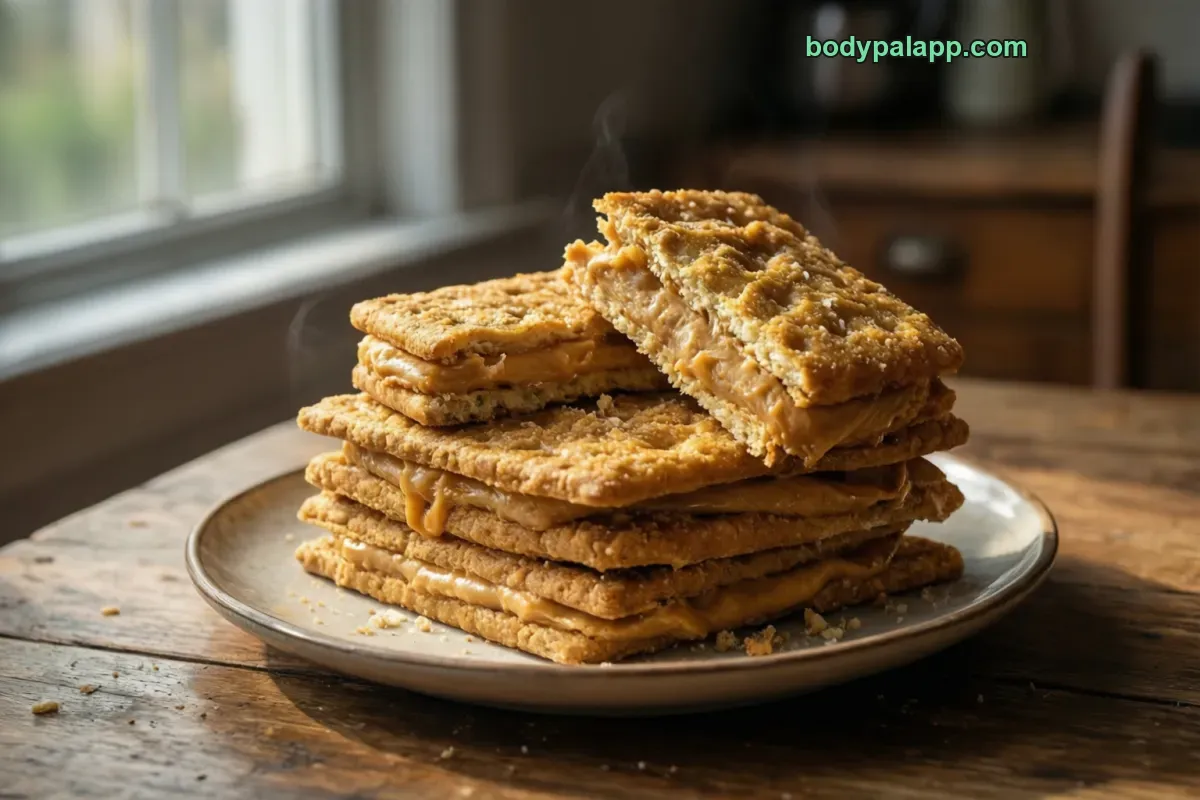
Peanut butter crackers calories come to 222 for one 45 g pack and 494 per 100 g. A single pack is a modest snack at 11% of the daily value for calories. Packs come in multiples, though, and fat and refined carbs supply almost all of the energy. Protein is a minor share at 9%.
222kcal
1 pack · 45 g, sandwich-type, packaged
9%protein
5.2 gProtein
26 gCarbs
11 gFat
How to burn off 222 kcal
—Walking, brisk
—Jogging
—Cycling, moderate
—Swimming
Skip the math. BodyPal counts these calories from your steps and workouts automatically.
Nutrition facts
Sandwich-type, packaged · per 45 g
Calories
222 kcal
Protein
5.2 g
Carbohydrate
26 g
Fat
11 g
Saturated fat
2.2 g
Cholesterol
0 mg
Sodium
360 mg
Potassium
97 mg
Iron
1.2 mg
Source: USDA FoodData Central
🛡️
Verified nutrition data
Numbers on this page come from USDA FoodData Central, the U.S. Department of Agriculture’s food composition database, and from manufacturer labels where a branded product is named. Last verified September 2026. How we verify our data →
Peanut butter crackers: calories, protein and sodium by serving
Percent of daily value uses the FDA reference of 2,000 kcal a day.
Serving
kcal
Protein
Carbs
Fat
Sodium
% DV kcal
1 pack (45 g)
222
5.2 g
26.3 g
11 g
360 mg
11%
1 sandwich cracker (7 g)
35
0.8 g
4.1 g
1.7 g
56 mg
2%
100 g
494
11.5 g
58.4 g
24.5 g
801 mg
25%
3 × 1 pack (45 g)
667
15.5 g
1,081 mg
5 × 1 pack (45 g)
1,112
25.8 g
1,802 mg
One pack is 222 calories, three packs are 667
The standard 45 g pack of sandwich-type peanut butter crackers lands at 222 calories, 5.2 g of protein and 360 mg of sodium. That is a fair size for a snack. It covers about 11% of the daily value for calories and 16% for sodium, which leaves plenty of room for meals.
The trouble is that these crackers come in boxes of individually wrapped packs, and one rarely feels like enough. Two packs (90 g) bring the total to 445 calories and 721 mg of sodium. Three packs (135 g) reach 667 calories and 1,081 mg of sodium, which is meal territory. Five packs over a long afternoon add up to 1,112 calories and 1,802 mg of sodium, while protein only climbs to 25.8 g.
If you want finer control, count crackers instead of packs. One sandwich cracker weighs about 7 g and carries 35 calories, 0.8 g of protein and 56 mg of sodium. Eating a few straight from the box and putting the rest away is the easiest way to stay near the single-pack number.
Fat and carbs split the calories almost evenly
Carbohydrates supply 47% of the calories in peanut butter crackers and fat supplies 44%. Protein brings in just 9%. Per 100 g that works out to 58.4 g of carbs, 24.5 g of fat and 11.5 g of protein. The peanut butter filling raises the protein above a plain cracker, but it is still a carb-and-fat snack, not a protein snack.
Per pack you get 26.3 g of carbs, 11 g of fat and 5.2 g of protein. That protein covers 10% of the daily value, which helps a little but will not carry you to dinner on its own. Fiber is low at 1 g per pack, or 2.3 g per 100 g, so the crackers digest quickly.
Sugar is moderate. A pack has 4.7 g, and the per-100 g figure is 10.5 g, much of it from the sweetened filling. Saturated fat sits at 4.8 g per 100 g. Cholesterol is 0, since the crackers and filling contain no animal fat.
Sodium is the row to watch
At 801 mg per 100 g, peanut butter crackers are salty even by snack standards. That is 35% of the daily value in 100 g. A single 45 g pack carries 360 mg, or 16% of the daily value, more than the 11% it contributes to calories. Sodium is the number that runs ahead of the rest.
This matters most when packs multiply. Two packs reach 721 mg and three reach 1,081 mg, so a snack habit can quietly eat a large slice of the day's sodium before any salted dinner. Each sandwich cracker adds 56 mg on its own.
If you watch sodium, treat one pack as the ceiling and keep the rest of that day's snacks unsalted. Fresh fruit, plain yogurt or unsalted nuts balance the salt without adding much more of it. Reading the label on store brands such as Hannaford or Food Lion is worth it too, since packaged recipes vary.
A pack works best with something fresh beside it
Peanut butter crackers are built for convenience: shelf-stable, portioned and easy to toss in a bag. That makes them a practical backup snack for work, school or travel. On their own, though, they offer little fiber and modest protein, so the fullness fades quickly.
Pair a pack with an apple, a handful of grapes, baby carrots or a glass of milk. The fruit and vegetables add fiber and water, and milk adds protein, so the same 222 calories feel like a more complete snack. This is a better move than opening a second pack, which would add another 222 calories and more salt.
If you track your intake, log the packs rather than guessing. A single wrapper is easy to forget by evening. BodyPal can log the crackers from a photo, which helps when you are snacking on the go and the box is already in the recycling.
How does peanut butter crackers compare?
Here is how peanut butter crackers stack up against butter crackers, club crackers and Ritz crackers, per 100 g and per usual serving.
Verdict: Calories barely differ at 494 per 100 g versus 510 for butter and club crackers and 492 for Ritz, so pick peanut butter crackers if you want more staying power, since they carry 11.5 g of protein per 100 g against 6.6 to 7.2 g. If sodium is your concern, butter and club crackers are the lower pick at 726 mg per 100 g, while Ritz is the saltiest at 882 mg.
Most popular peanut butter crackers brands in the United States
How many calories are in a pack of peanut butter crackers?
A 45 g pack has about 222 calories, and one sandwich cracker (7 g) has about 35.
Are peanut butter crackers good for weight loss?
A 45 g pack gives 222 calories with 11.0 g fat, 5.2 g protein and 1.0 g fiber. Per 100 g they have 494 calories.
Peanut butter crackers vs butter crackers: which has fewer calories?
Peanut butter crackers have 494 calories per 100 g, butter crackers 510.
How much protein is in peanut butter crackers?
About 5.2 g per 45 g pack, or 11.5 g per 100 g.
How many calories are in one peanut butter sandwich cracker?
One sandwich cracker of about 7 g has 35 calories. It also carries 0.8 g of protein and 56 mg of sodium, so counting single crackers is an easy way to keep a snack small.
How much sodium is in a pack of peanut butter crackers?
A 45 g pack has 360 mg of sodium, which is 16% of the daily value. Two packs reach 721 mg, and per 100 g the crackers carry 801 mg, or 35% of the daily value.
How much sugar is in peanut butter crackers?
A 45 g pack contains 4.7 g of sugar, and 100 g contains 10.5 g. Much of that comes from the sweetened filling, while fiber stays low at 1 g per pack.
Do peanut butter crackers have cholesterol?
No. Peanut butter crackers contain 0 mg of cholesterol. They do have 4.8 g of saturated fat per 100 g, and total fat is 11 g in a 45 g pack.
Where do the calories in peanut butter crackers come from?
Carbohydrates supply 47% of the calories, fat 44% and protein 9%. Per 100 g that means 58.4 g of carbs, 24.5 g of fat and 11.5 g of protein.