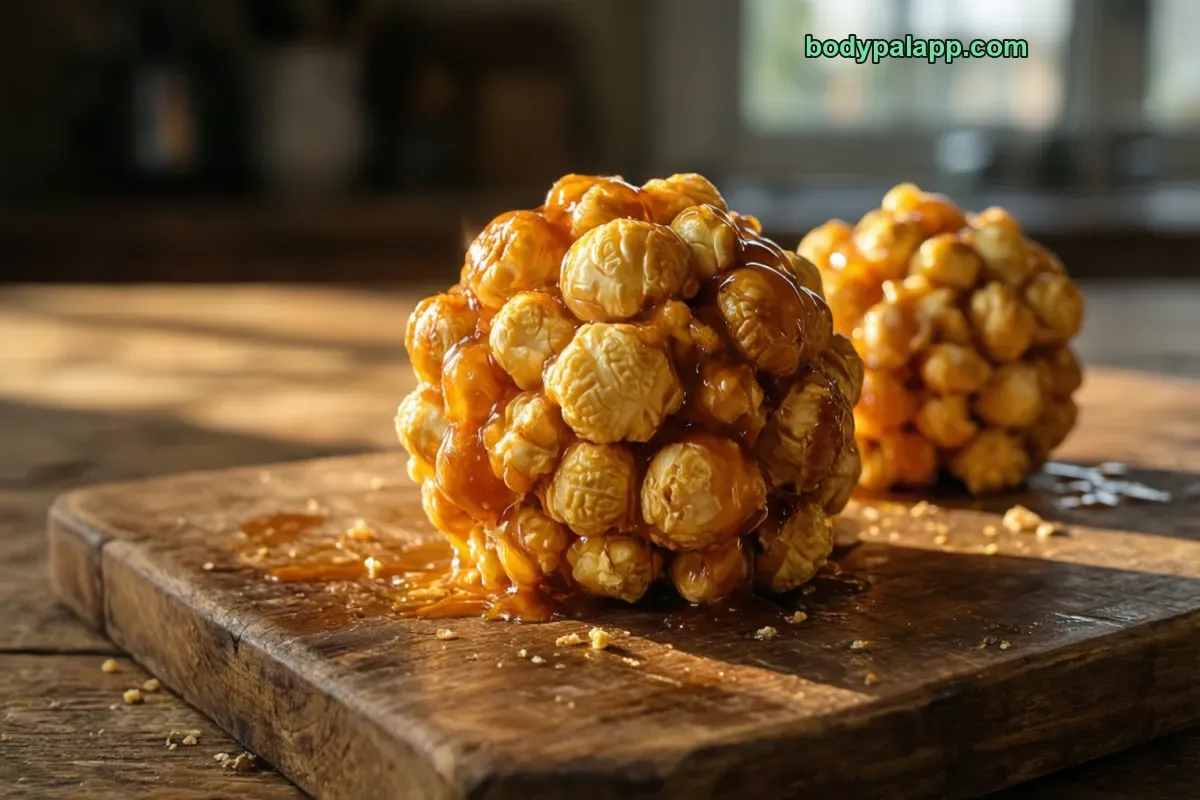
Popcorn ball calories come to 150 for one 35 g ball and 428 per 100 g, based on the USDA entry for caramel coated popcorn. Sugar is what you should notice first. A single ball carries 18.5 g of sugars, and carbohydrates supply 71% of its calories, while protein barely registers at 1.3 g.
150kcal
1 popcorn ball · 35 g, caramel coated
3%protein
1.3 gProtein
27 gCarbs
4.4 gFat
How to burn off 150 kcal
—Walking, brisk
—Jogging
—Cycling, moderate
—Swimming
Skip the math. BodyPal counts these calories from your steps and workouts automatically.
Nutrition facts
Caramel coated · per 35 g
Calories
150 kcal
Protein
1.3 g
Carbohydrate
27 g
Fat
4.4 g
Saturated fat
1.3 g
Cholesterol
0 mg
Sodium
179 mg
Potassium
38 mg
Iron
0.6 mg
Source: USDA FoodData Central
🛡️
Verified nutrition data
Numbers on this page come from USDA FoodData Central, the U.S. Department of Agriculture’s food composition database, and from manufacturer labels where a branded product is named. Last verified September 2026. How we verify our data →
Popcorn ball: calories, protein and sodium by serving
Percent of daily value uses the FDA reference of 2,000 kcal a day.
Serving
kcal
Protein
Carbs
Fat
Sodium
% DV kcal
1 Ball (35 g)
150
1.3 g
27.5 g
4.4 g
179 mg
7%
3 oz portion (85 g)
364
3.2 g
66.7 g
10.8 g
435 mg
18%
100 g
428
3.8 g
78.5 g
12.7 g
512 mg
21%
3 × 1 Ball (35 g)
449
4 g
538 mg
5 × 1 Ball (35 g)
749
6.6 g
896 mg
One ball is 150 calories, a handful of them is a meal
A standard 35 g popcorn ball lands at 150 calories, about 7% of the daily value. On its own that is a modest snack. The trouble is that popcorn balls rarely travel alone: they come in bags, party trays and holiday tins, and the second one goes down as easily as the first.
Two balls bring you to 300 calories. Three reach 449, which is the size of a small lunch, and five add up to 749 calories with nothing more filling than air and caramel inside. The count matters far more than the brand or the flavor.
Weight tells the same story. A 3 oz portion of 85 g holds 364 calories, or 18% of the daily value. If the balls you have are bigger than the 35 g standard, as homemade ones often are, weigh one before you log it. A large homemade ball can easily be worth two of the reference size.
Sugar coating drives almost every calorie
Per 100 g, a popcorn ball has 78.5 g of carbohydrates, and 52.8 g of that is sugars. Put another way, more than half the weight of the snack is sugar from the caramel coating. Carbs supply 71% of the calories, fat 26% and protein just 3%.
Fat comes in at 12.7 g per 100 g, with 3.6 g saturated, mostly from the butter or oil in the coating. Per ball that works out to 4.4 g of fat. It is not a fatty snack, but it is not a lean one either.
There is one point in its favor. The popcorn underneath still contributes fiber: 5.2 g per 100 g, or 1.8 g in a single ball. That is more than most candy offers. It does not change the overall picture, though. A popcorn ball is a sweet first and a whole grain second.
Sodium adds up faster than you expect
Sweet snacks are not usually where people look for salt, but caramel corn carries a surprising amount. One ball has 179 mg of sodium, 8% of the 2300 mg daily value. Per 100 g the figure is 512 mg, or 22% of the daily value.
The multiples make the point. Two balls deliver 358 mg, three reach 538 mg and five hit 896 mg. That is a real share of a day's sodium from something that tastes mostly of sugar. The sweet and salty versions from brands like Kathy Kaye and Clover Valley lean into that contrast on purpose.
If you watch sodium, count popcorn balls alongside chips and crackers rather than with fruit or candy. Cholesterol, by contrast, is 0 in the USDA data, so that row is not a concern.
Treat it as dessert, not as a popcorn snack
The word popcorn makes this feel lighter than it is. With 1.3 g of protein per ball, 3% of the daily value, a popcorn ball does little to keep you full. It works best as a planned treat after a meal that already did the filling work.
If you want one as an afternoon snack, pair it with something that brings protein, like a glass of milk, a yogurt or a piece of cheese. That way the 150 calories come with some staying power. Holding to one ball and putting the bag away is the simplest strategy of all.
Homemade and store-bought balls vary in size and coating, so the reference numbers are a starting point. BodyPal can log a popcorn ball from a photo, which helps when the ball in your hand is clearly larger than the standard 35 g.
How does popcorn ball compare?
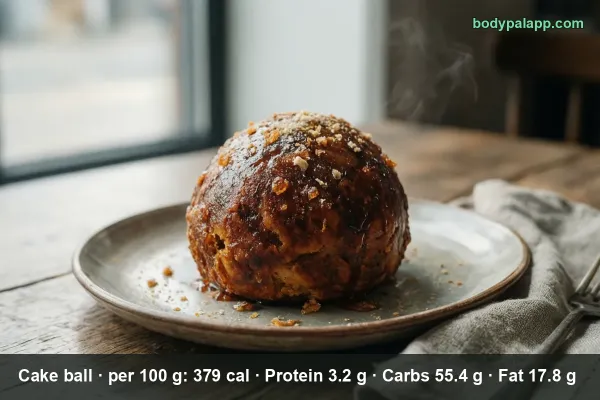
Here is how a popcorn ball stacks up against cake balls, cheese balls and plain popcorn, per 100 g and per usual serving.
Verdict: If you just want popcorn, plain popcorn wins easily at 31 calories per cup, with 12.9 g protein and only 8 mg sodium per 100 g, against 428 calories and 512 mg for the popcorn ball. As a party treat the popcorn ball sits close to the cake ball at 379 and the cheese ball at 441 per 100 g, so let portion size, not the type, make the decision.
Most popular popcorn ball brands in the United States
Packaged popcorn balls vary by recipe and syrup ratio, so brand labels range from about 357 to 419 calories per 100 g against the 428 estimate above. Source: manufacturer labels / USDA FoodData Central.
Popcorn ball FAQs
How many calories are in a popcorn ball?
One popcorn ball (35 g) has about 150 calories. A larger 3 oz (85 g) portion is about 364 calories, and 100 g is 428 calories.
Is a popcorn ball good for weight loss?
A popcorn ball is 428 calories per 100 g with 52.8 g of sugar, so one 35 g ball carries about 150 calories and 18.5 g of sugar from the caramel coating.
Popcorn ball vs cake ball: which has fewer calories?
A popcorn ball is 428 calories per 100 g and a cake ball is 379, so cake ball runs about 49 calories lower per 100 g.
How much sugar is in a popcorn ball?
A 35 g popcorn ball has about 18.5 g of sugar, from 52.8 g per 100 g. It also has 4.4 g of fat and 1.3 g of protein.
How many calories are in two popcorn balls?
Two standard popcorn balls have 300 calories, with 358 mg of sodium and 2.6 g of protein. Three balls reach 449 calories, so the count adds up quickly at parties.
How much sodium is in a popcorn ball?
One 35 g popcorn ball has 179 mg of sodium, 8% of the daily value. Per 100 g it is 512 mg, or 22% of the daily value, which is a lot for a sweet snack.
Does a popcorn ball have more calories than plain popcorn?
Yes. A popcorn ball has 428 calories per 100 g versus 387 for plain popcorn. Because plain popcorn is so light, one cup has only 31 calories, while a single ball has 150.
How much protein is in a popcorn ball?
A popcorn ball has 1.3 g of protein, just 3% of the daily value. Protein supplies only 3% of its calories, so it will not keep you full for long.
Does a popcorn ball have any fiber?
A popcorn ball has 1.8 g of fiber, coming from the popcorn under the coating. Per 100 g that is 5.2 g, more than most candies, though sugars still dominate at 52.8 g.