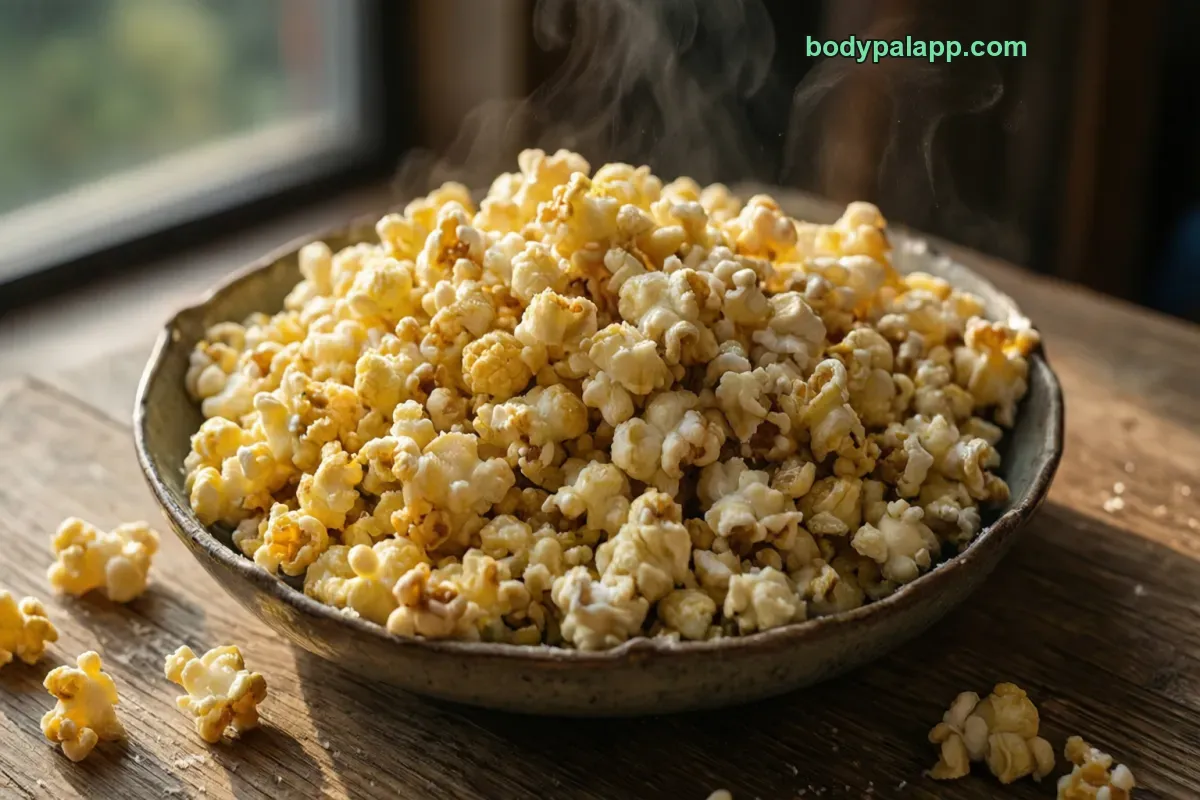
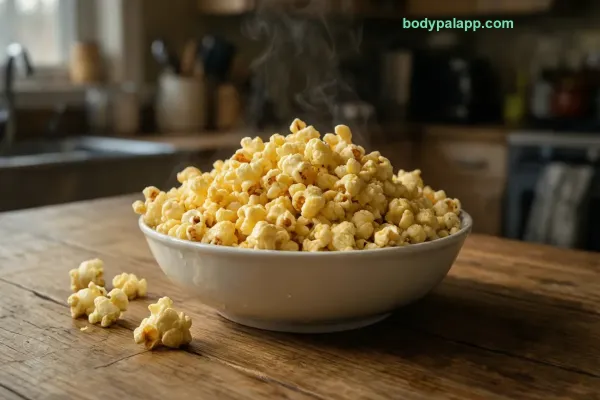
Popcorn with coconut oil calories come to 40 for a 1 cup (8 g) serving and 500 per 100 g. The thing to notice is how light each cup is. Popcorn is mostly air, so your total depends on how many cups you eat, and fat supplies 49 percent of the calories.
40kcal
1 cup · 8 g, oil-popped, unsalted
7%protein
0.7 gProtein
5 gCarbs
2.2 gFat
How to burn off 40 kcal
—Walking, brisk
—Jogging
—Cycling, moderate
—Swimming
Skip the math. BodyPal counts these calories from your steps and workouts automatically.
Nutrition facts
Oil-popped, unsalted · per 8 g
Calories
40 kcal
Protein
0.7 g
Carbohydrate
4.6 g
Fat
2.2 g
Saturated fat
0.4 g
Cholesterol
0 mg
Sodium
0 mg
Potassium
18 mg
Iron
0.2 mg
Source: USDA FoodData Central
🛡️
Verified nutrition data
Numbers on this page come from USDA FoodData Central, the U.S. Department of Agriculture’s food composition database, and from manufacturer labels where a branded product is named. Last verified September 2026. How we verify our data →
Popcorn with coconut oil: calories, protein and sodium by serving
Percent of daily value uses the FDA reference of 2,000 kcal a day.
Serving
kcal
Protein
Carbs
Fat
Sodium
% DV kcal
1 cup (8 g)
40
0.7 g
4.6 g
2.2 g
0 mg
2%
1 oz (28 g)
142
2.6 g
16.5 g
8 g
1 mg
7%
100 g
500
9 g
58.1 g
28.1 g
3 mg
25%
3 × 1 cup (8 g)
120
2.2 g
1 mg
5 × 1 cup (8 g)
200
3.6 g
1 mg
Five cups of popcorn land at 200 calories
A cup of oil-popped popcorn weighs only 8 g and carries 40 calories. That makes it one of the few snacks where the bowl looks big and the number stays small. Two cups come to 80 calories, three cups to 120, and five cups to 200.
The catch is that nobody eats one cup. A movie-night bowl easily holds five or more, and the count climbs steadily with every handful. Weight tells the story better than volume: 1 oz (28 g) is 142 calories, and a full 100 g reaches 500, which is 25 percent of the daily value for calories.
If you want the snack to stay light, decide on the number of cups before you start. Measuring once with a cup gives you a feel for portion size that you can reuse every time you pop a batch.
Fat edges out carbs as the main calorie source
Plain air-popped corn is mostly starch. Popping it in oil changes the balance. Per 100 g this popcorn has 58.1 g of carbs and 28.1 g of fat, and because fat is denser in energy, it ends up supplying 49 percent of the calories against 45 percent from carbs. Protein brings the remaining 7 percent.
In a single cup that works out to 4.6 g of carbs, 2.2 g of fat and 0.7 g of protein. The oil is what lifts popcorn from a near-zero snack to one that counts, so a heavy pour at the stove matters more than an extra kernel or two.
One honest note on the data: the USDA row behind this page is generic oil-popped, unsalted popcorn. It does not separate coconut oil from other oils, which is why the olive oil and generic oil pages show the same numbers. Saturated fat sits at 5.1 g per 100 g in that row.
Unsalted, it is nearly sodium-free and fairly high in fiber
Sodium is the row most people expect to be a problem with popcorn, and here it is not. This entry is unsalted, so a cup has 0 mg and even 100 g has just 3 mg. Whatever salt shows up in your bowl is the salt you shake on yourself.
That is the real gap between homemade and packaged popcorn. Microwave butter popcorn carries 763 mg of sodium per 100 g, against the daily value of 2300 mg. If you watch sodium, popping your own and seasoning lightly keeps you in control.
Fiber is the quiet strength. A cup gives 0.8 g, an ounce gives 2.8 g, and 100 g gives 10 g, which is a solid share of the 28 g daily value. Sugar is close to nil at 0.5 g per 100 g, and cholesterol is 0.
A measured bowl fits easily into a snack budget
Popcorn works best as a volume snack: lots to chew for a modest number of calories, as long as the portion is set in advance. Three cups at 120 calories is a reasonable afternoon snack for many people, and five cups at 200 covers a movie.
Protein is low, at 2.6 g per ounce, so popcorn on its own will not keep you full for long. Pairing it with something higher in protein, like a glass of milk or a piece of cheese, rounds it out. Flavor with spices, herbs or nutritional yeast rather than more oil or butter if you want the number to stay close to what is on this page.
If counting cups feels tedious, BodyPal can log popcorn from a photo of your bowl, which helps when the portion is eyeballed rather than measured.
How does popcorn with coconut oil compare?
Here is how popcorn with coconut oil stacks up against other oil-popped and microwave popcorn, per 100 g and per usual serving.
Verdict: Coconut oil, olive oil and generic oil-popped popcorn all land at 40 calories a cup and 500 per 100 g, so pick the oil you like the taste of. Skip microwave butter popcorn if you watch sodium or portions: a 87 g bag is 465 calories with 763 mg of sodium per 100 g.
Popcorn with coconut oil FAQs
How many calories are in a cup of popcorn with coconut oil?
About 40 calories per cup (8 g) of oil-popped popcorn, and 142 calories in a 1 oz serving (28 g).
Is popcorn with coconut oil good for weight loss?
A cup is 40 calories with 0.8 g of fiber. Per 100 g it has 500 calories, 28.1 g fat and 10 g fiber.
Popcorn with coconut oil vs microwave popcorn: which has fewer calories?
Oil-popped popcorn has 500 calories per 100 g versus 583 for regular microwave popcorn. A cup is 40 calories versus 64.
How much fat is in popcorn with coconut oil?
A cup has 2.2 g fat, 4.6 g carbs and 0.7 g protein. A 1 oz serving has 8.0 g fat.
How many calories are in an ounce of popcorn with coconut oil?
One ounce (28 g) of oil-popped popcorn has 142 calories. That is 7 percent of the daily value, with 8 g of fat, 16.5 g of carbs and 2.8 g of fiber.
How many calories are in 100 grams of popcorn with coconut oil?
A 100 g portion has 500 calories, about 25 percent of the daily value. It also brings 28.1 g of fat, 58.1 g of carbs, 9 g of protein and 10 g of fiber.
How many calories are in 5 cups of popcorn with coconut oil?
Five cups (40 g) come to 200 calories. Three cups are 120 and two cups are 80, so each cup you add puts about 40 calories on the total.
Is popcorn with coconut oil high in sodium?
No. Unsalted, a cup has 0 mg of sodium and 100 g has only 3 mg. Any sodium in your bowl comes from the salt or toppings you add after popping.
Does popcorn with coconut oil have fiber?
Yes. A cup has 0.8 g of fiber, an ounce has 2.8 g, and 100 g has 10 g. Sugar stays very low at 0.5 g per 100 g.