
How many calories are in a bowl of pork ramen?
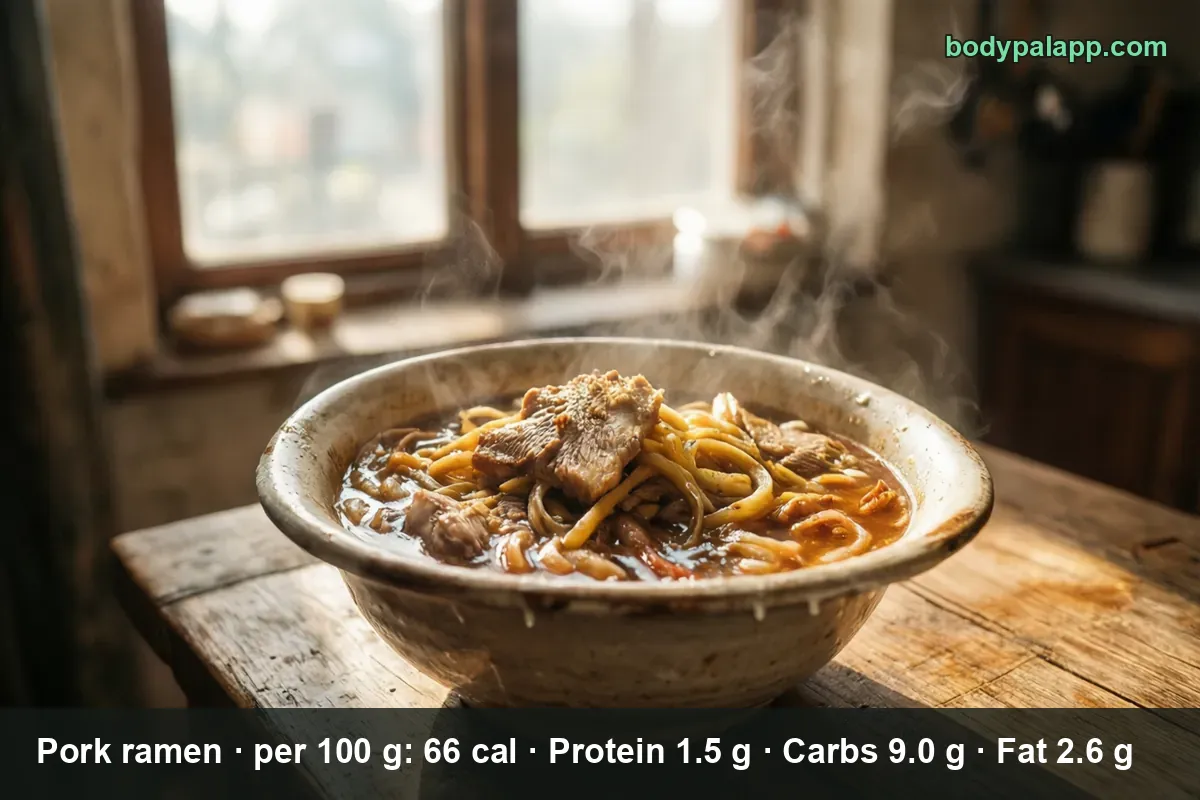
One restaurant-size bowl of pork ramen weighs 440 g and carries 290 calories. The soup itself runs 66 calories per 100 g, because water is most of what sits in the bowl. A single cup is 162. That number covers noodles and broth; the sliced chashu on top is extra.
On this page
- Pork ramen quick facts
- US servings, from one cup to the whole bowl
- Dry instant ramen is a different food
- Sodium, not calories, is the row to watch
- How does pork ramen compare?
- Most popular pork ramen brands
- FAQ
Pork ramen quick facts
The number people actually want is for the thing in front of them: a finished bowl, noodles swimming in broth. That is FNDDS 2709152, "Soup, ramen noodles, water added" — the only USDA record for ramen after it has been cooked with water. Everything else in the database is a dry block or a sealed package, and those live in their own section below.
Two honest limits on this record. It is plain ramen soup, so the chashu pork, the soft egg and the ladle of tonkotsu fat that make a shop bowl what it is are not counted in it. And USDA does not publish added sugars or trans fat for this FNDDS entry, so those rows are missing from the table rather than guessed.
| Nutrient | Per 100 g | Per 1 bowl (440 g) | % Daily Value |
|---|---|---|---|
| Calories | 66 | 290 | — |
| Total fat | 2.64 g | 11.6 g | 15% |
| Saturated fat | 1.22 g | 5.4 g | 27% |
| Carbohydrate | 9.04 g | 39.8 g | 14% |
| Dietary fiber | 0.4 g | 1.8 g | 6% |
| Total sugars | 0.3 g | 1.3 g | — |
| Protein | 1.53 g | 6.7 g | 13% |
| Sodium | 282 mg | 1241 mg | 54% |
% Daily Value is based on a 2,000-calorie diet.
Verified nutrition data
Numbers on this page come from USDA FoodData Central, the U.S. Department of Agriculture’s food composition database, and from manufacturer labels where a branded product is named. Last verified September 2026. How we verify our data →
Cholesterol is 0 mg, which surprises people who assume a pork-flavored soup must carry some. Potassium is 27 mg per 100 g, or 119 mg in the bowl — 3% of the Daily Value, so ramen does nothing for that column.
US servings, from one cup to the whole bowl
| Serving | Weight | Calories |
|---|---|---|
| 1 oz | 28 g | 18 kcal |
| 1 cup | 245 g | 162 kcal |
| 2 cups | 490 g | 323 kcal |
| 1 bowl, one individual container | 440 g | 290 kcal |
| 1 oz dry, as it yields prepared | 165 g | 109 kcal |
| Per 100 g | 100 g | 66 kcal |
The cup, the bowl and the "1 oz dry, as it yields" line are USDA household measures for this record. The 1 oz and 2 cup rows are our own arithmetic from the USDA 100 g figure, not USDA servings.
The cup-versus-bowl gap is where most logging errors happen. A cup of ramen is 245 g and 162 calories; the bowl a shop hands you is 440 g and 290 — nearly 1.8 times as much soup. If you log "a bowl" and the app assumes a cup, you are 128 calories light before a single slice of pork goes in. Weigh the bowl once, and you will know which one you own forever.
That last row is useful for a different reason: one ounce of dry noodles swells to 165 g of soup. Ramen is one of the few foods where the cooked weight is several times the dry weight, and the water carries no calories at all.
Dry instant ramen is a different food
Here is the single most misread number on this page. One hundred grams of dry instant ramen is 440 calories. One hundred grams of the same ramen after cooking is 66. Water is roughly 85% of what you scoop out of the pot, so "100 g of ramen" means nothing until you say dry or prepared.
| Version | Per 100 g | Typical piece | Calories |
|---|---|---|---|
| Instant ramen, dry, any flavor | 440 kcal | 1 package without flavor packet (81 g) | 356 kcal |
| Beef-flavor instant ramen, dry | 441 kcal | 1 package without flavor packet (82 g) | 362 kcal |
| Chicken-flavor instant ramen, dry | 439 kcal | 1 package without flavor packet (81 g) | 356 kcal |
| Reduced-fat, reduced-sodium ramen, dry | 350 kcal | 1.41 oz, half a block (40 g) | 140 kcal |
| Prepared ramen soup | 66 kcal | 1 cup (245 g) | 162 kcal |
| Ramen bowl, vegetarian | 108 kcal | 1 cup (245 g) | 265 kcal |
Note how flat the top three rows are: 440, 441 and 439 per 100 g. The flavor on the packet barely moves the calories, because the calories are in the fried noodle block, not the seasoning. Among the dry blocks, only the reduced-fat version, baked instead of fried, comes in under 400 — at 350 per 100 g, with 2.5 g of fat against 17.59 g in the standard block.
USDA's serving for those dry rows is "1 package without flavor packet," while the 100 g values describe the flavored product. So the 356 calories are the noodles alone; the packet adds a little more, and most of the salt.
Branded pork ramen lands wherever its water content lands. A Maruchan Hearty Pork container is 481 calories per 100 g and 230 for the labeled half-container, an Itsuki tonkotsu pork ramen 333 per 100 g and 290 for its 87 g serving, while a refrigerated Simple Truth pork ramen is only 56 per 100 g — because it is sold already wet, with 340 g in the bag for 190 calories.
Sodium, not calories, is the row to watch
At 290 calories, a bowl of pork ramen is a cheap lunch by calorie count. The salt is another story. One bowl carries 1,241 mg of sodium, 54% of the FDA Daily Value of 2,300 mg — a little over half a teaspoon of table salt, before anyone reaches for the soy sauce.
Dry instant ramen is worse per gram than it looks. The standard block is 1,855 mg of sodium per 100 g, or 81% of a day's Daily Value; the chicken-flavor version is the saltiest at 1,923 mg, which is 84%. The reduced-sodium block is the outlier at 1,200 mg, 52% — still half a day, just not most of it. The CDC's sodium guidance is worth reading if ramen is a weekly habit rather than an occasional one.
Saturated fat is the second row people skip. The bowl carries 5.4 g, 27% of the Daily Value, which is a lot for a soup that reads as light. The Dietary Guidelines for Americans put the ceiling at less than 10% of daily calories from saturated fat — about 20 g at 2,000 calories. One bowl uses just over a quarter of it, and the fried noodle block is where it comes from.
Protein is the gap in the other direction: 6.7 g in the whole bowl, 13% of the Daily Value. If you want ramen to hold you until dinner, the pork on top is not decoration — it is the only thing in the bowl doing that job.
How does pork ramen compare?
| Soup | Per 100 g | US serving | Calories |
|---|---|---|---|
| Pork ramen, prepared | 66 kcal | 1 cup (245 g) | 162 kcal |
| Ramen bowl, vegetarian | 108 kcal | 1 cup (245 g) | 265 kcal |
| Pho with meat | 77 kcal | 1 cup (245 g) | 189 kcal |
| Wonton soup | 33 kcal | 1 cup (245 g) | 81 kcal |
Our take: plain pork ramen is the second-lightest cup here, and wonton soup is exactly half of it, 81 against 162. The surprise is the vegetarian ramen bowl at 265 a cup — the meatless option is the heaviest on the list, because those bowls arrive with oil, thicker noodles and toppings already counted in. If you want the lowest calorie count, order wonton. If you want the soup to actually feed you, pho gives 5.81 g of protein per 100 g against 1.53 g for ramen, for 27 more calories a cup. For pork ramen itself, the useful move is not swapping the soup but sizing it: a cup with extra chashu beats a full 440 g bowl of mostly noodles.
Most popular pork ramen brands in the United States
Ranked by how widely each product appears among foods sold in the United States, from the BodyPal food database of over 3.3 million products. Calories are the figures printed on each Nutrition Facts label, checked against USDA FoodData Central.
| Product | Calories (per 100 g) |
|---|---|
| Maruchan Ramen Noodle Soup Hearty Pork | 481 cal |
| Maruchan Pork Ramen Noodle Soup | 442 cal |
| Itsuki Tonkotsu Pork Ramen | 333 cal |
| Fortune Miso Pork Ramen | 266 cal |
| Simple Truth Pork Ramen | 56 cal |
| Simple Truth Pork Ramen with Miso Broth | 56 cal |
Brand popularity: BodyPal food database. Nutrition: manufacturer labels / USDA FoodData Central.
Pork ramen FAQs
How many calories are in a bowl of pork ramen?
A 440 g bowl of prepared pork ramen is 290 calories, at 66 calories per 100 g. That covers noodles and broth as USDA measures them, not the chashu slices, egg or extra fat a ramen shop ladles on top. A 245 g cup of the same soup is 162 calories.
How many calories in one pack of instant pork ramen?
A dry instant ramen package is 356 calories for 81 g, since dry ramen runs 440 calories per 100 g. Nothing is lost when you add water, so that block plus its seasoning is what lands in your bowl. Reduced-fat, reduced-sodium blocks are 350 per 100 g instead.
Is pork ramen high in sodium?
Yes. One 440 g bowl carries 1,241 mg of sodium, 54% of the FDA Daily Value, and dry instant ramen is 1,855 mg per 100 g — 81% of a day in one block. A little over half a teaspoon of table salt sits in the finished bowl.
How much protein is in pork ramen?
A 440 g bowl gives 6.7 g of protein, 13% of the Daily Value, from 1.53 g per 100 g. That is low for a main meal; the noodles supply most of it and USDA's prepared record does not include chashu slices, which is where the real protein in a shop bowl comes from.
Does the broth or the noodles have more calories?
The noodles: a dry block is 440 calories per 100 g while the finished soup is 66, so the fried noodles and their fat carry almost everything. USDA does not publish a broth-only record, so an exact split is not possible from these numbers alone.
Ramen vs pho — which has fewer calories?
Pork ramen, by a small margin: 162 calories per 245 g cup against 189 for pho with meat, or 66 against 77 per 100 g. Pho pays for that gap in protein, 5.81 g per 100 g versus 1.53 g, so it is the more filling cup of the two.
Is tonkotsu ramen more fattening than shoyu ramen?
USDA has no shoyu or tonkotsu record to compare, so the honest answer is packaged: an Itsuki tonkotsu pork ramen is 333 calories per 100 g and 290 per 87 g serving, against 66 per 100 g for plain prepared ramen. Pork-bone broth is fatty, and it shows.
Is pork ramen OK for weight loss?
A 290-calorie bowl fits most lunch budgets, so calories are not the problem — 1,241 mg of sodium and only 6.7 g of protein are. If you eat ramen often, the reduced-sodium dry block at 1,200 mg per 100 g and a topping of real pork fix both gaps.
Similar foods
- Bean Soup — 171 cal per cup
- Caldo De Res — 348 cal per bowl
- Pea Soup — 156 cal per cup
- Lentil Soup — 153 cal per cup
- Tripe Soup — 148 cal per cup
- Chicken Taco Soup — 140 cal per cup
Count it without the math
Point the camera at the bowl and BodyPal counts the noodles, the broth and the pork on top for you.


How long does it take to burn off pork ramen?
One bowl (440 g) is 290 kcal. Enter your weight and the amount you ate to see how long it takes you to burn that off:
lb
| Activity | Time to burn 290 kcal |
|---|---|
| Walking, brisk | 58 min |
| Cycling, moderate | 36 min |
| Swimming, moderate | 41 min |
| Jogging | 34 min |
| Weight training, moderate | 1 hr 4 min |
Times are for a 155 lb adult at a steady pace; change the weight to see yours. The amount is set to the portion in the text (440 g); change it to what you actually ate. BodyPal works this out from your steps automatically.
This table assumes you know your daily total. If you do not, the daily calorie calculator works it out from five numbers.