
How many calories are in bean soup?
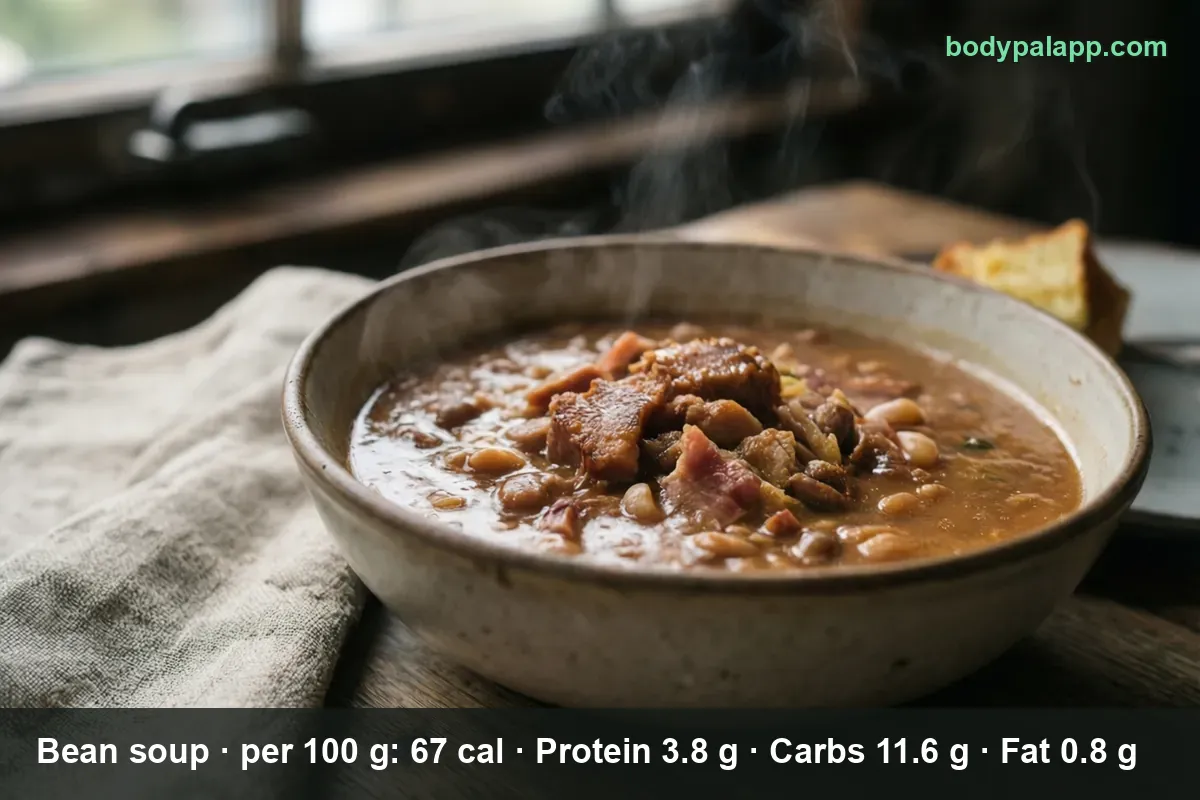
A 1-cup serving of bean soup weighs 255 g and carries 171 calories. Per 100 g the soup runs 67 calories, which puts it near the bottom of the bowl rankings for anything that still counts as a meal. The cup also holds 9.6 g of protein and 10.2 g of fiber.
You'd need to walk about 34 minutes to burn the 171 calories in a 1-cup (255 g) serving.
How long does it take to burn off bean soup?
A 1-cup (255 g) serving is 171 kcal. Enter your weight and the amount you ate to see how long it takes you to burn that off:
lb
| Activity | Time to burn 171 kcal |
|---|---|
| Walking, brisk | 34 min |
| Cycling, moderate | 21 min |
| Swimming, moderate | 24 min |
| Jogging | 20 min |
| Weight training, moderate | 38 min |
Times are for a 155 lb adult at a steady pace; change the weight to see yours. The amount is set to the portion in the text (255 g); change it to what you actually ate. BodyPal works this out from your steps automatically.
On this page
- Bean soup quick facts
- US servings from one ounce to a two-cup bowl
- What ham and pork add to the bowl
- Condensed soup is not what you eat
- The sodium trap in canned bean soup
- Fiber beats protein on this label
- How does bean soup compare?
- Most popular bean soup brands
- FAQ
Bean soup quick facts
The row on this page is FNDDS 2707453, "Soup, bean" — plain bean soup as it reaches the table, ready to eat, no meat stirred in. That is the version most people are holding when they go looking for a number: a bowl ladled out at home or ordered as a side. The canned and condensed records in USDA describe a different preparation of the same food, not a different source, and they get their own sections further down.
| Nutrient | Per 100 g | Per 1 cup (255 g) | % Daily Value |
|---|---|---|---|
| Calories | 67 | 171 | — |
| Total fat | 0.76 g | 1.9 g | 2% |
| Saturated fat | 0.13 g | 0.3 g | 2% |
| Carbohydrate | 11.62 g | 29.6 g | 11% |
| Dietary fiber | 4 g | 10.2 g | 36% |
| Total sugars | 1.14 g | 2.9 g | — |
| Protein | 3.76 g | 9.6 g | 19% |
| Sodium | 244 mg | 622 mg | 27% |
% Daily Value is based on a 2,000-calorie diet.
Verified nutrition data
Numbers on this page come from USDA FoodData Central, the U.S. Department of Agriculture’s food composition database, and from manufacturer labels where a branded product is named. Last verified September 2026. How we verify our data →
Two rows you would see on a can are missing here on purpose: added sugars and trans fat. USDA does not publish either value for this FNDDS record, so there is nothing honest to print. Cholesterol is 0 mg, which is what you would expect from a bowl built on beans and broth, and the cup carries 502 mg of potassium, 11% of the Daily Value. The %DV column follows the FDA Daily Values for a 2,000-calorie day.
US servings from one ounce to a two-cup bowl
| Serving | Weight | Calories |
|---|---|---|
| 1 oz | 28.4 g | 19 kcal |
| Half a cup, cup-of-soup size | 127.5 g | 85 kcal |
| 1 cup | 255 g | 171 kcal |
| One diner bowl, 1.5 cups | 382.5 g | 256 kcal |
| Two cups, a full dinner portion | 510 g | 342 kcal |
| Per 100 g | 100 g | 67 kcal |
The 1-cup (255 g) line is the USDA household measure, and it is the only weight in that table that comes from the record itself. The half cup, the 1.5-cup bowl, the two-cup portion and the ounce are our own arithmetic from the USDA 100 g figure, not USDA servings — soup scales cleanly, since it is a liquid you can pour and weigh.
The gap worth noticing is between the cup and the bowl. Order soup as a starter and you are near 171 calories; order it as lunch and the bowl a kitchen sends out is closer to 1.5 cups, or 256. Nothing about the soup changed. Weigh your own bowl once with the bowl tared out and you will never have to guess again.
What ham and pork add to the bowl
| Version | Per 100 g | Typical serving | Calories |
|---|---|---|---|
| Plain bean soup | 67 kcal | 1 cup (255 g) | 171 kcal |
| Bean soup with meat | 84 kcal | 1 cup (255 g, our arithmetic) | 214 kcal |
| Bean with ham, chunky ready-to-serve | 95 kcal | 1 cup (243 g) | 231 kcal |
| Bean with pork, condensed | 129 kcal | 1/2 cup (130 g) | 168 kcal |
| Bean with pork, prepared with water | 63 kcal | 1 cup (266 g) | 168 kcal |
| Bean with frankfurters, condensed | 142 kcal | 1 cup (263 g) | 373 kcal |
| Bean with frankfurters, prepared with water | 75 kcal | 1 cup (250 g) | 188 kcal |
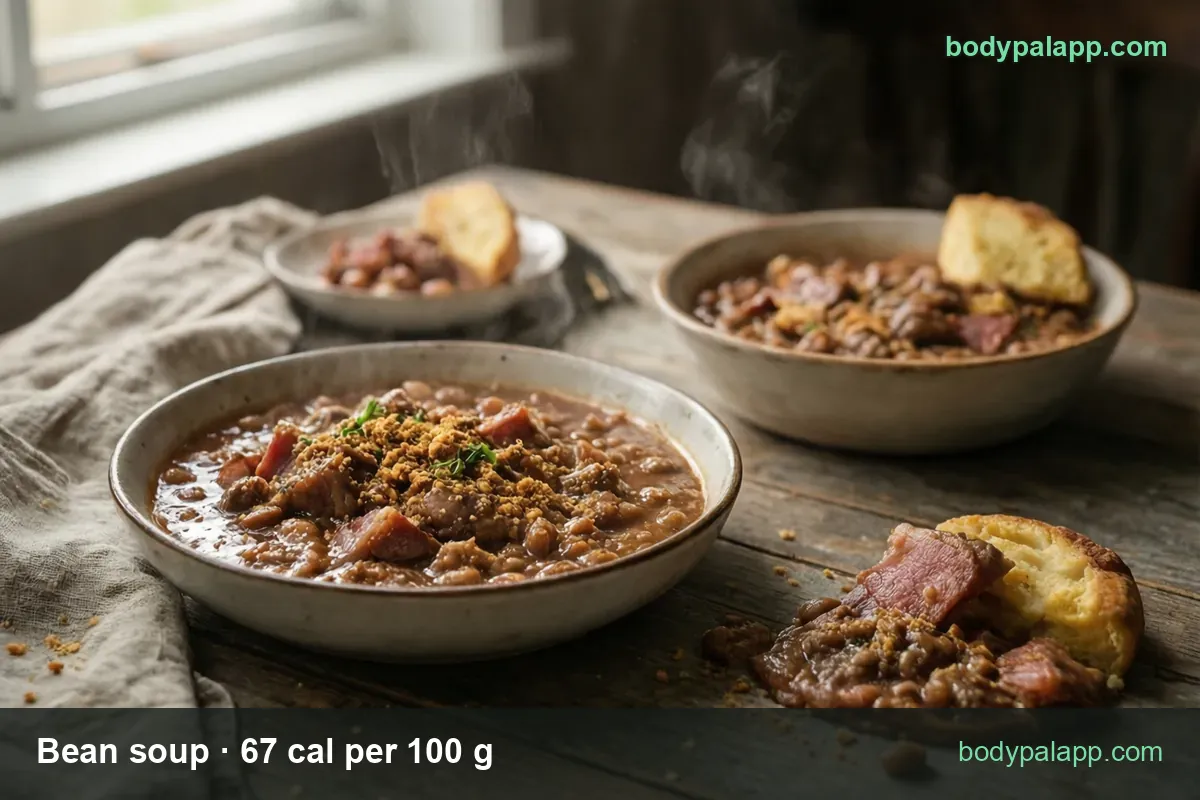
Meat moves this soup less than you would guess. The FNDDS record for bean soup with meat sits at 84 calories per 100 g against 67 for plain — the 214-calorie cup on that row is our arithmetic from the 100 g figure at the plain soup's cup weight, since USDA does not publish a separate household measure for it. Chunky bean with ham is the heaviest of the ready-to-eat versions at 95 per 100 g, or 231 for its 1-cup (243 g) serving.
What the meat really changes is the fat and protein split. Plain bean soup is 0.76 g of fat per 100 g; the version with meat is 2.35 g and the chunky ham can 3.5 g, with saturated fat climbing from 0.13 g to 1.37 g. Protein rises in step, from 3.76 g to 5.19 g. Sixty extra calories a cup, mostly bought with fat.
Frankfurters are the outlier. Prepared with water the soup is 75 calories per 100 g and 188 a cup, still modest — but a cup of the condensed concentrate is 373, and that number only applies if you eat it straight from the can, which is the next trap.
Condensed soup is not what you eat
The label on a condensed can describes a food nobody actually eats. USDA's condensed bean with pork record is 129 calories per 100 g. The prepared version, the same soup after you stir in a can of water, is 63.
Run it through and the arithmetic is neat: the half cup of concentrate you tip out (130 g) is 168 calories, and the full 1-cup (266 g) serving it becomes is also 168. The calories never moved. The volume doubled. If you log the condensed number against the volume in your bowl, you double-count the soup; if you log the prepared number against the concentrate, you halve it.
Store brands sit in the same territory. The USDA Branded rows for Campbell's condensed bean with bacon come in at 142 calories per 100 g of concentrate, close to the 129 of the generic condensed record, with the chunky bean and ham cans down at 61 to 62 per 100 g because they are already diluted and ready to serve.
The sodium trap in canned bean soup
Calories are not what should worry you in a bean soup. Sodium is. A cup of the plain FNDDS soup carries 622 mg, 27% of the Daily Value, from 244 mg per 100 g — about a quarter of a teaspoon of table salt in one bowl.
The canned versions climb from there. Plain canned bean soup is 264 mg per 100 g, the chunky bean with ham can is 400 mg, and a cup of canned bean with pork prepared with water reaches 928 mg — 40% of a day's sodium in one serving. The Dietary Guidelines for Americans cap the day at 2,300 mg, so that single cup takes a hefty bite before anything else on the plate.
There is an easy lever. USDA lists reduced-sodium versions of both the canned soup and the ham soup at 187 mg per 100 g, a drop of about 30% from the standard can, and for the plain canned soup the calories do not move: 47 per 100 g either way. If you are watching sodium, the reduced-sodium can is the better pick, and it costs you nothing nutritionally.
Fiber beats protein on this label
Here is the number that makes bean soup worth its bowl. One cup gives 10.2 g of dietary fiber — 36% of the 28 g Daily Value — for 171 calories. The same cup gives 9.6 g of protein, which is 19% of the protein DV. Nearly twice the share of fiber as protein, in a soup that stays under 200 calories.
That ratio is unusual. Most soups under 200 calories a cup are mostly water and salt; this one is beans, and the beans carry through. MyPlate counts beans in both the protein and the vegetable group for exactly that reason.
The canned versions dilute it. Plain canned bean soup drops to 2.7 g of fiber per 100 g against 4 g for the ready-to-eat record — thinner soup, less bean per spoon. The chunky bean with ham can, thick enough to stand a spoon in, comes back up to 4.6 g per 100 g.
How does bean soup compare?
| Soup | Per 100 g | Protein per 100 g | Fat per 100 g | 1 cup |
|---|---|---|---|---|
| Bean soup | 67 kcal | 3.76 g | 0.76 g | 171 kcal |
| Split pea soup | 61 kcal | 3.55 g | 0.7 g | — |
| Lentil soup | 60 kcal | 3.82 g | 0.69 g | — |
| Italian wedding soup | 66 kcal | 3.57 g | 2.4 g | — |
The cup column is empty for the three neighbors on purpose: USDA does not publish a cup weight for those FNDDS records, and inventing one would put a made-up number next to a real one. Per 100 g is the honest comparison.
Our take: on calories these four are the same soup. Seven calories per 100 g separate the lightest, lentil at 60, from bean soup at 67, and you will never feel that difference. Lentil is the only one of the three with more protein per gram, by a rounding error. The real split is fat — Italian wedding soup carries more than three times the fat of the other three, because meatballs. If you want the lightest bowl, take lentil or split pea; if you want the one that keeps you full longest for the calories, bean soup's 10.2 g of fiber a cup is the reason to pick it.
Most popular bean soup brands in the United States
Ranked by how widely each product appears among foods sold in the United States, from the BodyPal food database of over 3.3 million products. Calories are the figures printed on each Nutrition Facts label, checked against USDA FoodData Central.
| Product | Calories (per 100 g) |
|---|---|
| Campbell's Condensed Bean with Bacon | 142 cal |
| Campbell's Condensed Bean & Bacon | 142 cal |
| Campbell's Chunky Bean & Ham | 62 cal |
| Campbell's Bean and Ham | 61 cal |
| Campbell's Healthy Request Bean with Bacon | 142 cal |
Brand popularity: BodyPal food database. Nutrition: manufacturer labels / USDA FoodData Central.
Bean soup FAQs
How many calories in 1 cup of bean soup?
A 1-cup serving of bean soup weighs 255 g and carries 171 calories, from the USDA FNDDS record for plain bean soup at 67 calories per 100 g. That cup also brings 9.6 g of protein and 10.2 g of fiber, so it eats like a light meal rather than a starter.
How many calories are in a bowl of bean soup?
A diner-style bowl of about 1.5 cups (382.5 g) runs 256 calories, our own arithmetic from the USDA 100 g figure rather than a USDA serving. Two full cups (510 g) reach 342 calories. Bowls vary a lot between kitchens, so weigh yours once and you will know which one you are eating.
Is bean soup good for weight loss?
At 67 calories per 100 g, bean soup is one of the lighter things you can fill a bowl with, and a cup lands at 171 calories with 10.2 g of fiber. That mix of volume and fiber is why a cup before a sandwich tends to end the meal sooner than the sandwich alone would.
How much protein is in bean soup?
One cup has 9.6 g of protein, 19% of the Daily Value, from 3.76 g per 100 g. The USDA record for bean soup with meat is higher at 5.88 g per 100 g, and chunky bean with ham reaches 5.19 g. Plain bean soup is a fiber food first and a protein food second.
How much fiber is in bean soup?
A cup delivers 10.2 g of dietary fiber, 36% of the 28 g Daily Value, from 4 g per 100 g. That is a bigger share of the day's fiber than the same cup gives you of protein, which is 19%. Plain canned bean soup is thinner and drops to 2.7 g per 100 g.
Is canned bean soup high in sodium?
Canned plain bean soup carries 264 mg of sodium per 100 g against 244 mg for the ready-to-eat record, and the reduced-sodium can drops to 187 mg. A cup of canned bean with pork prepared with water is the outlier at 928 mg, 40% of the Daily Value in one serving.
Does bean and ham soup have more calories than plain bean soup?
Yes — chunky bean with ham runs 95 calories per 100 g against 67 for plain, so a 1-cup (243 g) serving is 231 calories next to 171. The ham also pushes sodium to 400 mg per 100 g and saturated fat to 1.37 g, which matters more than the 60 extra calories.
How many calories in condensed bean soup before adding water?
Condensed bean with pork is 129 calories per 100 g, so the half cup (130 g) of concentrate you tip out of the can is 168 calories. Add the water and those same 168 calories spread across a full 1-cup (266 g) serving at 63 calories per 100 g. Same soup, double the volume.
Similar foods
- Ceviche — 158 cal per cup
- Pomegranate — 72 cal for 1/2 cup arils
- Clementine — 35 cal per clementine
- Clam Chowder — 237 cal per cup
- Chinese Chicken and Broccoli — 206 cal per cup
- Tom yum soup — 191 cal per bowl
Count it without the math
Point the camera at the bowl and BodyPal counts the soup for you, ham and all.

