
How many calories are in a pork steak?
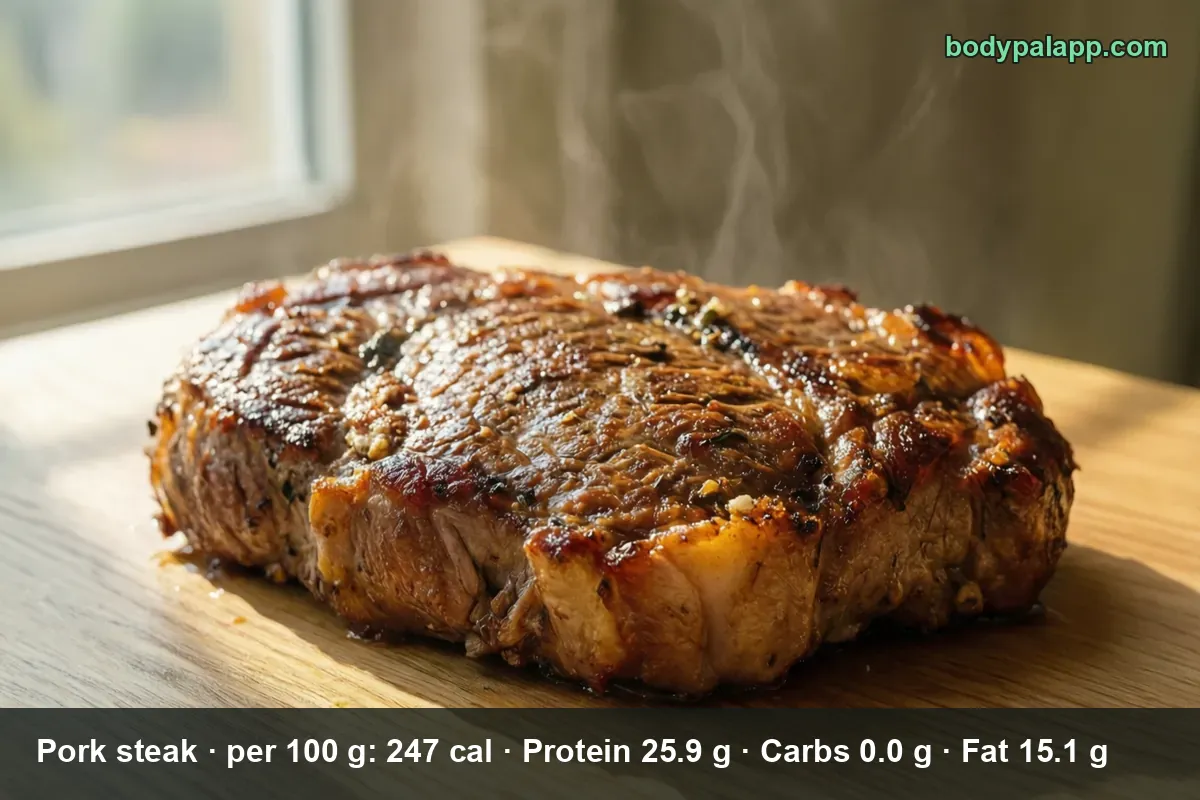
A cooked pork steak of 120 g carries 296 calories, and the meat runs 247 calories per 100 g. Almost none of that is carbohydrate — the steak is 25.93 g of protein and 15.08 g of fat per 100 g. The number that moves most is not the cut but the fat strip along its edge.
On this page
- Pork steak quick facts
- US servings, from one slice to a cup of diced pork
- Trimmed, untrimmed and breaded
- Carnitas, barbecue pork and ground pork
- Saturated fat and cholesterol are the rows to watch
- How does pork steak compare?
- Most popular pork steak brands
- FAQ
Pork steak quick facts
In the US a pork steak is cut from the shoulder — the blade end of the butt — which is why it has that ribbon of fat running through it and along one edge. USDA carries three separate records for the same cooked steak, split by what actually ends up eaten. The one below, FNDDS 2705873, "Pork, steak, NS as to fat eaten", is the unspecified case: you cooked it, you cut into it, nobody kept score of the fat. It sits between the trimmed record at 230 calories per 100 g and the eat-everything record at 264.
That is the figure to use when the steak is already on the plate in front of you. The portion column is USDA's own household measure, one steak of any size at 120 g.
| Nutrient | Per 100 g | Per 1 steak (120 g) | % Daily Value |
|---|---|---|---|
| Calories | 247 | 296 | — |
| Total fat | 15.08 g | 18.1 g | 23% |
| Saturated fat | 5.66 g | 6.8 g | 34% |
| Carbohydrate | 0 g | 0 g | 0% |
| Dietary fiber | 0 g | 0 g | 0% |
| Total sugars | 0 g | 0 g | — |
| Protein | 25.93 g | 31.1 g | 62% |
| Sodium | 317 mg | 380 mg | 17% |
% Daily Value is based on a 2,000-calorie diet.
Verified nutrition data
Numbers on this page come from USDA FoodData Central, the U.S. Department of Agriculture’s food composition database, and from manufacturer labels where a branded product is named. Last verified September 2026. How we verify our data →
Two label rows are missing on purpose. USDA does not publish added sugars or trans fat for this record, so there is nothing honest to put in those cells for fresh cooked meat. Cholesterol and potassium do exist here: 98 mg and 330 mg per 100 g, which works out to 118 mg of cholesterol (39% DV) and 396 mg of potassium (8% DV) in one steak. The 380 mg of sodium is roughly a sixth of a teaspoon of table salt — the USDA figure reflects meat as people typically season and cook it, not the bare cut.
US servings, from one slice to a cup of diced pork
| Serving | Weight | Calories |
|---|---|---|
| 1 slice, any size | 30 g | 74 kcal |
| 1 oz cooked | 28 g | 70 kcal |
| 1 oz raw, as it yields cooked | 20 g | 49 kcal |
| One steak, any size | 120 g | 296 kcal |
| 1 cup, diced | 135 g | 333 kcal |
| Per 100 g | 100 g | 247 kcal |
Four of those — the slice, the steak, the cup and the raw-ounce yield — are USDA household measures attached to the record itself. The 1 oz cooked line is our own arithmetic from the USDA 100 g figure, not a USDA serving.
The raw-ounce row is the one worth staring at, because it is where most people log the wrong number. USDA's yield measure says an ounce of raw pork steak comes off the grill weighing 20 g. Scale that up and a 4 oz raw steak — the weight printed on the package — lands near 80 g cooked and about 198 calories, while 4 oz of cooked steak on the scale is 112 g and about 277 calories, both our own arithmetic from the 100 g figure. Same words, a 79-calorie gap.
The diced cup is the other trap. It looks like a modest measure, but 135 g of chopped pork steak is 333 calories, 37 more than the whole steak it came from.
Trimmed, untrimmed and breaded
| Version | Per 100 g | Typical piece | Calories |
|---|---|---|---|
| Lean only, fat trimmed | 230 kcal | 1 steak (120 g) | 276 kcal |
| Fat strip unspecified (this page) | 247 kcal | 1 steak (120 g) | 296 kcal |
| Lean and fat eaten | 264 kcal | 1 steak (120 g) | 317 kcal |
| Breaded, coated | 275 kcal | 1 steak (120 g) | 330 kcal |
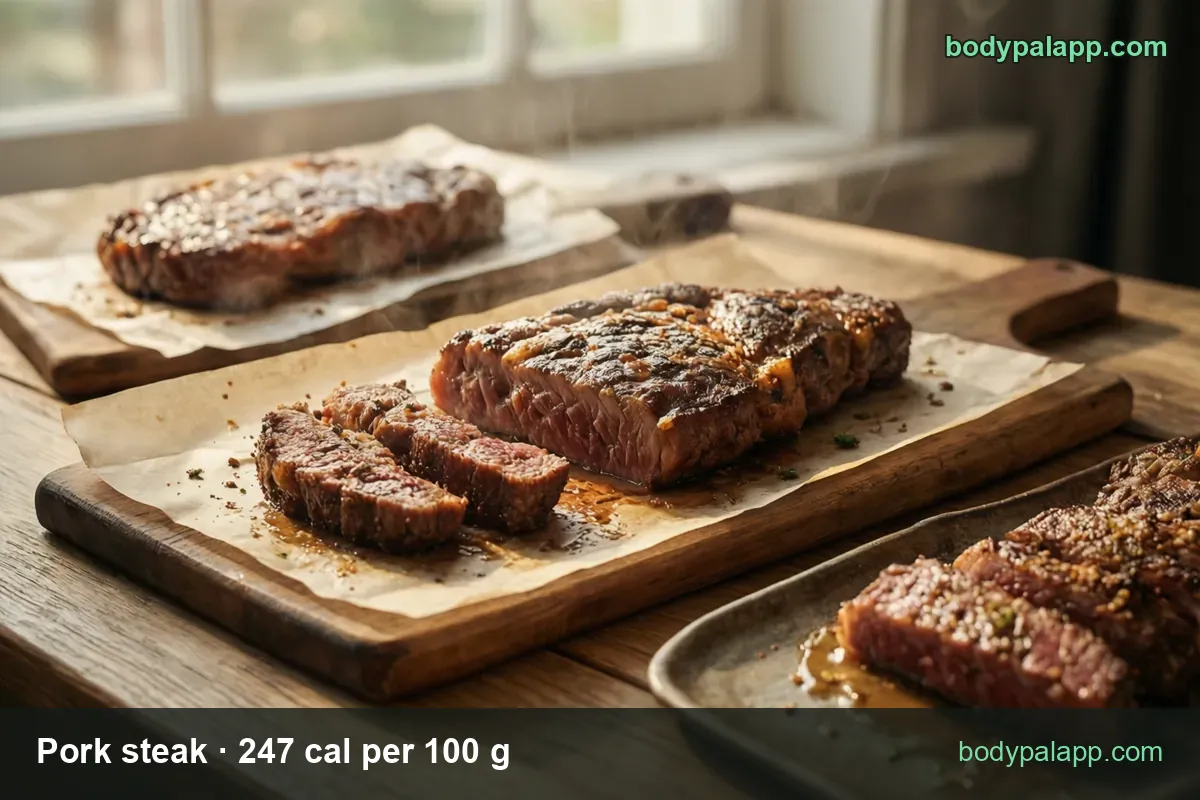
Between the top and third rows there is a 41-calorie spread and 1.9 g of saturated fat, decided entirely by whether the fat edge goes in your mouth or on the side of the plate. No recipe change, no cooking method, just the knife. That is a bigger swing than most people expect from a cut this lean-looking, and it is the single easiest edit on this page.
Breading is the other lever, and it is sneakier than it looks. The coated steak adds only 34 calories to the 120 g piece. What it really does is turn a zero-carb food into one with 7.2 g of carbohydrate per 100 g and push sodium from 317 to 352 mg per 100 g. Store-bought fully cooked breaded pork steaks are heavier still: the frozen patties in the USDA branded database run 298 to 306 calories per 100 g, or 321 to 331 per 3.85 oz piece. Fresh raw-weight packages, the ones labeled 4 oz, sit at 205 to 232 calories per 100 g and 230 to 260 per serving as packed.
Carnitas, barbecue pork and ground pork
The same shoulder becomes several other things in an American kitchen, and the numbers separate quickly once fat or sauce enters.
| Pork from the shoulder | Per 100 g | US serving | Calories |
|---|---|---|---|
| Carnitas | 271 kcal | 3 oz (85 g) | 230 kcal |
| Barbecue pork, no sauce | 249 kcal | 3 oz (85 g) | 212 kcal |
| Ground pork | 299 kcal | 3 oz (85 g) | 254 kcal |
Carnitas is the same meat braised and then crisped in its own fat, which is why it lands 24 calories per 100 g above the steak. Barbecue pork with no sauce added is almost identical to the plain steak — 249 against 247 — so the sauce, not the smoke, is what changes a pulled-pork plate. Ground pork is the heaviest of the three at 299 per 100 g, because the grind carries a fattier mix than a whole steak does. All three 3 oz servings are our own arithmetic from the USDA 100 g figures.
Saturated fat and cholesterol are the rows to watch
One steak delivers 6.8 g of saturated fat, 34% of the FDA Daily Value of 20 g. The Dietary Guidelines for Americans put saturated fat below 10% of daily calories, which is about 22 g on a 2,000-calorie day — so a single pork steak uses roughly a third of that before anything else on the plate. Trimming the fat edge brings it to 5.8 g; eating all of it takes it to 7.8 g.
Cholesterol reads high at 118 mg, 39% DV, though the Daily Value is the only place that number still carries a limit — the Dietary Guidelines dropped the 300 mg cap. Saturated fat is the more useful row.
The number in pork steak's favor is protein: 31.1 g in one steak, 62% of the 50 g Daily Value, with zero carbohydrate underneath it. MyPlate counts about 5.5 oz-equivalents of protein foods a day for many adults, and this steak covers a good share of it in one item. If you are watching saturated fat, the trimmed version at 276 calories is the better pick; if you want the protein at the lowest calorie cost, it is also the better pick. Both arguments point the same way, which is unusual.
How does pork steak compare?
Priced at the same 3 oz cooked weight, against its neighbors in the USDA pork category:
| Pork cut | Per 100 g | US serving | Calories |
|---|---|---|---|
| Pork steak | 247 kcal | 3 oz (85 g) | 210 kcal |
| Pork ribs | 254 kcal | 3 oz (85 g) | 216 kcal |
| Barbecue pork, no sauce | 249 kcal | 3 oz (85 g) | 212 kcal |
| Ground pork | 299 kcal | 3 oz (85 g) | 254 kcal |
Every 3 oz figure here is our own arithmetic from the USDA 100 g values, so the four are directly comparable; the everyday pork steak serving is larger, 120 g and 296 calories.
Our take: pork steak is the lightest of the four per gram, and it beats all of them except ground pork on protein — 25.93 g per 100 g against ground pork's 26.92 g. Ribs are the outlier and not in a good way: 16.22 g of protein per 100 g, roughly five-eighths of the steak's, plus 12.13 g of carbohydrate from the glaze. If you are choosing pork for a calorie-counted dinner, take the steak and cut the fat edge off. Save the ribs for the days you are not counting.
Most popular pork steak brands in the United States
Ranked by how widely each product appears among foods sold in the United States, from the BodyPal food database of over 3.3 million products. Calories are the figures printed on each Nutrition Facts label, checked against USDA FoodData Central.
| Product | Calories (per 100 g) |
|---|---|
| Prairie Fresh Chef's Prime Pork Steak | 223 cal |
| PrairieFresh Prime Chef's Prime Pork Steak | 214 cal |
| PrairieFresh Prime Chef's Prime Pork Steak | 205 cal |
| Prairie Fresh Bone In Pork Steak Ready Butt | 232 cal |
| Pierre Fully Cooked Breaded Pork Steak | 298 cal |
| Advance Pierre Country Fried Pork Steaks | 306 cal |
Brand popularity: BodyPal food database. Nutrition: manufacturer labels / USDA FoodData Central.
Pork steak FAQs
How many calories are in a pork steak?
A 120 g cooked pork steak carries 296 calories, at 247 calories per 100 g. That is the USDA figure for a steak eaten without specifying whether the fat strip was cut off. Trim it on the plate and the same steak drops to 276 calories; eat every bit of the fat and it reaches 317.
How many calories in a 4 oz pork steak?
Four ounces of cooked pork steak is 112 g and about 277 calories, our own arithmetic from the USDA 100 g figure rather than a USDA serving. Four ounces raw is a different thing: USDA's yield measure shrinks an ounce of raw pork to 20 g cooked, so that steak lands near 198 calories.
Is pork steak good for weight loss?
One steak is 296 calories carrying 31.1 g of protein, 62% of the Daily Value, in a portion most people finish in a few minutes. That protein-per-calorie ratio is the argument for it. The argument against is 6.8 g of saturated fat, 34% of the Daily Value. Trimmed, it is 276 calories.
How much protein is in a pork steak?
31.1 g of protein in a 120 g steak, which is 62% of the 50 g Daily Value, from 25.93 g per 100 g. A cup of diced pork steak, 135 g, brings 35 g. Among the pork cuts on this page only ground pork edges it out, at 26.92 g per 100 g.
Does trimming the fat lower pork steak calories?
Yes — 276 calories for a 120 g steak with the fat strip cut off, against 317 when all of it is eaten. That is 41 calories and 1.9 g of saturated fat decided by the knife rather than the recipe. USDA publishes the two cases as separate records, 2705875 and 2705874.
How many calories in a breaded pork steak?
330 calories for a 120 g breaded pork steak, against 296 for the plain one. The coating adds only 34 calories, but it brings 7.2 g of carbohydrate per 100 g where there were none and pushes sodium from 317 to 352 mg per 100 g. Frozen breaded patties run 321 to 331 per piece.
Is pork steak high in cholesterol?
118 mg in a 120 g steak, 39% of the 300 mg Daily Value used on the Nutrition Facts label. That is a lot for one item on the plate, though dietary cholesterol no longer carries a numeric cap in the Dietary Guidelines. Saturated fat, at 34% DV, is the more useful row to read.
How many calories in grilled pork shoulder steak?
296 calories for a 120 g grilled shoulder steak. In the US a pork steak is cut from the shoulder, or blade, and the USDA record covers the cooked meat itself rather than anything added in the pan. Grilling does not change the figure; whether the fat edge is eaten changes it by 41 calories.
Similar foods
- Bresaola — 70 cal per ounce
- Hamburger Patty — 193 cal per patty
- Chicken Francese — 425 cal per medium breast
- Top Sirloin Steak — 413 cal per 6 oz steak
- Chicken Breast Tender — 38 cal per tender
- Chicken Wing — 88 cal per wing
Count it without the math
Point the camera at the plate and BodyPal counts the pork steak for you, fat edge and all.


How long does it take to burn off pork steak?
One steak (120 g) is 296 kcal. Enter your weight and the amount you ate to see how long it takes you to burn that off:
lb
| Activity | Time to burn 296 kcal |
|---|---|
| Walking, brisk | 59 min |
| Cycling, moderate | 37 min |
| Swimming, moderate | 42 min |
| Jogging | 35 min |
| Weight training, moderate | 1 hr 6 min |
Times are for a 155 lb adult at a steady pace; change the weight to see yours. The amount is set to the portion in the text (120 g); change it to what you actually ate. BodyPal works this out from your steps automatically.
Want the bigger picture? Calculate your daily calorie needs — your maintenance figure, a target for losing or gaining, and the date you get there.