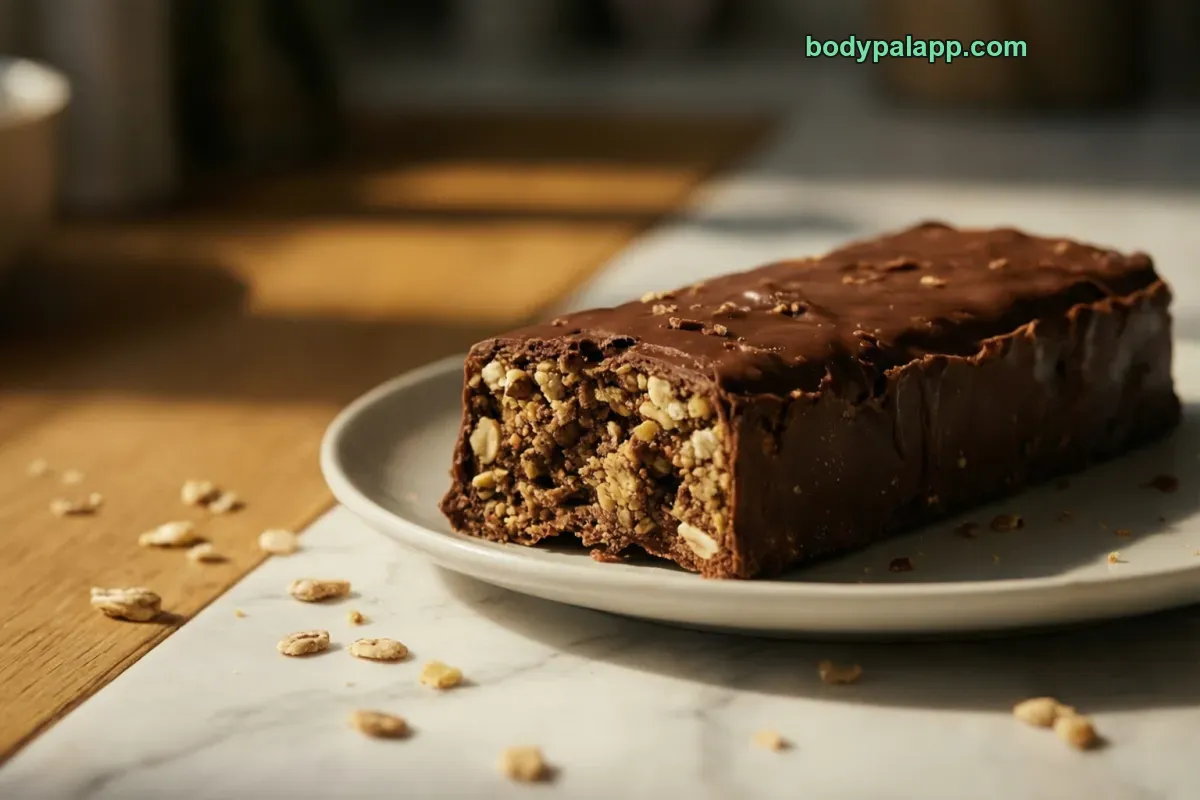
Protein bar calories come to 218 for one 53 g bar, or 412 per 100 g. That bar carries 16.1 g of protein, 32% of the daily value, yet protein supplies only 29% of its calories. Carbs and fat do most of the work, so treat a protein bar as a dense snack, not a light one.
218kcal
1 bar · 53 g, ready to eat
29%protein
16.1 gProtein
20 gCarbs
8 gFat
How to burn off 218 kcal
—Walking, brisk
—Jogging
—Cycling, moderate
—Swimming
Skip the math. BodyPal counts these calories from your steps and workouts automatically.
Nutrition facts
Ready to eat · per 53 g
Calories
218 kcal
Protein
16.1 g
Carbohydrate
20 g
Fat
8 g
Saturated fat
1.8 g
Cholesterol
2 mg
Sodium
231 mg
Potassium
420 mg
Iron
2.9 mg
Source: USDA FoodData Central
🛡️
Verified nutrition data
Numbers on this page come from USDA FoodData Central, the U.S. Department of Agriculture’s food composition database, and from manufacturer labels where a branded product is named. Last verified September 2026. How we verify our data →
Protein bar: calories, protein and sodium by serving
Percent of daily value uses the FDA reference of 2,000 kcal a day.
Serving
kcal
Protein
Carbs
Fat
Sodium
% DV kcal
1 bar (53 g)
218
16.1 g
20.4 g
8 g
231 mg
11%
Small bar (35 g)
144
10.6 g
13.4 g
5.3 g
153 mg
7%
Large bar (80 g)
332
20 g
40.4 g
10 g
190 mg
17%
100 g
412
30.3 g
38.4 g
15.2 g
436 mg
21%
3 × 1 bar (53 g)
655
48.2 g
693 mg
5 × 1 bar (53 g)
1,092
80.4 g
1,155 mg
Bar size moves the total from 144 to 332 calories
The standard bar in this guide weighs 53 g and comes to 218 calories, 11% of the daily value. Bars on the shelf are not one size, though. A small 35 g bar drops to 144 calories, while a large 80 g bar climbs to 332.
The large bar is where totals get away from you. It holds 20 g of protein, 40% of the daily value, but it also packs 40.4 g of carbs and 10 g of fat. Its 23 g of sugars sits far above the 8 g in the standard bar, and on its own it covers 17% of daily calories.
So read the weight before the flavor. The gram count on the wrapper tells you more about the total than the word protein on the front. The small bar still delivers 10.6 g of protein for 144 calories, which makes it the easiest size to fit into a tight day. If you eat bars often, buying the size you actually want beats opening a large one and finishing it anyway.
Protein supplies only 29% of the calories
Per 100 g, this bar has 30.3 g of protein, 38.4 g of carbs and 15.2 g of fat. Turn those grams into calories and the split is 37% carbs, 33% fat and 29% protein. Protein is the smallest of the three shares, even on a bar sold on its protein.
That is a recipe choice, not a trick. Fat, sugar and syrups make a bar chewy, sweet and shelf-stable, and all of them bring calories. Fat alone supplies about a third of the energy, and saturated fat comes to 3.4 g per 100 g against a daily value of 20 g. At 412 calories per 100 g, this bar sits firmly in dense-snack territory.
The protein is still real. One 53 g bar gives 16.1 g, or 32% of the daily value, for 218 calories. If protein per calorie is the goal, a bar does the job in a pinch. Just count it as a mixed snack with a protein bonus, not as pure protein.
Sugar and sodium are the rows to watch
The standard bar carries 8 g of sugars and 3.9 g of fiber. Per 100 g that is 15.2 g of sugars, the same figure as the fat. Fiber reaches 7.3 g per 100 g against a daily value of 28 g, a genuine plus for a packaged snack. The large 80 g bar pushes both rows up, to 23 g of sugars and 10 g of fiber.
Sodium is easy to miss on a sweet snack. One bar has 231 mg, 10% of the daily value, and 100 g reaches 436 mg, or 19%. That is more sodium than many people expect from something that tastes like dessert. If you watch sodium, count bars the way you would count a salty snack.
The rest of the label is calmer. Cholesterol sits at just 3 mg per 100 g, and potassium is a quiet upside at 793 mg per 100 g. Flavors and brands vary most on sugar, so that is the line to compare when you switch bars.
Two bars add up to 437 calories
Bars are easy to eat back to back because they are small and need no plate. Two standard bars come to 437 calories and 32.2 g of protein. Three reach 655 calories, and five hit 1,092 calories with 1,155 mg of sodium. Grazing on bars through a long day adds up faster than the wrappers suggest.
A single bar works best as a planned snack or as the protein part of a quick meal. Pair it with fruit if you want more volume, or with plain water if you want the total to stay at 218. A bar eaten on top of a full lunch is a second snack, not a protein fix.
Brands differ in size and recipe. RXBAR, PowerBar Clean Whey Protein Bar and similar products print their own numbers, so check the label weight against the sizes above. BodyPal can log a bar from a photo of the wrapper or the bar itself.
How does protein bar compare?
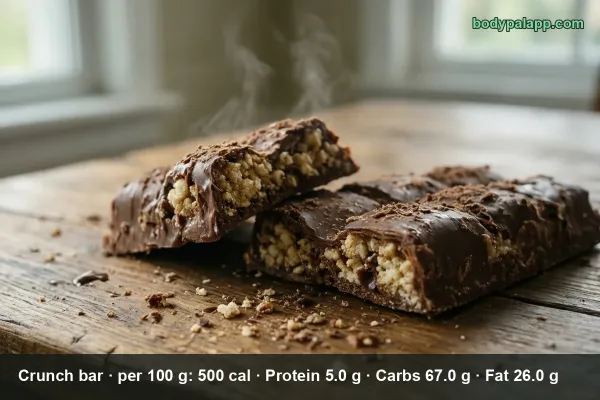
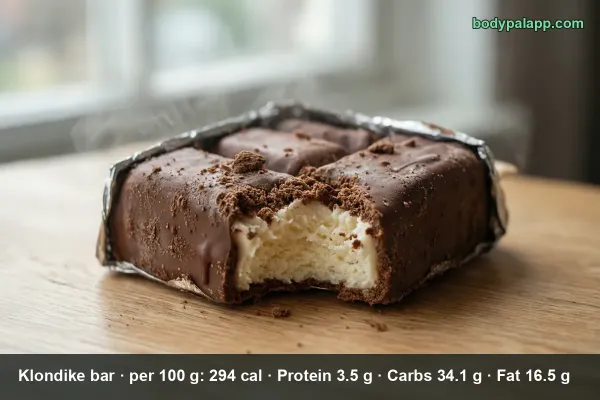
Here is how a protein bar stacks up against a Snickers bar, a crunch bar and a klondike bar, per 100 g and per usual serving.
Verdict: For the fewest calories per bite, the klondike bar wins at 294 per 100 g against 412 here, though it brings just 3.5 g of protein. For staying full, pick the protein bar: its 30.3 g of protein per 100 g beats the Snickers bar's 7.5 g, and it carries fewer calories than the Snickers bar's 491.
Most popular protein bar brands in the United States
Ranked by popularity in the BodyPal database
# Productkcal / 100 g
1PowerBar Clean Whey Protein Bar1 bar · 60 g317 kcal
2RXBAR Protein Bar1 bar · 33 g394 kcal
3RXBAR Kids Protein Bar1 bar · 33 g424 kcal
4RXBAR Protein Bar, Blueberry1 bar · 52 g385 kcal
5RXBAR Protein Bar, Berry Blast1 bar · 33 g394 kcal
6RXBAR Protein Bar, Peanut Butter1 bar · 52 g385 kcal
7RXBAR Protein Bar, Coconut Cacao1 bar · 52 g404 kcal
8RXBAR Protein Bar, Mango Pineapple1 bar · 52 g404 kcal
Bar sizes and recipes vary a lot, so brand labels here run from 317 to 424 calories per 100 g around the 412 used above. Source: manufacturer labels / USDA FoodData Central.
Protein bar FAQs
How many calories are in one protein bar?
A standard 53 g protein bar is about 218 calories. A larger 80 g bar is closer to 332 calories.
Are protein bars good for weight loss?
One 53 g bar is 218 calories with 16.1 g protein, 20.4 g carbs and 8 g sugar. It is denser than fruit but lighter than a candy bar, which runs about 491 calories per 100 g.
Protein bar vs Snickers bar: which has fewer calories?
Per 100 g a protein bar is 412 calories and a Snickers bar 491. A 53 g protein bar works out at 218 calories.
How much protein is in a protein bar?
About 16.1 g in a 53 g bar, from 30.3 g per 100 g. Branded bars range from 21.2 g to 33.3 g of protein per 100 g.
What are the nutrition facts for a protein bar?
One 53 g bar has 218 calories, 16.1 g of protein, 20.4 g of carbs and 8 g of fat. It also carries 8 g of sugars, 3.9 g of fiber and 231 mg of sodium, based on a USDA formulated bar entry.
How much fat is in a protein bar?
A standard 53 g bar has 8 g of fat, and 100 g has 15.2 g, of which 3.4 g is saturated. Fat supplies 33% of the bar's calories, which is more than protein contributes.
Do protein bars differ in calories by size?
Yes, by a lot. A small 35 g bar has 144 calories, a standard 53 g bar has 218, and a large 80 g bar has 332. Check the weight on the wrapper before you log it.
How many calories and how much protein are in 100 g of protein bar?
100 g of protein bar gives 412 calories and 30.3 g of protein, 61% of the daily value. Even so, protein provides only 29% of those calories, while carbs at 37% and fat at 33% supply the rest.