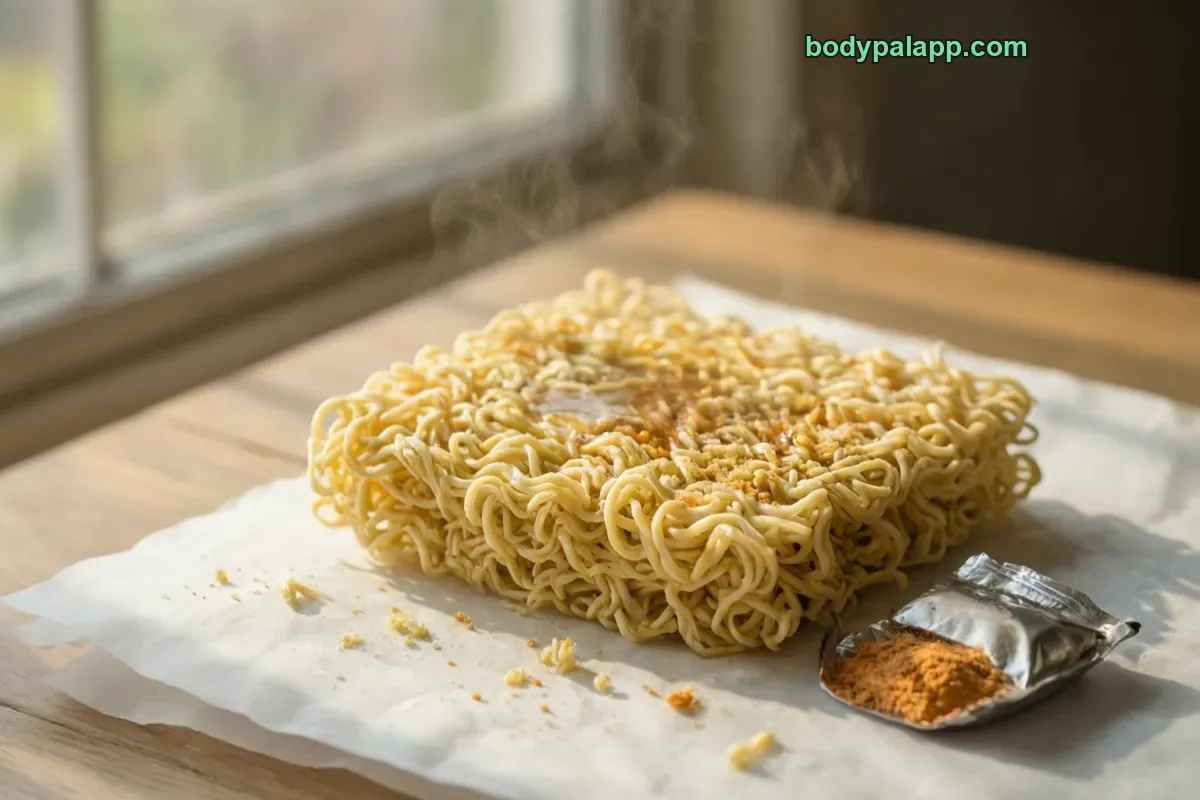
Ramen noodles package calories come to 374 for one 3 oz package (85 g), or 440 per 100 g dry. The number that matters more is sodium: a single package carries 1,577 mg, which is 69% of the daily value, before you add anything else to the bowl.
374kcal
1 3 oz package · 85 g, dry, any flavor
9%protein
8.6 gProtein
51 gCarbs
15 gFat
How to burn off 374 kcal
—Walking, brisk
—Jogging
—Cycling, moderate
—Swimming
Skip the math. BodyPal counts these calories from your steps and workouts automatically.
Nutrition facts
Dry, any flavor · per 85 g
Calories
374 kcal
Protein
8.6 g
Carbohydrate
51 g
Fat
15 g
Saturated fat
6.9 g
Cholesterol
0 mg
Sodium
1577 mg
Potassium
154 mg
Iron
3.5 mg
Source: USDA FoodData Central
🛡️
Verified nutrition data
Numbers on this page come from USDA FoodData Central, the U.S. Department of Agriculture’s food composition database, and from manufacturer labels where a branded product is named. Last verified September 2026. How we verify our data →
Ramen noodles: calories, protein and sodium by serving
Percent of daily value uses the FDA reference of 2,000 kcal a day.
Serving
kcal
Protein
Carbs
Fat
Sodium
% DV kcal
3 oz package (85 g)
374
8.6 g
51.2 g
15 g
1,577 mg
19%
Noodle block only (81 g)
356
8.2 g
48.8 g
14.2 g
1,503 mg
18%
100 g
440
10.2 g
60.3 g
17.6 g
1,855 mg
22%
3 × 3 oz package (85 g)
1,122
25.9 g
4,730 mg
5 × 3 oz package (85 g)
1,870
43.2 g
7,884 mg
One package is 374 calories, two are 748
A standard 3 oz package weighs 85 g and comes to 374 calories, about 19% of the daily value for energy. Weigh just the noodle block (81 g) and you get 356 calories. Nearly all the energy in the package sits in the block, so the noodles are what you should count.
The packages are small and cheap, so plenty of people cook two. Two packages come to 748 calories with 17.3 g of protein. Three reach 1,122 calories. Five packages, which is a lot of noodles, add up to 1,870 calories. The total climbs quickly because every block adds the same 374 calories, and a bigger pot doesn't make a bowl look much fuller.
If you track what you eat, count packages, not bowls. A deep bowl can hold a second block without looking any different, and that second block doubles everything on the label. Writing down how many packages went into the pot keeps the count honest.
Fat supplies over a third of the calories
Ramen is mostly starch. Carbs supply 55% of the calories, with 51.2 g per package. Fat supplies 36%, which is high for a noodle. Per 100 g the dry block has 17.6 g of fat, and 8.1 g of that is saturated, close to half of the 20 g daily value in a 100 g portion.
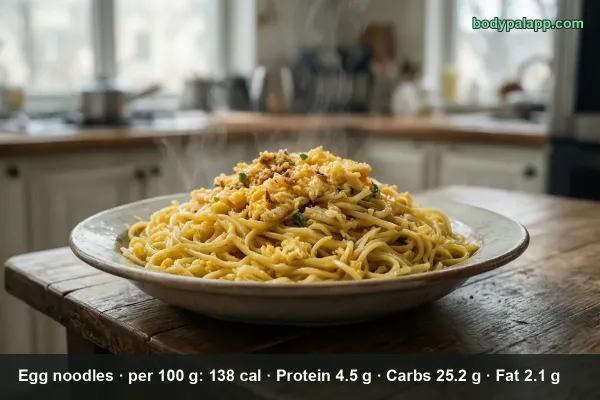
Compare that with plain egg noodles, which carry 2.1 g of fat per 100 g cooked. Instant ramen gets its richness from fat in the block itself. That is why a package of ramen has about as many calories as a full plate of other pasta while looking like a light snack.
Protein is the weak spot. It supplies just 9% of the calories, or 8.6 g per package, which is 17% of the daily value. Fiber is 2.5 g and sugars are 1.7 g. In short, a package gives you plenty of energy but little that keeps you full, so many people get hungry again soon after eating it.
Sodium is the row to watch
Sodium is the number that stands out on this label. One package carries 1,577 mg, 69% of the daily value. Per 100 g the figure is 1,855 mg, or 81%. Few foods you would call a snack pack this much salt into so small a serving.
Doubling up changes the picture completely. Two packages hold 3,154 mg of sodium, well over a full day's daily value in one meal. Three packages come to 4,730 mg, and five reach 7,884 mg. Count your packages for sodium as carefully as you count them for calories.
If you watch sodium, the simplest move is to stick to one package and treat the rest of the day's meals as the place to go lighter. Potassium sits at only 181 mg per 100 g, so the noodles do little to balance that salt. Cholesterol is 0, which is one row where ramen is not a concern.
Build the bowl around one package
A package of ramen works better as the base of a meal than as the whole meal. With protein at 8.6 g and fiber at 2.5 g, it needs help. A boiled or poached egg, leftover chicken or a few cubes of tofu add the protein the noodles lack. Frozen peas, spinach, cabbage or sliced scallions add bulk and fiber with little energy.
Adding vegetables also stretches one package into a bigger bowl, which makes it easier to resist a second block and the extra 374 calories that comes with it. Water from the vegetables thins the broth too, so each spoonful tastes less concentrated.
Keep the rest of the day in mind. A ramen lunch at 19% of daily calories and 69% of daily sodium leaves room for other meals, but less room for salty ones. BodyPal can log a bowl from a photo, which helps when you have added toppings and are not sure what the total looks like.
How does ramen noodles compare?
Here is how a package of dry ramen compares with egg noodles and a chocolate chip waffle, per 100 g and per usual serving.
Verdict: For fewer calories and almost no sodium, pick egg noodles: a cup is 221 calories with 5 mg of sodium per 100 g, against 374 calories for a ramen package. Even a chocolate chip waffle serving at 208 calories comes in lighter than the package, so save ramen for when convenience matters most and stick to one block.
Ramen noodles FAQs
How many calories are in a package of ramen noodles?
A 3 oz package (85 g, dry) has about 374 calories. The noodle block without the flavor packet (81 g) has about 356.
Is ramen good for weight loss?
A 3 oz package has 374 calories, 15.0 g of fat and 51.2 g of carbs, with 8.6 g of protein. It also carries 1577 mg of sodium.
Ramen vs egg noodles: which has fewer calories?
Dry ramen has 440 calories per 100 g, while cooked egg noodles have 138 per 100 g. Ramen is weighed dry, so the two numbers describe different states.
How much sodium is in a package of ramen?
About 1577 mg of sodium in a 3 oz package, or 1855 mg per 100 g dry with the flavor packet counted.
How many calories are in the ramen noodle block without the seasoning?
The noodle block alone (81 g) has 356 calories, 8.2 g of protein, 48.8 g of carbs and 14.2 g of fat. That is 18% of the daily value for calories, so nearly all the package's energy comes from the noodles.
How many calories are in two packages of ramen noodles?
Two 3 oz packages come to 748 calories and 17.3 g of protein. They also carry 3,154 mg of sodium, which is more than a full day's daily value in a single meal.
How much protein is in a package of ramen noodles?
One package has 8.6 g of protein, 17% of the daily value. Protein supplies only 9% of ramen's calories, so adding an egg, chicken or tofu makes the bowl more filling.
How much fat is in ramen noodles?
A 3 oz package has 15 g of fat. Per 100 g that is 17.6 g, with 8.1 g saturated. Fat supplies 36% of ramen's calories, far more than in plain egg noodles.
How many carbs are in a package of ramen?
One package contains 51.2 g of carbs, with 2.5 g of fiber and 1.7 g of sugars. Carbs supply 55% of the calories, making starch the main source of energy.
Do ramen noodles have cholesterol?
Dry ramen noodles have 0 mg of cholesterol per 100 g. The rows worth watching are sodium, at 1,577 mg per package, and saturated fat, at 8.1 g per 100 g.