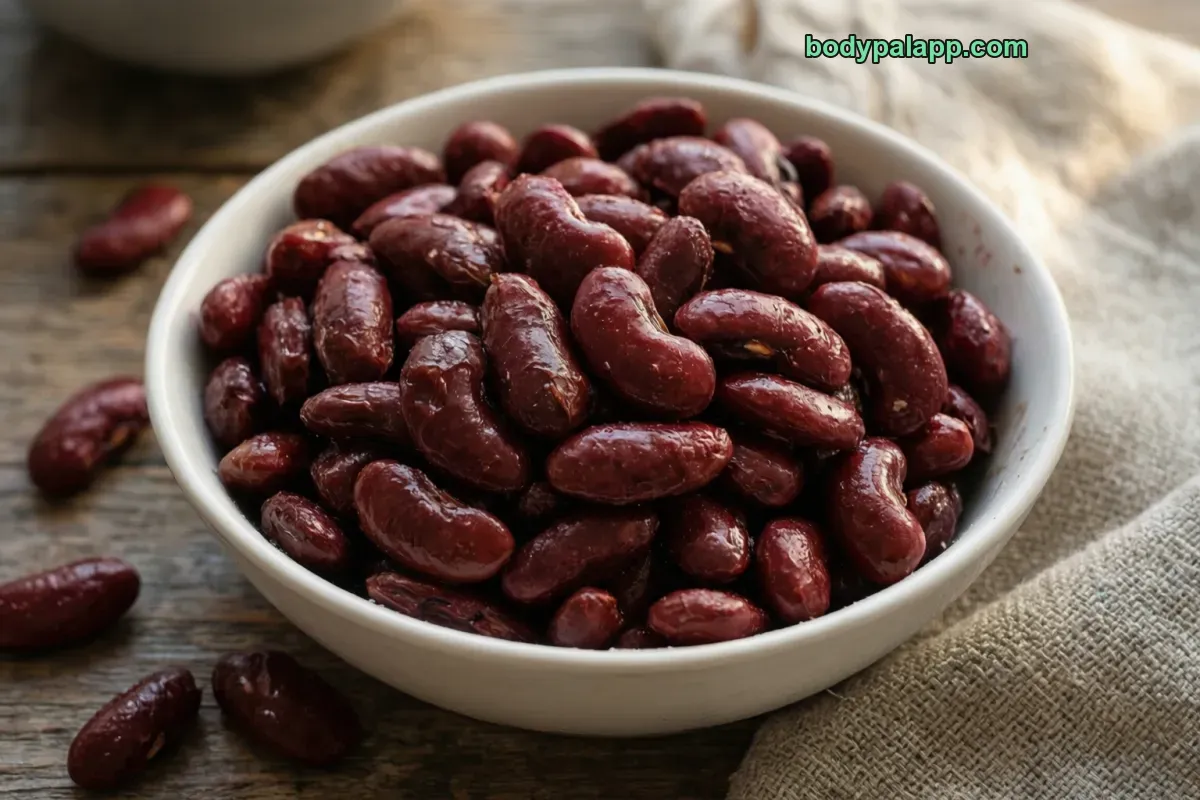
Red kidney beans calories come to 225 for 1 cup (177 g) of beans boiled without salt, or 127 per 100 g. That cup also brings 15.3 g of protein and 13.1 g of fiber for under 1 g of fat. The form matters most: a drained canned portion jumps to 614 mg of sodium.
225kcal
1 cup · 177 g, boiled, without salt
27%protein
15.3 gProtein
40 gCarbs
0.9 gFat
How to burn off 225 kcal
—Walking, brisk
—Jogging
—Cycling, moderate
—Swimming
Skip the math. BodyPal counts these calories from your steps and workouts automatically.
Nutrition facts
Boiled, without salt · per 177 g
Calories
225 kcal
Protein
15.3 g
Carbohydrate
40 g
Fat
0.9 g
Saturated fat
0.1 g
Cholesterol
0 mg
Sodium
4 mg
Potassium
713 mg
Iron
5.2 mg
Source: USDA FoodData Central
🛡️
Verified nutrition data
Numbers on this page come from USDA FoodData Central, the U.S. Department of Agriculture’s food composition database, and from manufacturer labels where a branded product is named. Last verified September 2026. How we verify our data →
Red kidney beans: calories, protein and sodium by serving
Percent of daily value uses the FDA reference of 2,000 kcal a day.
Serving
kcal
Protein
Carbs
Fat
Sodium
% DV kcal
1 cup (177 g)
225
15.3 g
40.4 g
0.9 g
4 mg
11%
Canned, drained (266 g)
330
21.2 g
57.2 g
2.8 g
614 mg
16%
100 g
127
8.7 g
22.8 g
0.5 g
2 mg
6%
3 × 1 cup (177 g)
674
46 g
11 mg
5 × 1 cup (177 g)
1,124
76.7 g
18 mg
One cup is a 225-calorie portion, and it scales fast
The standard reference is 1 cup (177 g) of boiled beans, which lands at 225 calories, about 11% of a 2000-calorie day. That is a moderate amount for a side dish or a salad topping. It also delivers 15.3 g of protein, which covers 31% of the daily value.
Beans rarely stay at one cup, though. Chili, rice and beans, and bean bowls tend to pile them on. Two cups reach 450 calories with 30.7 g of protein, three cups hit 674, and a big batch of 5 cups adds up to 1,124 calories. If you cook a pot and eat from it all week, measure the ladle once so you know what a serving actually holds.
The canned row in the table shows a larger portion: 266 g drained comes to 330 calories and 21.2 g of protein. That is simply more beans by weight, so compare it with the cup figure carefully. Per 100 g, the boiled number stays at 127, and it is the easiest anchor for logging any amount you weigh yourself.
Carbs supply 70% of the calories, protein most of the rest
The calorie split is 70% carbohydrate, 27% protein and just 3% fat. Per 100 g that works out to 22.8 g of carbs, 8.7 g of protein and 0.5 g of fat. For a plant food, that protein share is high, which is why kidney beans often stand in for meat in chili and stews.
The carbs are not the fast kind. Of those 22.8 g, 7.4 g is fiber and only 0.3 g is sugar. A full cup carries 13.1 g of fiber, close to half of the 28 g daily value, alongside 0.6 g of sugar. That fiber is a big part of why a cup of beans feels more filling than its calorie count suggests.
Fat is barely a factor. Saturated fat sits at 0.1 g per 100 g and cholesterol is 0. Whatever fat ends up in your bowl comes from the oil, cheese, sour cream or meat you cook the beans with, so that is where to look if the dish runs higher than expected.
Canned beans are where sodium shows up
Beans boiled without salt are nearly sodium-free: 2 mg per 100 g and 4 mg for a full cup, which rounds to 0% of the daily value. Even 5 cups only reach 18 mg. On their own, plain cooked kidney beans add almost nothing to the sodium column.
The canned, drained portion tells a different story. Its 266 g carries 614 mg of sodium, 27% of the 2300 mg daily value, from a single serving. The same row also shows 10.1 g of sugars and 2.8 g of fat, both well above the plain boiled figures, so the canning liquid or sauce changes more than salt. Brands such as Goya sell both plain red kidney beans and versions in sauce, and the label is the only way to tell which one you have.
If you watch sodium, dried beans cooked at home give you the most control. With canned beans, check the label and rinse them before use. Then log them as canned rather than boiled, because the numbers really do differ.
Pair them with something that adds fat or flavor, not more starch
Kidney beans already bring carbs, protein and fiber, so the smartest partners fill the gaps. Vegetables, tomatoes, onions and peppers add volume for very few calories. A little olive oil, avocado or cheese adds the fat that beans lack and makes the meal more satisfying.
The classic pairing with rice works, but it stacks starch on starch. If you are counting calories, keep the rice portion smaller than the bean portion and let the beans carry the meal. In a salad, half a cup of beans adds protein and fiber without turning it into a heavy lunch.
Kidney beans also contribute potassium, 403 mg per 100 g, against a 4700 mg daily value. That makes them a useful everyday ingredient rather than an occasional one. For quick tracking, BodyPal can log a bowl of chili or a bean salad from a photo, and you can adjust the portion afterward.
How does red kidney beans compare?
Here is how red kidney beans compare with black beans, butter beans and white beans, per 100 g and per usual cooked serving.
Verdict: For the fewest calories pick butter beans, at 115 per 100 g and 216 per cup, while white beans run highest at 139 per 100 g but also lead on protein with 9.7 g. Red kidney beans, at 127 per 100 g, sit almost level with black beans at 132, so choose between those two on taste, not on calories.
Most popular red kidney beans brands in the United States
Ranked by popularity in the BodyPal database
# Productkcal / 100 g
1Goya Red Kidney Beans1/2 cup · 122 g90 kcal
2Goya Red Kidney Beans in Sauce1/2 cup · 130 g123 kcal
3Goya Premium Red Kidney Beans1/2 cup · 123 g73 kcal
4Goya Prime Premium Red Kidney Beans, 29 Oz1/2 cup · 123 g89 kcal
5Goya Prime Premium Red Kidney Beans, 15.5 Oz1/2 cup · 123 g73 kcal
Canned labels count the beans with their canning liquid, so most read lower per 100 g than the boiled beans above. Source: manufacturer labels / USDA FoodData Central.
Red kidney beans FAQs
How many calories are in a cup of red kidney beans?
About 225 calories in one cup of boiled red kidney beans (177 g). A tablespoon (11 g) is about 14 calories.
Are red kidney beans good for weight loss?
Per 100 g boiled they have 127 calories, 7.4 g fiber, 8.7 g protein and 0.5 g fat.
Red kidney beans vs black beans: which has fewer calories?
Boiled red kidney beans have 127 calories per 100 g, black beans 132.
How much protein is in a cup of red kidney beans?
One cup (177 g) of boiled red kidney beans has 15.3 g protein, 40.4 g carbs and 13.1 g fiber.
Do canned kidney beans have more calories than boiled ones?
A drained canned portion of 266 g has 330 calories, while 1 cup (177 g) of boiled beans has 225. Much of the gap is the larger weight, but the canned row also shows more sugar and 614 mg of sodium.
How much fiber is in a cup of red kidney beans?
One cup (177 g) of boiled red kidney beans has 13.1 g of fiber, or 7.4 g per 100 g. That is close to half of the 28 g daily value, with only 0.6 g of sugar.
Are red kidney beans high in sodium?
Not when boiled without salt: 1 cup has just 4 mg of sodium, 0% of the daily value. Canned and drained beans are different, with 614 mg in 266 g, which is 27% of the daily value.
How many calories are in 2 cups of kidney beans?
Two cups of boiled red kidney beans (354 g) have 450 calories and 30.7 g of protein. Three cups come to 674 calories, so portion size moves the total quickly in chili or bean bowls.
How much fat do red kidney beans have?
Very little: 1 cup of boiled kidney beans has 0.9 g of fat, and fat supplies only 3% of their calories. Saturated fat is 0.1 g per 100 g and cholesterol is 0.