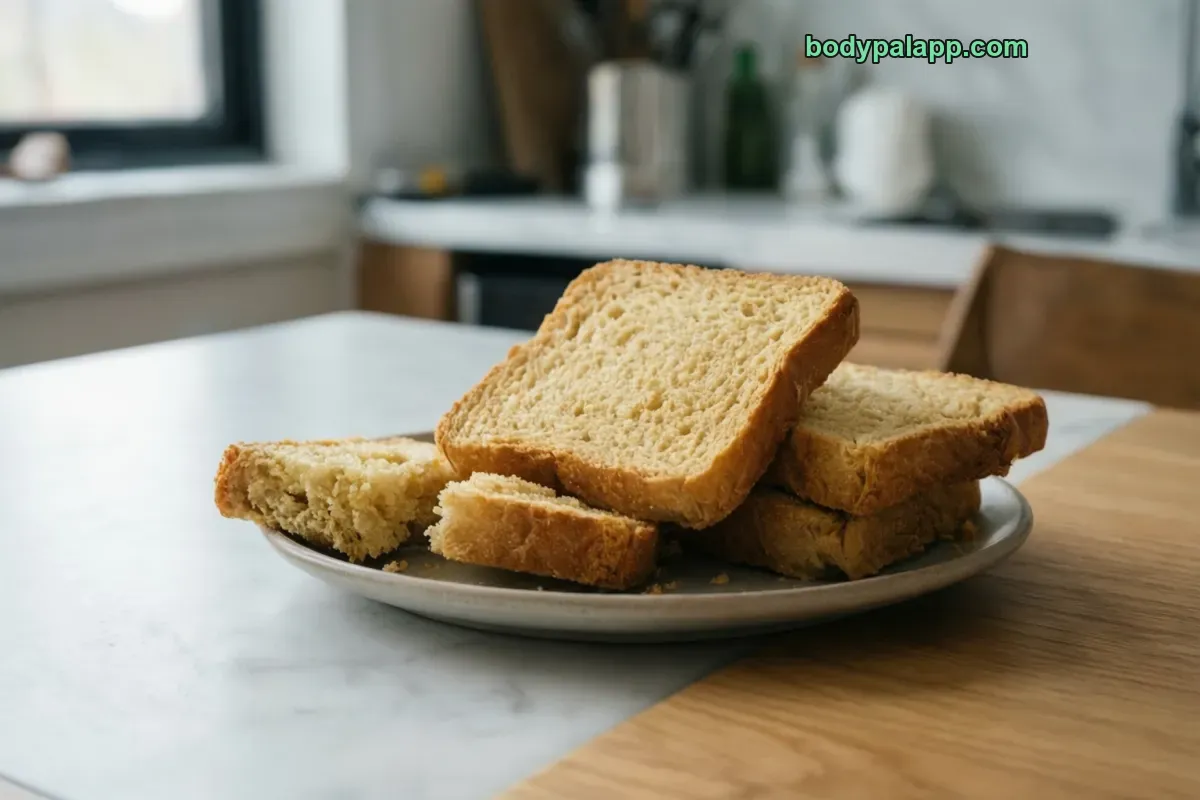
Rusk calories come to 41 for one rusk (10 g) and 407 per 100 g. The per-100 g number is the one to notice. Rusk is dry toast, so each piece weighs little but packs dense energy. Two or three with coffee feel like nothing, yet the total climbs faster than you'd guess.
41kcal
1 rusk · 10 g, dry rusk toast
13%protein
1.4 gProtein
7 gCarbs
0.7 gFat
How to burn off 41 kcal
—Walking, brisk
—Jogging
—Cycling, moderate
—Swimming
Skip the math. BodyPal counts these calories from your steps and workouts automatically.
Nutrition facts
Dry rusk toast · per 10 g
Calories
41 kcal
Protein
1.4 g
Carbohydrate
7.2 g
Fat
0.7 g
Saturated fat
0.1 g
Cholesterol
8 mg
Sodium
25 mg
Potassium
25 mg
Iron
0.3 mg
Source: USDA FoodData Central
🛡️
Verified nutrition data
Numbers on this page come from USDA FoodData Central, the U.S. Department of Agriculture’s food composition database, and from manufacturer labels where a branded product is named. Last verified October 2026. How we verify our data →
Rusk: calories, protein and sodium by serving
Percent of daily value uses the FDA reference of 2,000 kcal a day.
Serving
kcal
Protein
Carbs
Fat
Sodium
% DV kcal
1 rusk (10 g)
41
1.4 g
7.2 g
0.7 g
25 mg
2%
1 oz (28 g)
114
3.8 g
20.2 g
2 g
71 mg
6%
100 g
407
13.5 g
72.3 g
7.2 g
253 mg
20%
3 × 1 rusk (10 g)
122
4.1 g
76 mg
5 × 1 rusk (10 g)
204
6.8 g
127 mg
One rusk is 41 calories, five are 204
A single 10 g rusk has 41 calories, about 2% of the daily value. That makes one piece one of the easier bakery items to log. The trouble is that almost nobody stops at one. Rusks come in sleeves and boxes, and they are made for dunking, which makes them disappear quickly.
Here is how the count moves. Two rusks (20 g) come to 81 calories. Three (30 g) reach 122. Five (50 g) land at 204, roughly the same as a small snack bar. An ounce (28 g) is 114 calories, or 6% of the daily value, which is close to three pieces.
If you eat rusk straight from the package, weigh a handful once. Pieces vary by brand. Britannia Milk Rusk, Reese Original Holland Rusk and Tazah White Rusk Toast all differ in size and shape, so counting pieces works only after you know what one of yours weighs. A full 100 g, which is easy to reach with a box open, is 407 calories and 20% of the daily value.
Carbs supply 71% of the calories
Rusk is a carbohydrate food first. Per 100 g it has 72.3 g of carbs, 13.5 g of protein and 7.2 g of fat. In calorie terms that splits into 71% carbs, 16% fat and 13% protein. The fat is low for a bakery item, and saturated fat is only 1.4 g per 100 g.
Per rusk, the numbers are small: 7.2 g of carbs, 1.4 g of protein and 0.7 g of fat. One piece covers 3% of the daily value for protein. Scale up to 100 g and protein reaches 27% of the daily value, which is respectable for dry toast but still far behind the carbs.
The practical takeaway: rusk gives quick energy and some crunch, not much staying power on its own. If you want it to hold you until the next meal, the rest of the plate has to bring the protein and fat.
Sodium is low, cholesterol is the surprise
Sodium is not the problem here. One rusk carries 25 mg, about 1% of the daily value. Five rusks add 127 mg, and even a full 100 g stays at 253 mg, or 11% of the daily value. For a packaged cracker, that is a modest number.
The row that stands out is cholesterol: 78 mg per 100 g in the USDA entry for rusk toast. That is unusual for something that looks like plain dry bread. At normal portions it stays small, since a single 10 g piece is a tenth of that 100 g figure. If you track cholesterol closely, it is worth knowing the number exists.
Potassium sits at 245 mg per 100 g. That is a minor contribution, not a reason to choose rusk. Read rusk as a low-sodium, carb-forward snack with an unexpected cholesterol line.
Rusk works best as a side, not the snack
Rusk is built for tea and coffee, and that is where it fits best: two pieces at 81 calories next to a hot drink is a light, controlled snack. The risk is grazing. A box on the table can turn into 204 calories before the cup is empty.
Because the calories lean so heavily on carbs, pairing matters. Rusk with cheese, eggs, yogurt or nut butter turns a crunchy carb into something more filling. Whole meal and rye versions, like Booivakn Whole Meal Wheat and Rye Rusks or Tazah Rye Rusk Toast with Sesame Seeds, are other options if you prefer a darker grain, though their labels will differ from the USDA values used here.
If you'd rather not weigh pieces, BodyPal can log rusk from a photo of your plate, which helps when the portion is a loose handful rather than a neat count.
How does rusk compare?
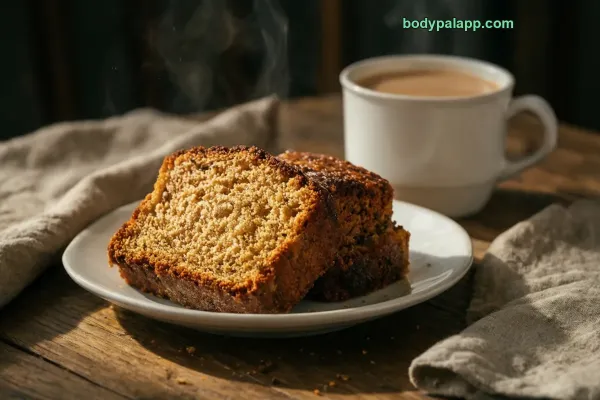
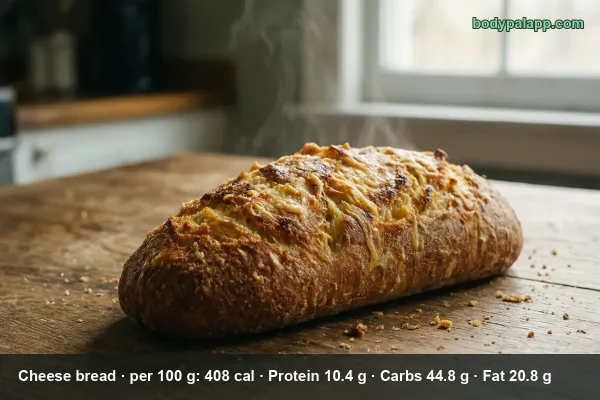
Here is how rusk compares with cake rusk, cheese bread and a butter croissant, per 100 g and per usual serving.
Verdict: All four sit at about 407 calories per 100 g, so the real difference is portion and fat: a 41-calorie rusk is far easier to control than a 231-calorie butter croissant with 21 g of fat per 100 g. If you watch sodium, rusk at 253 mg per 100 g beats cheese bread at 750 mg.
Most popular rusk brands in the United States
Ranked by popularity in the BodyPal database
# Productkcal / 100 g
1Britannia Milk Rusk100 g463 kcal
2Reese Original Holland Rusk2 pieces · 15 g400 kcal
3Tazah Rye Rusk Toast with Sesame Seeds1 oz · 28 g393 kcal
4Tazah Mediterranea Rusk Toast with Herbs1 oz · 28 g393 kcal
5Booivakn Whole Meal Wheat and Rye Rusks100 g390 kcal
6Tazah White Rusk Toast1 oz · 28 g393 kcal
7Marco Polo Regular Rusk Toast4 toasts · 31 g387 kcal
Recipes vary by brand: milk rusks with added fat and sugar read higher than plain rusk toast. Source: manufacturer labels / USDA FoodData Central.
Rusk FAQs
How many calories are in one rusk?
One rusk (10 g) has about 41 calories. Per 100 g, rusk toast has 407 calories.
Is rusk good for weight loss?
A single rusk is 41 calories, but rusk is a dry, dense food: 100 g holds 407 calories and 72.3 g carbs.
Rusk vs cake rusk: which has more calories?
Both come to about 407 calories per 100 g, so a 10 g rusk is 41 calories either way.
How many carbs and protein are in a rusk?
One 10 g rusk has 7.2 g carbs, 1.4 g protein and 0.7 g fat. Per 100 g that is 72.3 g carbs and 13.5 g protein.
How many calories are in one cake rusk?
One cake rusk (10 g) has 41 calories. Our cake rusk entry matches rusk exactly at 407 calories per 100 g, so a single piece is a small, easy snack to log.
How many calories are in 2 cake rusks?
Two cake rusks (20 g) come to 81 calories, with 2.7 g of protein and 51 mg of sodium. That is a light pairing with tea or coffee.
How many calories does rusk have per 100 grams?
Rusk has 407 calories per 100 g, about 20% of the daily value. That 100 g also carries 72.3 g of carbs, 13.5 g of protein and 7.2 g of fat.
How many calories are in an ounce of rusk?
An ounce (28 g) of rusk has 114 calories, about 6% of the daily value. It provides 20.2 g of carbs, 3.8 g of protein and 2 g of fat.