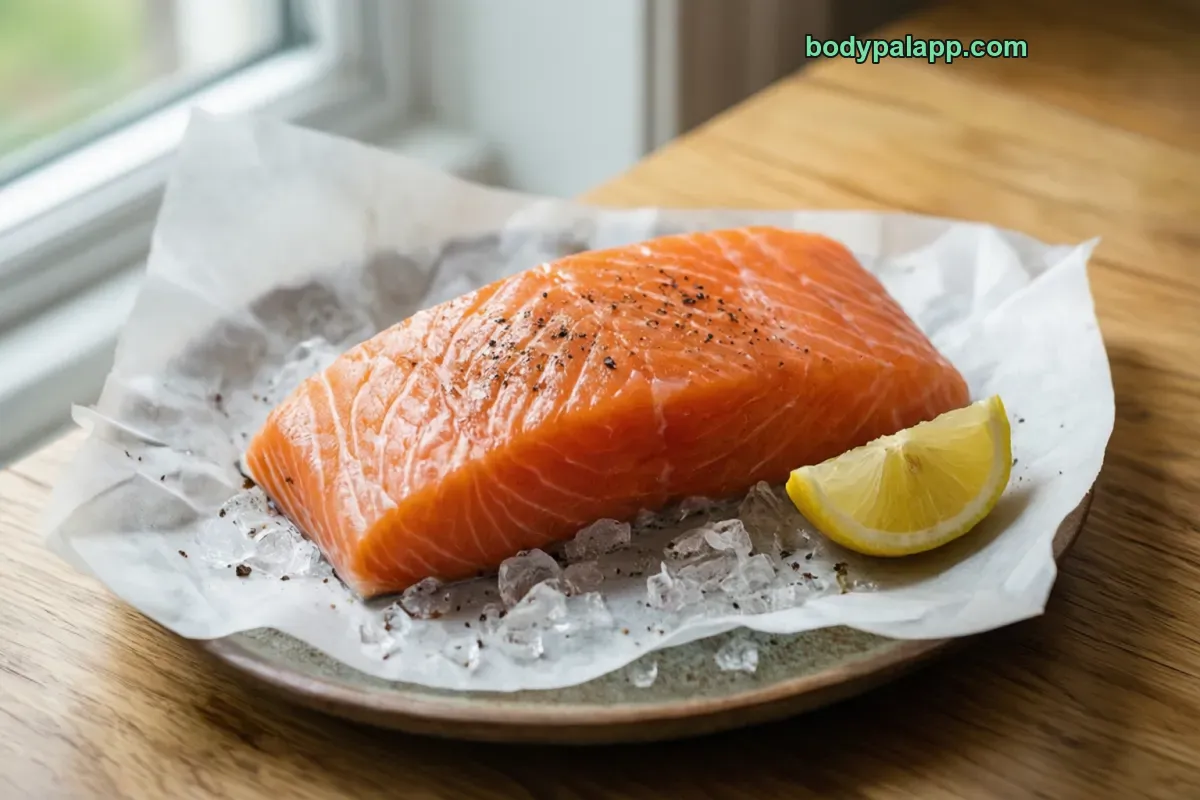
Skinless salmon fillet calories come to 350 for a 6 oz fillet (170 g) and 206 per 100 g, based on farmed Atlantic salmon cooked with dry heat. The surprise is the split: fat, not protein, supplies most of that energy, at 56% of calories against 44% from protein. That fat share is why fillet size moves the total so quickly.
350kcal
1 6 oz fillet · 170 g, farmed Atlantic, cooked
44%protein
38 gProtein
0 gCarbs
21 gFat
How to burn off 350 kcal
—Walking, brisk
—Jogging
—Cycling, moderate
—Swimming
Skip the math. BodyPal counts these calories from your steps and workouts automatically.
Nutrition facts
Farmed atlantic, cooked · per 170 g
Calories
350 kcal
Protein
38 g
Carbohydrate
0 g
Fat
21 g
Saturated fat
4.1 g
Cholesterol
107 mg
Sodium
104 mg
Potassium
653 mg
Iron
0.6 mg
Source: USDA FoodData Central
🛡️
Verified nutrition data
Numbers on this page come from USDA FoodData Central, the U.S. Department of Agriculture’s food composition database, and from manufacturer labels where a branded product is named. Last verified September 2026. How we verify our data →
Skinless salmon fillet: calories, protein and sodium by serving
Percent of daily value uses the FDA reference of 2,000 kcal a day.
Serving
kcal
Protein
Carbs
Fat
Sodium
% DV kcal
6 oz fillet (170 g)
350
37.6 g
0 g
21 g
104 mg
18%
3 oz portion (85 g)
175
18.8 g
0 g
10.5 g
52 mg
9%
Wild sockeye, 6 oz (170 g)
265
45 g
0 g
9.5 g
156 mg
13%
100 g
206
22.1 g
0 g
12.4 g
61 mg
10%
3 × 6 oz fillet (170 g)
1,051
112.7 g
311 mg
5 × 6 oz fillet (170 g)
1,751
187.9 g
519 mg
A 6 oz fillet is a 350-calorie plate
The default serving here is a 6 oz cooked fillet (170 g), and it carries 350 calories, 37.6 g of protein and 21 g of fat. That is 18% of a 2000-calorie daily value and 75% of the daily value for protein in a single piece of fish. A 3 oz portion (85 g) halves everything: 175 calories and 18.8 g of protein.
Totals climb fast once you cook for a table or go back for seconds. Two 6 oz fillets (340 g) add up to 700 calories, three (510 g) reach 1,051, and five (850 g) come to 1,751. If you are cutting portions from a large side of salmon, weigh the cooked piece instead of eyeballing it. A generous cut can double the number without looking much bigger on the plate.
For logging, the 100 g row is the cleanest anchor: 206 calories, 22.1 g of protein and 12.4 g of fat. Scale from there with a kitchen scale, or let BodyPal log the fillet from a photo if you would rather skip the weighing.
Fat supplies more calories than protein
Salmon tends to get filed with the lean proteins, but farmed Atlantic salmon does not fit that box. Per 100 g it has 22.1 g of protein and 12.4 g of fat, and because fat is the denser fuel, it ends up providing 56% of the calories against 44% from protein. Carbs, sugars and fiber all read 0.
Most of that fat is not saturated. Saturated fat comes to 2.4 g per 100 g, measured against a 20 g daily value, so the bulk of the 12.4 g falls outside the saturated column. That is a different profile from fattier red meats, where the saturated share tends to be the headline.
What this means in practice depends on your goal. If you are tracking fat grams, the 21 g in a 6 oz fillet is a meaningful share of a 78 g daily value. If protein is the priority, the same fillet still delivers 37.6 g, and the wild sockeye row shows 45 g of protein with 9.5 g of fat for the same 170 g.
Sodium stays low until you season it
Plain cooked salmon is light on salt. A 6 oz fillet has 104 mg of sodium, just 5% of the daily value, and 100 g has 61 mg. Even five fillets only reach 519 mg, and the 3 oz portion's 52 mg barely registers on a day's total.
The salt you add is usually the bigger number. Soy glazes, teriyaki marinades, seasoning rubs and smoked or cured salmon all move this row, and none of those are reflected in the plain cooked-fillet figures. If you watch sodium, salmon finished with lemon and herbs keeps the number close to what you see here.
Two other rows are worth a glance. Cholesterol is 63 mg per 100 g, set against a 300 mg daily value, and potassium is 384 mg per 100 g. Both scale with portion size exactly the way the calories do, so a double fillet doubles them too.
Zero carbs leaves room on the plate
A fillet brings protein and fat but 0 g of carbs and 0 g of fiber, so the rest of the plate decides what kind of meal it becomes. Roasted vegetables, a leafy salad, or a scoop of rice or potatoes fill those gaps. The calorie cost of each side is the part you control, and it can easily rival the fish itself.
Cooking fat is the hidden variable. These numbers describe salmon cooked with dry heat, so butter in the pan or a generous pour of olive oil sits on top of the 350 calories, not inside them. Baking, broiling, grilling or air frying keeps the total closest to the listed figure.
If you want the fillet to stretch further, the 3 oz portion at 175 calories pairs well with a bigger pile of vegetables. If you want more protein for fewer calories, wild sockeye at 265 calories per 6 oz is the leaner swap. Brands on this page, such as Fishin' Company and First Street, sell skinless fillets that make portioning easier.
How does skinless salmon fillet compare?
Here is how skinless salmon stacks up against salmon skin and two chicken cuts, per 100 g and per usual serving.
Verdict: For the fewest calories with the most protein, chicken breast without skin wins at 176 per 100 g with 29.6 g of protein, while salmon's 206 sits close to the 214 of chicken leg with skin. Pick salmon when you want its fat on purpose and far less sodium, 61 mg per 100 g against 353 and 341 for the chicken.
Most popular skinless salmon fillet brands in the United States
Ranked by popularity in the BodyPal database
# Productkcal / 100 g
1Fishin' Company Skinless Salmon Fillets4 oz · 113 g159 kcal
2First Street Wild Caught Pacific Skinless Salmon Fillets4 oz · 113 g150 kcal
4No Name Original Boneless & Skinless Salmon Fillets1 fillet · 142 g239 kcal
Packaged fillets are labeled per raw weight and many are wild salmon, so they read lower than the cooked farmed numbers above. Source: manufacturer labels / USDA FoodData Central.
Skinless salmon fillet FAQs
How many calories are in a skinless salmon fillet?
A 6 oz (170 g) farmed Atlantic fillet cooked without skin has about 350 calories, and a 3 oz portion has 175.
Is salmon good for weight loss?
A 3 oz portion has 175 calories with 18.8 g protein, 10.5 g fat and 0 g carbs.
Farmed vs wild salmon: which has fewer calories?
Per 100 g cooked, farmed Atlantic salmon has 206 calories, wild sockeye 156 and wild coho 139.
How much protein is in a salmon fillet?
A 6 oz (170 g) cooked farmed fillet has about 37.6 g protein, or 22.1 g per 100 g.
How many calories are in half a salmon fillet?
Half of a 6 oz fillet is a 3 oz portion (85 g), which has 175 calories when the salmon is cooked and skinless. It also brings 18.8 g of protein, 10.5 g of fat and 52 mg of sodium, or 9% of a 2000-calorie daily value.
How many calories are in 100 g of cooked salmon without skin?
A 100 g serving of cooked skinless farmed Atlantic salmon has 206 calories. That comes with 22.1 g of protein, 12.4 g of fat and 0 g of carbs, which works out to 10% of the daily calorie value and 44% of the protein value.
What is the full nutrition breakdown of skinless salmon?
Per 100 g, cooked skinless salmon has 206 calories, 22.1 g of protein, 12.4 g of fat including 2.4 g saturated, and 0 g of carbs, sugars or fiber. It also has 61 mg of sodium, 63 mg of cholesterol and 384 mg of potassium.
How many calories are in 6 oz of salmon with no skin?
A 6 oz (170 g) cooked skinless fillet has 350 calories, which is 18% of a 2000-calorie daily value. It covers 75% of the protein daily value with 37.6 g, while sodium stays at 104 mg, just 5% of the daily value.