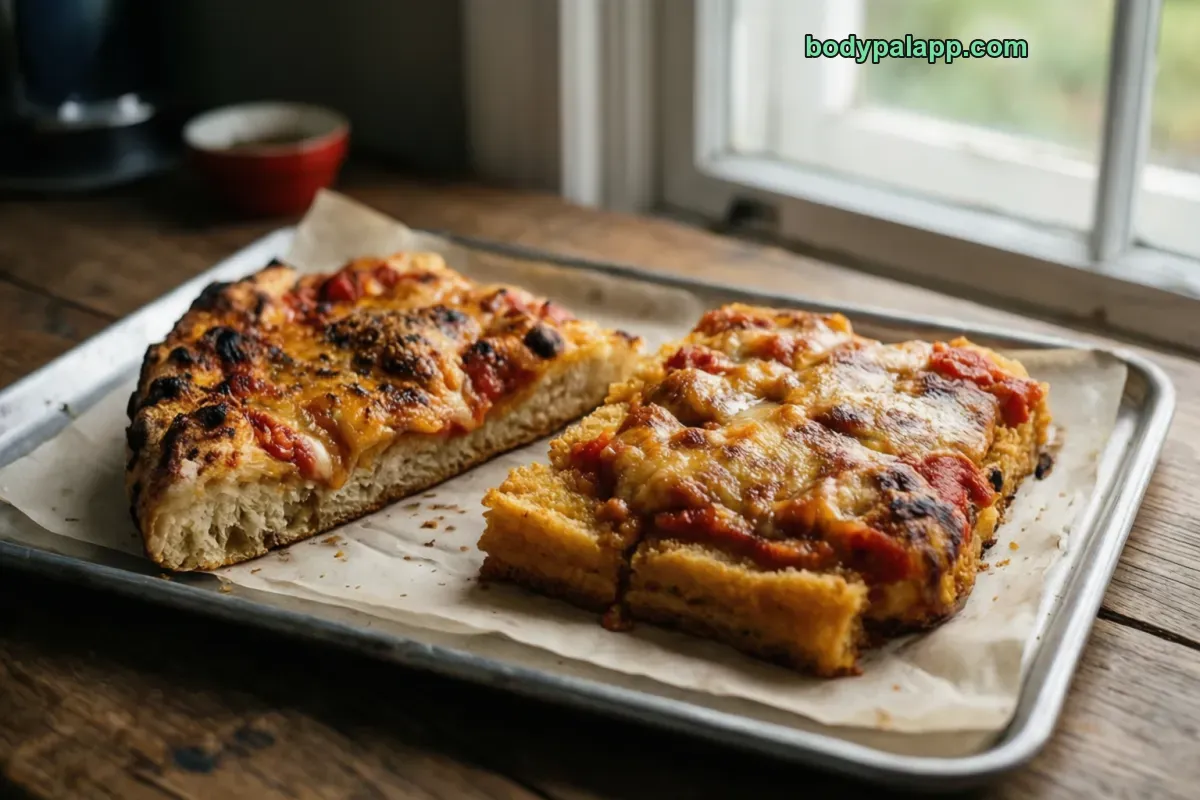
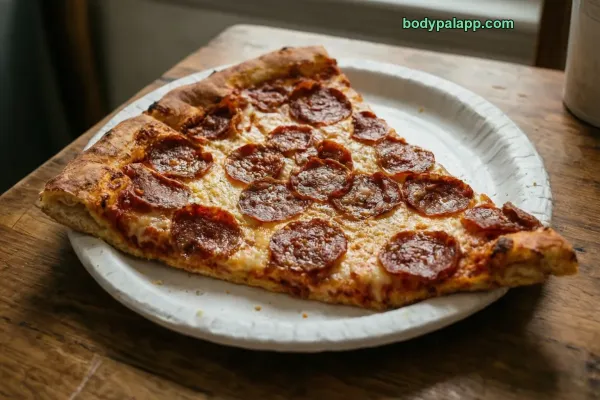
Sicilian pizza calories come to 358 for one slice (132 g) and 271 per 100 g. The number to notice is sodium, not calories: that single slice carries 713 mg, or 31% of the daily value. A second square nearly doubles both, so your slice count decides how heavy this meal gets.
358kcal
1 slice · 132 g, thick crust, cheese
16%protein
14.3 gProtein
44 gCarbs
13.9 gFat
How to burn off 358 kcal
—Walking, brisk
—Jogging
—Cycling, moderate
—Swimming
Skip the math. BodyPal counts these calories from your steps and workouts automatically.
Nutrition facts
Thick crust, cheese · per 132 g
Calories
358 kcal
Protein
14.3 g
Carbohydrate
44 g
Fat
13.9 g
Saturated fat
5.6 g
Cholesterol
22 mg
Sodium
713 mg
Potassium
223 mg
Iron
3.3 mg
Source: USDA FoodData Central
🛡️
Verified nutrition data
Numbers on this page come from USDA FoodData Central, the U.S. Department of Agriculture’s food composition database, and from manufacturer labels where a branded product is named. Last verified September 2026. How we verify our data →
Sicilian pizza: calories, protein and sodium by serving
Percent of daily value uses the FDA reference of 2,000 kcal a day.
Serving
kcal
Protein
Carbs
Fat
Sodium
% DV kcal
1 slice (132 g)
358
14.3 g
43.8 g
13.9 g
713 mg
18%
Small slice (93 g)
252
10.1 g
30.8 g
9.8 g
502 mg
13%
100 g
271
10.8 g
33.2 g
10.5 g
540 mg
14%
3 × 1 slice (132 g)
1,073
42.8 g
2,138 mg
5 × 1 slice (132 g)
1,789
71.3 g
3,564 mg
Two slices make a 715-calorie meal
A standard square of Sicilian pizza weighs about 132 g and lands at 358 calories, which is 18% of the daily value. The thick, airy crust makes each piece heavier than a thin-crust wedge, so one square goes further than it looks. A small slice of 93 g drops the total to 252 calories, or 13% of the daily value.
The total climbs fast once you go back for more. Two slices (264 g) reach 715 calories, three slices (396 g) hit 1,073, and five slices (660 g), roughly what a hungry person might eat from a shared sheet pan, add up to 1,789. Sodium tracks right along: 1,426 mg for two slices and 2,138 mg for three.
The practical takeaway is simple. Decide on your slice count before the pan hits the table. If you are hungry, cut the corner pieces smaller instead of skipping the meal, since a 93 g piece still feels like real pizza. Two squares is a full meal for most people; three is a big one.
Half the calories come from the crust
Carbohydrates supply 49% of the calories in Sicilian pizza, fat supplies 35%, and protein supplies 16%. Per 100 g that works out to 33.2 g of carbs, 10.5 g of fat and 10.8 g of protein. The thick, focaccia-like base is what pushes the carb share this high.
Per slice, you get 43.8 g of carbs, 13.9 g of fat and 14.3 g of protein. That protein figure covers 29% of the daily value, which is respectable for a pizza and comes mostly from the cheese. Fiber is modest at 2.9 g per slice, and sugars stay low at 4.4 g, mostly from the tomato sauce.
Fat deserves a quick look too. Saturated fat runs 4.2 g per 100 g, coming from the mozzarella and the oil used to crisp the pan crust. Cholesterol, by contrast, is low at 17 mg per 100 g. In short, this is a bread-forward food with a solid layer of cheese, not a protein meal.
Sodium is the row to watch
Sicilian pizza carries 540 mg of sodium per 100 g, which is 23% of the daily value. On a full slice that becomes 713 mg, or 31%. Even the small slice delivers 502 mg, 22% of the daily value. Compare that with its calorie share of 18% per slice, and you can see sodium outruns calories on this food.
Salt hides in every layer: the dough, the sauce and the cheese. That is why the numbers stack so quickly. Two slices bring 1,426 mg and three slices bring 2,138 mg, which leaves very little room for anything else salty that day.
If you watch sodium, the fix is not to avoid pizza but to plan around it. Keep the rest of the meal low in salt, skip extra parmesan or salty toppings like pepperoni, and drink water rather than a salty side. Potassium is modest at 169 mg per 100 g, so fresh produce elsewhere in the day helps balance the plate.
A salad turns two squares into a balanced meal
Because Sicilian pizza is heavy on carbs and light on fiber, it pairs best with foods that bring volume and crunch. A large green salad with a light vinaigrette, roasted vegetables or a bowl of raw peppers and cucumber adds fiber and fills you up without many extra calories. That often makes one square feel like enough.
Toppings change the math. Vegetables like mushrooms, onions and spinach add bulk for little cost, while sausage, pepperoni and extra cheese push both calories and sodium up. Frozen options such as Screamin' Sicilian pizzas are popular, but check the label, since stuffed and overtopped versions are built differently from a classic cheese square.
If you track your food, logging pizza is easiest by slice count and weight. BodyPal can log a slice from a photo, which helps when squares come in uneven sizes from the corner or the middle of the pan. The goal is an honest number, not a perfect one.
How does Sicilian pizza compare?
Here is how Sicilian pizza stacks up against margherita, Costco and Pizza Hut pan pizza, per 100 g and per usual serving.
Verdict: Sicilian, margherita and Costco pizza share the same 271 calories per 100 g, so slice size decides your total: 358 for a 132 g square versus 377 for a Costco extra-large slice of 139 g. If you watch sodium or fat, skip Pizza Hut pan pizza, which carries 624 mg sodium and 12.6 g fat per 100 g against 540 mg and 10.5 g here.
Most popular Sicilian pizza brands in the United States
5Butch's Pizza Original Cheese and Pepperoni Super Thin Crust1/3 pizza · 123 g252 kcal
Frozen pizzas are labeled per package fraction, so one listed serving can weigh more or less than the 132 g slice used above. Source: manufacturer labels / USDA FoodData Central.
Sicilian pizza FAQs
How many calories are in a slice of Sicilian pizza?
A 132 g slice is about 358 calories. A smaller 93 g slice comes to 252 calories.
Is Sicilian pizza good for weight loss?
One 132 g slice is 358 calories with 13.9 g fat and 43.8 g carbs, and two slices come to 716 calories.
How does Sicilian pizza compare with thin-crust pizza?
Thick-crust cheese pizza has 271 calories per 100 g and thin-crust has 295, but a thin slice weighs less: an 87 g thin slice is 257 calories against 358 for a 132 g Sicilian slice.
How much protein is in Sicilian pizza?
A 132 g slice has 14.3 g protein, along with 713 mg sodium and 236 mg calcium.
How many calories are in a small slice of Sicilian pizza?
A small slice of Sicilian pizza (93 g) has 252 calories, or 13% of the daily value. It also brings 10.1 g of protein and 502 mg of sodium, making it a lighter way to enjoy a square.
How much sodium is in a slice of Sicilian pizza?
One slice of Sicilian pizza (132 g) contains 713 mg of sodium, which is 31% of the daily value. Two slices raise that to 1,426 mg, so sodium adds up faster than calories.
How many calories are in 3 slices of Sicilian pizza?
Three slices of Sicilian pizza (396 g) total 1,073 calories. That portion also delivers 42.8 g of protein and 2,138 mg of sodium, which makes it a very large meal.
How many carbs are in Sicilian pizza?
A slice of Sicilian pizza has 43.8 g of carbs, or 33.2 g per 100 g. Carbs supply 49% of its calories, while fiber is just 2.9 g per slice.
Is Sicilian pizza high in fat?
A slice of Sicilian pizza has 13.9 g of fat, and fat supplies 35% of its calories. Saturated fat is 4.2 g per 100 g, mostly from the cheese and the oiled pan crust.