Soy sauce calories come to 8 for 1 tbsp (16 g) and 53 per 100 g, so the energy barely registers in a day of eating. Sodium is the real story: that same tablespoon carries 879 mg, or 38% of the daily value, which makes salt, not calories, the reason to measure your pour.
8kcal
1 tablespoon · 16 g, made from soy and wheat
57%protein
1.3 gProtein
1 gCarbs
0.1 gFat
How to burn off 8 kcal
—Walking, brisk
—Jogging
—Cycling, moderate
—Swimming
Skip the math. BodyPal counts these calories from your steps and workouts automatically.
Nutrition facts
Made from soy and wheat · per 16 g
Calories
8 kcal
Protein
1.3 g
Carbohydrate
0.8 g
Fat
0.1 g
Saturated fat
0 g
Cholesterol
0 mg
Sodium
879 mg
Potassium
70 mg
Iron
0.2 mg
Source: USDA FoodData Central
🛡️
Verified nutrition data
Numbers on this page come from USDA FoodData Central, the U.S. Department of Agriculture’s food composition database, and from manufacturer labels where a branded product is named. Last verified September 2026. How we verify our data →
Soy sauce: calories, protein and sodium by serving
Percent of daily value uses the FDA reference of 2,000 kcal a day.
Serving
kcal
Protein
Carbs
Fat
Sodium
% DV kcal
1 tbsp (16 g)
8
1.3 g
0.8 g
0.1 g
879 mg
0%
1 tsp (5.3 g)
3
0.4 g
0.3 g
0 g
291 mg
0%
Takeout packet (8.9 g)
5
0.7 g
0.4 g
0.1 g
489 mg
0%
100 g
53
8.1 g
4.9 g
0.6 g
5,493 mg
3%
3 × 1 tbsp (16 g)
25
3.9 g
2,637 mg
5 × 1 tbsp (16 g)
42
6.5 g
4,394 mg
Five tablespoons still add only 42 calories
Every common portion of soy sauce is small in calories. A teaspoon (5.3 g) has 3, a takeout packet (8.9 g) has 5, and a tablespoon (16 g) has 8. The percent daily value for calories rounds to 0 for all three, which tells you how little they move a food log.
Pour more and the total climbs slowly. Two tablespoons (32 g) come to 17 calories, three (48 g) come to 25, and five (80 g) come to 42. That last amount is a lot of sauce, roughly what vanishes into a big stir-fry or a dipping dish that keeps getting refilled at the sushi counter, and it is still a minor line in a day of eating.
So the measuring spoon matters less for calories than for salt. Real pours rarely match the label serving, and nobody notices an extra 8 calories. If you track meals, a takeout packet is the easiest unit because its size is fixed: log each one as 5 calories and 489 mg of sodium, and the count stays honest without any guesswork.
Protein supplies 57% of its few calories
Per 100 g, soy sauce has 8.1 g of protein, 4.9 g of carbs and 0.6 g of fat. Because the total is only 53 calories, protein ends up as 57% of the energy, carbs 34% and fat 9%. On paper that reads like a lean protein food.
In practice it is not. A tablespoon gives 1.3 g of protein, which is 3% of the daily value, and even 5 tablespoons deliver only 6.5 g alongside 4,394 mg of sodium. It makes little sense to count soy sauce toward a protein target, because the salt that comes with each gram of protein is far too high.
The rest of the panel is quiet. Sugars are 0.4 g per 100 g, fiber is 0.8 g, saturated fat is 0.1 g and cholesterol is 0. The USDA row behind these numbers is shoyu-style soy sauce made from soy and wheat, the familiar all-purpose style. Sweetened or thickened soy-based sauces are a different product, so check their own labels rather than borrowing these figures.
One tablespoon is 38% of a day's sodium
Soy sauce carries 5,493 mg of sodium per 100 g, which is 239% of the daily value. That is more than twice a full day's sodium in an amount of liquid that fits in a small glass, and the portion you pour decides how much of it reaches your plate.
At the small end, a teaspoon has 291 mg (13% of the daily value) and a takeout packet has 489 mg (21%). A tablespoon jumps to 879 mg. Two tablespoons reach 1,758 mg, and three reach 2,637 mg, which is more than the whole daily value from the sauce alone, before the rice, noodles or protein on the plate add anything.
That is why the calorie figure on this page is the least useful one. If you watch sodium, the 38% from a single tablespoon is the number to remember, and the teaspoon is the measure to reach for. The panel also lists 435 mg of potassium per 100 g, far below the sodium figure, so the salt side of the label is the one that deserves your attention.
Treat it as seasoning, not as a sauce base
Because the calories are so low, soy sauce can add a lot of savory flavor to rice, vegetables, eggs or tofu without moving your calorie total. The trade-off sits entirely in sodium, so the useful habit is to decide the amount before you pour instead of shaking it straight from the bottle over a finished plate.
A few practical moves keep the numbers sensible. Measure with a teaspoon, which holds 291 mg instead of 879 mg. Use one packet instead of a free pour when you eat takeout. Stretch it with a splash of vinegar, which brings acidity with very little sodium. If the rest of the meal is already salty, go lighter on the soy and let the other ingredients carry the flavor.
Brands such as Kikkoman Soy Sauce appear on this page for reference. If you log meals, BodyPal can log soy sauce from a photo of your plate.
How does soy sauce compare?
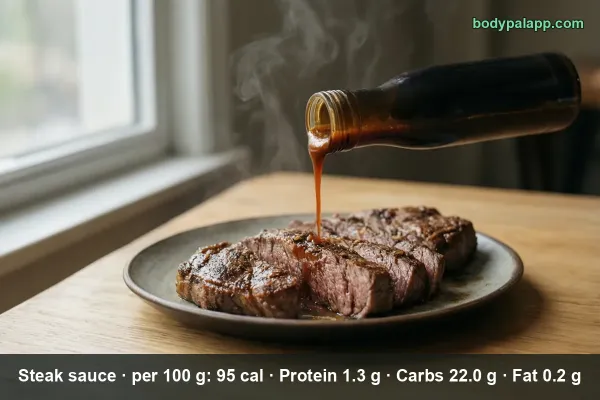
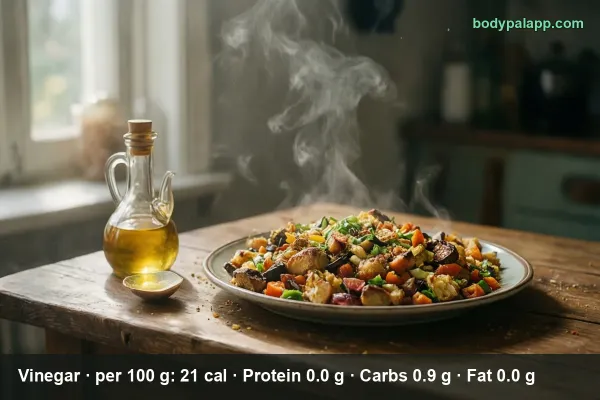
Here is how soy sauce stacks up against A1 sauce and vinegar, per 100 g and per usual serving.
Verdict: For the fewest calories, vinegar wins at 21 per 100 g against 53 for soy sauce and 95 for A1 sauce. For sodium, soy sauce is the heaviest by far at 5,493 mg per 100 g, so if salt is your concern, A1 sauce at 1,647 mg or vinegar at 5 mg is the lighter pick.
Most popular soy sauce brands in the United States
Ranked by popularity in the BodyPal database
# Productkcal / 100 g
1Kikkoman Soy Sauce1 tbsp · 15 ml67 kcal
Kikkoman's figure is measured per 15 ml of liquid rather than per 100 g of weight, which is why it reads higher than the 53 calories above. Source: manufacturer labels / USDA FoodData Central.
Soy sauce FAQs
How many calories are in a tablespoon of soy sauce?
About 8 calories in one tablespoon (16 g). A teaspoon is 3 calories and a takeout packet about 5.
Is soy sauce good for weight loss?
A tablespoon adds only about 8 calories, so it barely moves a daily total. The same tablespoon carries about 879 mg of sodium.
Soy sauce vs A1 sauce: which has fewer calories?
Soy sauce has 53 calories per 100 g and A1 sauce 95, so soy sauce is the lighter of the two.
How much sodium is in soy sauce?
5,493 mg per 100 g, which works out to about 879 mg in one tablespoon. The reduced-sodium version has 3,598 mg per 100 g.
Is soy sauce high in calories?
No. Soy sauce has 53 calories per 100 g and 8 per tablespoon, so even 5 tablespoons add only 42. The number worth watching is sodium, at 879 mg per tablespoon.
What is the nutritional value of soy sauce per 100 g?
Per 100 g, soy sauce has 53 calories, 8.1 g protein, 4.9 g carbs, 0.6 g fat, 0.4 g sugars and 0.8 g fiber. It also carries 5,493 mg of sodium, 239% of the daily value.
How many calories are in 1 teaspoon of soy sauce?
A teaspoon (5.3 g) of soy sauce has 3 calories. It also has 291 mg of sodium, 13% of the daily value, which makes the teaspoon the smallest practical measure if you watch salt.
How much sodium does USDA FoodData Central list for a tablespoon of soy sauce?
USDA FoodData Central lists 879 mg of sodium for 1 tbsp (16 g) of soy sauce made from soy and wheat, which is 38% of the daily value. Per 100 g the figure is 5,493 mg.