
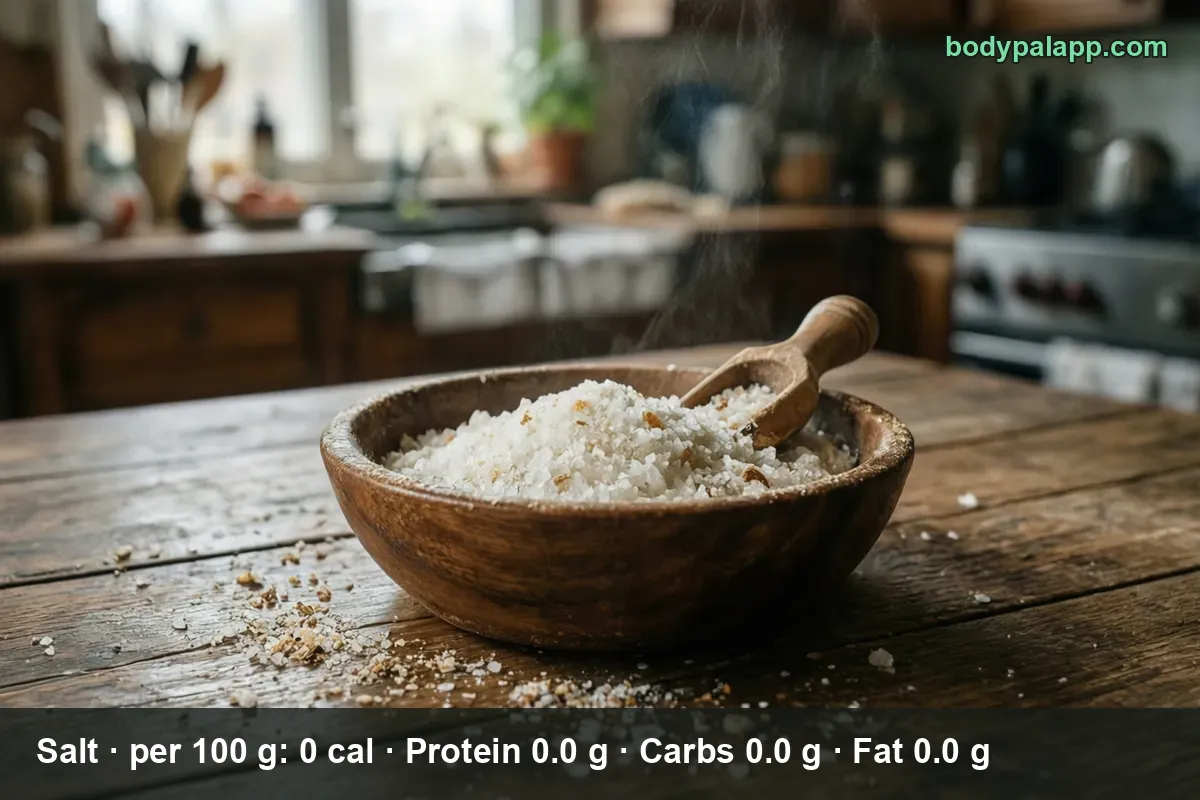
How many calories are in salt?
A level teaspoon of table salt weighs 6 g and carries 0 calories. Per 100 g it is still 0 calories — no fat, no carbohydrate, no protein. What the teaspoon does carry is sodium: 2,325 mg, which is 101% of the Daily Value. The whole day's benchmark sits in one spoon.
On this page
- Salt quick facts
- Salt servings, from a dash to an ounce
- Iodized, sea and kosher salt
- Salted foods are where the calories hide
- Sodium is the row that counts
- How does salt compare?
- Most popular salt brands
- FAQ
Salt quick facts
The record behind this page is SR Legacy 173468, "Salt, table" — the plain white salt in the shaker on the kitchen table and in the box in the cabinet. It is the one entry with a full nutrient profile plus household measures, from a dash up to a cup, which is what you need when you are trying to put a number on a pinch. The Foundation record for iodized salt exists too, but that edition reports only minerals, so it cannot fill a full label.
| Nutrient | Per 100 g | Per 1 tsp (6 g) | % Daily Value |
|---|---|---|---|
| Calories | 0 | 0 | — |
| Total fat | 0 g | 0 g | 0% |
| Saturated fat | 0 g | 0 g | 0% |
| Carbohydrate | 0 g | 0 g | 0% |
| Dietary fiber | 0 g | 0 g | 0% |
| Total sugars | 0 g | 0 g | — |
| Protein | 0 g | 0 g | 0% |
| Sodium | 38758 mg | 2325 mg | 101% |
% Daily Value is based on a 2,000-calorie diet.
Verified nutrition data
Numbers on this page come from USDA FoodData Central, the U.S. Department of Agriculture’s food composition database, and from manufacturer labels where a branded product is named. Last verified September 2026. How we verify our data →
There is no added sugars row here for two reasons: the SR Legacy edition of table salt does not publish added sugars at all, and salt contains no carbohydrate for sugar to sit in. Cholesterol is 0 mg. Potassium is 8 mg per 100 g, which works out to a rounded 0 mg in a teaspoon — a rounding, not a typo. Every macronutrient row on this label is a zero, and that is the point: salt is a mineral, not a food with an energy value.
Salt servings, from a dash to an ounce
| Serving | Weight | Calories |
|---|---|---|
| 1 dash | 0.4 g | 0 kcal |
| 1/4 teaspoon, the label serving | 1.5 g | 0 kcal |
| 1 teaspoon | 6 g | 0 kcal |
| 1 tablespoon | 18 g | 0 kcal |
| 1 oz | 28.35 g | 0 kcal |
| Per 100 g | 100 g | 0 kcal |
Every one of those weights is a USDA household measure for record 173468, not a scaled estimate. The calorie column never moves, which makes the table almost useless — until you swap the column for sodium, and then it becomes the most useful thing on the page.
| Serving | Weight | Sodium | % Daily Value |
|---|---|---|---|
| 1 dash | 0.4 g | 155 mg | 7% |
| 1/4 teaspoon, the label serving | 1.5 g | 581 mg | 25% |
| 1 teaspoon | 6 g | 2325 mg | 101% |
| 1 tablespoon | 18 g | 6976 mg | 303% |
| 1 oz | 28.35 g | 10988 mg | 478% |
| Per 100 g | 100 g | 38758 mg | 1685% |
Read the second row twice. The serving printed on the side of a salt box is a quarter teaspoon, and it already carries a quarter of the Daily Value. Four small shakes over a plate and the day's sodium benchmark is gone, without a single calorie logged. A tablespoon stirred into pasta water is 6,976 mg — three days' worth — though most of that stays in the water and goes down the drain rather than onto the plate.
Iodized, sea and kosher salt
| Version | Per 100 g | Typical serving | Calories |
|---|---|---|---|
| Table salt (SR Legacy 173468) | 0 kcal | 1 tsp (6 g) | 0 kcal |
| Iodized table salt (746775) | 0 kcal | 1 tsp (6 g) | 0 kcal |
| Sea salt, La Baleine | 0 kcal | 1/4 tsp (1.4 g) | 0 kcal |
| Kosher salt, Diamond Crystal | 0 kcal | 1/4 tsp (1.0 g) | 0 kcal |
Not one of them has a calorie in it. The Foundation record for iodized salt lists 38,700 mg of sodium per 100 g against table salt's 38,758 mg, a gap of about 0.15% — the two are the same crystal with iodine added. A teaspoon of the iodized version comes to about 2,322 mg of sodium, our own arithmetic from the 100 g figure rather than a USDA serving.
The interesting difference is not chemistry, it is packing. USDA Branded lists Morton table salt with a 1.5 g label serving for a quarter teaspoon, Great Value the same 1.5 g, La Baleine sea salt 1.4 g, and Diamond Crystal kosher salt 1.0 g. Same spoon, a third less salt in it, because flakes and coarse grains leave air between them. Scaling table salt's sodium concentration across those weights — our own arithmetic, not a USDA serving — a quarter teaspoon of kosher salt lands near 388 mg of sodium where table salt lands at 581 mg. That is the whole reason recipes tell you which salt they were written for.
None of the branded salt records in USDA carry an energy value, because there is nothing to declare; their labels print 0 calories per serving. Bob's Red Mill and 365 Everyday Value sea salts sit in the same place: 0 calories, 1.0 to 1.4 g per quarter teaspoon.
Salted foods are where the calories hide
Nobody searching "calories in salt" is actually eating salt on its own. The calories belong to whatever the salt is on, and USDA has records for the classics.
| Salted food | Per 100 g | US serving | Calories |
|---|---|---|---|
| Salted butter (173410) | 717 kcal | 1 tbsp (14.2 g) | 102 kcal |
| Salted peanuts | 599 kcal | 1 oz (28.35 g) | 170 kcal |
| Salt pork, raw (168287) | 748 kcal | 1 oz (28.35 g) | 212 kcal |
| Salted potato chips (169677) | 532 kcal | 1 oz (28.35 g) | 151 kcal |
| Hard salted pretzels (167555) | 384 kcal | 1 oz (28.35 g) | 109 kcal |
The two ounce-for-ounce figures for chips and pretzels are our own scaling from the USDA 100 g numbers, not USDA servings; the butter, peanut and salt pork servings come straight from the records. Salt pork is the densest thing on the list at 748 kcal per 100 g, and none of that comes from the curing salt — it is pork fat, 80.5 g of it per 100 g.
Sodium tells a different story than calories here. Pretzels carry 1,240 mg per 100 g and potato chips only 527 mg, yet the chips are 148 calories per 100 g heavier. Dried salted cod is the outlier: 7,027 mg of sodium per 100 g, about 18% of the concentration of pure salt, at 290 calories. Salted mackerel sits at 4,450 mg and 305 calories. If you are watching sodium rather than calories, preserved fish is a much bigger lever than the shaker.
Sodium is the row that counts
The Daily Value for sodium on a US label is 2,300 mg, and the Dietary Guidelines for Americans set the same figure as the adult ceiling. One level teaspoon of table salt is 2,325 mg. That is the single most useful fact on this page: the teaspoon and the daily limit are, for practical purposes, the same amount.
Working backwards, 2,300 mg of sodium is about 5.9 g of salt — our own arithmetic from the 38,758 mg per 100 g figure. Slightly less than a teaspoon. Cooks who measure salt by eye tend to be shocked by how small that pile looks.
Salt from the shaker is only part of the picture, though. Most sodium in the American diet arrives already inside packaged and restaurant food, which is why the CDC points people at labels rather than at their salt box. A teaspoon of salt logged in a food diary shows up as zero calories and a triple-digit percentage of sodium, and that mismatch is exactly what trips people up.
How does salt compare?
| Seasoning | Per 100 g | US serving | Calories |
|---|---|---|---|
| Table salt | 0 kcal | 1 tsp (6 g) | 0 kcal |
| Sazon seasoning mix (172242) | 0 kcal | 1/4 tsp (1 g) | 0 kcal |
| Distilled vinegar (172237) | 18 kcal | 1 tbsp (14.9 g) | 3 kcal |
| Capers, canned (172238) | 23 kcal | 1 tbsp drained (8.6 g) | 2 kcal |
Our take: if you are counting calories, salt is free and you should stop thinking about it — season the vegetables, because a vegetable you actually eat beats an unseasoned one you push around the plate. Of the four rows above, only salt and the sazon mix are at 0 calories per 100 g; vinegar and capers still cost you 3 and 2 calories a tablespoon, which is noise. If sodium is what you are watching, the ranking flips completely: the teaspoon of salt is 101% of the day, and a splash of vinegar is the cheapest flavor on the list. That is the trade worth making at the stove.
Most popular salt brands in the United States
Ranked by how widely each product appears among foods sold in the United States, from the BodyPal food database of over 3.3 million products. Calories are the figures printed on each Nutrition Facts label, checked against USDA FoodData Central.
| Product | Calories (per 100 g) |
|---|---|
| Morton Salt | 0 cal |
| Diamond Crystal Salt | 0 cal |
| Great Value Salt | 0 cal |
| La Baleine Sea Salt | 0 cal |
| 365 Everyday Value Sea Salt | 0 cal |
| Bob's Red Mill Sea Salt | 0 cal |
Brand popularity: BodyPal food database. Nutrition: manufacturer labels / USDA FoodData Central.
Salt FAQs
How many calories are in salt?
Zero: table salt is 0 calories per 100 g and 0 calories in any serving you will ever use, from a 0.4 g dash to a full tablespoon. It has no fat, no carbohydrate and no protein, so there is nothing in it for the body to burn.
How many calories in a teaspoon of salt?
0 calories. A level teaspoon of table salt weighs 6 g and adds nothing to your calorie total, which is why it never needs a line in a food diary. The number that matters in that teaspoon is sodium: 2,325 mg, or 101% of the Daily Value.
How much sodium is in 1 teaspoon of salt?
2,325 mg, which is 101% of the 2,300 mg Daily Value used on US labels. Table salt carries 38,758 mg of sodium per 100 g, so one level teaspoon covers the whole day's benchmark on its own. A quarter teaspoon, the serving printed on the box, is 581 mg.
Does salt have calories or carbs?
Neither: the USDA record for table salt lists 0 g of carbohydrate, 0 g of fat, 0 g of protein and 0 calories per 100 g. Salt is a mineral rather than a macronutrient. The only figure on its label that moves is sodium, at 38,758 mg per 100 g.
Is sea salt lower in sodium than table salt?
Not per gram: USDA lists sea salt brands at 0 calories with the same sodium chloride base as table salt, and La Baleine's label serving is 1.4 g against Morton's 1.5 g. Coarser crystals mean a spoon holds slightly less, but gram for gram the sodium is identical.
How much salt is 2,300 mg of sodium?
About 5.9 g, our own arithmetic from the USDA figure of 38,758 mg of sodium per 100 g. That is a shade under one level teaspoon, which weighs 6 g and delivers 2,325 mg. The Dietary Guidelines put the adult ceiling at less than 2,300 mg a day.
Is kosher salt less salty than table salt?
Per spoon yes, per gram no: Diamond Crystal's label serving is a quarter teaspoon at 1.0 g, while Morton table salt's quarter teaspoon is 1.5 g. Same salt, bigger flakes, less of it in the spoon: roughly 388 mg of sodium against 581 mg, by our own scaling.
How many grams is a quarter teaspoon of salt?
1.5 g for standard table salt, which is the serving size printed on the box. That 1.5 g carries 581 mg of sodium, 25% of the Daily Value. Coarse salts weigh less in the same spoon: 1.4 g for La Baleine sea salt and 1.0 g for Diamond Crystal kosher salt.
Similar foods
- Tajín Seasoning — 0 cal for 1/4 tsp
- Tea Bag — 0 cal per bag
- Ground Coffee — 2 cal per cup
- Konjac Noodles — 10 cal for 4 oz drained
- Buffalo Sauce — 2 cal per tablespoon
- Ramen Broth — 39 cal per cup
Count it without the math
Point the camera at the plate and BodyPal counts what the salt is sitting on.


Burning it off is one side of it. The other is knowing your number: work out how many calories you need a day, with macros and a goal date.