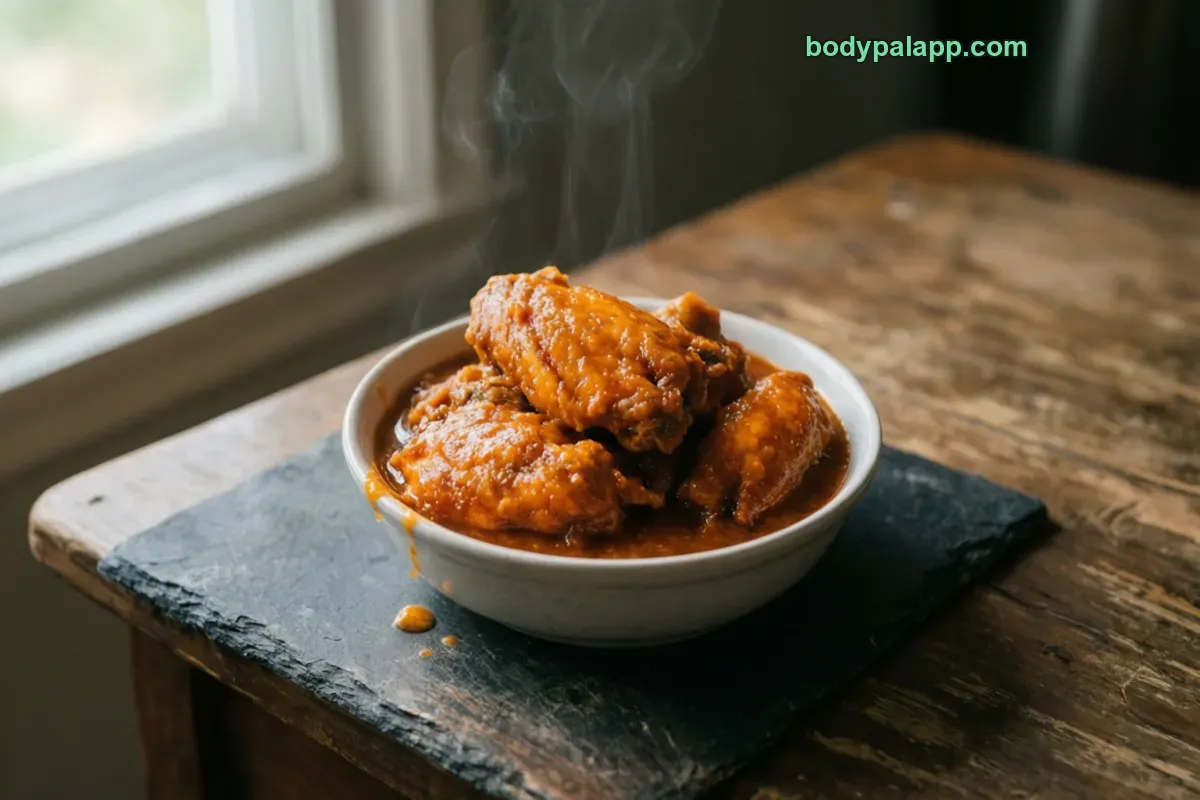
Buffalo sauce calories come to 2 for 1 tablespoon (16 g) of bottled sauce and 11 per 100 g. The calorie count is close to nothing. The sodium is not: that same tablespoon carries 467 mg, 20% of the daily value, so how much you pour matters far more for salt than for energy.
2kcal
1 tablespoon · 16 g, bottled, ready to use
34%protein
0.2 gProtein
0 gCarbs
0.1 gFat
How to burn off 2 kcal
—Walking, brisk
—Jogging
—Cycling, moderate
—Swimming
Skip the math. BodyPal counts these calories from your steps and workouts automatically.
Nutrition facts
Bottled, ready to use · per 16 g
Calories
2 kcal
Protein
0.2 g
Carbohydrate
0.1 g
Fat
0.1 g
Saturated fat
0 g
Cholesterol
0 mg
Sodium
467 mg
Potassium
19 mg
Iron
0.2 mg
Source: USDA FoodData Central
🛡️
Verified nutrition data
Numbers on this page come from USDA FoodData Central, the U.S. Department of Agriculture’s food composition database, and from manufacturer labels where a branded product is named. Last verified September 2026. How we verify our data →
Buffalo sauce: calories, protein and sodium by serving
Percent of daily value uses the FDA reference of 2,000 kcal a day.
Serving
kcal
Protein
Carbs
Fat
Sodium
% DV kcal
1 tablespoon (16 g)
2
0.2 g
0.1 g
0.1 g
467 mg
0%
2 tablespoons (32 g)
4
0.4 g
0.2 g
0.2 g
933 mg
0%
Dipping cup (28 g)
3
0.3 g
0.2 g
0.2 g
817 mg
0%
100 g
11
1.2 g
0.8 g
0.7 g
2,917 mg
1%
3 × 1 tablespoon (16 g)
5
0.6 g
1,400 mg
5 × 1 tablespoon (16 g)
9
1 g
2,334 mg
Five tablespoons still stay in single digits
A single tablespoon (16 g) of bottled buffalo sauce has 2 calories. Double it to 2 tablespoons (32 g) and you reach 4. A 28 g dipping cup lands in between at 3. These are numbers most food logs would round away.
Even heavy use barely registers. Three tablespoons (48 g) come to 5 calories, and five tablespoons (80 g), enough to coat a generous plate of wings, add up to 9. A full 100 g, more sauce than most people use in one sitting, is 11 calories, or 1% of the daily value for energy. You would struggle to eat enough of it to make a dent in your day.
So counting tablespoons is not worth the effort for calories alone. The reason to measure is sodium, which climbs fast while the calorie line stays almost flat. Track this sauce for salt, not for energy, and you will be watching the number that actually changes.
Fat is the biggest slice of a tiny total
Per 100 g, buffalo sauce has 1.2 g protein, 0.8 g carbs and 0.7 g fat. In calorie terms, fat supplies 45% of the energy, protein 34% and carbs 21%. On paper that reads like a fat-led condiment with a respectable protein share.
Those percentages sound meaningful until you remember the base. Split 11 calories that way and every slice is a crumb. A tablespoon holds 0.2 g protein, 0.1 g carbs and 0.1 g fat, amounts that will not move your daily macros in any direction. The split is a curiosity, not a planning tool.
Sugar is close to absent: 0.1 g per 100 g and 0 g in a tablespoon, 2 tablespoons or a dipping cup. Fiber sits at 0.6 g per 100 g, saturated fat at 0.1 g, and cholesterol at 0. If you count carbs or sugar, this sauce barely shows up on the ledger, which is exactly why it is popular with people who track closely.
Sodium is the row to watch
Here is where buffalo sauce stops being a free condiment. One tablespoon has 467 mg of sodium, 20% of the daily value. Two tablespoons bring 933 mg, or 41%, and a 28 g dipping cup has 817 mg, 36% of the day's allowance in a single small container.
Pour freely and the number escalates quickly. Three tablespoons carry 1,400 mg; five carry 2,334 mg. Per 100 g the sauce holds 2,917 mg of sodium, 127% of the daily value, so a heavy coating can deliver about a full day's sodium from sauce alone, before you count the wings, the dip or anything else on the plate.
If you watch sodium, measure with a spoon instead of pouring from the bottle, and toss food in a thin coat rather than drowning it. Serving the sauce on the side and dipping lightly also keeps the total in check. Potassium is modest at 120 mg per 100 g.
Let the sauce season lean, low-salt foods
Because the sauce adds so few calories, the total of a buffalo dish is set by what it coats, not by the sauce itself. The same heat works on grilled chicken, shrimp, roasted cauliflower, eggs or a wrap, so you can pick the base that fits your day and let the sauce handle the flavor.
The sodium is the part to plan around. If buffalo sauce is on the menu, keep the rest of that meal lower in salt: plain vegetables like celery and carrots, unsalted rice or potatoes, and fresh rather than processed sides. That way the sauce gets to be the salty element instead of one of several.
Bottled versions vary by maker, and this page lists several, from Primal Kitchen to Mrs. Clark's Foods and Bitchin' Sauce. Check the label of the one you buy, paying most attention to the sodium line. If you snap a photo of the plate, BodyPal can log the sauce along with the rest of the meal.
How does buffalo sauce compare?
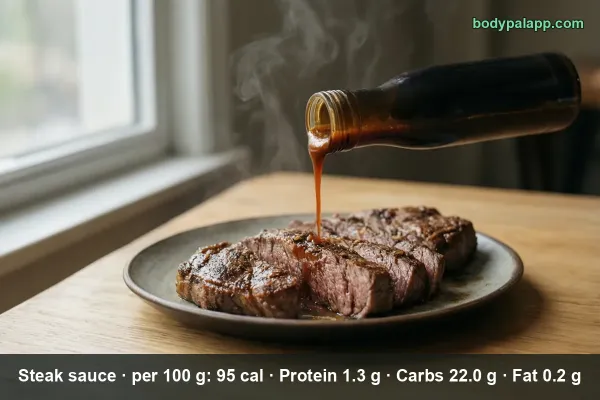
Here is how buffalo sauce stacks up against A1 sauce, soy sauce and honey mustard, per 100 g and per usual serving.
Verdict: For the fewest calories, buffalo sauce wins easily at 11 per 100 g, against 53 for soy sauce, 95 for A1 sauce and 275 for honey mustard, which packs 25 times the energy. If sodium is your concern, honey mustard is the lightest at 509 mg per 100 g, while soy sauce is the saltiest at 5,493 mg.
Most popular buffalo sauce brands in the United States
6Steak 'n Shake Buffalo Sauce, Medium Hot2 tbsp · 32 g141 kcal
Most bottled buffalo sauces are blended with butter or oil, so their labels read far higher than the vinegar and pepper sauce measured above. Source: manufacturer labels / USDA FoodData Central.
Buffalo sauce FAQs
How many calories are in buffalo sauce?
One tablespoon (16 g) is 2 calories and 2 tablespoons are 4 calories. Per 100 g buffalo sauce has 11 calories.
Is buffalo sauce good for weight loss?
A tablespoon adds only 2 calories, so it barely moves a daily total. The number to watch is sodium: 2,917 mg per 100 g, or about 467 mg in one tablespoon.
Buffalo sauce vs A1 sauce: which has fewer calories?
Buffalo sauce has 11 calories per 100 g and A1 sauce has 95, so buffalo sauce is the lighter choice by weight.
How much fat and carbs are in buffalo sauce?
Per 100 g there are 0.7 g fat and 0.8 g carbs, of which 0.1 g is sugar. A tablespoon works out to about 0.1 g of fat and 0.1 g of carbs.
Does buffalo sauce have sugar?
Barely. Buffalo sauce has 0.1 g of sugar per 100 g, and a tablespoon, 2 tablespoons or a dipping cup all show 0 g. Sugar is not a reason to skip it; sodium is the number worth checking.
How much sodium is in buffalo sauce?
One tablespoon (16 g) has 467 mg of sodium, 20% of the daily value. Per 100 g it is 2,917 mg, or 127% of the daily value, so the amount you pour matters a lot.
Is buffalo sauce high in calories?
No. It has 11 calories per 100 g and 2 per tablespoon. Even five tablespoons (80 g) come to only 9 calories, so the sauce adds very little energy to a meal.
Which sauce has the most calories: buffalo, soy, A1 or honey mustard?
Honey mustard, at 275 calories per 100 g and 41 per tablespoon. A1 sauce has 95 per 100 g, soy sauce 53, and buffalo sauce just 11, the lowest of the four.
What are the macros in buffalo sauce?
By calories, buffalo sauce is 45% fat, 34% protein and 21% carbs. In grams per 100 g that is 0.7 g fat, 1.2 g protein and 0.8 g carbs, tiny amounts in any serving.