
How many calories are in konjac noodles?
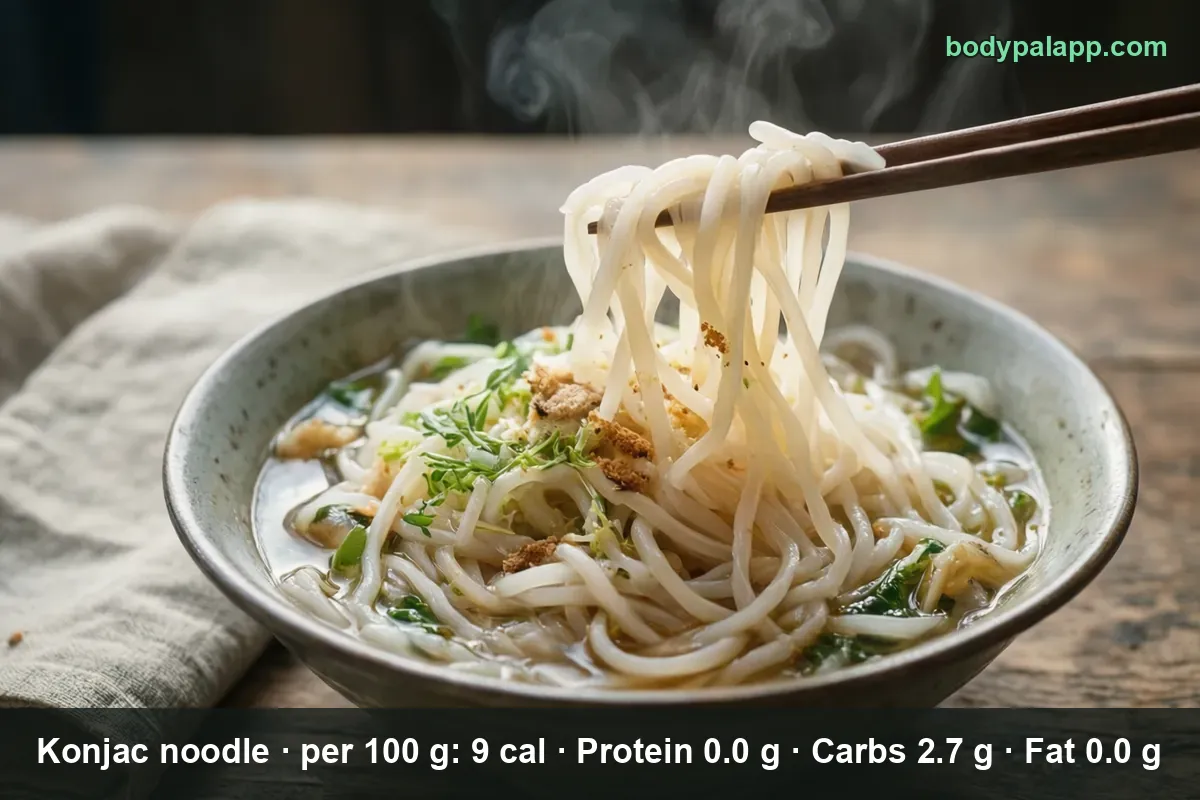
A 4 oz (112 g) drained serving of konjac noodles carries 10 calories. Per 100 g the drained noodles run 9 calories, which is among the lowest numbers on any noodle shelf in America. Nearly all of that weight is water, and nearly all of the rest is glucomannan fiber.
On this page
- Konjac noodle quick facts
- US servings, from one ounce to a whole bag
- Spaghetti, fettuccine, tofu shirataki and rice
- Fiber is the only row that moves
- How do konjac noodles compare?
- Most popular konjac noodle brands
- FAQ
Konjac noodle quick facts
USDA has no Foundation, SR Legacy or FNDDS entry for konjac. The plant is imported, processed and sold as a packaged product, so every record in FoodData Central is a Branded label. The one used here is SHIRATAKI NOODLES, 2396564, a plain drained konjac noodle with a real household serving of 4 oz behind it. It is the bag most people actually pull out of the refrigerator case.
One thing worth knowing before you read the table: konjac noodles are packed wet, in liquid, and every number below describes the noodles after they are drained and rinsed. The liquid you pour off carries nothing you need to count.
| Nutrient | Per 100 g | Per 4 oz drained (112 g) | % Daily Value |
|---|---|---|---|
| Calories | 9 | 10 | — |
| Total fat | 0.0 g | 0.0 g | 0% |
| Saturated fat | 0.0 g | 0.0 g | 0% |
| Carbohydrate | 2.68 g | 3.0 g | 1% |
| Dietary fiber | 2.7 g | 3.0 g | 11% |
| Total sugars | 0.0 g | 0.0 g | — |
| Protein | 0.0 g | 0.0 g | 0% |
| Sodium | 0 mg | 0 mg | 0% |
% Daily Value is based on a 2,000-calorie diet.
Verified nutrition data
Numbers on this page come from USDA FoodData Central, the U.S. Department of Agriculture’s food composition database, and from manufacturer labels where a branded product is named. Last verified September 2026. How we verify our data →
The label carries no added sugars line, so that row is left off entirely — plain konjac noodles contain no sugar of any kind to add to. Cholesterol and potassium both read 0 mg on this panel, which is what you would expect from a food that is essentially water and root fiber.
You may notice the fiber figure (2.7 g) sitting slightly above the total carbohydrate figure (2.68 g) per 100 g. That is a rounding artifact, not an error: the panel declares 3 g of both per serving, and the per-100-g conversion lands them a hundredth of a gram apart. In practice, the carbohydrate in konjac noodles is fiber, full stop.
US servings, from one ounce to a whole bag
| Serving | Weight | Calories |
|---|---|---|
| 1 oz | 28 g | 3 kcal |
| 4 oz drained, the label serving | 112 g | 10 kcal |
| One bag, two servings | 224 g | 20 kcal |
| Per 100 g | 100 g | 9 kcal |
Only the 4 oz row is a USDA serving. The 1 oz line and the whole-bag line are our own arithmetic from the USDA 100 g figure, not USDA servings — 28 g and 224 g scaled from 9 calories per 100 g.
The whole-bag row is the one that matters, because that is how konjac noodles get eaten. A 4 oz portion looks thin next to a plate of spaghetti, so most people empty the package into the pan. That decision costs 20 calories. There is no other kind of noodle in the US market where doubling the portion is this close to free.
Spaghetti, fettuccine, tofu shirataki and rice
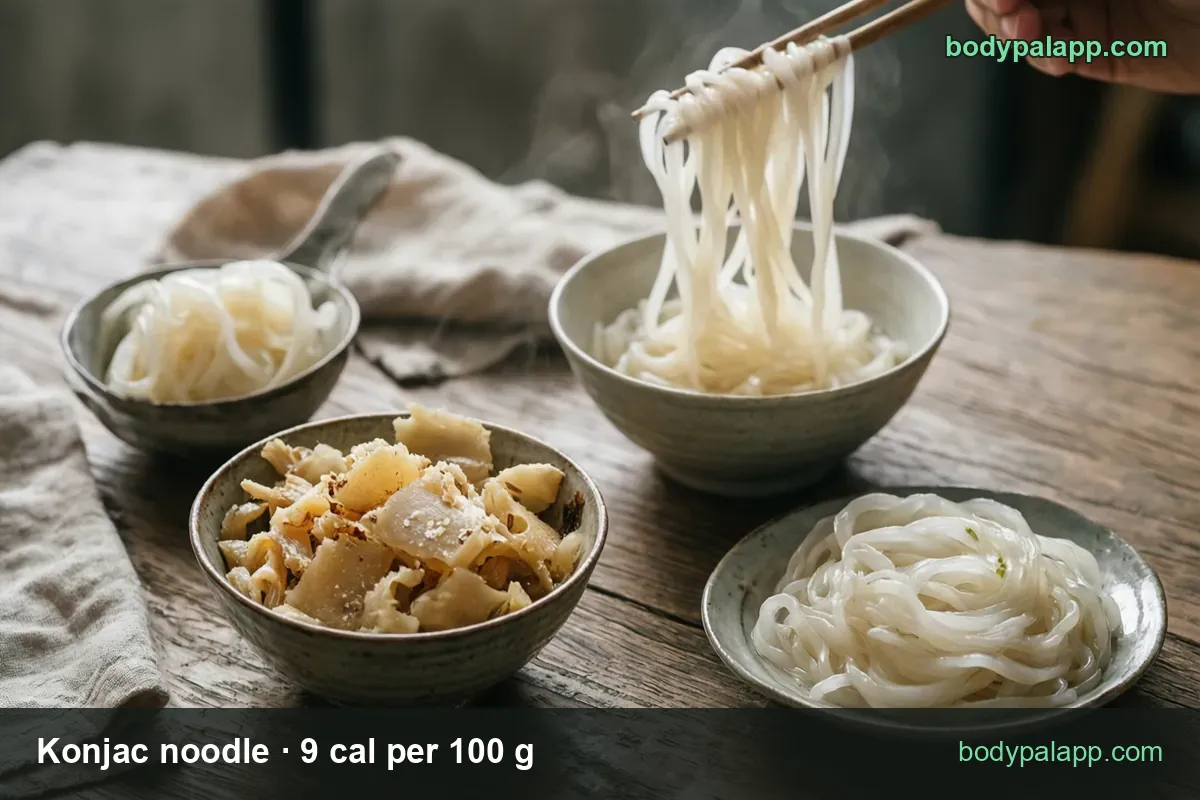
Cut shape barely moves the calories. What moves them is what the manufacturer blends into the konjac paste.
| Version | Per 100 g | Typical package serving | Calories |
|---|---|---|---|
| Konjac spaghetti | 10 kcal | 3.52 oz (100 g) | 10 kcal |
| Konjac fettuccine | 10 kcal | 3.52 oz (100 g) | 10 kcal |
| Konjac rice | 10 kcal | 3.52 oz (100 g) | 10 kcal |
| Macaroni-style shirataki | 9 kcal | 4 oz (113 g) | 10 kcal |
| Tofu shirataki noodles | 9 kcal | 1 package (226 g) | 20 kcal |
| Ramen-style brown rice shirataki | 20 kcal | 7 oz (198 g) | 40 kcal |
Tofu shirataki is the interesting one. House Foods adds soy to the konjac, which lifts protein to 0.88 g and fat to 0.44 g per 100 g while the calories stay at 9. The trade is texture: it is firmer and less springy than plain konjac, and it takes sauce better. The ramen-style noodle blends in organic brown rice, which more than doubles the density to 20 calories per 100 g and pushes a 7 oz nest to 40.
Store brands sit further apart than you would guess for a food that is mostly water. Simple Truth Organic fettuccine-style declares 5 calories per 100 g, Skinny Pasta konjac noodles 10, Haiku Organic linguine 12, and NuPasta angel hair 17 — more than three times the spread from lightest to heaviest. The difference is drained water and the small amount of rice or oat flour some brands add for bite, not the konjac itself. Every one of them is still a rounding error next to real pasta.
Fiber is the only row that moves
On a 4 oz serving, konjac noodles deliver 3.0 g of fiber against 3.0 g of total carbohydrate. Read against the FDA Daily Values, that is 11% of the 28 g fiber target from a food supplying 1% of the carbohydrate target and 0% of everything else. No other common starch swap has that shape.
The fiber is glucomannan, a soluble fiber drawn from the konjac corm. It absorbs many times its weight in water, which is why the noodles feel substantial in the bowl despite carrying no meaningful energy. That same property is why the package tells you to drain and rinse rather than boil down the liquid.
The gap this leaves is protein. Konjac noodles have none, and the Dietary Guidelines for Americans put protein foods at the center of a balanced plate. If you build dinner around konjac instead of pasta, the protein has to arrive from somewhere else — chicken, shrimp, tofu, eggs. If you are watching sodium, note that the plain drained noodle reads 0 mg, so the entire sodium load of the finished dish comes from whatever sauce you add.
How do konjac noodles compare?
| Food | Per 100 g | US serving | Calories |
|---|---|---|---|
| Konjac noodles | 9 kcal | 4 oz drained, 112 g | 10 kcal |
| Zucchini, raw | 17 kcal | 4 oz, 112 g | 19 kcal |
| Rice noodles, cooked | 108 kcal | 4 oz, 112 g | 121 kcal |
| Pasta, cooked, enriched | 158 kcal | 4 oz, 112 g | 177 kcal |
Our take: konjac is the lightest of the four by a wide margin, and it is not close — raw zucchini, the usual low-carb noodle stand-in, is nearly twice as dense per 100 g. Swapping 4 oz of cooked pasta for 4 oz of konjac saves 167 calories, and swapping a full 224 g bag against the same weight of pasta — 354 calories of pasta against 20 — saves 334 (our arithmetic from the USDA 100 g figures). For pure calorie control, konjac wins outright. For a meal that keeps you full and fed, pasta is still bringing 5.8 g of protein per 100 g that konjac cannot match, so treat konjac as a volume base and let the protein come from the topping.
Most popular konjac noodle brands in the United States
Ranked by how widely each product appears among foods sold in the United States, from the BodyPal food database of over 3.3 million products. Calories are the figures printed on each Nutrition Facts label, checked against USDA FoodData Central.
| Product | Calories (per 100 g) |
|---|---|
| NuPasta Konjac Low Calorie Pasta Angel Hair | 17 cal |
| Skinny Pasta Konjac Noodles | 10 cal |
| House Foods Tofu Shirataki Noodles | 9 cal |
| Skinny Shirataki Noodles | 9 cal |
| Haiku Organic Konjac Noodles Linguine | 12 cal |
| Simple Truth Organic Fettuccine Style Shirataki Noodles | 5 cal |
Brand popularity: BodyPal food database. Nutrition: manufacturer labels / USDA FoodData Central.
Konjac noodle FAQs
How many calories are in konjac noodles?
A 4 oz (112 g) drained serving has 10 calories, and 100 g has 9. That holds for plain konjac or shirataki noodles with nothing added. A whole 224 g bag comes to 20 calories, which is our own arithmetic from the USDA 100 g figure rather than a USDA serving.
Are konjac noodles zero calorie?
No. The label serving is 10 calories, not zero, and 100 g is 9. The zero-calorie shorthand comes from FDA rounding rules that let a serving under 5 calories be declared as zero. Konjac noodles sit just above that line at a 4 oz serving.
How many carbs are in shirataki noodles?
3.0 g of carbohydrate in a 4 oz (112 g) serving, and 2.68 g per 100 g. Fiber accounts for essentially all of it, at 3.0 g per serving. That works out to 1% of the Daily Value for carbohydrate and 11% for fiber, an unusual split for anything sold as a noodle.
Are konjac noodles good for weight loss?
At 10 calories per 4 oz serving they replace a starch almost for free: 4 oz of cooked pasta is 177 calories, so the swap saves 167. Weight loss still depends on the whole day of eating, and konjac brings no protein at all, so pair it with something that does.
What is the difference between konjac and tofu shirataki noodles?
Tofu shirataki is konjac with soy added: 9 calories per 100 g, the same as plain shirataki, but 0.88 g of protein and 0.44 g of fat where plain konjac has none of either. A full 226 g package is 20 calories. The texture is firmer and less springy.
How much fiber is in konjac noodles?
2.7 g per 100 g, or 3.0 g in a 4 oz (112 g) serving, which is 11% of the FDA Daily Value of 28 g. The fiber is glucomannan, a soluble fiber from the konjac root. It is why the noodles hold water and feel filling in the bowl.
Do konjac noodles have protein?
None. Plain konjac noodles read 0.0 g of protein per 100 g and 0.0 g per 4 oz serving. Tofu shirataki is the exception at 0.88 g per 100 g, still under 2 g for a whole 226 g package. Cooked pasta, by contrast, carries 5.8 g per 100 g.
How many calories in a whole bag of konjac noodles?
A standard 224 g bag holds two 4 oz servings and 20 calories in total, our own arithmetic from the USDA 100 g figure. House Foods tofu shirataki comes in a 226 g package that is also 20 calories. Eating the entire bag barely registers on a food log.
Similar foods
- Buffalo Sauce — 2 cal per tablespoon
- Ramen Broth — 39 cal per cup
- Ground Coffee — 2 cal per cup
- Salt — 0 cal per tsp
- Tajín Seasoning — 0 cal for 1/4 tsp
- Tea Bag — 0 cal per bag
Count it without the math
Point the camera at the bowl and BodyPal counts the noodles, the sauce and the topping for you.


One food is easy to picture; a whole day is harder. See how many calories you need a day and what a deficit actually looks like.