
How many calories are in sprinkles?
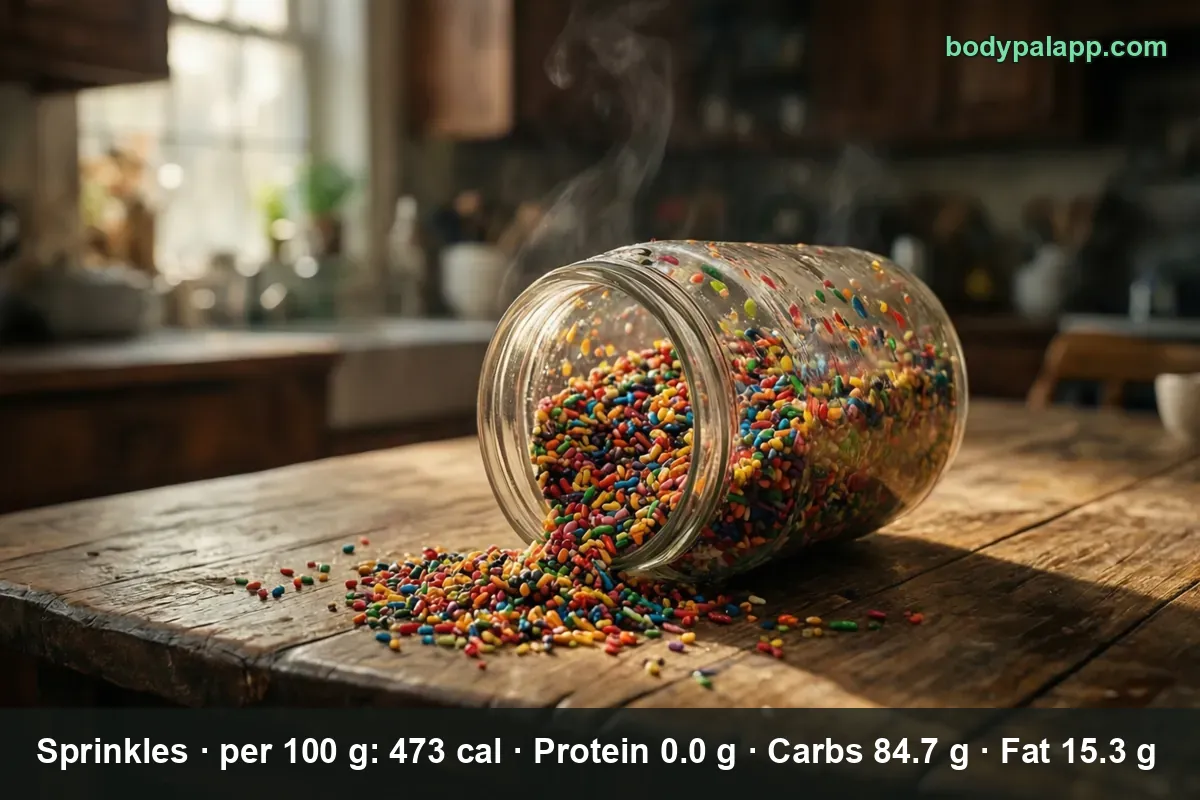
One tablespoon of sprinkles weighs 10 g and carries 47 calories. Per 100 g the jar runs 473 calories, heavier per gram than plain candy at 429. Almost none of that is protein or fiber, both flat at zero, and the number that surprises people sits in the saturated fat row rather than the sugar row.
On this page
- Sprinkles quick facts
- US servings, from a teaspoon to a full cup
- Jimmies, a dusting, and a cup in the batter
- Saturated fat is the row nobody expects
- How do sprinkles compare?
- Most popular sprinkles brands
- FAQ
Sprinkles quick facts
The figures below come from one record: FNDDS 2710334, "Candy, sprinkles", published in the 2021-2023 survey release. It is the only USDA entry that describes decorative sugar strands as their own product. Foundation Foods and SR Legacy have nothing equivalent, and the branded database is a maze of cake-decorating kits and mixed toppings sold as part of something else. Someone typing this question is holding a small jar of jimmies or nonpareils, so that is the record the page is built on.
Two rows you would see on a store label are missing here. USDA does not publish added sugars or trans fat for this record, so neither appears in the table below; in practice almost every gram of sugar in a sprinkle is added rather than intrinsic, since there is no fruit or milk in the base. Cholesterol is 0 mg per 100 g and potassium is 2 mg per 100 g, both of which round to nothing at spoon size.
| Nutrient | Per 100 g | Per 1 tablespoon (10 g) | % Daily Value |
|---|---|---|---|
| Calories | 473 | 47 | — |
| Total fat | 15.27 g | 1.5 g | 2% |
| Saturated fat | 12.97 g | 1.3 g | 6% |
| Carbohydrate | 84.66 g | 8.5 g | 3% |
| Dietary fiber | 0 g | 0 g | 0% |
| Total sugars | 84.83 g | 8.5 g | — |
| Protein | 0 g | 0 g | 0% |
| Sodium | 2 mg | 0 mg | 0% |
% Daily Value is based on a 2,000-calorie diet.
Verified nutrition data
Numbers on this page come from USDA FoodData Central, the U.S. Department of Agriculture’s food composition database, and from manufacturer labels where a branded product is named. Last verified September 2026. How we verify our data →
One oddity is worth flagging rather than hiding: USDA lists total sugars at 84.83 g against carbohydrate of 84.66 g. The sugar figure edges past the carbohydrate figure because the two are measured by different methods, and both are reproduced here exactly as published. The practical reading is simple. Sprinkles are sugar and fat, with nothing else in them.
US servings, from a teaspoon to a full cup
| Serving | Weight | Calories |
|---|---|---|
| 1 teaspoon | 3.3 g | 16 kcal |
| 1 tablespoon | 10 g | 47 kcal |
| 2 tablespoons | 20 g | 95 kcal |
| 1 oz | 28.4 g | 134 kcal |
| 1 cup | 160 g | 757 kcal |
| Per 100 g | 100 g | 473 kcal |
Only two of the household servings above come straight from USDA. The one-cup weight of 160 g is a listed household measure on the record, and the two-tablespoon line matches the portion USDA files under "quantity not specified" for people who could not say how much they used. The teaspoon, the single tablespoon and the ounce are our own arithmetic from the USDA 100 g figure, not USDA servings: the gram weights are 1/48 and 1/16 of the cup and a standard 28.4 g ounce.
That distinction matters more here than on most foods, because sprinkles are the rare item people measure in two completely different worlds. On top of a cone or a cupcake, the unit is a shake of the jar: a teaspoon, maybe a tablespoon. Inside a batch of funfetti cookies, the unit is a cup. The gap between them is not a rounding difference. It is 16 calories against 757, roughly 47 times more from the same jar.
Jimmies, a dusting, and a cup in the batter
| Version | Per 100 g | Typical amount | Calories |
|---|---|---|---|
| Rainbow sprinkles (jimmies), one spoonful | 473 kcal | 1 tablespoon, 10 g | 47 kcal |
| A light dusting on a cupcake | 473 kcal | 1 teaspoon, 3.3 g | 16 kcal |
| Baking a batch, sprinkles stirred in | 473 kcal | 1 cup, 160 g | 757 kcal |
Jimmies, nonpareils, sanding sugar and chocolate strands all sit behind the same USDA record, because the recipe barely changes across shapes: sugar, a hard vegetable fat, a little starch and color. USDA does not break the shapes apart, and no clean retail jar in the branded database carries a full label with a confirmed barcode match, so there is no separate brand figure to give you. Treating every shape at 473 calories per 100 g is the honest default.
The dusting is the version most people actually eat. A teaspoon on a cupcake adds 16 calories, which is small enough that it will not change how you log the cupcake. Two heaped shakes over ice cream land near the tablespoon at 47. It is the third line that ambushes people. A cup of sprinkles folded into cookie dough contributes 757 calories to the batch before a single other ingredient is counted, which is more than most people expect from something they think of as decoration.
Saturated fat is the row nobody expects
Sugar gets the attention, and it earns it: 8.5 g in a tablespoon is about two teaspoons of table sugar. But the row that moves fastest against the FDA Daily Values is saturated fat. Of the 15.27 g of total fat per 100 g, 12.97 g is saturated, about 85% of it. The coating that gives sprinkles their snap and shine is built on a hard vegetable fat, not on butter or cocoa butter, and hard fats are saturated by definition.
At spoon size this is a non-event. A tablespoon is 1.3 g of saturated fat, 6% of the Daily Value, and 2% of the total fat allowance. Scale it to a cup for baking and the arithmetic flips: 20.8 g of saturated fat, 104% of the Daily Value, against only 31% of the day's total fat. A decoration that supplies a full day of saturated fat while barely touching the fat budget is an unusual shape for a food, and it is the single most useful thing to know before a baking session.
The Dietary Guidelines for Americans put saturated fat at under 10% of daily calories, which is roughly the same place the FDA's 20 g Daily Value lands. If you are already watching that number, the fix is not to skip the sprinkles on a cone. It is to weigh what goes into the mixing bowl. And if you want the rest of the plate to carry something back, MyPlate is a reasonable starting point for what a dessert sits next to.
How do sprinkles compare?
| Candy | Per 100 g | US serving | Calories |
|---|---|---|---|
| Sprinkles | 473 kcal | 1 oz, 28.4 g | 134 kcal |
| Candy, NFS | 429 kcal | 1 oz, 28.4 g | 122 kcal |
| Fruit-flavored candy pieces | 400 kcal | 1 oz, 28.4 g | 113 kcal |
| White chocolate candy | 539 kcal | 1 oz, 28.4 g | 153 kcal |
Our take: of these four, only white chocolate candy is denser per gram than sprinkles, and the reason is the same in both cases — fat. Fruit-flavored pieces are almost pure sugar at 94.39 g of carbohydrate and 2.28 g of fat per 100 g, which is why they come in lowest despite tasting sweeter. Sprinkles read as a garnish and price like candy. Nobody eats an ounce of them, though, so the practical comparison is not the ounce column at all: it is a tablespoon at 47 calories against a fun-size candy, and on that basis the sprinkles win easily. Keep them on top of the dessert and they are cheap. Pour them into the dessert and they stop being a garnish.
Most popular sprinkles brands in the United States
Ranked by how widely each product appears among foods sold in the United States, from the BodyPal food database of over 3.3 million products. Calories are the figures printed on each Nutrition Facts label, checked against USDA FoodData Central.
| Product | Calories (per 100 g) |
|---|---|
| Mr. Sprinkles Rainbow Sprinkles | 500 cal |
| Sweetshop Sprinkles | 375 cal |
| Mr. Sprinkles Chocolate Sprinkles | 500 cal |
| De Ruijter Dark Chocolate Sprinkles | 318 cal |
| Wilton Sprinkles | 375 cal |
| Cake Mate Sprinkles | 375 cal |
Brand popularity: BodyPal food database. Nutrition: manufacturer labels / USDA FoodData Central.
Sprinkles FAQs
How many calories are in a tablespoon of sprinkles?
47 calories for a level tablespoon of about 10 g, at 473 calories per 100 g. That one spoon carries 8.5 g of carbohydrate and 8.5 g of sugar, with no protein and no fiber behind it. The 10 g weight is our own arithmetic from the USDA 100 g figure, not a USDA serving.
How many calories are in a teaspoon of sprinkles?
16 calories for a teaspoon of roughly 3.3 g, the light dusting that lands on one cupcake. Three of those, spread across three cupcakes, still come in under 50 calories total. Like the tablespoon, that gram weight is our own arithmetic from the USDA 100 g figure rather than a listed USDA serving.
How many calories are in a cup of sprinkles?
757 calories for a full cup, 160 g on the USDA measure, which is the figure that matters when sprinkles go into cookie dough rather than onto a cone. That one cup also carries 20.8 g of saturated fat, 104% of the Daily Value, and 136 g of sugar.
How much sugar is in sprinkles?
84.83 g per 100 g, which works out to 8.5 g in a tablespoon and 136 g in a cup. Carbohydrate is 84.66 g per 100 g, so sugar accounts for the whole carbohydrate load; the two figures are published that way by USDA and are not smoothed here. Fiber is zero.
Do sprinkles have any protein or fiber?
Zero on both counts: USDA lists 0 g protein and 0 g dietary fiber per 100 g, so a tablespoon adds 47 calories of pure carbohydrate and fat with nothing structural attached. Cholesterol is 0 mg and potassium is 2 mg per 100 g, which rounds to nothing at spoon size.
Are chocolate sprinkles higher in calories than rainbow sprinkles?
USDA publishes one record for sprinkles, 473 calories per 100 g, and does not split chocolate jimmies from rainbow ones. Chocolate versions are usually built on the same sugar and vegetable fat base, so treat both at 47 calories a tablespoon until the label on the jar says otherwise.
Why are sprinkles so high in saturated fat?
12.97 g of the 15.27 g of total fat is saturated, about 85% of it, because the coating that gives sprinkles their snap is built on a hard vegetable fat rather than butter or cocoa butter. A tablespoon is only 1.3 g, 6% of the Daily Value, but a baking cup is 104%.
How many calories do sprinkles add to a cupcake or an ice cream cone?
About 16 calories for the teaspoon that fits on one cupcake and 47 for the heavier tablespoon most people shake over an ice cream cone. Either way the topping is a rounding error next to the dessert underneath; a cup stirred into the batter, at 757 calories, is not.
Similar foods
- Peanut Butter Cookies — 147 cal per cookie
- Corn Tortilla Chips — 132 cal per oz
- Milk Duds — 213 cal per box
- Rolo — 199 cal for 7 pieces
- Cereal Bar — 203 cal per bar
- Chips Ahoy Chocolate Chip Cookies — 190 cal per pack
Count it without the math
Point the camera at the cupcake and BodyPal counts it for you, sprinkles included.


How long does it take to burn off sprinkles?
One tablespoon (10 g) is 47 kcal. Enter your weight and the amount you ate to see how long it takes you to burn that off:
lb
| Activity | Time to burn 47 kcal |
|---|---|
| Walking, brisk | 9 min |
| Cycling, moderate | 6 min |
| Swimming, moderate | 7 min |
| Jogging | 6 min |
| Weight training, moderate | 10 min |
Times are for a 155 lb adult at a steady pace; change the weight to see yours. The amount is set to the portion in the text (10 g); change it to what you actually ate. BodyPal works this out from your steps automatically.
Want the bigger picture? Calculate your daily calorie needs — your maintenance figure, a target for losing or gaining, and the date you get there.