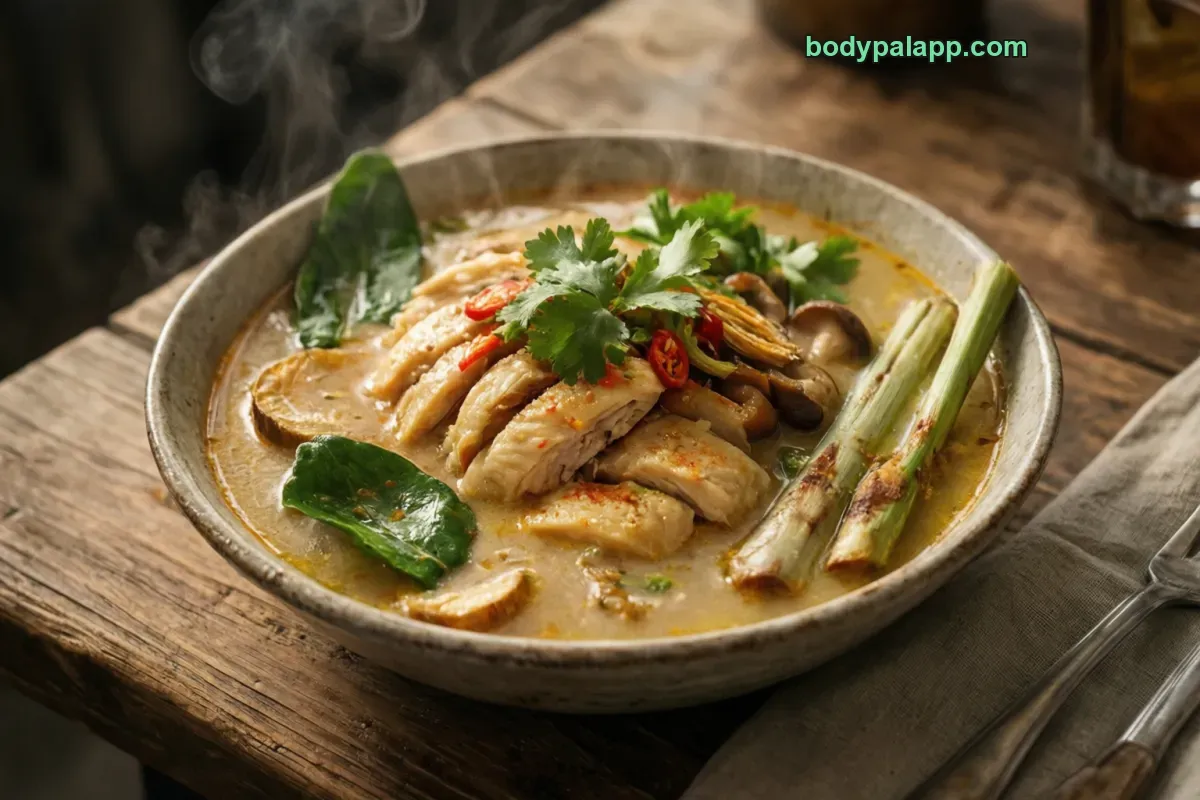
Tom kha soup calories come to 102 for 1 bowl (283 g), or 36 per 100 g. The surprise is the split: carbs, not coconut fat, supply 67% of those calories, while protein sits at just 2.3 g a bowl. Sodium, at 399 mg per bowl, is the number that grows fastest with refills.
102kcal
1 bowl · 283 g, ready-to-eat Thai coconut curry
8%protein
2.3 gProtein
18 gCarbs
3 gFat
How to burn off 102 kcal
—Walking, brisk
—Jogging
—Cycling, moderate
—Swimming
Skip the math. BodyPal counts these calories from your steps and workouts automatically.
Nutrition facts
Ready-to-eat thai coconut curry · per 283 g
Calories
102 kcal
Protein
2.3 g
Carbohydrate
18.4 g
Fat
3 g
Saturated fat
1 g
Cholesterol
0 mg
Sodium
399 mg
Iron
0 mg
Source: USDA FoodData Central
🛡️
Verified nutrition data
Numbers on this page come from USDA FoodData Central, the U.S. Department of Agriculture’s food composition database, and from manufacturer labels where a branded product is named. Last verified September 2026. How we verify our data →
Tom kha soup: calories, protein and sodium by serving
Percent of daily value uses the FDA reference of 2,000 kcal a day.
Serving
kcal
Protein
Carbs
Fat
Sodium
% DV kcal
1 bowl (283 g)
102
2.3 g
18.4 g
3 g
399 mg
5%
8 oz portion (227 g)
82
1.8 g
14.8 g
2.4 g
320 mg
4%
100 g
36
0.8 g
6.5 g
1.1 g
141 mg
2%
3 × 1 bowl (283 g)
306
6.8 g
1,197 mg
5 × 1 bowl (283 g)
509
11.3 g
1,995 mg
One bowl is 102 calories, and refills add up fast
The standard serving here is 1 bowl (283 g), and it lands at 102 calories, about 5% of the daily value for energy. An 8 oz portion (227 g) drops to 82 calories. That gap is small, so the size of your container matters less than how many times you go back to the pot.
Refills are where the total climbs. Two bowls come to 204 calories, three reach 306, and five bowls, a full 1,415 g of soup, add up to 509. Even at five bowls the calorie count stays moderate for that much volume, which says a lot about how watery this soup really is. Most of what you are eating is broth.
The catch is that volume alone does not make a meal. Per bowl you get only 2.3 g of protein, and five bowls still deliver just 11.3 g. So the soup reads light on paper and can feel light in practice too. Plan the rest of the plate around it rather than counting on extra bowls to fill the gap.
Carbs supply two thirds of the calories, not the coconut
Coconut milk gives tom kha its reputation as a rich soup, yet in this ready-to-eat version fat accounts for only 25% of the calories. Carbs carry 67%, and protein trails far behind at 8%. Per 100 g that works out to 6.5 g of carbs, 1.1 g of fat and 0.8 g of protein.
Sugar is a real share of those carbs: 3.7 g per 100 g, or 10.5 g in a full bowl. Fiber adds 2.8 g per bowl, a modest but useful amount for a broth. Saturated fat stays low at 0.4 g per 100 g, and cholesterol is 0, so the fat row is not the one that should worry you here.
The upshot is that this bowl behaves more like a light, slightly sweet broth than a cream soup. If a restaurant version tastes noticeably richer and thicker, assume it carries more coconut milk, and more fat, than these figures show. The ready-to-eat numbers are a floor, not a ceiling.
Sodium is the row to watch once you go back for more
One bowl carries 399 mg of sodium, 17% of the daily value. The 8 oz portion has 320 mg, or 14%. Per 100 g the soup sits at 141 mg, which is lower than many canned soups and is one of the better numbers on this label.
The problem is multiplication. Two bowls bring 798 mg, three bowls 1,197 mg, and five bowls 1,995 mg. Calories stay modest across those refills, while sodium stacks up much faster in daily-value terms. A second bowl barely moves your calorie count but meaningfully moves your salt count.
If you watch sodium, treat one bowl as the portion and keep the rest of the meal low in salt: plain rice, fresh herbs, a squeeze of lime, or steamed vegetables rather than another salty side. Going easy on extra fish sauce or soy sauce at the table helps keep the total close to the label.
Pair it with protein to turn it into a meal
At 2.3 g of protein a bowl, about 5% of the daily value, this soup does not hold up a meal by itself. Its strength is the low calorie count, which leaves plenty of room for something more substantial alongside it.
Classic tom kha gai adds chicken, and shrimp or tofu work the same way: they push protein up while the broth keeps the calorie total in check. Add rice or noodles and you add carbs on top of the 18.4 g already in the bowl, so size those portions with intent rather than by habit.
These figures come from the USDA row for a ready-to-eat Thai coconut curry soup, so homemade and restaurant bowls will differ with the amount of coconut milk, sugar and add-ins. Jarred pastes such as Maesri Tom Kha Soup make home versions easy, but the final numbers depend on what you stir in. If you want a quick log, BodyPal can record the bowl from a photo.
How does tom kha soup compare?
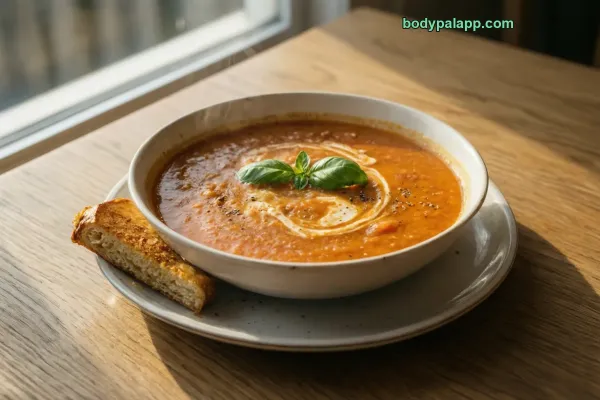
Here is how tom kha stacks up against tomato soup, mushroom soup and corn chowder, per 100 g and per usual serving.
Verdict: For the lightest bowl, tom kha and tomato soup are close at 36 and 34 calories per 100 g, but tom kha carries 141 mg of sodium per 100 g against 263 mg, so it is the better pick if salt matters. Save corn chowder, at 238 calories a cup and 6.3 g of fat per 100 g, for when you want the soup to be the whole meal.
Most popular tom kha soup brands in the United States
Ranked by popularity in the BodyPal database
# Productkcal / 100 g
1Maesri Tom Kha Soup143 g70 kcal
Canned tom kha bases are sold concentrated, so the label number is higher than the ready-to-eat bowl above. Source: manufacturer labels / USDA FoodData Central.
Tom kha soup FAQs
How many calories are in a bowl of tom kha soup?
About 102 calories in a 283 g bowl. That works out to 36 calories per 100 g.
Is tom kha soup good for weight loss?
A 283 g bowl is 102 calories with 3 g of fat and 2.3 g of protein, which is light for a full bowl of soup.
Tom kha soup vs tomato soup: which has fewer calories?
Tomato soup is slightly lighter at 34 calories per 100 g against 36 for tom kha, so a 283 g bowl is 96 calories versus 102.
How much fat is in tom kha soup?
1.1 g of fat per 100 g, so about 3 g in a 283 g bowl, of which 1 g is saturated fat.
How many carbs are in tom kha soup?
A bowl of tom kha soup (283 g) has 18.4 g of carbs, or 6.5 g per 100 g. Carbs make up 67% of its calories, and 10.5 g of each bowl is sugar.
What are the nutrition facts for tom kha soup?
One 283 g bowl has 102 calories, 2.3 g protein, 18.4 g carbs, 3 g fat, 2.8 g fiber and 399 mg sodium. Sodium is the standout at 17% of the daily value.
How many calories are in an 8 oz portion of tom kha soup?
An 8 oz portion (227 g) of tom kha soup has 82 calories, with 1.8 g protein, 14.8 g carbs and 2.4 g fat. It also carries 320 mg of sodium, 14% of the daily value.
How many calories does tom kha have per 100 g?
Tom kha has 36 calories per 100 g, with 0.8 g protein, 6.5 g carbs and 1.1 g fat. That puts it close to tomato soup at 34 and just below mushroom soup at 39.
How much sugar is in tom kha soup?
A bowl of tom kha soup has 10.5 g of sugars, or 3.7 g per 100 g. That is more than half of its 18.4 g of carbs, which explains the slightly sweet edge of the broth.