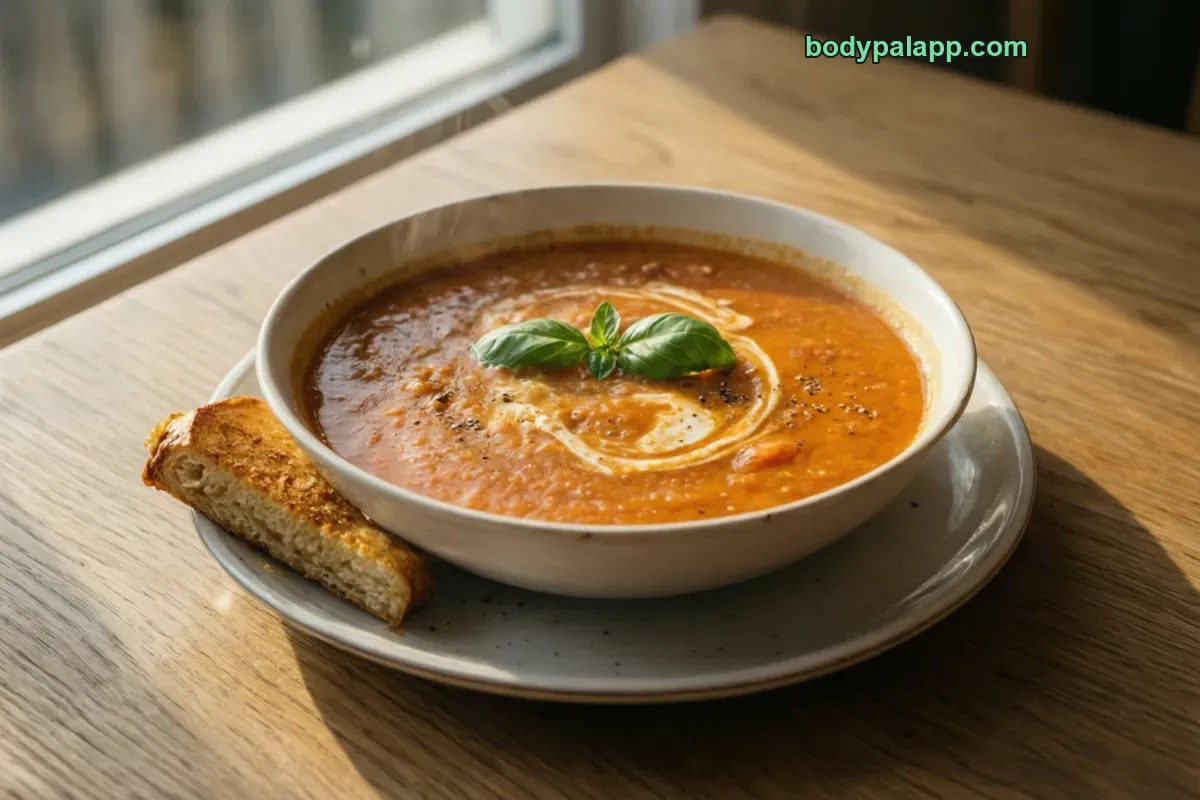
Tomato soup calories come to 83 for one cup (245 g) of canned, ready-to-eat soup, or 34 per 100 g. The number to watch is sodium, not energy. That same cup carries 644 mg, 28% of the daily value, while its calories make up only 4%.
83kcal
1 cup · 245 g, canned, ready to eat
7%protein
1.5 gProtein
19 gCarbs
0.8 gFat
How to burn off 83 kcal
—Walking, brisk
—Jogging
—Cycling, moderate
—Swimming
Skip the math. BodyPal counts these calories from your steps and workouts automatically.
Nutrition facts
Canned, ready to eat · per 245 g
Calories
83 kcal
Protein
1.5 g
Carbohydrate
18.7 g
Fat
0.8 g
Saturated fat
0.1 g
Cholesterol
0 mg
Sodium
644 mg
Potassium
277 mg
Iron
1.1 mg
Source: USDA FoodData Central
🛡️
Verified nutrition data
Numbers on this page come from USDA FoodData Central, the U.S. Department of Agriculture’s food composition database, and from manufacturer labels where a branded product is named. Last verified September 2026. How we verify our data →
Tomato soup: calories, protein and sodium by serving
Percent of daily value uses the FDA reference of 2,000 kcal a day.
Serving
kcal
Protein
Carbs
Fat
Sodium
% DV kcal
1 cup (245 g)
83
1.5 g
18.7 g
0.8 g
644 mg
4%
Cream of tomato (255 g)
179
3.1 g
16.3 g
11.9 g
627 mg
9%
Single container (440 g)
150
2.8 g
33.7 g
1.5 g
1,157 mg
7%
100 g
34
0.6 g
7.7 g
0.3 g
263 mg
2%
3 × 1 cup (245 g)
250
4.6 g
1,933 mg
5 × 1 cup (245 g)
417
7.7 g
3,222 mg
A full container is still only 150 calories
One cup (245 g) is the standard serving at 83 calories. A single container of 440 g, the amount many people heat and finish in one sitting, comes to 150 calories. By energy alone that is a light lunch, about 7% of the daily value.
Bowls usually hold more than a cup, and the total climbs slowly. Two cups (490 g) come to 167 calories, three cups (735 g) to 250, and five cups (1,225 g) to 417. Even the largest of those is a modest number for that much food in a bowl.
That makes tomato soup one of the more forgiving foods to eyeball. If you pour a bigger bowl than you planned, the calorie error stays small. The protein and fiber stay small too, which matters more for how a meal holds up, and the sodium does not stay small at all.
Carbs supply 85% of the calories
Tomato soup is a carbohydrate food. Of its calories, 85% come from carbs, 8% from fat and 7% from protein. Per 100 g that works out to 7.7 g of carbs, 0.3 g of fat and 0.6 g of protein.
More than half of those carbs are sugars: 4.2 g per 100 g, or 10.2 g in a cup and 18.3 g in the 440 g container. The card does not split natural from added sugar, so the label on your can is the place to check whether any was added.
Protein is the weak spot. A cup gives 1.5 g, just 3% of the daily value, and fiber matches it at 1.5 g. Saturated fat sits at 0.1 g per 100 g and cholesterol at 0. In plain terms, regular tomato soup is low in almost everything except carbs and salt, which explains why it rarely works as a whole meal by itself.
Sodium is the row to watch
Per 100 g, tomato soup carries 263 mg of sodium against only 34 calories. Put another way, one cup uses 4% of the daily value for calories but 28% for sodium. Few foods tilt that far toward salt relative to their energy.
Portions make the gap sharper. The 440 g container holds 1,157 mg, which is 50% of the daily value in one sitting. Two cups bring 1,289 mg, three cups 1,933 mg, and five cups 3,222 mg, which on its own runs past the full daily value.
Choosing the cream version does not get you out of it: a 255 g serving of cream of tomato still has 627 mg. If you watch sodium, look for a low-sodium or unsalted can, such as Campbell's Condensed Unsalted Tomato Soup, and compare labels before you buy. The calories will barely change; the sodium can change a lot.
Pair it with protein to make a meal
At 83 calories and 1.5 g of protein per cup, tomato soup does its best work as a starter or a side. It leaves plenty of room in a day of eating for foods that bring the protein and fiber the bowl lacks.
The classic pairings fill that gap. A grilled cheese sandwich, eggs on whole-grain toast, a handful of beans stirred into the bowl or a side of chicken all add substance, so you do not need a huge portion of soup to feel you ate a meal. If you pick a cheese-heavy side, the soup is the lighter half of the plate.
Cream of tomato shifts the balance. At 179 calories and 11.9 g of fat per 255 g, it is the richer choice, so a leaner side keeps the total in check. To keep track without weighing, BodyPal can log tomato soup from a photo.
How does tomato soup compare?
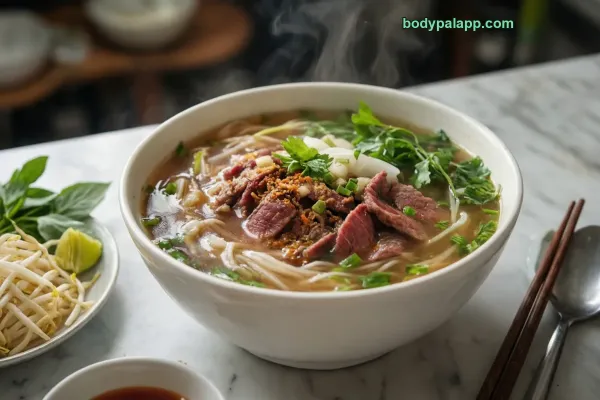
Here is how tomato soup stacks up against pho, california roll and cocktail shrimp, per 100 g and per usual serving.
Verdict: For the fewest calories, tomato soup wins at 34 per 100 g, against 77 for pho and 94 for california roll. For staying full, pick cocktail shrimp, which packs 24 g of protein per 100 g at only 84 calories a serving.
Most popular tomato soup brands in the United States
Ranked by popularity in the BodyPal database
# Productkcal / 100 g
1Heinz Cream of Tomato Soup100 g51 kcal
2Garden Fresh Gourmet Tomato Soup1 cup · 245 g98 kcal
3Campbell's Tomato Soup1 cup · 240 ml42 kcal
4Pacific Foods Organic Roasted Red Pepper and Tomato Soup240 ml52 kcal
5Campbell's Mexican Style Tomato Soup1 cup · 240 ml46 kcal
Condensed cans are labeled before water is added, so their numbers read higher than the ready-to-eat soup above. Source: manufacturer labels / USDA FoodData Central.
Tomato soup FAQs
How many calories are in a cup of tomato soup?
A cup of canned tomato soup (245 g) is 83 calories. A single-serve container of 440 g comes to 150 calories.
Is tomato soup good for weight loss?
A cup is 83 calories with 0.8 g of fat and 1.5 g of fiber, which is light for a filling 245 g bowl. Cream of tomato is 70 calories per 100 g, roughly double the 34 of plain canned.
What is the calorie difference between tomato soup and cream of tomato soup?
Plain canned tomato soup has 34 calories and 0.3 g of fat per 100 g, while cream of tomato has 70 calories and 4.7 g of fat per 100 g.
How much sodium is in tomato soup?
Canned tomato soup has 263 mg of sodium per 100 g, about 644 mg in a 245 g cup. The reduced sodium version has 191 mg per 100 g, or about 468 mg per cup.
Is tomato soup calorie dense?
No. Canned tomato soup has 34 calories per 100 g, so even a full cup (245 g) comes to just 83 calories. Most of its weight is water, and carbs supply 85% of what energy it has.
How many calories are in a can of tomato soup?
A single 440 g container of ready-to-eat tomato soup has 150 calories. It also carries 1,157 mg of sodium, which is 50% of the daily value, so the salt matters more than the calories.
How many calories are in a bowl of tomato soup?
A large bowl of two cups (490 g) has 167 calories, and three cups (735 g) come to 250. Check how much your bowl holds, since a single cup is only 83 calories.
How many calories does tomato soup have per 100 g?
Tomato soup has 34 calories per 100 g, with 7.7 g of carbs, 0.6 g of protein and 0.3 g of fat. That same 100 g carries 263 mg of sodium and 4.2 g of sugars.
Is tomato soup fattening?
Regular canned tomato soup has only 0.3 g of fat and 34 calories per 100 g, so it is light. Cream of tomato is richer, with 179 calories and 11.9 g of fat in a 255 g serving.