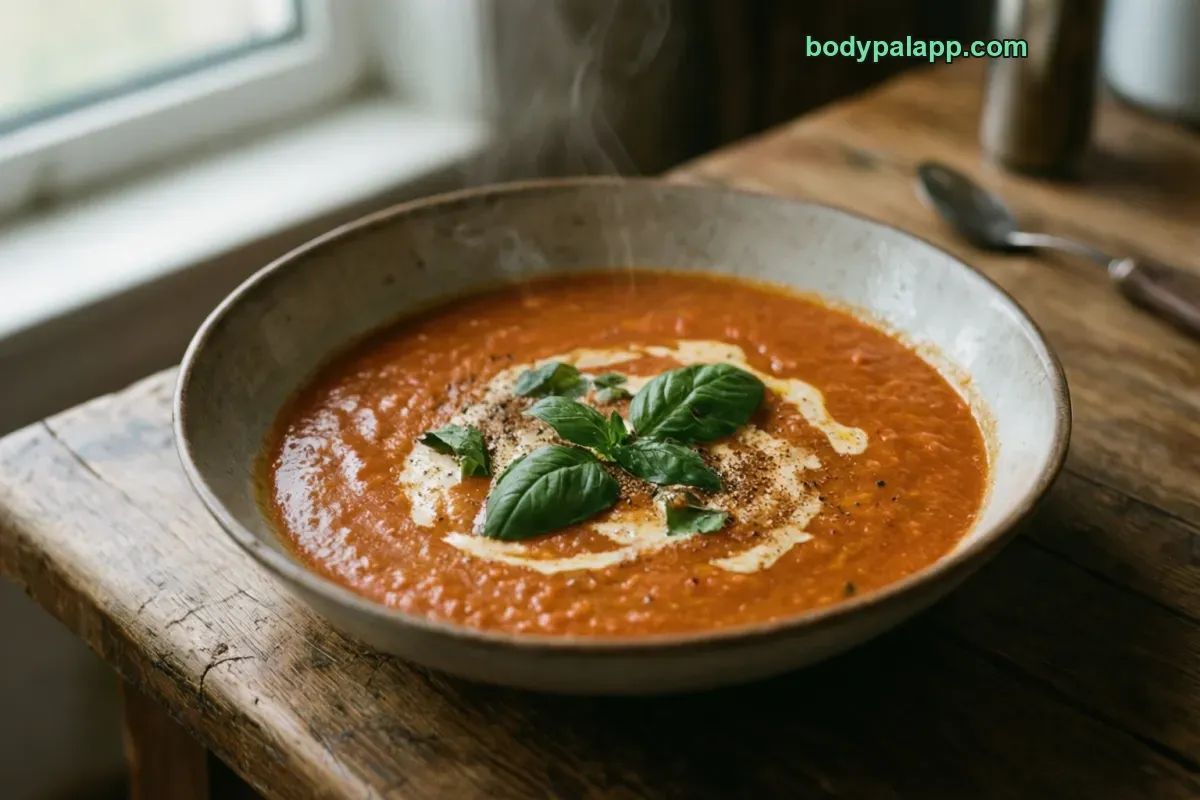
Tomato basil soup calories come to 110 for 1 cup (245 g) and 45 per 100 g. The number worth noticing is sodium, not calories: that one cup carries 630 mg, 27% of the daily value, while its calories fill just 6%. Bowl size moves the salt total far faster than the calorie total.
110kcal
1 cup · 245 g, packaged, per label
8%protein
2 gProtein
16 gCarbs
3.5 gFat
How to burn off 110 kcal
—Walking, brisk
—Jogging
—Cycling, moderate
—Swimming
Skip the math. BodyPal counts these calories from your steps and workouts automatically.
Nutrition facts
Packaged, per label · per 245 g
Calories
110 kcal
Protein
2 g
Carbohydrate
16 g
Fat
3.5 g
Saturated fat
2.5 g
Cholesterol
10 mg
Sodium
630 mg
Source: USDA FoodData Central
🛡️
Verified nutrition data
Numbers on this page come from USDA FoodData Central, the U.S. Department of Agriculture’s food composition database, and from manufacturer labels where a branded product is named. Last verified September 2026. How we verify our data →
Tomato basil soup: calories, protein and sodium by serving
Percent of daily value uses the FDA reference of 2,000 kcal a day.
Serving
kcal
Protein
Carbs
Fat
Sodium
% DV kcal
1 cup (245 g)
110
2 g
16 g
3.5 g
630 mg
6%
100 g
45
0.8 g
6.5 g
1.4 g
257 mg
2%
3 × 1 cup (245 g)
331
6 g
1,889 mg
5 × 1 cup (245 g)
551
10 g
3,148 mg
One cup is 110 calories; three cups reach 331
The label serving is 1 cup (245 g), and it comes to 110 calories, 2 g of protein and 3.5 g of fat. That is 6% of the daily calorie value, a light starter by any measure. The catch is that few people stop at one ladle when the soup is the whole lunch.
A generous bowl often holds two cups. At 490 g you are at 221 calories and 1,259 mg of sodium. Three cups, the size of a big restaurant bowl or a carton split unevenly, reach 331 calories and 1,889 mg of sodium. Calories climb slowly here. Sodium does not.
Finish a family-size pot alone, 5 cups or 1,225 g, and the total is 551 calories with 10 g of protein and 3,148 mg of sodium. The calorie count stays moderate even at that size. The salt total is the part that outgrows the portion, and it is the reason to measure the bowl rather than guess.
Carbs supply 62% of the calories
The calorie split is 62% carbohydrate, 30% fat and 8% protein. Per 100 g the soup holds 6.5 g of carbs, 1.4 g of fat and 0.8 g of protein. Most of those carbs show up as sugar: 4.5 g per 100 g, or 11 g in a cup.
Fat is the second source, and most of it is saturated. Saturated fat is 1 g of the 1.4 g per 100 g, and cholesterol is 4 mg, a pattern that usually points to cream or butter in a packaged recipe. Brands labeled creamy, such as O, That's Good! Creamy Tomato Basil Soup, lean further in that direction, so read the fat line on the carton.
Protein is the weak spot. A cup gives 2 g, only 4% of the daily value, and fiber is also 2 g. That combination explains why a bowl of soup on its own can feel light an hour later. The soup brings volume and flavor; it does not bring much staying power.
Sodium is the row to watch
Per 100 g the soup carries 257 mg of sodium, 11% of the daily value, against only 2% of daily calories. In a cup the gap widens to 27% of sodium for 6% of calories. Few items on a lunch tray are that lopsided.
Against the 2300 mg daily value, two cups at 1,259 mg take up more than half the day, and three cups at 1,889 mg leave little room for bread, cheese or deli meat. If you watch sodium, the portion matters more than anything you add to the bowl.
Labels vary. Brands on this page include Wild Harvest, Ahold Organic and Harry's Fresh Foods, and their sodium can differ from this USDA row, which describes an Ahold packaged soup. Check the panel on the carton you actually buy. Making the soup at home lets you set the salt yourself, which is the simplest way to change this row.
Pair it with protein to make it a meal
At 110 calories and 2 g of protein, a cup works best as a side or a starter. Pair it with something that carries protein, such as a grilled chicken sandwich, sliced turkey or a bowl of beans, and the meal stops feeling like a snack.
The classic partner is grilled cheese. It adds protein and fat, along with more sodium, so keep the soup to one cup when the sandwich is on the plate. A side salad with a vinaigrette adds crunch and fiber without much salt, and it makes the soup feel like part of a full plate.
Soup is easy to undercount because bowls are rarely measured. Weigh one serving at home once; seeing what 245 g looks like in your own bowl makes every later guess better. BodyPal can also log the soup from a photo of the bowl, which helps when the ladle is generous.
How does tomato basil soup compare?
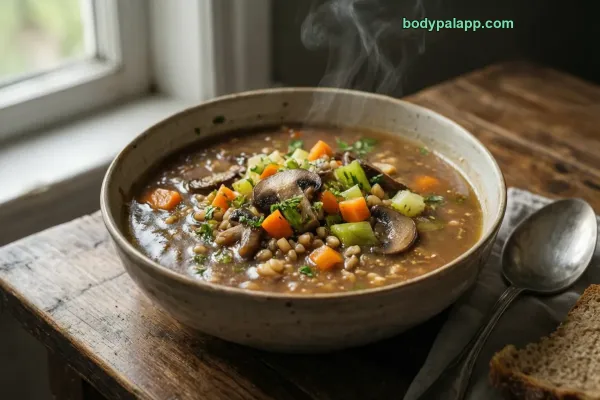
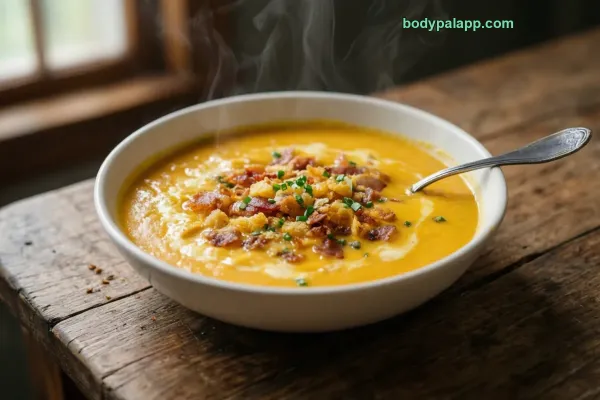
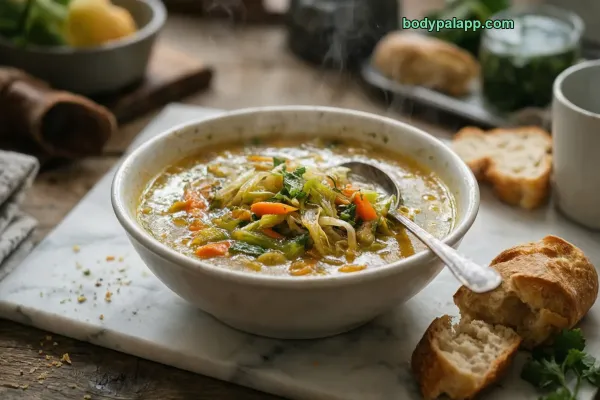
Here is how tomato basil soup stacks up against mushroom barley soup, beer cheese soup and generic soup, per 100 g and per usual 1 cup serving.
Verdict: For the lightest bowl pick mushroom barley soup at 73 calories a cup, though it carries 365 mg of sodium per 100 g against 257 for tomato basil. Beer cheese soup at 321 calories a cup, 2.9 times this soup, is a treat rather than a starter, while plain soup at 120 calories brings more protein, 3.5 g per 100 g.
Most popular tomato basil soup brands in the United States
How many calories are in a cup of tomato basil soup?
About 110 calories in one cup (245 g), or 45 calories per 100 g.
Is tomato basil soup good for weight loss?
One cup has 110 calories and 3.5 g of fat, which is low for a full bowl of soup.
Tomato basil soup vs creamy tomato basil soup: which has fewer calories?
The regular soup has 45 calories per 100 g, while a creamy version has 59. That is 110 vs 140 calories per serving.
How much sugar is in tomato basil soup?
One cup has 11.0 g of sugar out of 16.0 g of carbs. It also has 2.0 g of protein.
How many calories are in two cups of tomato basil soup?
Two cups (490 g) come to 221 calories, with 4 g of protein and 1,259 mg of sodium. That is a filling bowl for the calories, but the sodium takes more than half of the 2300 mg daily value.
How much sodium is in a cup of tomato basil soup?
One cup (245 g) has 630 mg of sodium, 27% of the daily value. Per 100 g it is 257 mg. Have two cups and the total reaches 1,259 mg, so portion size matters.
How much protein does tomato basil soup have?
A cup gives just 2 g of protein, 4% of the daily value, and 100 g gives 0.8 g. Protein supplies only 8% of the calories, so pair the soup with a protein food if it is your meal.
How many calories are in 100 g of tomato basil soup?
100 g of tomato basil soup has 45 calories, with 6.5 g of carbs, 1.4 g of fat and 0.8 g of protein. Sugars are 4.5 g and sodium is 257 mg.
Is tomato basil soup high in fat?
Not by the numbers: a cup has 3.5 g of fat and 100 g has 1.4 g. Fat still supplies 30% of the calories, and 1 g of every 100 g is saturated fat.