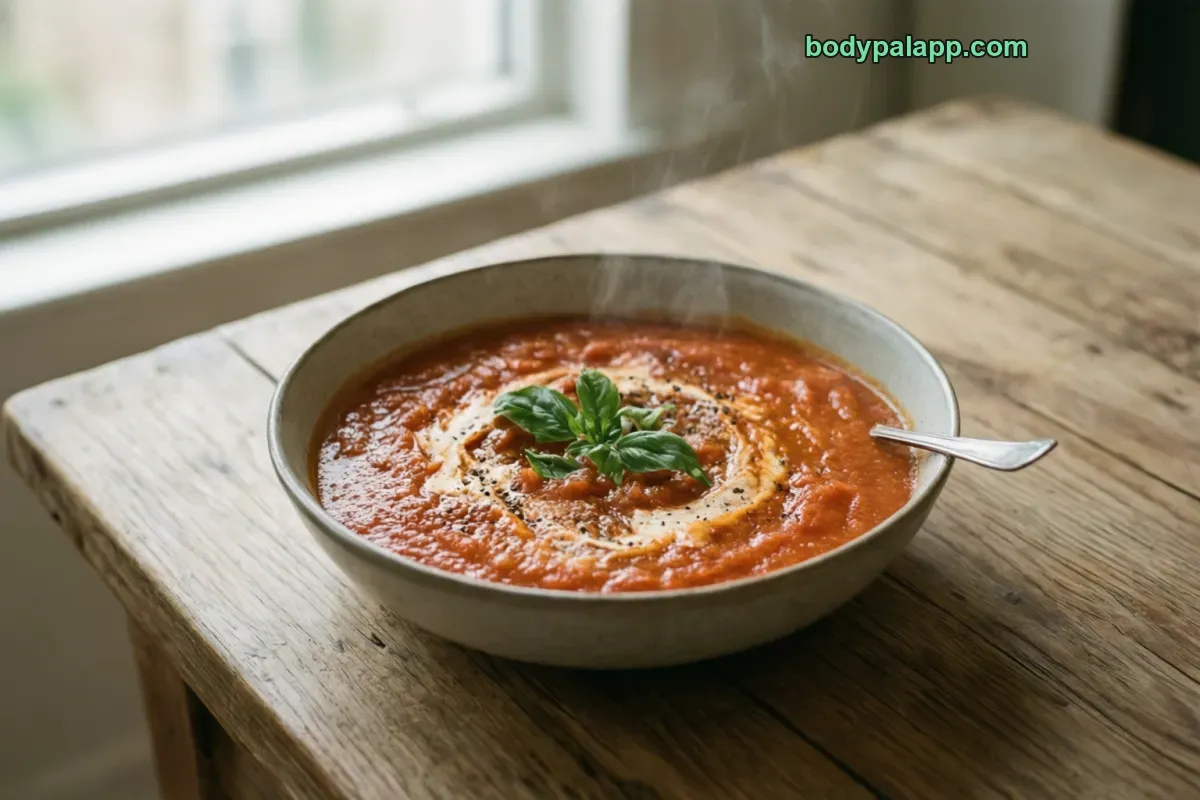
Homemade tomato soup calories come to 47 for 1 cup (245 g) and 19 per 100 g of a broth-based pot. Calories are not the catch. Sodium is: that same cup carries 598 mg, 26% of the daily value. Swap the broth base for cream and the cup jumps to 179 calories.
47kcal
1 cup · 245 g, broth-based, homemade
12%protein
1.6 gProtein
9 gCarbs
1 gFat
How to burn off 47 kcal
—Walking, brisk
—Jogging
—Cycling, moderate
—Swimming
Skip the math. BodyPal counts these calories from your steps and workouts automatically.
Nutrition facts
Broth-based, homemade · per 245 g
Calories
47 kcal
Protein
1.6 g
Carbohydrate
8.9 g
Fat
1 g
Saturated fat
0.1 g
Cholesterol
0 mg
Sodium
598 mg
Potassium
414 mg
Iron
1.1 mg
Source: USDA FoodData Central
🛡️
Verified nutrition data
Numbers on this page come from USDA FoodData Central, the U.S. Department of Agriculture’s food composition database, and from manufacturer labels where a branded product is named. Last verified September 2026. How we verify our data →
Homemade tomato soup: calories, protein and sodium by serving
Percent of daily value uses the FDA reference of 2,000 kcal a day.
Serving
kcal
Protein
Carbs
Fat
Sodium
% DV kcal
1 cup (245 g)
47
1.6 g
8.9 g
1 g
598 mg
2%
Cream of tomato, 1 cup (255 g)
179
3.1 g
16.3 g
11.9 g
627 mg
9%
100 g
19
0.7 g
3.6 g
0.4 g
244 mg
1%
3 × 1 cup (245 g)
140
4.8 g
1,793 mg
5 × 1 cup (245 g)
233
8 g
2,989 mg
Three cups barely reach 140 calories
One cup (245 g) of broth-based tomato soup lands at 47 calories, just 2% of a 2000-calorie daily value. Double it and you reach 93 calories for 490 g. Three cups, a generous lunch pot, total 140 calories. Even five cups, 1,225 g of soup, come to only 233 calories.
That math makes portion size nearly irrelevant for energy. What climbs fast is sodium. Two cups carry 1,196 mg, three cups 1,793 mg, and five cups 2,989 mg, which is more than a full day's daily value on its own. So the question of bowl size is really a question of salt.
Protein stays low at every size: 1.6 g per cup, 4.8 g in three cups, 8 g in five. A big bowl fills the stomach with volume and warmth, but it will not carry a meal on protein alone. Treat it as the light half of a lunch, not the whole thing.
Carbs supply 70% of the calories
Per 100 g the soup holds 19 calories, 3.6 g of carbs, 0.7 g of protein and 0.4 g of fat. Split by energy, carbs make up 70%, fat 18% and protein 12%. That profile is exactly what you expect from a pot built mostly from tomatoes, water and a little oil.
Of the 3.6 g of carbs, 2 g are sugars, which in a homemade pot come from the tomatoes themselves. A full cup delivers 4.9 g of sugars and 2.2 g of fiber. Fiber at 0.9 g per 100 g is modest, but it is real for something this light.
Fat is the lever that changes everything. At 0.4 g per 100 g, with 0.1 g saturated, the broth version barely registers on the fat line. Cholesterol is 0. The calorie count of tomato soup is decided almost entirely by what you stir in at the end.
Sodium is the row to watch
A cup holds 598 mg of sodium, 26% of the daily value, against only 2% of daily calories. Per 100 g that is 244 mg for 19 calories. Few foods show a gap that wide between energy and salt, and it is the number worth tracking here.
The reason is simple: broth and seasoning do most of the flavor work in a light soup. When you make it at home, you control both. Low-sodium stock and salting at the end, after tasting, are the two easiest ways to pull the number down without changing the calories at all.
Potassium runs to 169 mg per 100 g, courtesy of the tomatoes. If you track sodium, log the soup by the cup rather than guessing from the bowl, since every extra cup adds another 598 mg. A refill feels free on calories. On sodium it is not.
Cream turns 47 calories into 179
Cream of tomato soup, 1 cup (255 g), comes to 179 calories, against 47 for the broth-based cup. Fat explains most of the gap: 11.9 g per cup versus 1 g. Carbs also rise to 16.3 g and sugars to 6 g.
Protein edges up to 3.1 g and sodium to 627 mg, 27% of the daily value, so the creamy bowl is not meaningfully saltier. It is simply denser. At 9% of daily calories, it starts to behave like a side dish rather than a starter.
If you like a velvety texture, a small splash of cream at the end, a blended potato or puréed white beans thicken a pot without going all the way to the full cream version. Pair the lighter soup with something protein-rich, such as a chicken sandwich, eggs or a cheese toast, because the soup alone brings little. BodyPal can log the bowl from a photo.
How does homemade tomato soup compare?
Here is how homemade tomato soup stacks up against three other soups, per 100 g and per usual serving.
Verdict: For the fewest calories, tomato soup wins at 19 per 100 g, with egg drop soup close behind at 27 and homemade chicken soup about 2.1 times higher at 40. If you want a bowl that holds you longer, chicken soup gives 3.4 g of protein per 100 g for 98 calories a cup, while onion soup with cheese costs 265 calories per cup.
Most popular homemade tomato soup brands in the United States
Ranked by popularity in the BodyPal database
# Productkcal / 100 g
1Garden Fresh Gourmet Tomato Soup1 cup · 245 g98 kcal
2Campbell's Condensed Tomato Soup120 ml75 kcal
3Campbell's Tomato Soup1 cup · 240 ml42 kcal
4Pacific Foods Tomato Soup1 cup · 240 ml42 kcal
5Simple Truth Tomato Soup1 pouch · 400 g20 kcal
6Annie's Organic Tomato Soup1 can · 245 g41 kcal
7Nona Lim Tomato Soup8 oz · 227 g26 kcal
8Wegmans Tomato Soup1 can · 425 g38 kcal
Label numbers are for packaged tomato soups: Campbell's condensed is labeled undiluted (before adding water), and several store-bought versions are creamier or richer than a broth-based homemade soup, so they run higher than the page's main figure. Source: manufacturer labels / USDA FoodData Central.
Homemade tomato soup FAQs
How many calories are in a cup of homemade tomato soup?
About 47 calories in one cup (245 g) of broth-based tomato soup, or 19 calories per 100 g.
Is tomato soup good for weight loss?
A cup of broth-based tomato soup has 47 calories and 2.2 g of fiber. The cream of tomato version is 179 calories per cup.
Tomato soup vs chicken soup: which has fewer calories?
Per 100 g, broth-based tomato soup has 19 calories and homemade chicken soup has 40.
How many carbs are in tomato soup?
One cup has 8.9 g of carbs, including 4.9 g of sugars, plus 1.6 g of protein.
How many calories are in cream of tomato soup?
A cup of cream of tomato soup (255 g) has 179 calories, with 11.9 g of fat, 16.3 g of carbs and 3.1 g of protein. That is far more than the 47 calories in a broth-based cup.
How much sodium is in a cup of tomato soup?
A cup (245 g) of homemade tomato soup carries 598 mg of sodium, 26% of the daily value. The creamy version has 627 mg, or 27%, so both deserve attention if you watch salt.
How many calories are in 100 g of tomato soup?
100 g of homemade tomato soup has 19 calories, with 0.7 g of protein, 3.6 g of carbs and 0.4 g of fat. That makes it one of the lightest soups by weight.
How much sugar is in homemade tomato soup?
A cup of homemade tomato soup has 4.9 g of sugars, or 2 g per 100 g, coming from the tomatoes. A cup of cream of tomato soup has 6 g.
How much protein is in tomato soup?
A cup of homemade tomato soup has just 1.6 g of protein, 3% of the daily value. Even five cups only reach 8 g, so pair it with a protein-rich food.