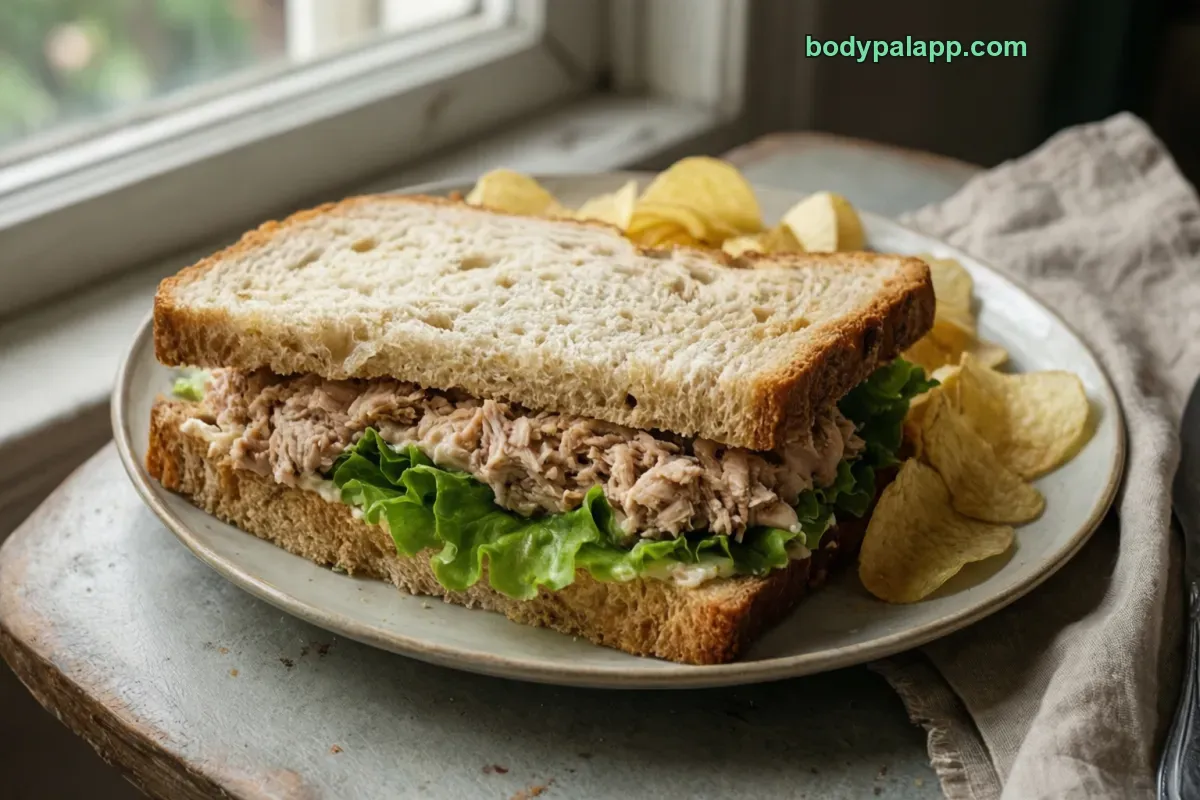
Tuna salad sandwich calories come to 392 for one regular 180 g sandwich on white bread, or 218 per 100 g. The figure to notice is fat: it supplies 48% of the calories, more than the bread does. Sodium is the other row that adds up, at 772 mg, or 34% of the daily value, per sandwich.
392kcal
1 regular sandwich · 180 g, on white bread
18%protein
17.7 gProtein
33 gCarbs
21 gFat
How to burn off 392 kcal
—Walking, brisk
—Jogging
—Cycling, moderate
—Swimming
Skip the math. BodyPal counts these calories from your steps and workouts automatically.
Nutrition facts
On white bread · per 180 g
Calories
392 kcal
Protein
17.7 g
Carbohydrate
33 g
Fat
21 g
Saturated fat
3.5 g
Cholesterol
32 mg
Sodium
772 mg
Potassium
256 mg
Iron
3.1 mg
Source: USDA FoodData Central
🛡️
Verified nutrition data
Numbers on this page come from USDA FoodData Central, the U.S. Department of Agriculture’s food composition database, and from manufacturer labels where a branded product is named. Last verified September 2026. How we verify our data →
Tuna salad sandwich: calories, protein and sodium by serving
Percent of daily value uses the FDA reference of 2,000 kcal a day.
Serving
kcal
Protein
Carbs
Fat
Sodium
% DV kcal
1 regular (180 g)
392
17.7 g
33 g
21.2 g
772 mg
20%
On wheat (180 g)
391
18.9 g
30.7 g
21.4 g
765 mg
20%
With cheese (200 g)
466
21.9 g
33.9 g
27 g
978 mg
23%
100 g
218
9.9 g
18.3 g
11.8 g
429 mg
11%
3 × 1 regular (180 g)
1,177
53.2 g
2,317 mg
5 × 1 regular (180 g)
1,962
88.7 g
3,861 mg
Two sandwiches make a 785-calorie lunch
One regular sandwich weighs 180 g and lands at 392 calories, which is 20% of the daily value. That already counts as a full meal for a lot of people. The deli habit of ordering two changes the math fast: two sandwiches come to 785 calories, 35.5 g of protein and 1,544 mg of sodium.
The totals keep climbing in a straight line. Three sandwiches, the kind of count you reach when you share a party tray, hit 1,177 calories. Five reach 1,962 calories, close to the 2000-calorie daily value used on nutrition labels. Few people eat five, but sandwich platters make it easy to lose track of how many halves went by.
Size matters as much as count. A 200 g sandwich with cheese reaches 466 calories, 23% of the daily value, while a smaller 100 g portion sits at 218. Pre-made sandwiches vary in weight, so check the label before you assume yours is the regular 180 g. A thick deli build can easily outweigh it.
Fat supplies nearly half the calories
The calorie split is 48% fat, 34% carbs and 18% protein. That surprises people who think of tuna as a lean choice. The tuna itself is lean, but tuna salad is usually bound with mayonnaise, and that dressing is where most of the fat comes from.
Per 100 g you get 11.8 g of fat, 18.3 g of carbs and 9.9 g of protein. Saturated fat stays modest at 2 g per 100 g, and cholesterol is low at 18 mg. A regular sandwich carries 21.2 g of fat and 33 g of carbs, with the carbs coming mostly from the white bread. Sugars are small at 5.7 g per sandwich.
Protein is still a real asset here. One sandwich supplies 17.7 g, which is 35% of the daily value, enough to make it a filling lunch rather than a snack. If you want the protein share to rise, a lighter hand with the dressing does far more than swapping the bread, because the fat is where the extra calories sit.
Sodium is the row to watch
One regular sandwich carries 772 mg of sodium, 34% of the daily value. Salt arrives from several places at once: the tuna, the dressing and the bread all contribute. None of them tastes especially salty on its own, which is why the total tends to surprise people.
Cheese pushes the number to 978 mg, or 43% of the daily value, in a single sandwich. Doubling up adds up quickly. Two regular sandwiches reach 1,544 mg, and three reach 2,317 mg, which is past the full daily value from sandwiches alone.
Per 100 g the figure is 429 mg, 19% of the daily value, so even a small portion carries a noticeable amount. If you watch sodium, skip the cheese slice, keep the other meals of the day lower in salt, and pair the sandwich with fresh fruit or raw vegetables instead of chips or pickles. Those sides add crunch without stacking more salt on top.
Wheat bread adds fiber, not calories
Switching from white to wheat barely moves the calorie count: 391 on wheat against 392 on white, both for a 180 g sandwich. Fat is nearly identical too, at 21.4 g versus 21.2 g. If your goal is fewer calories, the bread is not where the savings are.
The difference shows up in the smaller rows. Fiber rises from 1.8 g to 3.8 g, protein ticks up from 17.7 g to 18.9 g, or 38% of the daily value, and carbs drop slightly to 30.7 g. Sodium falls a little as well, to 765 mg, which is 33% of the daily value.
So choose wheat for the fiber, not for weight control. Pairing either version with a side salad or a piece of fruit adds volume without much fat. BodyPal can log the sandwich from a photo, which helps when you are not sure which bread or how much filling went into it.
How does tuna salad sandwich compare?
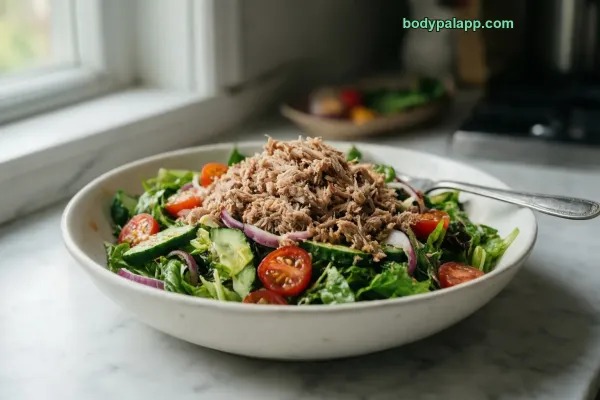
Here is how a tuna salad sandwich stacks up against a salad with tuna, a club sandwich and a ham and cheese sandwich, per 100 g and per usual serving.
Verdict: For the fewest calories per serving, pick the club sandwich at 289 or the ham and cheese sandwich at 288, since both come in smaller portions, though they carry more sodium at 769 mg and 716 mg per 100 g. For the most protein with less sodium, pick the salad with tuna, at 16 g of protein and 402 mg of sodium per 100 g.
Most popular tuna salad sandwich brands in the United States
Label numbers vary with the bread, the amount of mayonnaise and how much filling each product contains. Source: manufacturer labels / USDA FoodData Central.
Tuna salad sandwich FAQs
How many calories are in a tuna salad sandwich?
About 392 calories for a regular sandwich on white bread (180 g), or 391 on wheat bread.
Is a tuna salad sandwich good for weight loss?
A regular sandwich has 392 calories with 17.7 g protein, 21.2 g fat and 33.0 g carbs. A large one (270 g) is 589 calories.
Tuna salad sandwich vs club sandwich: which has fewer calories?
They are almost the same by weight: 218 calories per 100 g for a tuna salad sandwich and 222 for a club sandwich.
How much protein is in a tuna salad sandwich?
A regular tuna salad sandwich on white bread has 17.7 g protein, and one on wheat bread has 18.9 g.
How many calories are in two tuna sandwiches?
Two regular tuna salad sandwiches come to 785 calories. The pair also carries 35.5 g of protein and 1,544 mg of sodium, so a double order works more like a large meal than a light lunch.
How much sodium is in a tuna sandwich?
A regular 180 g tuna salad sandwich on white bread has 772 mg of sodium, 34% of the daily value. Adding cheese raises it to 978 mg, or 43% of the daily value.
Does a tuna sandwich on wheat have fewer calories than one on white bread?
Barely. A 180 g tuna salad sandwich on wheat has 391 calories versus 392 on white bread. The wheat version gives more fiber, 3.8 g against 1.8 g, and slightly more protein at 18.9 g.
What are the nutrition facts for a tuna sandwich?
One regular tuna salad sandwich has 392 calories, 17.7 g of protein, 33 g of carbs and 21.2 g of fat. It also has 1.8 g of fiber, 5.7 g of sugars and 772 mg of sodium.
How many calories are in 100 g of tuna sandwich?
There are 218 calories in 100 g of tuna salad sandwich on white bread. That portion holds 9.9 g of protein, 11.8 g of fat and 18.3 g of carbs.