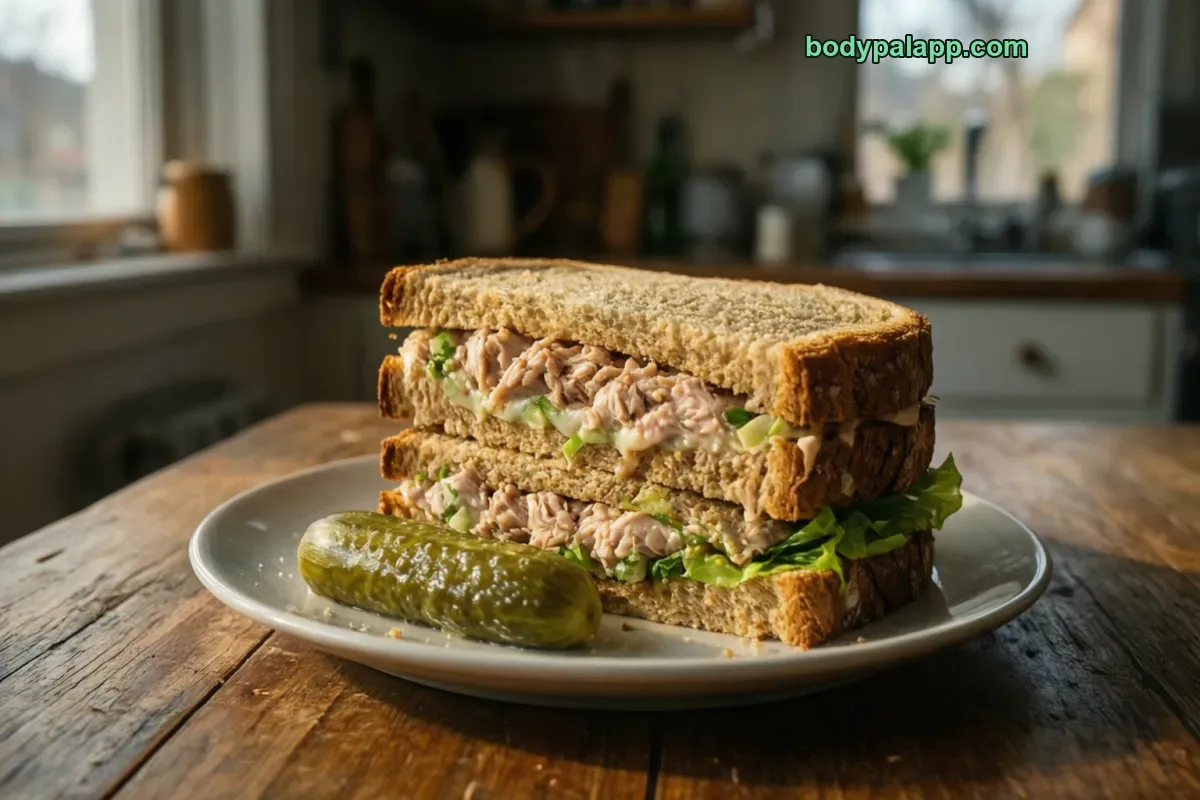
Tuna sandwich on whole wheat calories come to 391 for one regular 180 g sandwich and 217 per 100 g. The number to notice is fat. It supplies 49% of the calories, more than the bread does, because tuna salad carries its dressing. Protein stays solid at 18.9 g per sandwich.
Skip the math. BodyPal counts these calories from your steps and workouts automatically.
Nutrition facts
Tuna salad, wheat bread · per 180 g
Calories
391 kcal
Protein
18.9 g
Carbohydrate
31 g
Fat
21 g
Saturated fat
3.5 g
Cholesterol
32 mg
Sodium
765 mg
Potassium
299 mg
Iron
3 mg
Source: USDA FoodData Central
🛡️
Verified nutrition data
Numbers on this page come from USDA FoodData Central, the U.S. Department of Agriculture’s food composition database, and from manufacturer labels where a branded product is named. Last verified September 2026. How we verify our data →
Tuna sandwich on whole wheat: calories, protein and sodium by serving
Percent of daily value uses the FDA reference of 2,000 kcal a day.
Serving
kcal
Protein
Carbs
Fat
Sodium
% DV kcal
1 regular (180 g)
391
18.9 g
30.7 g
21.4 g
765 mg
20%
1 large (270 g)
586
28.4 g
46.1 g
32.1 g
1,148 mg
29%
With cheese (200 g)
464
23.1 g
31.6 g
27.2 g
972 mg
23%
100 g
217
10.5 g
17.1 g
11.9 g
425 mg
11%
3 × 1 regular (180 g)
1,172
56.8 g
2,295 mg
5 × 1 regular (180 g)
1,953
94.7 g
3,825 mg
A large sandwich jumps to 586 calories
The regular sandwich in this data weighs 180 g and lands at 391 calories, about 20% of a 2000-calorie daily value. That is a reasonable lunch on its own. Step up to a large 270 g sandwich, the kind with thick slices and a generous scoop of filling, and it reaches 586 calories, or 29% of the day.
Adding a slice of cheese moves a 200 g sandwich to 464 calories and pushes fat to 27.2 g. None of these jumps looks dramatic on its own. Stack them together and a large sandwich with cheese is a different meal from the regular one.
Repeat portions add up fast. Two regular sandwiches total 781 calories and three come to 1,172. If you pack one for lunch every day, the regular size is the one to standardize on, because the size you choose matters more than any single ingredient swap.
Almost half the calories come from fat
Per 100 g the sandwich carries 10.5 g of protein, 17.1 g of carbs and 11.9 g of fat. Converted to calories, fat supplies 49%, carbs 31% and protein 19%. The bread is not the heavy part. The dressing in the tuna salad is.
That split matters if you choose tuna for its protein. A regular sandwich still gives 18.9 g, which is 38% of the daily value, a good return for a lunch. But you get 21.4 g of fat alongside it, so tuna salad behaves more like a rich spread than like plain fish.
Saturated fat stays low at 1.9 g per 100 g, so most of that fat is not the saturated kind. Fiber comes to 3.8 g per regular sandwich, helped by the whole wheat bread. Sugars are modest at 5.6 g, which makes this a savory, fairly balanced plate rather than a sweet one.
Sodium is the row to watch
A regular sandwich carries 765 mg of sodium, 33% of the daily value in one item. The large version reaches 1,148 mg, which is 50% of the day, and the cheese version sits at 972 mg, or 42%. Tuna, bread and dressing each contribute, so there is no single ingredient to blame.
Sodium also scales faster than people expect. Two regular sandwiches bring 1,530 mg and three reach 2,295 mg, essentially a full daily value from sandwiches alone. If you watch sodium, keep this to one regular sandwich and let the rest of the day's meals run lower in salt.
Potassium is low at 166 mg per 100 g, so the sandwich does little to offset that sodium by itself. Fresh produce on the side does more for the meal than another salty snack would. Reading the sodium row before the calorie row is a fair habit with any deli sandwich.
Build the rest of the meal around it
At 391 calories, a regular tuna sandwich leaves room in a lunch for a side. Raw vegetables, a piece of fruit or a broth-based soup add volume without competing with the sandwich's fat. Chips are the pairing that quietly piles more calories and sodium on top.
For a lighter build, ask for less tuna salad and more lettuce and tomato in the sandwich itself. Serving it open-faced on a single slice of whole wheat also cuts the bread. These swaps barely change the per 100 g numbers, but they shrink the grams, and grams are what move the total.
BodyPal can log the sandwich from a photo, which helps when deli portions do not match the regular 180 g size. Weigh the filling once at home and you will know which row you are really eating.
How does tuna sandwich on whole wheat compare?
Here is how a tuna sandwich on whole wheat stacks up against other tuna dishes, per 100 g and per usual serving.
Verdict: For weight loss, tuna noodle casserole is the lighter pick at 139 calories per 100 g and 311 per cup, while the tuna salad wrap is the heaviest at 488 per wrap. The tuna mayo sandwich is practically the same food as this one at 392 calories, so choose on bread preference, not calories.
Tuna sandwich on whole wheat FAQs
How many calories are in a tuna sandwich on whole wheat?
About 391 calories for a regular sandwich (180 g), or 586 for a large one (270 g).
Is a tuna sandwich on whole wheat good for weight loss?
A regular sandwich has 391 calories with 18.9 g of protein, 21.4 g of fat and 3.8 g of fiber.
How many calories does cheese add to a tuna sandwich?
A regular tuna sandwich on wheat with cheese (200 g) is 464 calories, compared with 391 without cheese (180 g).
How much protein is in a tuna sandwich on whole wheat?
A regular sandwich has 18.9 g of protein and a large one 28.4 g, which is 10.5 g per 100 g.
How many calories are in a large tuna sandwich on wheat?
A large 270 g tuna sandwich on whole wheat has 586 calories, 29% of the daily value. It also brings 28.4 g of protein, 32.1 g of fat and 1,148 mg of sodium.
How much sodium is in a tuna sandwich on wheat?
A regular 180 g sandwich has 765 mg of sodium, 33% of the daily value. A large one reaches 1,148 mg, and adding cheese brings a 200 g sandwich to 972 mg.
How many carbs are in a tuna sandwich on whole wheat?
A regular sandwich has 30.7 g of carbs, including 3.8 g of fiber and 5.6 g of sugars. Per 100 g, carbs come to 17.1 g, and they supply 31% of the calories.
Does a tuna wrap have more calories than a tuna sandwich?
Yes, the tuna salad wrap is higher: 488 calories for a 200 g wrap versus 391 for a regular 180 g sandwich. Per 100 g the wrap has 244 calories against 217 for the sandwich.
How many calories are in two tuna sandwiches?
Two regular tuna sandwiches on whole wheat total 781 calories, with 37.9 g of protein and 1,530 mg of sodium. Three regular sandwiches come to 1,172 calories.