
How many calories are in turkey and dressing?
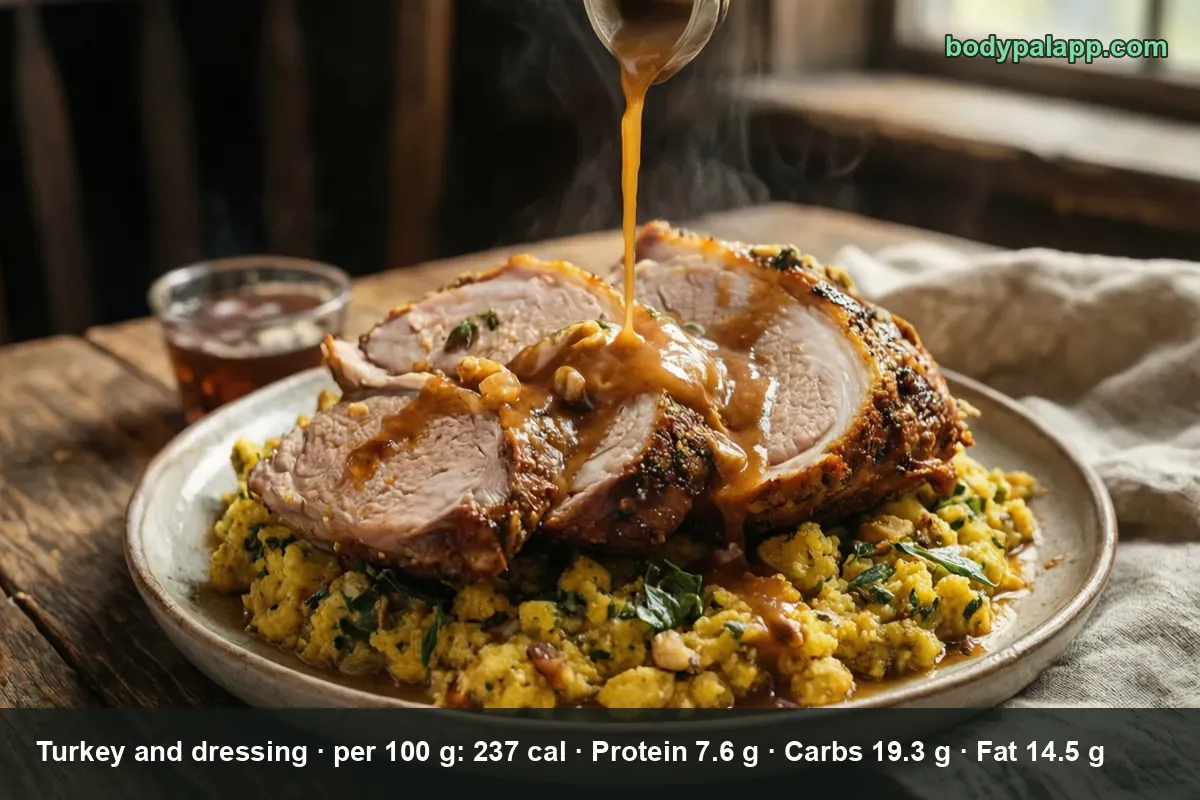
A 1-cup serving of turkey and dressing weighs 161 grams and carries 382 calories, or 237 calories per 100 g. That is a heavy scoop for something most people treat as a side dish: the same cup brings 23.3 grams of fat and 903 milligrams of sodium. Cornbread dressing with roast turkey is the version USDA measures.
On this page
- Turkey and dressing quick facts
- US servings, from a spoonful to a holiday plate
- Cornbread dressing, bread dressing and the frozen tray
- Sodium and cholesterol are the rows to watch
- How does turkey and dressing compare?
- Most popular turkey and dressing brands
- Turkey and dressing FAQs
Turkey and dressing quick facts
The record behind every number on this page is FNDDS 2708746, "Cornmeal dressing with chicken or turkey and vegetables", from the 2021-2023 survey release. It is the only USDA entry that puts cornmeal dressing, poultry and vegetables in one dish, which is exactly what a Southern plate of turkey and dressing is. The bread-crumb version has its own record, and it is a genuinely different food nutritionally, so it gets its own section below rather than being blended in.
Two records that come up in search were deliberately kept out of the headline number. Frozen turkey dinners include potatoes and a vegetable side, which dilutes the dish to 128 calories per 100 g, and the salad entries with the word "dressing" in them are about salad dressing, a different food that happens to share a name.
| Nutrient | Per 100 g | Per 1 cup (161 g) | % Daily Value |
|---|---|---|---|
| Calories | 237 | 382 | — |
| Total fat | 14.45 g | 23.3 g | 30% |
| Saturated fat | 3.1 g | 5.0 g | 25% |
| Carbohydrate | 19.27 g | 31.0 g | 11% |
| Dietary fiber | 1.2 g | 1.9 g | 7% |
| Total sugars | 3.47 g | 5.6 g | — |
| Protein | 7.6 g | 12.2 g | 24% |
| Sodium | 561 mg | 903 mg | 39% |
% Daily Value is based on a 2,000-calorie diet.
Verified nutrition data
Numbers on this page come from USDA FoodData Central, the U.S. Department of Agriculture’s food composition database, and from manufacturer labels where a branded product is named. Last verified September 2026. How we verify our data →
Two label rows are missing from that table on purpose. USDA does not publish added sugars or trans fat for this FNDDS record, so rather than print a blank line, the rows are gone. The total sugars figure of 5.6 grams per cup is all sugar present, most of it from the cornmeal and vegetables, and it cannot be compared against the 50-gram added-sugars limit on the FDA Daily Value list.
Cholesterol and potassium are worth naming. A cup delivers 151 mg of cholesterol, which is 50% of the 300 mg Daily Value, and 237 mg of potassium, only 5% of the 4,700 mg reference. For a dish that feels rich, the potassium contribution is negligible.
US servings, from a spoonful to a holiday plate
| Serving | Weight | Calories |
|---|---|---|
| 1 oz | 28 g | 67 kcal |
| Half cup, restaurant side | 81 g | 191 kcal |
| Three-quarter cup | 121 g | 286 kcal |
| One cup | 161 g | 382 kcal |
| Two cups, holiday plate | 322 g | 763 kcal |
| Per 100 g | 100 g | 237 kcal |
Only the 1-cup line is a USDA household measure. The half cup, the three-quarter cup, the two-cup plate and the ounce are our own arithmetic from the USDA 100 g figure, not USDA servings, so treat them as clean scaling rather than separate measurements.
The cup is where people get caught. A cafeteria scoop and a serving spoon of dressing at a family table are not the same size, and the difference between a half cup and a full cup is 191 calories — about the same as a slice of bread with butter added to the plate without anyone noticing. If you log this dish by eye, log it low and adjust; the density of cornbread dressing means a heaped spoon weighs more than it looks.
An ounce is a useful anchor for the moments when dressing is a garnish rather than a course. At 67 calories per ounce, the two spoonfuls somebody adds "just to try it" while carving is already close to 140 calories before the turkey is on the plate.
Cornbread dressing, bread dressing and the frozen tray
| Version | Per 100 g | Typical serving | Calories |
|---|---|---|---|
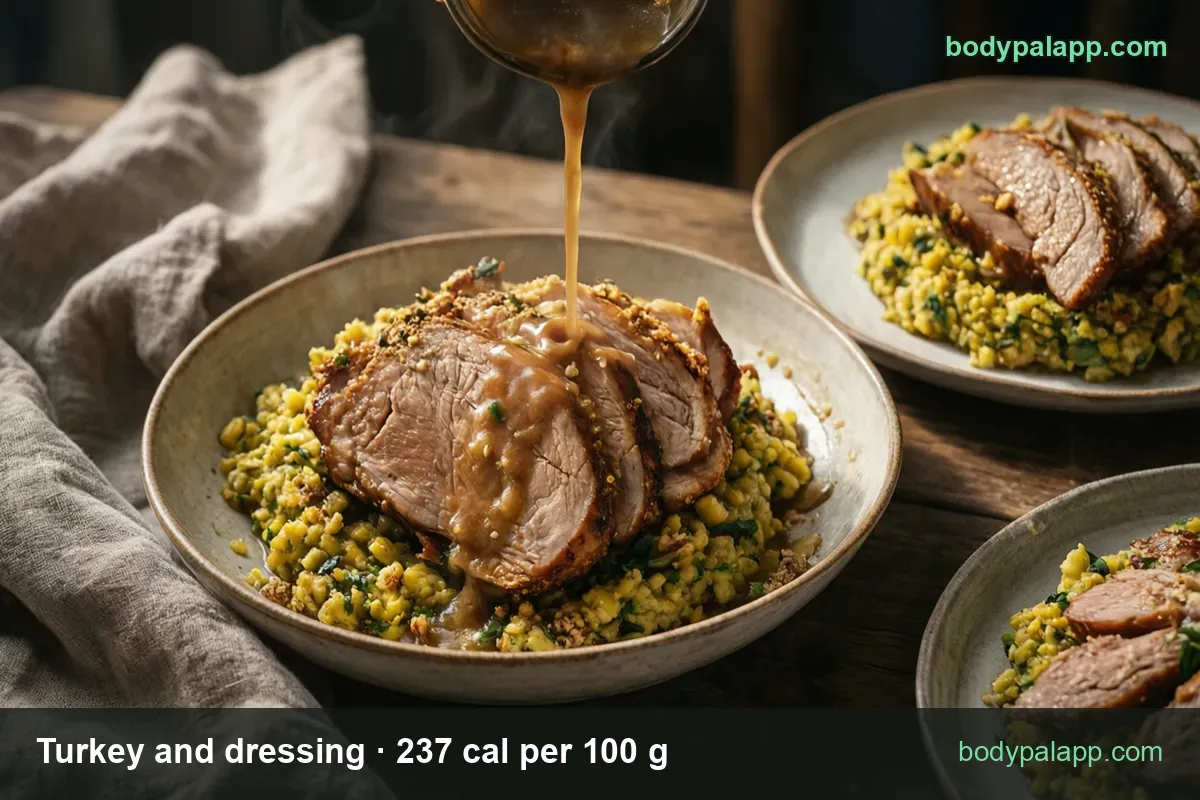
| Cornbread (cornmeal) dressing with turkey | 237 kcal | 1 cup (161 g) | 382 kcal |
| Half-cup side of the same dish | 237 kcal | 1/2 cup (81 g) | 191 kcal |
| Bread dressing with turkey and vegetables | 217 kcal | 1 oz (28 g) | 62 kcal |
| Frozen turkey dinner with gravy and dressing | 128 kcal | 1 tray (262 g) | 335 kcal |
| Diet frozen turkey with stuffing | 96 kcal | 1 meal, 8.5 oz (241 g) | 231 kcal |
| Turkey, stuffing and vegetables with gravy, plated | 128 kcal | 1 oz (28 g) | 36 kcal |
Cornbread versus bread. The cornmeal version is 237 calories per 100 g against 217 for the bread-crumb version, and the entire 20-calorie gap is fat: 14.45 g against 11.17 g per 100 g. Scale both to the same 161-gram cup and it is 382 calories against 349, our own arithmetic on the bread version rather than a USDA serving. That is a smaller difference than the internet arguments about cornbread would suggest — the fat you spoon or pour in matters more than which bread you started from.
The frozen tray is not the same food. A 9.25-ounce frozen turkey dinner comes in at 335 calories for the whole tray, which sounds like a win over a single cup of homemade. It is not a fair trade: that 262 grams includes potatoes and a vegetable side, so you are comparing a plate to a component. Per gram it is 128 calories against 237, and the dilution is the reason.
The diet version. A Weight Watchers-style turkey and stuffing meal is 96 calories per 100 g, 231 for the 241-gram tray, and the lightest thing in this table per gram by a wide margin. It also carries 9.3 g of protein per 100 g, more than the homemade dish's 7.6 g, because the meat-to-starch ratio flips.
There is no packaged supermarket version of homemade turkey and dressing to look up. USDA's Branded database returns no rows for cornmeal or bread dressing with turkey — the retail shelf holds frozen dinners with sides and dry stuffing mixes, and neither is this dish.
Sodium and cholesterol are the rows to watch
Calories are not the interesting story here. Sodium is. One cup carries 903 mg, or 39% of the 2,300 mg Daily Value, which works out to a bit under half a teaspoon of table salt sitting in a side dish. Run our arithmetic on the frozen tray for comparison — 326 mg per 100 g across 262 grams is 854 mg — and a single cup of homemade dressing edges out an entire frozen dinner for sodium. Most people assume the packaged meal is the salty one.
Cholesterol is the second surprise. At 151 mg per cup, this dish uses 50% of the Daily Value in one serving, the highest percentage anywhere on its label. Eggs and fat are what bind a cornbread dressing, and they show up here alongside the poultry rather than because of it.
Saturated fat lands at 5.0 g per cup, 25% of the Daily Value. The Dietary Guidelines for Americans put the ceiling at less than 10% of daily calories from saturated fat, which is about 22 grams on a 2,000-calorie day, so a cup of dressing spends roughly a quarter of that allowance.
The row that redeems the dish is protein: 12.2 grams per cup, 24% of the Daily Value, which is real food rather than empty starch. MyPlate counts turkey among the protein foods worth building a meal on, and the meat in this record is why the number is that high. If you want the protein without the sodium load, more turkey and less dressing on the plate is the lever, not a smaller total scoop.
How does turkey and dressing compare?
| Dish | Per 100 g | US serving | Calories |
|---|---|---|---|
| Turkey and dressing (cornmeal) | 237 kcal | 1 cup, 161 g | 382 kcal |
| Bread dressing with turkey and vegetables | 217 kcal | 1 oz, 28 g | 62 kcal |
| Frozen turkey dinner with gravy and dressing | 128 kcal | 1 tray, 262 g | 335 kcal |
| Diet frozen turkey with stuffing | 96 kcal | 1 meal, 241 g | 231 kcal |
Our take: cornmeal dressing with turkey is the densest of the four per gram at 237 calories per 100 g, and the diet frozen meal is the lightest at 96. If the goal is weight loss, the honest move is portion size rather than swapping recipes — a half cup at 191 calories fits a normal plate, a full cup at 382 crowds out most of what else is on it. If the goal is fullness on a holiday table, take the cup: 12.2 grams of protein and 23.3 grams of fat will hold you far longer than a second helping of potatoes. What we would not do is treat the frozen tray as the diet option because its total is 335 — you are eating three components for that number, not one.
Most popular turkey and dressing brands in the United States
Ranked by how widely each product appears among foods sold in the United States, from the BodyPal food database of over 3.3 million products. Calories are the figures printed on each Nutrition Facts label, checked against USDA FoodData Central.
| Product | Calories (per 100 g) |
|---|---|
| Hormel Compleats Turkey & Dressing | 102 cal |
| Marie Callender's Turkey & Stuffing Meal To Share | 87 cal |
| Banquet Creamy Turkey & Stuffing | 131 cal |
| Freshness Guaranteed Holiday Casserole with Turkey and Cornbread Stuffing | 173 cal |
| Stouffer's Roast Turkey Breast Medallions & Stuffing | 104 cal |
| Hungry-Man Stuffing Baked Turkey Patties | 134 cal |
Brand popularity: BodyPal food database. Nutrition: manufacturer labels / USDA FoodData Central.
Turkey and dressing FAQs
How many calories are in a cup of turkey and dressing?
A cup of turkey and dressing is 382 calories, based on 161 grams at 237 calories per 100 grams. That cup also carries 12.2 grams of protein, 31.0 grams of carbohydrate and 23.3 grams of fat. A half cup, the more common side portion, runs 191 calories.
Is dressing the same thing as stuffing?
At 237 calories per 100 grams, USDA files them as one food, titled cornmeal dressing with chicken or turkey and vegetables. The difference is regional, not nutritional: dressing in the South, stuffing farther north, and stuffing more often implies it was cooked inside the bird rather than in a separate pan.
How many calories in a half cup of turkey and dressing?
A half cup weighs 80.5 grams and comes to 191 calories, our own arithmetic from the USDA 100-gram figure rather than a USDA serving. It carries 6.1 grams of protein, 11.6 grams of fat and 452 milligrams of sodium, 20 percent of the daily sodium limit.
How much sodium is in turkey and dressing?
A cup has 903 milligrams of sodium, 39 percent of the 2,300-milligram Daily Value and roughly two fifths of a teaspoon of table salt. Per 100 grams the figure is 561 milligrams. Homemade dressing built on broth and canned soup can run higher; the USDA record is a survey average.
Is turkey and dressing high in cholesterol?
One cup carries 151 milligrams of cholesterol, 50 percent of the 300-milligram Daily Value, which is the highest percentage on the label for this dish. Per 100 grams it is 94 milligrams. The eggs and fat that bind a cornbread dressing contribute alongside the turkey itself.
How many carbs are in turkey and dressing?
A cup holds 31.0 grams of carbohydrate, 11 percent of the Daily Value, of which 1.9 grams is fiber and 5.6 grams is total sugars. Per 100 grams that is 19.27 grams of carbohydrate. USDA does not publish added sugars for this FNDDS record, so the sugar figure is total sugars only.
Is bread dressing lower in calories than cornbread dressing?
Yes, by 20 calories per 100 grams: bread dressing with turkey is 217 against 237 for the cornmeal version. Scaled to the same 161-gram cup, that is 349 calories against 382. The gap is almost all fat, 11.17 grams per 100 grams against 14.45.
How many calories in a Thanksgiving plate of turkey and dressing?
Two cups, a realistic holiday scoop, is 763 calories at 322 grams, our own arithmetic from the USDA 100-gram figure, not a USDA serving. That plate carries 1,806 milligrams of sodium and 302 milligrams of cholesterol, slightly more than a full day's Daily Value for cholesterol.
Similar foods
- Chicken And Waffles — 621 cal per package
- Boiled Chicken — 332 cal per cup
- Beef Strip Steak — 574 cal per regular steak
- Chicken — 203 cal for 3 oz roasted
- New York Strip Steak — 406 cal for 6 oz cooked
- NY Strip Steak — 574 cal per regular steak
Count it without the math
Point the camera at the plate and BodyPal counts the turkey, the dressing and the gravy for you.


How long does it take to burn off 382 kcal of turkey and dressing?
A 1-cup (161 g) serving is 382 kcal. Enter your weight and the amount you ate to see how long it takes you to burn that off:
lb
| Activity | Time to burn 382 kcal |
|---|---|
| Walking, brisk | 1 hr 16 min |
| Cycling, moderate | 48 min |
| Swimming, moderate | 55 min |
| Jogging | 45 min |
| Weight training, moderate | 1 hr 25 min |
Times are for a 155 lb adult at a steady pace; change the weight to see yours. The amount is set to the portion in the text (161 g); change it to what you actually ate. BodyPal works this out from your steps automatically.
Want the bigger picture? Calculate your daily calorie needs — your maintenance figure, a target for losing or gaining, and the date you get there.