
How many calories are in chicken?
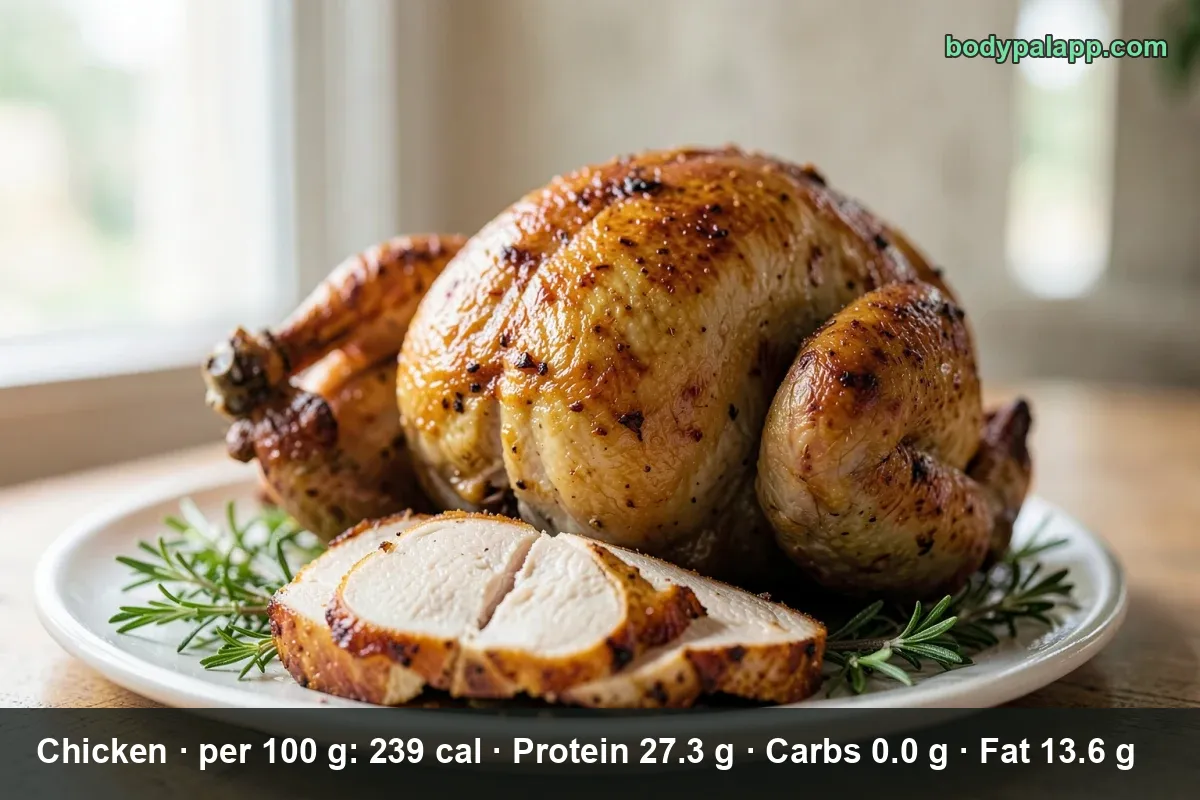
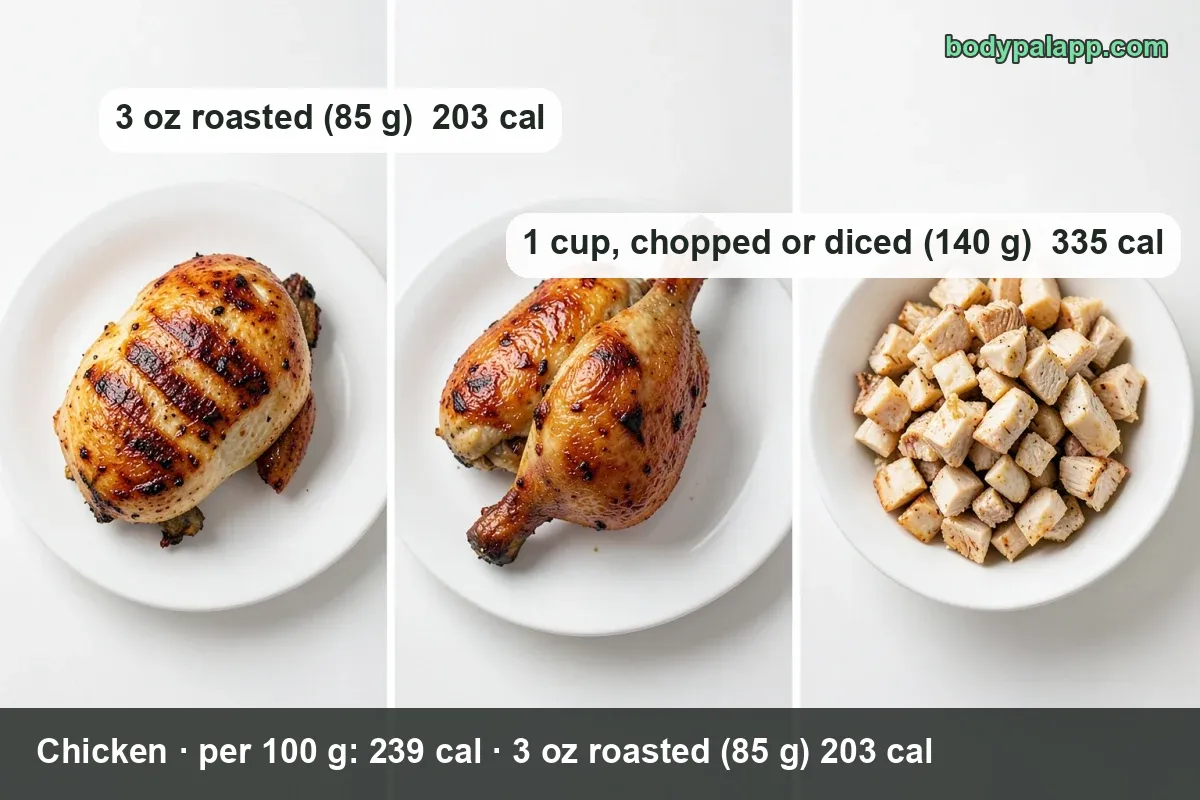
A 3 oz (85 g) serving of roasted chicken with the skin on carries 203 calories, and the bird runs 239 calories per 100 g. That same 3 oz brings 23.2 g of protein and almost no carbohydrate. Carve a whole roasted chicken off the bone and you have 299 g of meat and skin: 715 calories.
On this page
- Chicken quick facts
- US servings, from one ounce to half a bird
- Skin on or skin off, the 49-calorie gap
- Breast, thigh and drumstick, cut by cut
- Store rotisserie chicken and the sodium jump
- Raw or cooked, which number to log
- Protein and cholesterol are the rows to watch
- How does roast chicken compare?
- Most popular chicken brands
- Chicken FAQs
Chicken quick facts
Someone typing "calories in chicken" usually has a roasted bird in front of them, skin and all, not a trimmed fillet. So the number on this page comes from USDA SR Legacy 171450, "Chicken, broilers or fryers, meat and skin, cooked, roasted" — every part of the bird, roasted, weighed with the skin. The cuts and the skinless meat each get their own section further down, with their own USDA record.
| Nutrient | Per 100 g | Per 3 oz (85 g) | % Daily Value |
|---|---|---|---|
| Calories | 239 | 203 | — |
| Total fat | 13.6 g | 11.6 g | 15% |
| Saturated fat | 3.79 g | 3.2 g | 16% |
| Carbohydrate | 0 g | 0 g | 0% |
| Dietary fiber | 0 g | 0 g | 0% |
| Total sugars | 0 g | 0 g | — |
| Protein | 27.3 g | 23.2 g | 46% |
| Sodium | 82 mg | 70 mg | 3% |
% Daily Value is based on a 2,000-calorie diet.
Verified nutrition data
Numbers on this page come from USDA FoodData Central, the U.S. Department of Agriculture’s food composition database, and from manufacturer labels where a branded product is named. Last verified September 2026. How we verify our data →
Two rows you would see on a package are missing here: added sugars and trans fat. The SR Legacy edition does not publish either value for roasted chicken, so nothing is guessed in their place. Cholesterol and potassium are published: 88 mg and 223 mg per 100 g, which is 75 mg of cholesterol and 190 mg of potassium in a 3 oz serving, 25% and 4% of their Daily Values.
US servings, from one ounce to half a bird
| Serving | Weight | Calories |
|---|---|---|
| 1 oz | 28 g | 67 kcal |
| 3 oz roasted, meat and skin | 85 g | 203 kcal |
| 1 cup, chopped or diced | 140 g | 335 kcal |
| Half a chicken, bone removed | 178 g | 425 kcal |
| One chicken, bone removed | 299 g | 715 kcal |
Per 100 g the figure is 239 kcal. The cup, the half bird and the whole bird are USDA household measures for this record: half a chicken is the yield from a 1 lb ready-to-cook bird, and 299 g is what one roasted chicken gives up once the bones go in the stock pot. Only the 1 oz line is our own arithmetic from the USDA 100 g figure rather than a USDA serving.
The cup is where logs go wrong. One cup of chopped or diced roast chicken weighs 140 g and lands at 335 calories, 132 more than the 3 oz portion most people picture when they think "a serving of chicken." Chopped meat also packs differently depending on how hard you press it into the cup, and a scale settles that argument in two seconds.
Skin on or skin off, the 49-calorie gap
| Version | Per 100 g | 3 oz (85 g) | Protein per 100 g |
|---|---|---|---|
| Meat and skin, roasted | 239 kcal | 203 kcal | 27.3 g |
| Meat only, skin removed | 190 kcal | 162 kcal | 28.93 g |
Forty-nine calories per 100 g, 41 on a 3 oz plate, and the protein does not drop — it rises slightly, from 27.3 g to 28.93 g per 100 g, because the skin is fat and the meat underneath is not. Fat falls from 13.6 g to 7.41 g per 100 g, roughly a 45% cut.
That is the single biggest lever on this page. Roast the bird with the skin on so the meat stays moist, then leave the skin on the plate, and a big dinner portion comes down by more than a hundred calories without touching the amount of meat you eat.
Breast, thigh and drumstick, cut by cut
| Cut, roasted | Per 100 g | 3 oz (85 g) | USDA record |
|---|---|---|---|
| Breast, meat and skin | 197 kcal | 167 kcal | 171075 |
| Breast, meat only | 165 kcal | 140 kcal | 171477 |
| Thigh, meat and skin | 232 kcal | 197 kcal | 173625 |
| Drumstick, meat and skin | 191 kcal | 162 kcal | 173612 |
Skinless roast breast at 165 calories per 100 g is the leanest roast chicken record on this page, and 140 calories for 3 oz buys 26.4 g of protein — our own arithmetic from the 31.02 g per 100 g USDA figure. Nothing else on the bird comes close for protein per calorie.
The thigh is the other end: 232 calories per 100 g with the skin, 14.71 g of fat, 197 calories on a 3 oz plate. The drumstick surprises people. At 191 calories per 100 g it lands within a single calorie of skinless whole-bird meat, because a drumstick carries far less skin for its size than a thigh does. Gram for gram, a skin-on drumstick is the lighter pick of the two dark-meat cuts.
Store rotisserie chicken and the sodium jump
Calorie-wise, the supermarket rotisserie bird is fine. USDA's record for original-seasoning rotisserie breast with skin is 184 calories per 100 g, 156 in a 3 oz serving, which is actually below home-roasted breast with skin at 197.
Sodium is the difference. That rotisserie breast reads 347 mg per 100 g against 82 mg for plain roasted chicken — more than four times as much, because the bird is brined and rubbed before it goes on the spit. In a 3 oz serving that is about 295 mg, our own scaling of the USDA 100 g figure, or 13% of the 2,300 mg Daily Value against 3% for the chicken you roast yourself. If you are watching sodium, the home bird is the better pick; if you are watching calories only, buy the rotisserie and save the hour.
Raw or cooked, which number to log
Raw chicken with the skin reads lower per 100 g than roasted: 215 against 239. That is not a leaner food, it is a wetter one. Raw meat still holds the water that the oven drives off, which is why its protein sits at 18.6 g per 100 g while the roasted bird shows 27.3 g.
The fix is simple. Weigh the chicken raw, log the raw record; weigh it cooked, log the cooked one. Mixing them is the most common error on any meat entry. As a kitchen rule of thumb, a bird loses about a quarter of its weight to water and dripped fat in the oven, so 4 oz raw comes out near 3 oz cooked — a rounding of ours, not a USDA yield figure, and calories do not carry across untouched, since some of the fat ends up in the pan.
Packaged chicken is a third case. Tyson Crispy Chicken Strips list 226 calories per 100 g and 190 for a 3 oz (84 g) label serving, and Bilinski's Chicken Sausage 147 per 100 g, 100 per link. Breading and casing change the food, so log the package, not the bird.
Protein and cholesterol are the rows to watch
A 3 oz serving covers 46% of the Daily Value for protein while supplying 203 calories. MyPlate counts 1 oz of cooked poultry as one ounce-equivalent from the protein foods group, so that single serving is three of them.
Two rows run higher than people expect. Cholesterol is 75 mg per 3 oz, 25% of its Daily Value, and saturated fat is 3.2 g, 16% of the 20 g DV — most of it riding in the skin, since skinless meat drops to 2.04 g per 100 g. The Dietary Guidelines for Americans advise keeping saturated fat under 10% of daily calories, which is about 22 g on a 2,000-calorie day. A skin-on chicken dinner uses a meaningful slice of that; a skinless one barely dents it.
How does roast chicken compare?
| Preparation | Per 100 g | US serving | Calories |
|---|---|---|---|
| Roasted, meat and skin | 239 kcal | 3 oz, 85 g | 203 kcal |
| Roasted with giblets and neck | 234 kcal | 3 oz, 85 g | 199 kcal |
| Stewed, meat and skin | 219 kcal | 3 oz, 85 g | 186 kcal |
| Fried in flour, meat and skin | 269 kcal | 3 oz, 85 g | 229 kcal |
Our take: how you cook the bird moves the number less than whether you eat the skin. Stewing is the lightest of the four at 219 calories per 100 g, frying in flour the heaviest at 269, and the whole spread across all four preparations is 50 calories per 100 g — one calorie more than the gap between skin on and skin off in the same roasted bird. Frying costs 26 calories over roasting on a 3 oz plate, which is less than most people assume, though a thick batter and a deep fryer are a different food from a floured pan-fry. For everyday eating, roast the bird, then decide about the skin.
Most popular chicken brands in the United States
Ranked by how widely each product appears among foods sold in the United States, from the BodyPal food database of over 3.3 million products. Calories are the figures printed on each Nutrition Facts label, checked against USDA FoodData Central.
| Product | Calories (per 100 g) |
|---|---|
| Crazy Cuizine Chicken Bites | 200 cal |
| Archer Farms Bacon-Wrapped Chicken Breast | 186 cal |
| Tyson Crispy Chicken Strips | 226 cal |
| Tyson NatureRaised Southern Style Crispy Chicken Strips | 238 cal |
| Bilinski's Chicken Sausage | 147 cal |
Brand popularity: BodyPal food database. Nutrition: manufacturer labels / USDA FoodData Central.
Chicken FAQs
How many calories are in a whole roast chicken?
About 715 calories. USDA puts one roasted chicken with the bone removed at 299 g of meat and skin, which works out to 715 calories at 239 per 100 g. Split four ways that is roughly 179 calories each, before any stuffing, gravy or pan drippings go on the plate.
How many calories in 3 oz of chicken?
A 3 oz (85 g) serving of roasted chicken with the skin carries 203 calories, 23.2 g of protein and 11.6 g of fat. That is the standard cooked portion on most food logs, and it is a little smaller than the piece most people carve off a roasted bird at dinner.
How many calories in 1 cup of chopped chicken?
One cup of chopped or diced roast chicken weighs 140 g and holds 335 calories, 132 more than a 3 oz serving. Cups are the easiest place to overshoot, because loosely tumbled meat and firmly packed meat fill the same cup differently. Weighing the chicken settles it faster than measuring.
Does removing the skin lower chicken calories?
Yes, by 49 calories per 100 g. Meat and skin roasted is 239 calories per 100 g; the same bird with the skin pulled off is 190. On a 3 oz plate that is 203 against 162. Protein does not suffer at all, moving from 27.3 g to 28.93 g per 100 g.
How much protein is in a serving of chicken?
A 3 oz (85 g) roasted serving delivers 23.2 g of protein, 46% of the Daily Value, for 203 calories. Skinless roast breast does better still at 31.02 g per 100 g, which is 26.4 g in the same 3 oz by our own arithmetic, for only 140 calories.
Is rotisserie chicken higher in sodium?
Yes, 347 mg of sodium per 100 g against 82 mg for plain roasted chicken, more than four times as much. Store rotisserie breast with skin is brined before it goes on the spit. That is about 295 mg in a 3 oz serving, 13% of the Daily Value versus 3%.
Chicken breast vs chicken thigh calories?
Breast wins by 35 calories per 100 g. Roast breast with the skin is 197 calories per 100 g and 167 in a 3 oz serving; thigh with skin is 232 and 197. Take the skin off the breast and it falls to 165 per 100 g, 140 per 3 oz, the leanest roast chicken record on this page.
Raw vs cooked chicken calories, which do I log?
Log cooked chicken against the cooked figure of 239 calories per 100 g. Raw meat and skin reads lower at 215 per 100 g only because it still holds water, which is also why its protein shows 18.6 g instead of 27.3 g. Weigh it raw, use the raw record instead.
Similar foods
- Roast Chicken — 203 cal per 3 oz
- Tempura shrimp — 109 cal for 6 large shrimp
- Asada taco — 243 cal per taco
- Top Sirloin Steak — 413 cal per 6 oz steak
- Beef brisket — 208 cal per thick slice
- Street Taco — 125 cal per street taco
Count it without the math
Point the camera at the plate and BodyPal counts the chicken for you, skin and all.


How long does it take to burn off chicken?
A 3 oz (85 g) roasted serving is 203 kcal. Enter your weight and the amount you ate to see how long it takes you to burn that off:
lb
| Activity | Time to burn 203 kcal |
|---|---|
| Walking, brisk | 41 min |
| Cycling, moderate | 25 min |
| Swimming, moderate | 29 min |
| Jogging | 24 min |
| Weight training, moderate | 45 min |
Times are for a 155 lb adult at a steady pace; change the weight to see yours. The amount is set to the portion in the text (85 g); change it to what you actually ate. BodyPal works this out from your steps automatically.
Burning it off is one side of it. The other is knowing your number: work out how many calories you need a day, with macros and a goal date.