
How Many Calories in Beef Brisket?
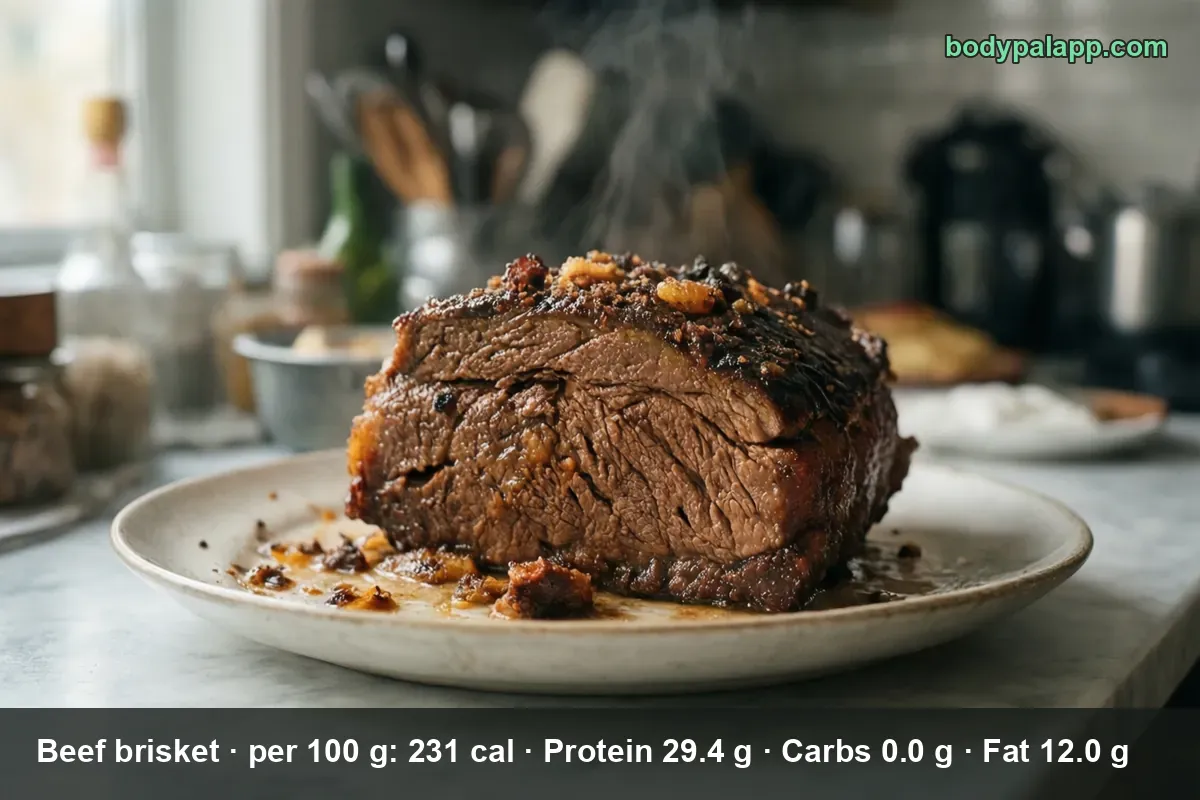
One thick slice of cooked beef brisket, 90 g of it, is 208 calories — 231 calories per 100 g. A thinner 60 g slice comes to 139. Chop it and pack a cup, 135 g, and you are at 312 calories, more than two regular slices in a single scoop.
On this page
- Beef brisket quick facts
- Flat, point and the 153-calorie gap
- US portions, slice by slice
- Raw or cooked: weigh one, log the other
- The trim costs more than the grade
- What smoking and sauce actually add
- Corned beef brisket is a different food
- How does beef brisket compare?
- Most popular beef brisket brands
- FAQ
Beef brisket quick facts
The reference here is brisket the way it reaches the plate: cooked, mixed trim, sliced. That is USDA FNDDS entry 2705851, and the serving is one thick slice, 90 g.
| Nutrient | Per 100 g | Per 1 thick slice (90 g) | % Daily Value |
|---|---|---|---|
| Calories | 231 kcal | 208 kcal | — |
| Total fat | 12.04 g | 10.8 g | 14% |
| Saturated fat | 4.62 g | 4.2 g | 21% |
| Carbohydrate | 0 g | 0 g | 0% |
| Dietary fiber | 0 g | 0 g | 0% |
| Total sugars | 0 g | 0 g | — |
| Protein | 29.41 g | 26.5 g | 53% |
| Sodium | 377 mg | 339 mg | 15% |
% Daily Value is based on a 2,000-calorie diet.
Verified nutrition data
Numbers on this page come from USDA FoodData Central, the U.S. Department of Agriculture’s food composition database, and from manufacturer labels where a branded product is named. Last verified September 2026. How we verify our data →
Two things in that table stand out. Protein is at 53% of the day in one slice, which is more than most people expect from a cut with a reputation for being fatty. Carbohydrate is a flat zero, and so is fiber and sugar — brisket is meat and nothing else, so the added sugars and trans fat rows have no values in this USDA entry and have been left out rather than filled with a guess.
Two more numbers sit outside the label block. Cholesterol is 94 mg per 100 g, so 85 mg in the thick slice — 28% of the Daily Value. Potassium is 285 mg per 100 g, 257 mg in the slice, about 5%.
Flat, point and the 153-calorie gap
Here is the number that actually decides your log, and most calorie charts never print it.
A whole packer brisket is two muscles. The flat is the lean rectangle everyone slices for sandwiches; cooked, trimmed to 0" of fat and eaten lean, it runs 205 calories per 100 g. The point, also called the deckle, is the thick fatty end that gets cubed for burnt ends; with its fat, trimmed to 0", it runs 358.
That is a 153-calorie spread inside one piece of meat. In slice terms, a 90 g thick slice off the flat is 184 calories. The same slice off the point is 322. Nobody at the counter asks which one you got.
So the honest answer to "how many calories in brisket" is 208 for a mixed thick slice, with a real range of roughly 184 to 322 depending on where the knife went in. If you are logging brisket often and you always take the lean end, you are eating a leaner meal than the number on this page suggests. If you take the marbled corner because it tastes better, you are eating about 55% more than the 208 on this page.
Protein moves the other way. The flat carries 33.26 g per 100 g; the point carries 23.53 g. The lean half is not just lighter, it is the better protein per calorie by a wide margin.
US portions, slice by slice
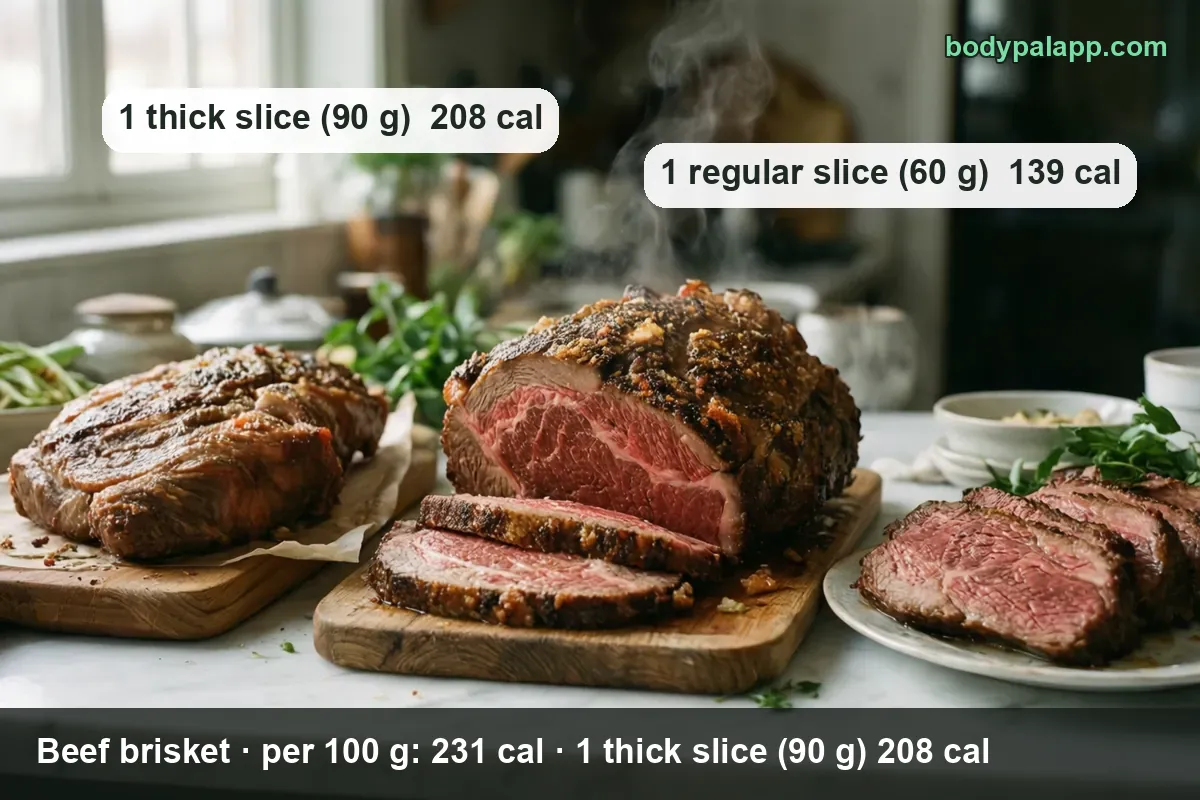
| Portion | Weight | Calories |
|---|---|---|
| 1 cubic inch | 17 g | 39 cal |
| 1 oz | 28 g | 65 cal |
| 1 regular slice | 60 g | 139 cal |
| 1 thick slice | 90 g | 208 cal |
| 1 cup, chopped | 135 g | 312 cal |
| 100 g | 100 g | 231 cal |
The cup row is the one that catches people. A cup of chopped brisket looks like a modest scoop next to two slices on a plate, but at 135 g it beats two regular slices (2 × 139 = 278) and lands at 312 calories — roughly 4.8 oz of meat. Chopped brisket packs densely, and "a cup" is how it gets logged when it comes out of a foil tray at a cookout.
The per-ounce figure is worth memorizing if you buy by weight at a counter: 65 calories an ounce. A half-pound plate, 8 oz, is about 520. Those two are our own scaling from the 231-calorie 100 g figure, not USDA serving sizes; the slice and cup rows above are.
Raw or cooked: weigh one, log the other
This is where most brisket logs go wrong, and the error runs in one direction only.
Raw whole brisket with its fat cap is 253 calories per 100 g. Cooked, the same cut is 331. Cooking did not add calories to the meat. It removed water — a brisket sheds roughly 25% to 30% of its weight in a long braise or a long smoke — so what is left is more concentrated per gram.
Run it through and the two paths agree. Weigh 8 oz raw (226 g) at 253 and you get 572 calories. That piece comes off the heat at around 160 g, which at the cooked figure of 331 is 530 calories. Close enough to be the same meal.
Cross the two and it falls apart. Weigh the cooked 160 g slice and multiply it by the raw number and you get 405 calories — you have just thrown away a quarter of the meal. The rule is short: raw weight with a raw entry, cooked weight with a cooked entry, never one with the other.
For the raw side, 4 oz (113 g) of untrimmed whole brisket is 286 calories. The same 4 oz of raw lean brisket, fat cap off, is 177.
The trim costs more than the grade
Butcher-counter logic says the grade is what you pay for. For calories, the knife matters far more.
| Cooked whole brisket, braised | Per 100 g | 1 thick slice (90 g) | 3 oz (85 g) |
|---|---|---|---|
| Lean and fat, trimmed to 1/8" fat | 331 cal | 298 cal | 281 cal |
| Lean and fat, trimmed to 0" fat | 291 cal | 262 cal | 247 cal |
| Lean only | 218 cal | 196 cal | 185 cal |
Leaving an eighth of an inch of fat cap on versus taking the fat off entirely and eating the lean is 113 calories per 100 g — a third of the food. Now compare that with grade. On the flat, lean only, trimmed to 1/8" and braised, USDA has choice at 203 calories per 100 g and select at 189, with the all-grades average at 196. That is about 7%.
Grade changes the marbling inside the muscle by a few percent. Trim changes how much pure fat is sitting on top of it. If you want a lighter plate of brisket, ask for lean slices from the flat and leave the cap on the board. That single request is worth more than anything printed on the package.
What smoking and sauce actually add
Smoke adds no calories. There is no wood-smoke row in USDA's database because there is nothing to add — the flavor compounds weigh essentially nothing, and a dry rub is spices with salt. So "calories in smoked brisket" and "calories in brisket" have the same answer: 231 per 100 g, 208 in a thick slice.
What a rub does add is sodium, and the mixed cooked entry already reflects that at 377 mg per 100 g, or 16% of the Daily Value. That is normal seasoning, not a problem: the FDA's Daily Value for sodium is 2,300 mg, and one thick slice uses 339 mg of it.
Sauce is the variable that actually moves the number, and it moves it as carbohydrate rather than fat. Plain brisket has zero carbohydrate. Supermarket brisket sold in barbecue sauce runs about 221 calories and 19.3 g of carbohydrate per 100 g — nearly all of it sugar from the sauce. The calories per 100 g barely change, because the sauce is watery, but the food stops being a zero-carb protein.
If you sauce your own, log the sauce as its own line. It is the only part of a brisket plate that carries sugar.
Corned beef brisket is a different food
Ask an American grocery store for brisket and there is a good chance the cryovac pack that comes back is corned. Same cut, brined in salt and curing agents, and by the numbers it should not share a row with the plain version.
| Corned beef brisket | Per 100 g | 4 oz (113 g) |
|---|---|---|
| Calories, cooked | 251 cal | 284 cal |
| Sodium, cooked | 973 mg | 1100 mg |
| Calories, raw | 198 cal | 224 cal |
| Sodium, raw | 1217 mg | 1375 mg |
The calories are almost a wash: 251 against 231 per 100 g. Sodium is not. Plain brisket gives you 377 mg per 100 g; corned brisket gives 973 — 2.6 times as much. A 4 oz portion carries about 1,100 mg of sodium, which is 48% of the day's Daily Value in one serving, before the potatoes and cabbage and mustard.
The Dietary Guidelines for Americans put the adult ceiling at 2,300 mg a day, and CDC notes that most Americans are already over it mainly through processed and restaurant food. Corned beef is a textbook example. Eat it on St. Patrick's Day and enjoy it; just do not log it as brisket, because the calorie number will be close and the sodium number will be wrong by a factor of nearly three.
How does beef brisket compare?
All five rows below are cooked, as-eaten USDA entries, measured at the one household unit they share: 1 cup, chopped, 135 g.
| Cut (1 cup, chopped, 135 g) | Calories | Protein | Carbs | Fat |
|---|---|---|---|---|
| Beef brisket | 312 cal | 39.7 g | 0.0 g | 16.3 g |
| Beef, unspecified cut | 312 cal | 36.6 g | 0.0 g | 17.6 g |
| Ribeye steak, lean eaten | 311 cal | 35.7 g | 0.0 g | 18.7 g |
| T-bone steak, lean eaten | 311 cal | 36.6 g | 0.0 g | 17.1 g |
| Chuck steak | 304 cal | 35.1 g | 0.3 g | 18.1 g |
Look at the calorie column and then stop worrying about it. Brisket, ribeye and T-bone are within one calorie of each other per 100 g — 231, 230, 230 — and chuck is six below. Every cut of beef on this list is the same food from a calorie standpoint. The reputation brisket has for being the heavy one comes from the point half and from portion size, not from the cut.
Our take: brisket wins this table on protein. At 39.7 g in a cup against 35.7 g for ribeye, it delivers the most protein per calorie of the five, and it does it with the least fat. If you are choosing beef for a high-protein plate, brisket from the flat is the pick: one thick slice already covers 53% of the Daily Value for protein, and it lands in the protein foods group MyPlate builds a plate around. If you are choosing for taste and do not care about the difference, take the point and log 322 for the slice instead of 208.
Most popular beef brisket brands in the United States
Ranked by how widely each product appears among foods sold in the United States, from the BodyPal food database of over 3.3 million products. Calories are the figures printed on each Nutrition Facts label, checked against USDA FoodData Central.
| Product | Calories (per 100 g) |
|---|---|
| O'Donnell's Corned Beef Brisket | 195 cal |
| Certified Angus Beef Corned Beef Brisket | 177 cal |
| Ahold Point Cut Corned Beef Brisket | 195 cal |
| Great Value Angus Beef Brisket | 157 cal |
| Certified Angus Beef Boneless Beef Brisket | 277 cal |
| Lloyd's Sliced Beef Brisket | 262 cal |
Brand popularity: BodyPal food database. Nutrition: manufacturer labels / USDA FoodData Central.
Beef brisket FAQs
How many calories in beef brisket?
208 calories in one thick slice, 90 g of cooked brisket, at 231 calories per 100 g. A regular 60 g slice is 139 calories. A cup of chopped brisket, 135 g, is 312. The same slice cut from the fatty point half would be 322.
How many calories in a slice of brisket?
139 calories for a regular 60 g slice and 208 for a thick 90 g one. The spread comes from which half of the packer it was cut from: a 90 g slice off the lean flat is 184 calories, the same slice off the point is 322.
How many calories in smoked brisket?
The same 231 calories per 100 g, or 208 in a thick slice. Smoke and a dry rub add flavor and sodium, not calories, and USDA has no separate entry for smoked brisket. Barbecue sauce is the part that adds anything: sauced brisket carries about 19.3 g of carbohydrate per 100 g.
How many calories are in an ounce of brisket?
65 calories per ounce, 28 g of cooked brisket. Scaled the same way, 3 oz is about 196 calories, a half-pound plate about 520, and a single cubic inch, 17 g, about 39. Buy by weight at the counter and the ounce figure is the fastest one to carry in your head.
How much protein is in beef brisket?
26.5 g in one thick 90 g slice, which is 53% of the Daily Value, at 29.41 g per 100 g. The lean flat does better still at 33.26 g per 100 g, while the fatty point drops to 23.53 g. A cup of chopped brisket carries 39.7 g.
Is brisket a lean meat?
Partly — at 12.04 g of fat per 100 g, mixed cooked brisket sits close to lean ribeye and T-bone, and the flat trimmed to 0 inches of fat is leaner still at 6.99 g. The point half is not lean at all: 28.50 g of fat and 358 calories per 100 g.
How many calories in corned beef brisket?
251 calories per 100 g cooked, so 284 in a 4 oz portion. Calories are close to plain brisket at 231, but sodium is not: 973 mg per 100 g against 377, which puts a 4 oz serving at about 1,100 mg, or 48% of the Daily Value.
Brisket flat or point — which has fewer calories?
The flat, by a long way: 205 calories per 100 g eaten lean against 358 for the point with its fat, both cooked and trimmed to 0 inches. The flat also carries more protein, 33.26 g per 100 g against 23.53 g, so it is the better choice on both counts.
Similar foods
- Brisket — 196 cal for 3 oz cooked
- Beef Chuck Roast — 262 cal for 4 oz
- Steak — 368 cal per regular steak
- Buffalo Chicken Dip — 140 cal for 1/4 cup
- Pork Schnitzel — 275 cal per schnitzel
- Turkey Wing — 426 cal per wing
Count it without the math
Point the camera at the plate and BodyPal reads the slice, sizes the portion and logs the calories and the protein for you.


How long does it take to burn off beef brisket?
One thick slice (90 g) is 208 kcal. Enter your weight and the amount you ate to see how long it takes you to burn that off:
lb
| Activity | Time to burn 208 kcal |
|---|---|
| Walking, brisk | 42 min |
| Cycling, moderate | 26 min |
| Swimming, moderate | 30 min |
| Jogging | 24 min |
| Weight training, moderate | 46 min |
Times are for a 155 lb adult at a steady pace; change the weight to see yours. The amount is set to the portion in the text (90 g); change it to what you actually ate. BodyPal works this out from your steps automatically.
One food is easy to picture; a whole day is harder. See how many calories you need a day and what a deficit actually looks like.