
How many calories are in a steak?
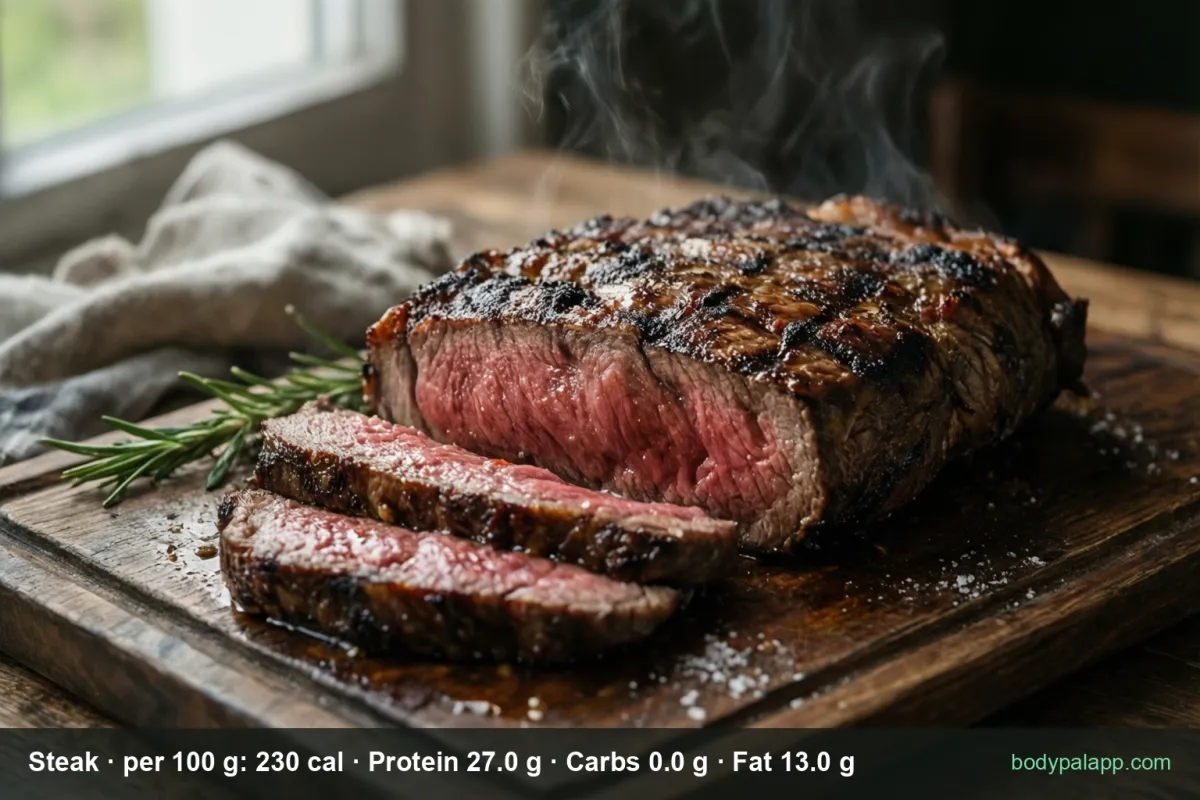
One regular steak — the middle-of-the-road piece most people put on a plate — weighs 160 g and carries 368 calories. Per 100 g, cooked steak runs 230 calories, which makes an 8 oz portion 522. Almost all of that is protein and fat. There are no carbs in it at all.
On this page
- Steak quick facts
- US servings, from one ounce to eight
- Ribeye, strip, sirloin and T-bone
- Flank and cube steak
- Protein, saturated fat and the sodium nobody expects
- How does steak compare?
- Most popular steak brands
- FAQ
Steak quick facts
The row behind every number here is FNDDS 2705823, "Steak, NS as to type of meat, NS as to fat eaten". "NS" means not specified: USDA is describing a cooked steak the way people actually eat one, without pinning down the cut or how much of the fat gets left on the plate. That is the right starting point for anyone typing "calories in steak" with dinner already in front of them. The named cuts follow further down, each with its own record.
USDA also carries a beef-only row, "Beef, steak, NFS," at 229 calories per 100 g. One calorie apart from the generic record, so it changes nothing about how you log a steak — it only narrows the meat to beef.
| Nutrient | Per 100 g | Per one regular steak (160 g) | % Daily Value |
|---|---|---|---|
| Calories | 230 | 368 | — |
| Total fat | 12.99 g | 20.8 g | 27% |
| Saturated fat | 5.31 g | 8.5 g | 42% |
| Carbohydrate | 0 g | 0 g | 0% |
| Dietary fiber | 0 g | 0 g | 0% |
| Total sugars | 0 g | 0 g | — |
| Protein | 26.95 g | 43.1 g | 86% |
| Sodium | 367 mg | 587 mg | 26% |
% Daily Value is based on a 2,000-calorie diet.
Verified nutrition data
Numbers on this page come from USDA FoodData Central, the U.S. Department of Agriculture’s food composition database, and from manufacturer labels where a branded product is named. Last verified September 2026. How we verify our data →
Two rows you would see on a package label are missing above. USDA does not publish added sugars or trans fat for this record, and on a plain seared steak the added sugars line would read zero anyway — beef without a marinade or a breading has nothing sweet in it. Cholesterol and potassium are published: 83 mg and 321 mg per 100 g, which work out to 133 mg of cholesterol (44% of the Daily Value) and 514 mg of potassium (11%) in one regular steak.
US servings, from one ounce to eight
| Serving | Weight | Calories |
|---|---|---|
| 1 oz | 28 g | 64 kcal |
| 4 oz cooked | 113 g | 260 kcal |
| One thin steak | 120 g | 276 kcal |
| One regular steak | 160 g | 368 kcal |
| 8 oz cooked | 227 g | 522 kcal |
| Per 100 g | 100 g | 230 kcal |
The two piece counts — thin and regular — are USDA's own household measures, which is why they come in at odd gram weights instead of round ounces. The ounce rows are ours: 4 oz, 8 oz and 1 oz are our own arithmetic from the USDA 100 g figure, not USDA servings.
Here is the trap. Steakhouse menus and butcher labels quote the weight before the steak hits heat, while the USDA record describes it after. Meat sheds water and rendered fat on the grill, so a piece sold as 8 oz is lighter than 8 oz once it rests. Log a raw ounce count against a cooked record and you overstate the meal. Weigh it off the grill, or use the piece counts above and let the average do the work.
Ribeye, strip, sirloin and T-bone
Cut is the biggest lever on this page, bigger than anything you do in the pan. These four are the ones people search by name, all shown at the same cooked 8 oz so the comparison is fair. That 8 oz column is our own scaling of each USDA 100 g figure, not a USDA household serving.
| Cut | Per 100 g | Typical serving | Calories |
|---|---|---|---|
| Ribeye | 260 kcal | 8 oz cooked, 227 g | 590 kcal |
| New York strip | 239 kcal | 8 oz cooked, 227 g | 543 kcal |
| Top sirloin | 239 kcal | 8 oz cooked, 227 g | 543 kcal |
| T-bone | 252 kcal | 8 oz cooked, 227 g | 572 kcal |
The ribeye's 590 against the strip's 543 is a 47-calorie gap on the same 8 oz plate — smaller than most people brace for, because the marbling that makes a ribeye a ribeye is fat you can partly leave behind. Its saturated fat tells the fuller story: 7.7 g per 100 g against 5.45 g for strip and sirloin.
Strip and sirloin share an identical USDA profile, right down to the decimal, so there is no point agonizing over which one to log. Pick either.
The T-bone needs one caveat. Its 252 calories per 100 g cover edible meat only — the bone is not in that weight. A 16 oz T-bone on a menu is never 16 oz of steak, so cut the meat off the bone before you weigh it.
Flank and cube steak
These two sit at the lean end, and they are the reason "steak" is not automatically a heavy order.
| Cut | Per 100 g | Typical serving | Calories |
|---|---|---|---|
| Cube steak | 187 kcal | 4 oz cooked, 113 g | 211 kcal |
| Flank steak | 243 kcal | 4 oz cooked, 113 g | 275 kcal |
Cube steak is the lightest cut on this page at 187 calories per 100 g, 73 fewer than a ribeye, and the leanest at 7.1 g of fat. It also carries 28.83 g of protein per 100 g, more than the generic steak record's 26.95 g. Flank is leaner in fat than a ribeye too, at 14.09 g, but it is dense meat with 29.13 g of protein per 100 g, so its calorie count per gram lands close to the middle of the pack rather than the bottom. Lean does not always mean light — with almost no water or fat to dilute it, muscle is calorie-dense on its own.
Packaged sliced steak follows the same logic. Shaved beef steak comes in around 179 calories per 100 g and thin sirloin tip steaks around 159, both lighter per gram than any whole cut above, because they are cut from lean round and sold raw rather than seared with the fat rendered in.
Protein, saturated fat and the sodium nobody expects
One regular steak covers 86% of the Daily Value for protein in a single piece of meat: 43.1 g. MyPlate counts steak squarely as a protein food, and few single items on a dinner plate move the protein line that far.
The price is on two other rows. Saturated fat comes to 8.5 g, or 42% of the FDA Daily Value of 20 g, and the Dietary Guidelines for Americans ask for less than 10% of daily calories from saturated fat. One steak takes a big bite out of that. Cholesterol adds another 133 mg, 44% of its Daily Value. If your week already leans on cheese and butter, the cut you choose starts to matter: cube steak at 2.12 g of saturated fat per 100 g is a different animal from ribeye at 7.7 g.
Then there is the row nobody expects on a piece of plain beef. Sodium: 367 mg per 100 g, 587 mg in one regular steak, 26% of the Daily Value. That is not coming from the cow. USDA's record describes steak as it is actually eaten, seasoned, and 587 mg is about a quarter teaspoon of table salt. Season it lighter and that row drops with it — it is the one number on this page you fully control.
How does steak compare?
| Meat | Per 100 g | US serving | Calories |
|---|---|---|---|
| Steak, generic cooked | 230 kcal | 4 oz cooked, 113 g | 260 kcal |
| Pork steak | 247 kcal | 4 oz cooked, 113 g | 279 kcal |
| Venison steak | 149 kcal | 4 oz cooked, 113 g | 168 kcal |
| Country fried steak | 306 kcal | 4 oz cooked, 113 g | 346 kcal |
Our take: pork steak is close enough to beef, 17 calories per 100 g apart, that swapping one for the other is not a calorie decision. Venison is the standout — 149 calories per 100 g with 29.96 g of protein, the lightest meat in this table by a wide margin, and worth ordering if you see it. Country fried steak is the one to watch: the batter and the fryer add 76 calories per 100 g over plain steak and drop the protein to 19.9 g, so you pay more and get less of what you came for. For weight loss, cube steak or venison; for a steak that still feels like a steak, top sirloin at 543 for a full 8 oz.
Most popular steak brands in the United States
Ranked by how widely each product appears among foods sold in the United States, from the BodyPal food database of over 3.3 million products. Calories are the figures printed on each Nutrition Facts label, checked against USDA FoodData Central.
| Product | Calories (per 100 g) |
|---|---|
| Old Neighborhood Beef Shaved Steak | 179 cal |
| Landis Lean Sirloin Tip Beef Steaks | 159 cal |
| Landis Wafer Sliced Lean Sirloin Tip Beef Steaks | 160 cal |
| Tyson Country Fried Steak | 333 cal |
Brand popularity: BodyPal food database. Nutrition: manufacturer labels / USDA FoodData Central.
Steak FAQs
How many calories are in a steak?
A regular steak of 160 g is 368 calories, from USDA's cooked steak record at 230 calories per 100 g. A thin steak of 120 g comes to 276, and a big 8 oz cut lands at 522. The cut and how much fat you eat move that number more than the cooking method does.
How many calories in an 8 oz steak?
An 8 oz cooked steak weighs 227 g and carries 522 calories with about 61.2 g of protein. That serving is our own arithmetic from the USDA 100 g figure of 230 calories, not a USDA household measure. A ribeye at the same weight is 590; a New York strip is 543.
How many calories in a 4 oz steak?
A 4 oz cooked steak is 113 g and 260 calories, again our scaling of the USDA per-100 g number rather than a listed serving. It brings 30.5 g of protein and 415 mg of sodium. Weigh it after cooking, because the USDA record describes the finished steak, not the raw piece.
How many calories in a ribeye steak?
A ribeye runs 260 calories per 100 g, so an 8 oz cooked steak is 590 calories, the highest of the common cuts on this page. Saturated fat is the reason: 7.7 g per 100 g against 5.31 g in the generic steak record. Leaving the fat cap on the plate pulls it down.
How many calories in a New York strip steak?
A New York strip is 239 calories per 100 g, which puts an 8 oz cooked steak at 543 calories with 61.6 g of protein. Top sirloin carries the same USDA profile, so the two log identically. At the same weight the strip sits 47 calories under a ribeye.
How many calories in a T-bone steak?
A T-bone is 252 calories per 100 g of edible meat, so 8 oz off the bone is 572 calories. The bone is not counted in that weight, which is why a 16 oz T-bone on a menu never means 16 oz of steak. Cut the meat away from the bone, then weigh it.
How many calories in cube steak?
Cube steak is 187 calories per 100 g, the lightest cut here, so a 4 oz portion is 211 calories with 32.6 g of protein. It is the leanest too, at 7.1 g of fat per 100 g. Bread it and pan-fry it and that changes: country fried steak is 306 per 100 g.
Is steak good for a high-protein diet?
One regular steak delivers 43.1 g of protein, 86% of the FDA Daily Value, for 368 calories. MyPlate counts steak as a protein food, and one piece covers most of a day's protein target. The trade-off is 8.5 g of saturated fat, 42% of the Daily Value, so it is protein at a price.
Similar foods
- Beef brisket — 208 cal per thick slice
- Brisket — 196 cal for 3 oz cooked
- Pork Schnitzel — 275 cal per schnitzel
- Turkey Wing — 426 cal per wing
- Beef Chuck Roast — 262 cal for 4 oz
- Buffalo Chicken Dip — 140 cal for 1/4 cup
Count it without the math
Point the camera at the plate and BodyPal counts the steak for you, cut and all.


How long does it take to burn off steak?
One regular steak (160 g) is 368 kcal. Enter your weight and the amount you ate to see how long it takes you to burn that off:
lb
| Activity | Time to burn 368 kcal |
|---|---|
| Walking, brisk | 1 hr 14 min |
| Cycling, moderate | 46 min |
| Swimming, moderate | 53 min |
| Jogging | 43 min |
| Weight training, moderate | 1 hr 22 min |
Times are for a 155 lb adult at a steady pace; change the weight to see yours. The amount is set to the portion in the text (160 g); change it to what you actually ate. BodyPal works this out from your steps automatically.
One food is easy to picture; a whole day is harder. See how many calories you need a day and what a deficit actually looks like.