
How many calories are in a beef chuck roast?
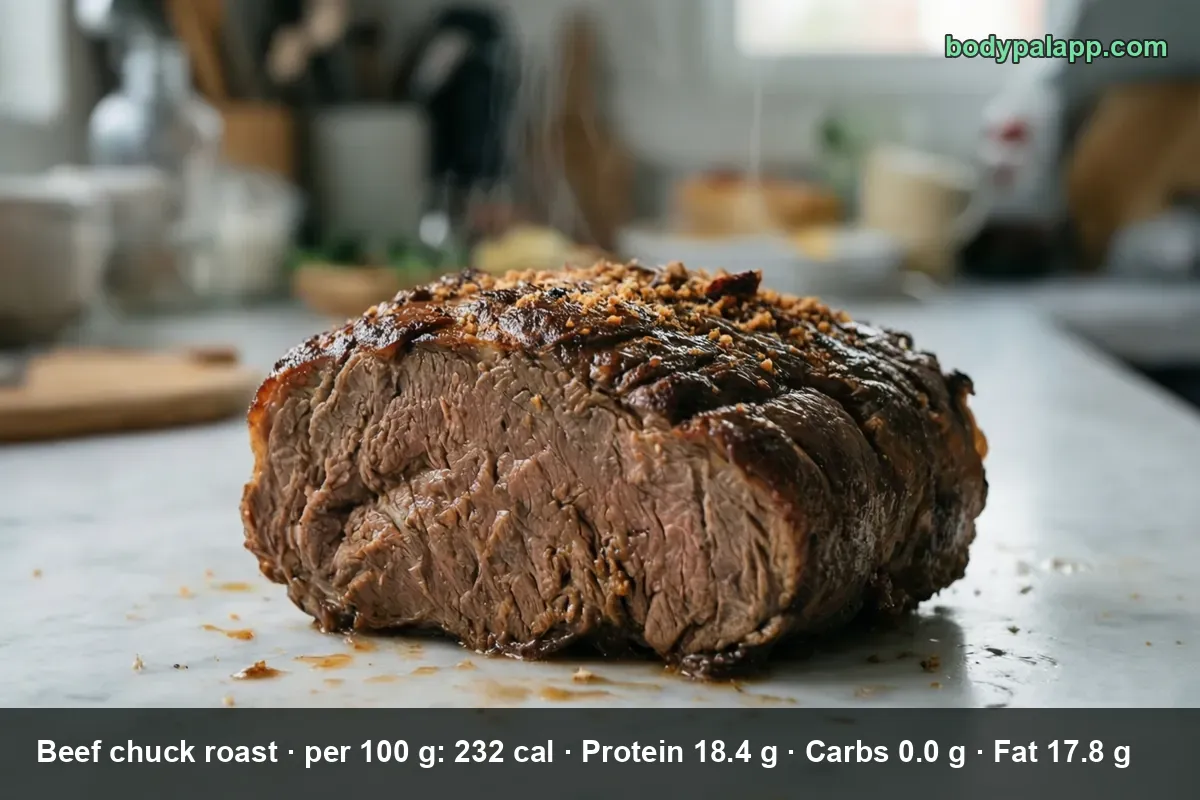
A 4 oz (113 g) raw chuck roast portion carries 262 calories, and the cut runs 232 calories per 100 g. That is the boneless chuck roast you pick up at the meat counter, weighed before it hits the pot. Braise it and the same meat concentrates: 3 oz of finished pot roast lands at 257.
On this page
- Beef chuck roast quick facts
- US servings from one ounce to a whole roast
- Chuck roast variants and how they cook down
- Trimming moves the number more than cooking does
- Raw weight or cooked weight for logging
- Saturated fat is the row to watch
- How does beef chuck roast compare?
- Most popular beef chuck roast brands
- FAQ
Beef chuck roast quick facts
Chuck is a big, hard-working shoulder section, and USDA holds more than fifty records under its name. Only one of them is described exactly as the thing in the butcher case: Foundation record 2646174, "Beef, chuck, roast, boneless, choice, raw", analyzed in 2025. That is the record used for the headline numbers here. The older SR Legacy entries describe sub-cuts of the same shoulder — arm, blade, under blade, chuck eye — and they sit in the tables further down rather than getting averaged into one blurry figure.
| Nutrient | Per 100 g | Per 4 oz (113 g) | % Daily Value |
|---|---|---|---|
| Calories | 232 | 262 | — |
| Total fat | 17.8 g | 20.1 g | 26% |
| Saturated fat | 6.34 g | 7.2 g | 36% |
| Carbohydrate | 0 g | 0 g | 0% |
| Protein | 18.4 g | 20.8 g | 42% |
| Sodium | 48.44 mg | 55 mg | 2% |
| Cholesterol | 66.75 mg | 75 mg | 25% |
| Potassium | 281.1 mg | 318 mg | 7% |
% Daily Value is based on a 2,000-calorie diet.
Verified nutrition data
Numbers on this page come from USDA FoodData Central, the U.S. Department of Agriculture’s food composition database, and from manufacturer labels where a branded product is named. Last verified September 2026. How we verify our data →
There are no rows here for dietary fiber, total sugars or added sugars: the Foundation analysis does not publish them for this record, and plain beef with no breading, glaze or marinade has no carbohydrate to divide up anyway. The carbohydrate row reads 0 g, and that is the whole story until a flour dredge or a sweet rub joins the pan.
US servings from one ounce to a whole roast
| Serving | Weight | Calories |
|---|---|---|
| 1 oz raw | 28 g | 65 kcal |
| 3 oz slice, raw weight | 85 g | 197 kcal |
| 4 oz raw | 113 g | 262 kcal |
| 8 oz raw | 227 g | 526 kcal |
| 1 lb raw, a small roast | 453.6 g | 1051 kcal |
| Per 100 g | 100 g | 232 kcal |
Every line above except the 100 g row is our own arithmetic from the USDA 100 g figure, not a USDA household serving — chuck roast is sold by weight, so ounces and pounds are the only measures that mean anything at the counter. Scale from there for the roast you actually bought: a 3 lb chuck roast is about 3,150 calories of raw meat, a 5 lb one about 5,250.
That whole-roast number is worth sitting with for a second. A pot roast dinner for four is not four 4 oz portions of a 3 lb roast; the roast shrinks, and what is left gets divided unevenly. Weigh your own slice rather than dividing the raw roast by the number of chairs.
Chuck roast variants and how they cook down
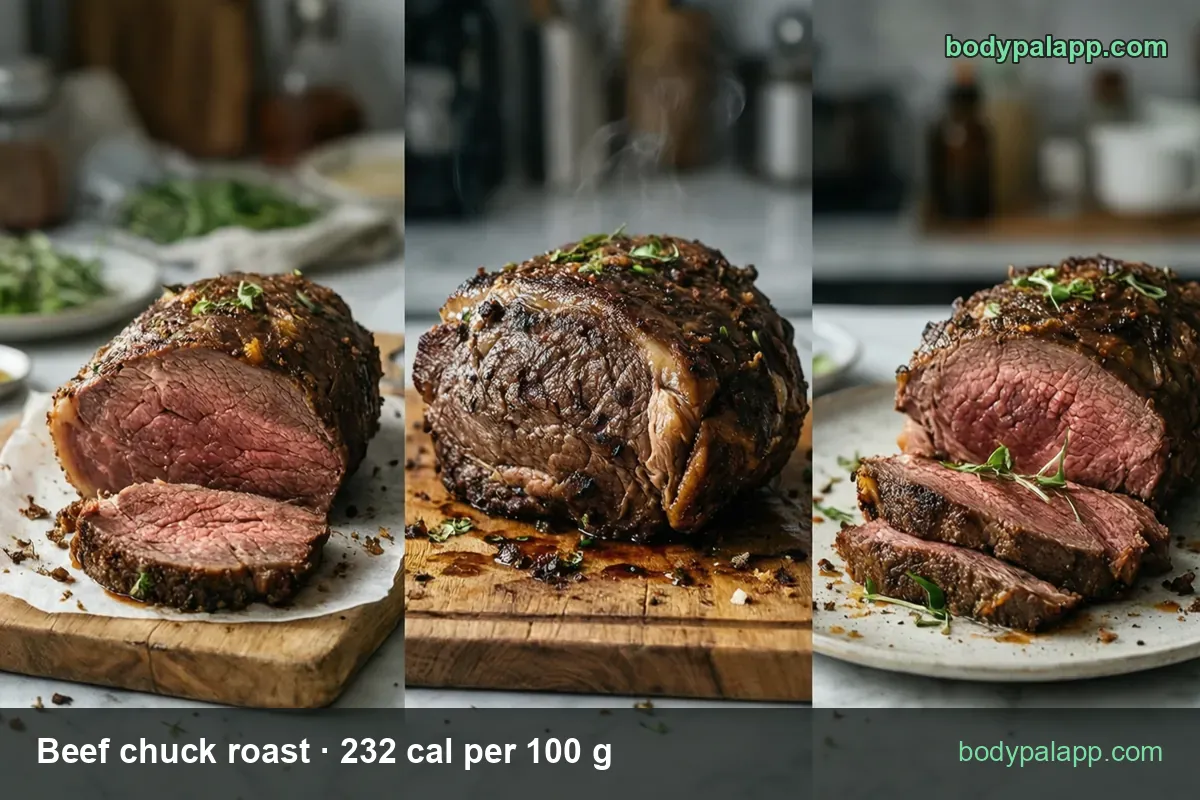
Chuck roast almost never gets eaten raw, so the cooked records matter more than the headline one for anyone logging dinner. USDA analyzes the shoulder cut by cut and by cooking method, and the spread is wide.
| Version | Per 100 g | Typical serving | Calories |
|---|---|---|---|
| Chuck roast, braised, lean and fat | 302 kcal | 3 oz cooked (85 g) | 257 kcal |
| Chuck roast, braised, lean only | 214 kcal | 3 oz cooked (85 g) | 182 kcal |
| Chuck eye roast, roasted, lean only | 183 kcal | 3 oz cooked (85 g) | 156 kcal |
| Chuck clod roast, roasted, lean and fat | 207 kcal | 3 oz cooked (85 g) | 176 kcal |
| Under blade pot roast, braised, lean and fat | 291 kcal | 3 oz cooked (85 g) | 247 kcal |
| Arm pot roast, raw, lean and fat | 249 kcal | 4 oz raw (113 g) | 281 kcal |
Braised lean-and-fat chuck is the densest thing on the list at 302 calories per 100 g, and roasted chuck eye the lightest at 183 — a 65% gap inside the same shoulder. Most retail labels sit lower still, because the packages are trimmed and graded differently: a Walmart Marketside chuck roast label declares 150 calories per 4 oz and a PRE chuck roast 140, while a Food Lion boneless chuck roast reads 300 for a 3.95 oz portion. Labels round hard and reflect one supplier's trim, so USDA's records are the safer default when you do not have the package in front of you.
Trimming moves the number more than cooking does
This is the part most calorie pages skip. The single biggest lever on a chuck roast is not the oven, the slow cooker or the sear — it is how much of the fat cap stays on. USDA analyzed the same arm pot roast twice, once with its 1/8-inch fat and once with the fat cut away.
| Raw cut | Per 100 g | Per 4 oz (113 g) |
|---|---|---|
| Chuck roast, boneless, choice | 232 kcal | 262 kcal |
| Arm pot roast, lean and fat, 1/8" trim | 249 kcal | 281 kcal |
| Blade roast, lean and fat, 1/8" trim | 248 kcal | 280 kcal |
| Under blade pot roast, trimmed to 0" | 196 kcal | 221 kcal |
| Chuck eye roast, trimmed to 0" | 180 kcal | 203 kcal |
| Arm pot roast, lean only | 132 kcal | 149 kcal |
The 4 oz column is our own arithmetic from each USDA 100 g figure, not a USDA serving. Same animal, same shoulder, same 4 oz: 281 calories with the fat, 149 without. That 132-calorie swing is larger than the difference between chuck roast and a ribeye steak, and it is entirely under your knife. Protein goes the other way, from 19.14 g to 22.11 g per 100 g, because taking fat out leaves more meat per gram.
Skimming the pot works the same way. Fat renders into the braising liquid, and if you chill the pot and lift the cap off before serving, a good share of those calories leaves with it.
Raw weight or cooked weight for logging
Beef loses about a quarter of its weight in the pot, mostly water. Four ounces raw comes out as roughly 3 ounces cooked, which is why the raw and cooked numbers look so alike from opposite directions: 4 oz raw is 262 calories, 3 oz of braised chuck is 257.
The trap is mixing them. If you weigh a cooked slice and log it against the raw figure, you undercount, because cooked meat is denser — 302 calories per 100 g braised against 232 raw. Pick a side and stay on it. Weigh the roast before it goes in and split the total by portion, or weigh your slice on the plate and use the braised numbers.
The protein reads better on the cooked side either way. Braised chuck roast, lean and fat, gives 25.6 g of protein in 3 oz; trimmed lean braised chuck gives 29.5 g in the same 3 oz, which is more than half the 50 g Daily Value from one modest slice.
Saturated fat is the row to watch
For a 4 oz raw serving the standout is not calories and it is definitely not salt. Sodium comes to 55 mg, about 2% of the Daily Value and roughly a fortieth of a teaspoon of table salt — unseasoned beef is nearly sodium-free, and whatever ends up on your plate came from the rub and the gravy. Cholesterol is 75 mg, a quarter of the Daily Value.
Saturated fat is the row that moves: 7.2 g in 4 oz, or 36% of the FDA Daily Value of 20 g. The Dietary Guidelines for Americans advise keeping saturated fat under 10% of daily calories, and a single 4 oz portion of untrimmed chuck uses roughly a third of that allowance. If you are watching saturated fat, trimmed lean chuck or a chuck eye roast is the better pick and costs you nothing in protein.
The upside is the protein column: 20.8 g in 4 oz, 42% of the Daily Value, and MyPlate counts a 4 oz portion as four ounce-equivalents of the protein foods group. Few foods deliver that much in a serving this size.
How does beef chuck roast compare?
| Cut | Per 100 g | US serving | Calories |
|---|---|---|---|
| Beef chuck roast | 232 kcal | 4 oz raw (113 g) | 262 kcal |
| Ribeye steak, boneless | 254 kcal | 4 oz raw (113 g) | 287 kcal |
| Ground beef, 80% lean | 243 kcal | 4 oz raw (113 g) | 274 kcal |
| Top round, boneless | 141 kcal | 4 oz raw (113 g) | 159 kcal |
Our take: chuck roast sits right in the middle of the beef case. It is lighter than ribeye and lighter than 80/20 ground beef, and of these four only top round is lighter than chuck. If the goal is weight loss, top round is the honest answer — 159 calories for the same 4 oz, a hundred fewer than chuck, with more protein per gram. If the goal is a Sunday roast that stays juicy for three hours in a covered pot, chuck earns its 262, and trimming the cap brings it most of the way toward round anyway.
Most popular beef chuck roast brands in the United States
Ranked by how widely each product appears among foods sold in the United States, from the BodyPal food database of over 3.3 million products. Calories are the figures printed on each Nutrition Facts label, checked against USDA FoodData Central.
| Product | Calories (per 100 g) |
|---|---|
| Marketside Beef Chuck Roast | 133 cal |
| Full Circle Market Angus Beef Chuck Roast | 196 cal |
| PRE Beef Chuck Roast | 124 cal |
| Wild Sky Grass Fed Beef Chuck Roast | 142 cal |
| Food Lion Boneless Beef Chuck Roast | 268 cal |
Brand popularity: BodyPal food database. Nutrition: manufacturer labels / USDA FoodData Central.
Beef chuck roast FAQs
How many calories are in a beef chuck roast?
A boneless chuck roast averages 232 calories per 100 g raw, so a 3 lb roast is about 3,150 calories before it goes in the oven. Most people log a portion rather than the roast: 4 oz raw is 262 calories, and a 3 oz slice off the finished pot roast is 257.
How many calories in 4 oz of chuck roast?
Four ounces of raw boneless chuck roast (113 g) is 262 calories, with 20.8 g of protein, 20.1 g of fat and no carbohydrate. That is raw weight. Cooked, the same piece shrinks to roughly 3 oz, and 3 oz of braised chuck roast comes to 257 calories.
Is chuck roast high in protein?
Yes — four ounces raw carries 20.8 g of protein, 42% of the Daily Value, for 262 calories. Braising concentrates it further: 25.6 g in a 3 oz serving of lean and fat, and 29.5 g in 3 oz of braised chuck with the fat trimmed away, at only 182 calories.
Does chuck roast have carbs?
None: USDA lists 0 g of carbohydrate for raw boneless chuck roast, and the braised records agree. Carbs show up only when something is added: a flour dredge, a sugar-based rub, canned gravy, or the potatoes and carrots cooking in the same pan. The meat itself contributes zero.
How many calories in a 3 lb chuck roast?
About 3,150 calories. That is our own arithmetic from the USDA figure of 232 calories per 100 g, not a USDA serving: 3 lb is 1,360 g of raw meat. The roast loses water and rendered fat in the pot, so it weighs less when it comes out but keeps nearly all those calories.
Is chuck roast healthier than ground beef?
They are close on calories: 232 per 100 g raw for chuck roast against 243 for 80/20 ground beef, or 262 versus 274 at 4 oz. Chuck roast has a slight edge on protein per calorie, and you can cut its fat cap off before cooking, which you cannot do with ground beef.
How many calories in slow cooker pot roast meat?
A 3 oz serving of braised chuck roast with its fat is 257 calories and 25.6 g of protein; trimmed of fat, the same 3 oz is 182 calories. Neither figure includes gravy, potatoes, or the fat that pools on top of the cooking liquid, which you can chill and skim.
Raw or cooked: which weight should I log?
Four ounces raw is 262 calories; 3 oz of cooked braised chuck is 257. Log whichever you actually weighed, and match the record to it. Beef loses about a quarter of its weight in the pot, so applying the raw figure of 232 per 100 g to cooked meat undercounts it badly.
Similar foods
- Beef brisket — 208 cal per thick slice
- Brisket — 196 cal for 3 oz cooked
- Buffalo Chicken Dip — 140 cal for 1/4 cup
- Steak — 368 cal per regular steak
- Pork Schnitzel — 275 cal per schnitzel
- Turkey Wing — 426 cal per wing
Count it without the math
Point the camera at the plate and BodyPal counts the slice for you, fat cap and all.


How long does it take to burn off 262 kcal of beef chuck roast?
A 4 oz (113 g) raw serving is 262 kcal. Enter your weight and the amount you ate to see how long it takes you to burn that off:
lb
| Activity | Time to burn 262 kcal |
|---|---|
| Walking, brisk | 52 min |
| Cycling, moderate | 33 min |
| Swimming, moderate | 37 min |
| Jogging | 31 min |
| Weight training, moderate | 58 min |
Times are for a 155 lb adult at a steady pace; change the weight to see yours. The amount is set to the portion in the text (113 g); change it to what you actually ate. BodyPal works this out from your steps automatically.
One food is easy to picture; a whole day is harder. See how many calories you need a day and what a deficit actually looks like.