
How many calories are in tempura shrimp?
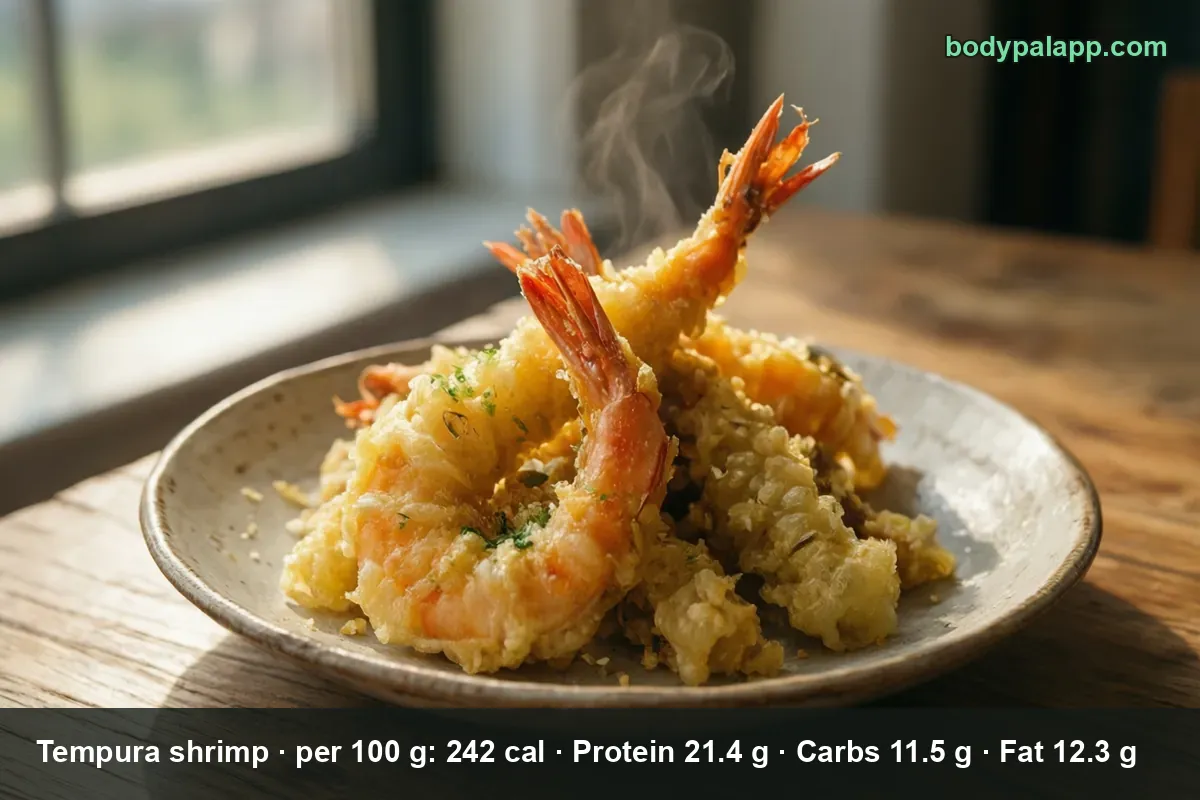
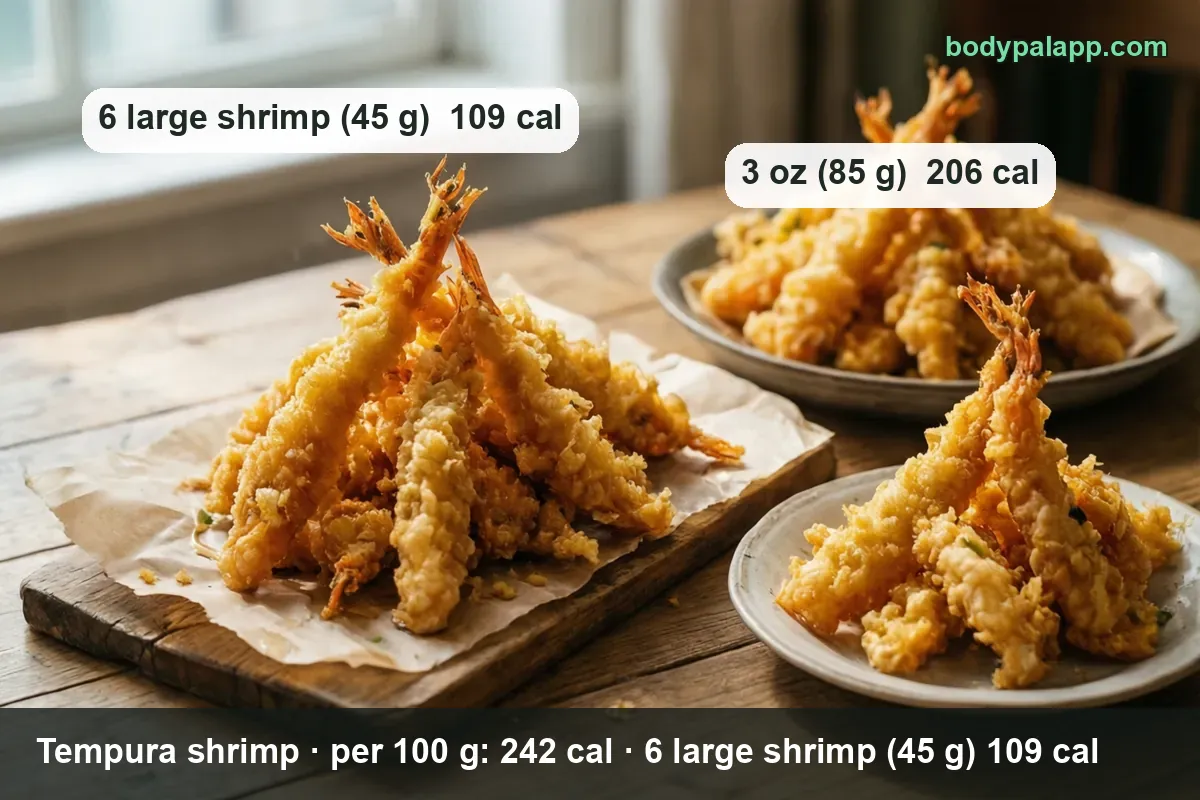
A 3 oz serving of tempura shrimp is 206 calories — 85 g on the plate, at 242 calories per 100 g. The pile of six large shrimp in the photo below comes to 109. Order the same food as a sit-down restaurant plate and it is 521. The spread has very little to do with the shrimp and almost everything to do with how much batter went around it.
On this page
- Tempura shrimp quick facts
- The piece count beats the ounce
- US servings, from four shrimp to a full plate
- Where the calories actually come from
- Restaurant and fast-food breaded shrimp
- Frozen tempura shrimp from the freezer aisle
- How does tempura shrimp compare?
- Most popular tempura shrimp brands
- FAQ
Tempura shrimp quick facts
The reference record is SR Legacy 171970, "Crustaceans, shrimp, mixed species, cooked, breaded and fried". USDA holds no entry with the word tempura on it outside packaged goods, and this is the only general breaded-and-fried shrimp record that is neither a restaurant plate nor a fast-food basket. The numbers back the choice: American retail tempura shrimp run 212 to 268 calories per 100 g, and 242 sits in the middle of that band. The serving column is USDA's own portion for the record, 3 oz.
| Nutrient | Per 100 g | Per 3 oz (85 g) | % Daily Value |
|---|---|---|---|
| Calories | 242 | 206 | — |
| Total fat | 12.28 g | 10.44 g | 13% |
| Saturated fat | 2.09 g | 1.78 g | 9% |
| Carbohydrate | 11.47 g | 9.75 g | 4% |
| Dietary fiber | 0.4 g | 0.34 g | 1% |
| Total sugars | 0.8 g | 0.68 g | — |
| Protein | 21.39 g | 18.18 g | 36% |
| Sodium | 344 mg | 292 mg | 13% |
% Daily Value is based on a 2,000-calorie diet.
Verified nutrition data
Numbers on this page come from USDA FoodData Central, the U.S. Department of Agriculture’s food composition database, and from manufacturer labels where a branded product is named. Last verified September 2026. How we verify our data →
Two rows are worth a second look, and neither is the one people expect from fried food. Protein is 18.18 g in a 3 oz serving, 36% of the day, which is the kind of figure a chicken breast posts. Fat is only 13%.
The row that is not printed above is the surprising one. USDA lists 138 mg of cholesterol per 100 g, so a 3 oz serving carries about 117 mg — 39% of the 300 mg Daily Value, three times the share that the fat row takes. That is shrimp being shrimp; the fryer had nothing to do with it.
There is no added sugars line and no trans fat line on this page because the 2018 SR Legacy release does not publish either field for this record. Nothing has been substituted from a label to fill the gap.
The piece count beats the ounce
USDA's second portion for the record is the useful one: 4 large shrimp weigh 30 g. That is 7.5 g per piece, batter included, and it means a single tempura shrimp is about 18 calories.
Run that arithmetic the other way and the trap appears. A 3 oz serving is not a modest handful — at 7.5 g apiece it is roughly eleven large shrimp. The six-piece pile in the photograph is 45 g and 109 calories, just over half of the 206 that "3 oz of tempura shrimp" enters into a food log.
So the ounce is the wrong unit here. Nobody eats shrimp by weight; they eat it by piece, off a shared plate, and then estimate. Logging six pieces as 3 oz adds 97 calories that were never on the plate. Counting tails is more accurate than guessing ounces, and it is the one food where that is easy to do.
US servings, from four shrimp to a full plate
| Serving | Weight | Calories |
|---|---|---|
| One large shrimp | 7.5 g | 18 |
| 4 large shrimp (USDA portion) | 30 g | 73 |
| 6 large shrimp (the pile above) | 45 g | 109 |
| 1 oz | 28 g | 68 |
| 3 oz (USDA portion) | 85 g | 206 |
| 100 g reference | 100 g | 242 |
Only the 30 g and 85 g rows are USDA portions; the single-piece weight, the six-piece pile and the 1 oz row are our own scaling from them at 242 calories per 100 g.
The four-piece row is the honest side portion: 73 calories, 6.4 g of protein, 3.4 g of carbohydrate and 3.7 g of fat. As an appetizer alongside something else, tempura shrimp is a genuinely cheap order.
One caution about weights. These are cooked figures — breaded, fried, ready to eat. Raw shrimp with no coating runs about 85 calories per 100 g, so the batter and the oil nearly triple the density per gram. Weighing shrimp raw and then logging it as tempura understates the plate by a factor of almost three, which is a much bigger error than any portion-size guess.
Where the calories actually come from
Fat, and not by a small margin. The 12.28 g in 100 g supplies about 111 calories at 9 per gram, roughly 46% of the 242. Protein contributes about 86 and carbohydrate about 46. In a food most people file under "fried carbs", the batter is the smallest of the three energy sources.
The carbohydrate row makes the same point in a different way: 11.47 g per 100 g, of which just 0.8 g is sugar and 0.4 g is fiber. Tempura batter is flour and starch that has soaked up frying oil. The calories it adds arrive as fat, not as the carbohydrate people assume they are counting.
That is also why the protein-to-calorie ratio holds up so well on the USDA record. Twenty-one grams of protein per 100 g against 242 calories is a real seafood number, and MyPlate counts breaded shrimp toward the protein foods group even when it has been fried. Keep the coating thin and shrimp stays a protein food. Thicken it and the ratio collapses, which is exactly what the next two sections show.
Restaurant and fast-food breaded shrimp
| Version | Per 100 g | Serving | Calories | Protein | Sodium |
|---|---|---|---|---|---|
| Breaded and fried (USDA reference) | 242 | 3 oz (85 g) | 206 | 18.2 g | 292 mg |
| Restaurant, family style | 308 | 1 order (169 g) | 521 | 21.4 g | 1901 mg |
| Fast food, breaded shrimp | 308 | 3 pieces (39 g) | 120 | 3.1 g | 350 mg |
Both out-of-home records land on 308 calories per 100 g, 27% above the reference, because commercial batter goes on thicker and holds more fryer oil: 18.7 to 18.9 g of fat per 100 g against 12.28 g. That much was predictable.
The protein column is where they part company. The restaurant plate keeps 12.67 g per 100 g; the fast-food basket keeps 7.84 g — 63% less protein than the reference record, at 27% more calories. When batter takes over, you are buying fried flour with a shrimp inside it.
And the real cost of the restaurant order is not on the calorie line at all. A 169 g plate carries 1,901 mg of sodium, 83% of the 2,300 mg Daily Value, against 292 mg for a 3 oz serving at home. The calories go up about two and a half times; the sodium goes up more than sixfold. Dietary Guidelines for Americans puts the adult sodium ceiling at 2,300 mg a day, so one shared appetizer can spend most of it before the entrée arrives.
The fast-food row deserves credit for the opposite reason. Three pieces at 39 g is a small object — 120 calories and 350 mg of sodium, 15% of the day. As a side, it is modest. It is simply not much shrimp.
Frozen tempura shrimp from the freezer aisle
Store tempura is a third food again, and its labels are remarkably consistent per gram. Across US retail boxes the density runs from 212 calories per 100 g on the Whole Catch box up to 268 on the Legal Sea Foods one, with SeaPak at 247 and both Aqua Star and Waterfront Bistro at 254. Calorie density barely moves, in other words, and the USDA reference at 242 sits inside that range: on calories alone, the freezer aisle and the USDA record agree.
Protein does not agree. Retail tempura declares roughly 7.1 to 11.8 g per 100 g where the reference record holds 21.39 g. Same calories, about half the protein. The missing grams went into batter, and one label spells out why: Whole Catch calls 85 g "about 3.5 pieces". USDA calls 85 g about eleven large shrimp. Both statements are true, and the difference between them is the thickness of the coating.
That is the single most useful thing to know before buying frozen tempura. Compare boxes on protein per serving, not on calories per serving — the calorie figures are all within a rounding error of each other, and the protein figures are not.
Watch the box size as well. The 142 g packs are not big portions of a light food; they are 361 calories, more than a 3 oz serving by three quarters, because the serving printed on the bag is 5 oz rather than 3.
How does tempura shrimp compare?
| Item | Per 100 g | Per 3 oz (85 g) | Protein | Carbohydrate | Fat |
|---|---|---|---|---|---|
| Tempura shrimp, breaded and fried | 242 | 206 | 18.2 g | 9.8 g | 10.4 g |
| Fast food, breaded shrimp | 308 | 262 | 6.7 g | 23.8 g | 16.1 g |
| Restaurant, family style breaded shrimp | 308 | 262 | 10.8 g | 19.0 g | 15.9 g |
| Shark, batter-dipped and fried | 228 | 194 | 15.8 g | 5.4 g | 11.7 g |
| Catfish, breaded and fried | 229 | 195 | 15.4 g | 6.8 g | 11.3 g |
The 3 oz column is our own scaling for the fast-food and the restaurant rows; USDA prints those as a 39 g basket and a 169 g plate.
Every battered seafood on that list falls between 228 and 308 calories per 100 g, a spread of 80. The protein column spreads by a factor of nearly three, from 6.7 g to 18.2 g for the same 85 g of food. Calories tell you almost nothing here; protein tells you what you bought.
Our take: for 3 oz of fried seafood, the shrimp reference record is the best value on the table — the highest protein and the lowest fat, for 206 calories, so if the fryer is happening anyway, order the shrimp. Fried catfish and shark are close behind at 195 and 194 calories with about 15 g of protein, and either beats the fast-food basket, which costs 262 calories for 6.7 g of protein and 23.8 g of carbohydrate. That last row is the one to skip, and it has nothing to do with its calorie count being 56 higher.
Most popular tempura shrimp brands in the United States
Ranked by how widely each product appears among foods sold in the United States, from the BodyPal food database of over 3.3 million products. Calories are the figures printed on each Nutrition Facts label, checked against USDA FoodData Central.
| Product | Calories (per 100 g) |
|---|---|
| SeaPak Oven Crispy Tempura Shrimp | 247 cal |
| Whole Catch Tempura Shrimp | 212 cal |
| Aqua Star Tempura Shrimp | 254 cal |
| Legal Sea Foods Crispy Oven-Ready Tempura Shrimp | 268 cal |
| Waterfront Bistro Tempura Shrimp with Sweet Soy Dipping Sauce | 254 cal |
Brand popularity: BodyPal food database. Nutrition: manufacturer labels / USDA FoodData Central.
Tempura shrimp FAQs
How many calories are in tempura shrimp?
206 calories in a 3 oz serving, 85 g of breaded and fried shrimp, at 242 calories per 100 g. That serving carries 18.18 g of protein, 10.44 g of fat, 9.75 g of carbohydrate and 292 mg of sodium. A smaller pile of six large shrimp, 45 g, is 109 calories.
How many calories are in one tempura shrimp?
About 18 calories per piece. USDA weighs 4 large breaded and fried shrimp at 30 g, which is 7.5 g each, and at 242 calories per 100 g that works out to roughly 18 apiece. Four are 73 calories, six are 109, and a full 3 oz serving is about eleven of them.
How many calories are in tempura shrimp per 100 g?
242 calories per 100 g for breaded and fried shrimp. Restaurant and fast-food versions both run 308 per 100 g, and frozen retail tempura sits between 212 and 268. The differences come from batter thickness and fryer oil, not from the shrimp itself.
How much protein is in tempura shrimp?
18.18 g in a 3 oz serving, 36% of the Daily Value, from 21.39 g per 100 g. Store-bought tempura declares far less, about 7.1 to 11.8 g per 100 g, and fast-food breaded shrimp only 7.84 g. Thicker batter means the same calories deliver roughly half the protein.
Is tempura shrimp healthy?
It is a fair protein source with two numbers to watch. A 3 oz serving gives 18.18 g of protein for 206 calories, but also 117 mg of cholesterol, 39% of the Daily Value, and 292 mg of sodium. A 169 g restaurant order reaches 1,901 mg of sodium, 83% of the day.
Tempura shrimp or grilled shrimp — how big is the difference?
Nearly triple, per gram. Plain shrimp with no coating is about 85 calories per 100 g against 242 for breaded and fried, so a 3 oz serving moves from roughly 72 calories to 206. The batter and the oil add the calories.
How many calories are in frozen tempura shrimp?
212 to 268 calories per 100 g across US retail labels, so an 85 g serving lands between 180 and 210. Larger packs print larger servings: a 142 g portion is 361 calories. Check the gram weight on the box before comparing it with a restaurant plate.
How many calories are in a restaurant tempura shrimp order?
521 calories for a 169 g family-style order at 308 calories per 100 g, with 21.4 g of protein, 37.7 g of carbohydrate, 31.6 g of fat and 1,901 mg of sodium. The calories are about two and a half times a 3 oz home serving; the sodium is over six times it.
Similar foods
- Fried Potatoes — 315 cal per cup
- Pizza Bread — 340 cal per piece
- Square Cut Pizza — 420 cal per slice
- Pizza Hot Pocket — 317 cal per hot pocket
- Quarter Pounder — 417 cal per burger
- Tuna Wrap — 488 cal per wrap
Count it without the math
Point the camera at the plate and BodyPal counts the tails, not the ounces.


How long does it take to burn off tempura shrimp?
A 3 oz (85 g) serving is 206 kcal. Enter your weight and the amount you ate to see how long it takes you to burn that off:
lb
| Activity | Time to burn 206 kcal |
|---|---|
| Walking, brisk | 41 min |
| Cycling, moderate | 26 min |
| Swimming, moderate | 29 min |
| Jogging | 24 min |
| Weight training, moderate | 46 min |
Times are for a 155 lb adult at a steady pace; change the weight to see yours. The amount is set to the portion in the text (85 g); change it to what you actually ate. BodyPal works this out from your steps automatically.
Burning it off is one side of it. The other is knowing your number: work out how many calories you need a day, with macros and a goal date.