
How Many Calories in a Roast Chicken?
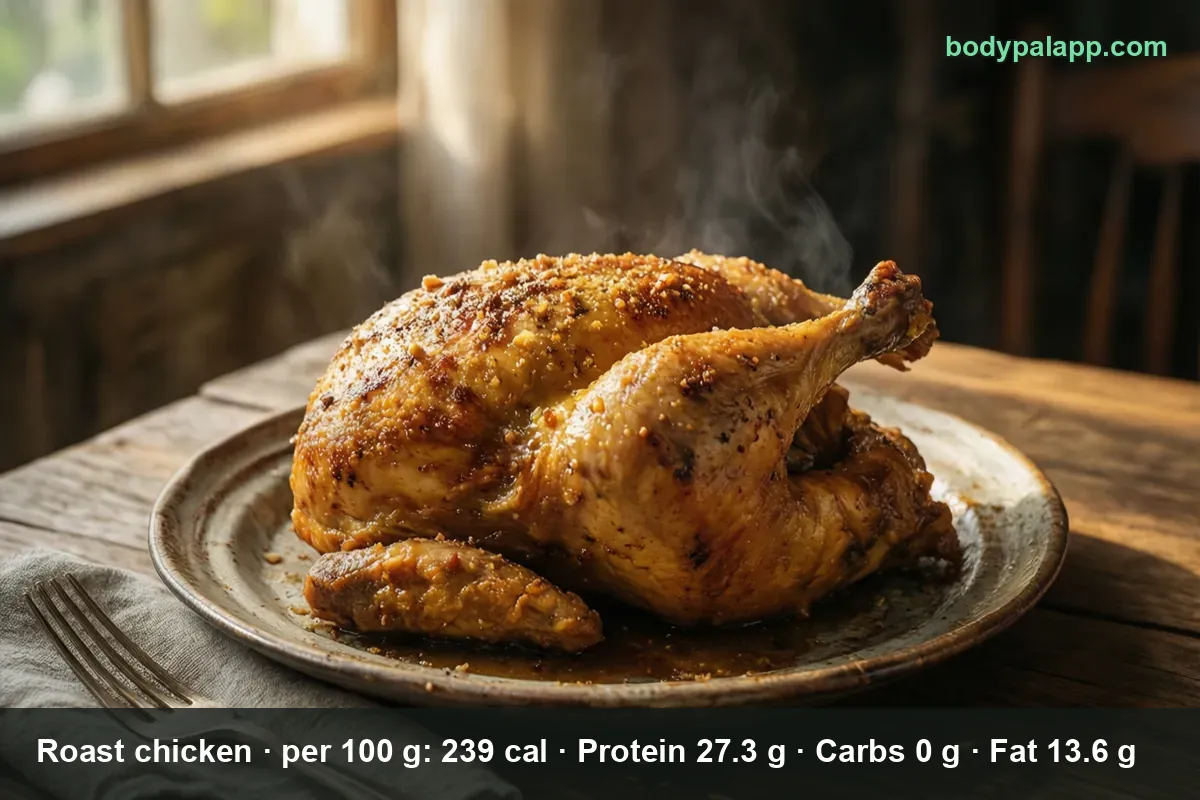
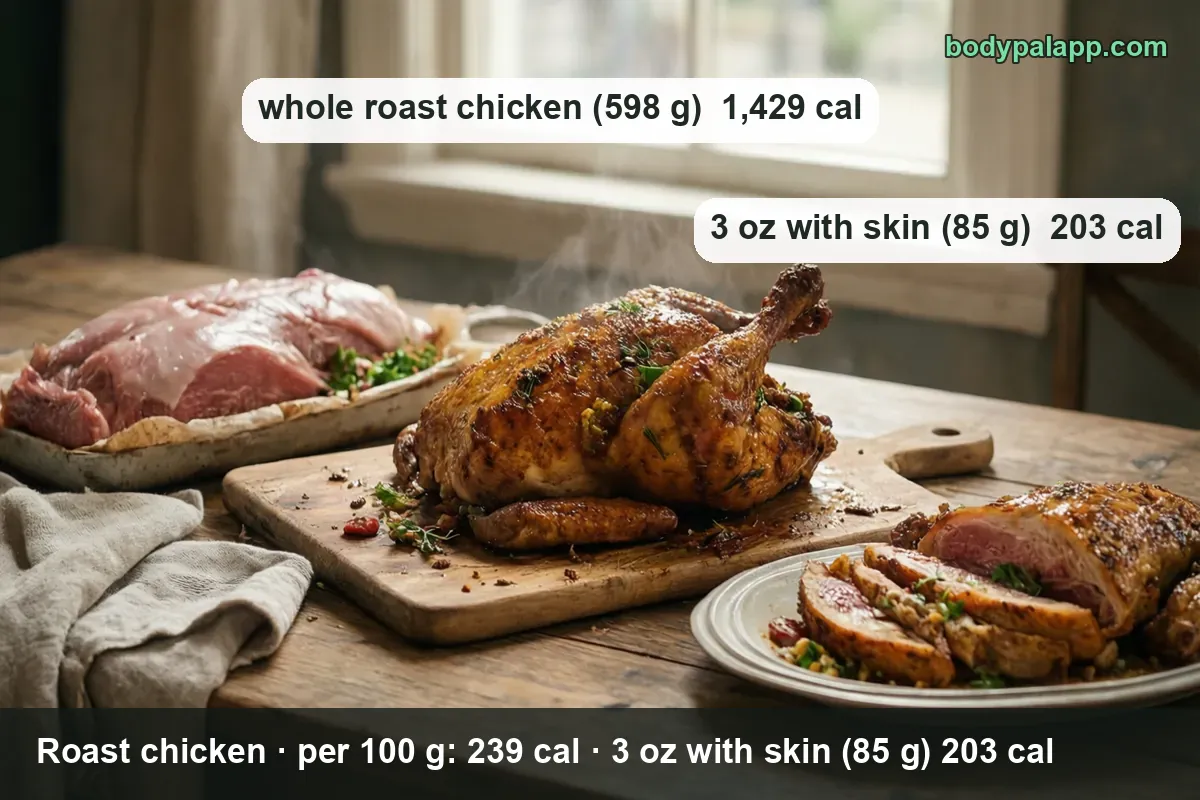
A 3 oz serving of roast chicken, meat and skin together, is 203 calories — 239 per 100 g. Carve a whole home-roasted bird and you get about 598 g of edible meat and skin, or 1,429 calories for the entire chicken. Half a chicken is 715. A supermarket rotisserie bird works out lower per ounce and much higher in sodium.
On this page
- Roast chicken quick facts
- What a whole roast chicken adds up to
- Rotisserie chicken is a different bird
- Cut by cut, from breast to wing
- What the skin costs
- Sodium is the number to watch
- Raw weight, cooked weight and the cup trap
- Roast chicken next to other roasts
- Most popular rotisserie chicken brands
- Roast chicken FAQs
Roast chicken quick facts
The reference below is a mixed 3 oz serving of a home-roasted bird — some white, some dark, skin left on, which is what ends up on a plate when someone carves.
| Nutrient | Per 100 g | Per 3 oz (85 g) | % Daily Value |
|---|---|---|---|
| Calories | 239 | 203 | — |
| Total fat | 13.6 g | 11.6 g | 15% |
| Saturated fat | 3.79 g | 3.2 g | 16% |
| Carbohydrate | 0 g | 0 g | 0% |
| Dietary fiber | 0 g | 0 g | 0% |
| Total sugars | 0 g | 0 g | — |
| Protein | 27.3 g | 23.2 g | 46% |
| Sodium | 82 mg | 70 mg | 3% |
| Cholesterol | 88 mg | 75 mg | 25% |
| Potassium | 223 mg | 190 mg | 4% |
% Daily Value is based on a 2,000-calorie diet.
Verified nutrition data
Numbers on this page come from USDA FoodData Central, the U.S. Department of Agriculture’s food composition database, and from manufacturer labels where a branded product is named. Last verified September 2026. How we verify our data →
Two rows deserve a second look. Protein is the headline: 23.2 g from one modest serving, 46% of the day, which is why roast chicken shows up in almost every high-protein meal plan. Cholesterol is the quiet one at 25% of the FDA Daily Value — a leg quarter alone clears half the day.
Total sugars carry no percentage because only added sugars have a Daily Value, and a plain roasted bird has none. There is no added-sugars row here either: the USDA entry for chicken, meat and skin, roasted does not carry one, and nothing is added to a chicken that goes into a home oven with salt and pepper.
What a whole roast chicken adds up to
A whole bird is the number people actually want, and it is the one most calorie charts skip.
| Portion | Weight | Calories |
|---|---|---|
| 1 oz, meat and skin | 28 g | 68 |
| 3 oz, meat and skin | 85 g | 203 |
| 1 cup, chopped or diced | 140 g | 335 |
| Yield from a 1 lb ready-to-cook bird | 178 g | 425 |
| Half a chicken, bones removed | 299 g | 715 |
| Whole chicken, meat and skin, bones removed | 598 g | 1,429 |
The whole-bird figure comes out of USDA's own yield data rather than a guess. USDA lists half a roasted chicken, bones removed, at 299 g of edible meat and skin, so the whole bird is 598 g and 1,429 calories. Cross-check it a second way: the light-meat half weighs 132 g and the dark-meat half 167 g, and 132 plus 167 is 299 again.
Work backwards from the yield and you can size the bird. Every 1 lb of raw ready-to-cook chicken gives 178 g of edible roasted meat with skin, so 598 g of finished meat came off a bird of roughly 3.4 lb raw — a standard American broiler from any grocery meat case.
That means the arithmetic for a family dinner is simple. Four people splitting one roast chicken evenly are eating about 357 calories each of meat and skin, before a single potato joins the plate.
Rotisserie chicken is a different bird
The bird from the hot case near the registers is not the same food as the one from your oven, and the difference is bigger than the price tag suggests.
USDA's survey database, which measures food as people actually eat it, puts rotisserie chicken with the skin eaten at 196 calories per 100 g against 239 for home-roasted. Skin not eaten drops it to 164. That gap runs past 10%, and it has nothing to do with one source being better than the other: store birds are brined and sold whole, and the survey figures reflect the proportion of skin people leave behind rather than the fully skinned proportion USDA carves in a lab.
| Rotisserie portion | Weight | Skin eaten | Skin not eaten |
|---|---|---|---|
| 3 oz | 85 g | 167 cal | 139 cal |
| 1 cup, diced | 135 g | 265 cal | 221 cal |
| One breast | 130 g | 228 cal | 173 cal |
| One leg (thigh + drumstick) | 140 g | 305 cal | 222 cal |
| Half a chicken | 300 g | 588 cal | 402 cal |
| Whole chicken | 600 g | 1,176 cal | 804 cal |
A whole rotisserie chicken eaten skin and all is 1,176 calories of edible meat. That is genuinely reasonable for a bird that feeds three or four people, and it is 253 fewer than a home-roasted chicken of the same edible weight. Calories are not the reason to be careful with it. Sodium is, and that section is below.
Warehouse-club and supermarket birds — the Costco, Sam's Club and Walmart deli chickens people search for by name — sit inside this range. Club-store deli items are sold without a UPC nutrition panel, so they carry no USDA record of their own; the survey rotisserie figures are the honest way to log one.
Cut by cut, from breast to wing
Per 100 g, with the skin on, the ranking of a roasted bird goes: wing 254, thigh 232, breast 197, drumstick 191. Per piece it inverts completely, because a wing is tiny and a leg quarter is not.
| Piece (rotisserie, skin eaten) | Weight | Calories |
|---|---|---|
| One wing | 35 g | 90 |
| One drumstick | 60 g | 124 |
| One thigh | 80 g | 181 |
| One breast | 130 g | 228 |
| One leg quarter | 140 g | 305 |
Home-roasted quarters are heavier still, because a quarter carries back and bone-adjacent meat the survey pieces do not. A breast quarter — breast plus wing, meat and skin — is 132 g and 293 calories. A leg quarter is 167 g and 423 calories.
That 130-calorie gap between the two quarters is the single biggest choice at the table, and it happens before anyone thinks about the brand of chicken or the seasoning. Protein per gram is close either way. Fat is not: dark meat with skin runs 15.78 g per 100 g against 10.85 g for light.
One more trap in the older numbers. USDA's classic entry puts a half breast with skin at 98 g, while the survey data measures a real store rotisserie breast at 130 g. Birds got bigger. Log "one chicken breast" against the old weight and you undercount by roughly a third.
What the skin costs
Skin on its own is 454 calories per 100 g and 40.68 g of fat. It is the most calorie-dense part of the bird by a wide margin, and it is also where most of the flavor lives.
Pull it off a 3 oz mixed serving and 203 calories become 162. That is 41 calories saved and saturated fat cut roughly in half, from 3.2 g to 1.7 g. On a breast the trade is smaller: 3 oz of breast with skin is 167 calories, without skin 140 — a 27-calorie difference for the leanest cut on the bird.
Scale it to a whole chicken and the number stops being trivial. A rotisserie bird eaten with the skin is 1,176 calories; the same bird with the skin left on the plate is 804. The skin on one chicken is worth 372 calories.
Do not try to calculate that by multiplying the whole-bird weight by the skinless figure — 598 g is a weight that includes skin, so the math would double-count. The survey pair works because the two edible weights, 600 g with skin and 490 g without, were measured separately.
Sodium is the number to watch
Here is the finding that changes how you shop. Home-roasted chicken carries 82 mg of sodium per 100 g. Store rotisserie chicken carries 343 mg — four times as much, because commercial birds are injected with brine before they ever reach the spit.
- 3 oz home-roasted: 70 mg (3% DV)
- 3 oz rotisserie: 292 mg (13% DV)
- One rotisserie leg quarter: 501 mg (22% DV)
- Half a rotisserie chicken: 1,029 mg (45% DV)
- A whole rotisserie chicken: 2,058 mg (89% DV)
Eating a whole rotisserie chicken over a couple of days is unremarkable. Eating one in an evening puts 89% of the day's sodium on the table from the meat alone, before bread, sauce or a side. The CDC puts most of the sodium Americans eat in packaged and prepared food rather than the salt shaker, and a brined deli bird is exactly that category wearing a fresh-food disguise.
Store labels vary more than the food does. Across supermarket rotisserie chicken records in USDA's branded database, the same 3 oz serving ranges from about 230 mg of sodium at the low end to roughly 910 mg at the high end — a fourfold spread for what looks like an identical product on the shelf. Plain birds sit low; barbecue and seasoned rubs sit high. Reading the deli label is worth more than switching cuts.
Roasting your own is the version that solves this. Same protein, same cut, a fraction of the sodium, and you control what goes on the skin.
Raw weight, cooked weight and the cup trap
Two measuring habits account for most of the logging errors on this food.
Raw against cooked. Raw chicken with skin is 215 calories per 100 g; roasted, it is 239. The oven adds nothing — it removes water, so what remains is more concentrated per gram. Weigh raw and log cooked and you will undercount every time. The clean conversion is USDA's yield: 1 lb of raw ready-to-cook chicken becomes 178 g of edible roasted meat and skin, worth 425 calories.
The cup. One cup of chopped or diced roast chicken is 140 g and 335 calories — not a serving, but 1.65 servings. People pile a cup into a salad and log it as a 3 oz piece at 203. That is a 132-calorie error from a single entry, repeated every time chicken goes into a bowl. If you use cups, use the cup figure; if you use ounces, weigh.
MyPlate counts 1 oz of cooked chicken as one ounce-equivalent of protein food, so a 3 oz serving covers a meaningful share of an adult's daily protein group on its own.
Roast chicken next to other roasts
| Roast (per 3 oz, 85 g) | Per 100 g | Calories | Protein | Fat |
|---|---|---|---|---|
| Roast chicken, meat and skin | 239 | 203 | 23.2 g | 11.6 g |
| Roast turkey, light meat with skin | 177 | 150 | 25.1 g | 4.7 g |
| Fried chicken breast, flour-coated | 222 | 189 | 27.1 g | 7.5 g |
| Roast pork loin, bone-in | 231 | 196 | 23.0 g | 10.9 g |
| Roast beef, eye of round | 208 | 177 | 24.1 g | 8.2 g |
Our take: if the goal is the most protein for the fewest calories, roast turkey light meat wins outright at 150 calories for 25.1 g of protein, and roast chicken without skin is the close second at 162 calories for 24.6 g. Roast chicken with the skin is not a diet food so much as a satisfying one — it beats pork loin and matches beef, and the reason fried chicken looks competitive on this table is that a flour coating dilutes the per-gram number without making the meal lighter.
Most popular rotisserie chicken brands in the United States
Ranked by how widely each product appears among foods sold in the United States, from the BodyPal food database of over 3.3 million products. Calories are the figures printed on each Nutrition Facts label, checked against USDA FoodData Central.
| Product | Calories (per 100 g) |
|---|---|
| Wegmans Plain Rotisserie Chicken | 167 cal |
| Winn-Dixie Rotisserie Chicken | 190 cal |
| Nature’s Place Rotisserie Chicken (Food Lion) | 202 cal |
| Full Circle Market Rotisserie Chicken | 200 cal |
| Wellsley Farms Whole Rotisserie Chicken (BJ’s) | 214 cal |
| ShopRite Rotisserie Chicken | 298 cal |
Brand popularity: BodyPal food database. Nutrition: manufacturer labels / USDA FoodData Central.
Roast chicken FAQs
How many calories are in a whole rotisserie chicken?
1,176 calories for a whole store rotisserie chicken eaten with the skin, based on 600 g of edible meat at 196 calories per 100 g. Leave the skin and it drops to 804 calories for 490 g. A home-roasted bird of similar size gives 598 g of meat and skin and 1,429 calories.
How many calories in a rotisserie chicken breast?
228 calories for one whole rotisserie breast of 130 g with the skin eaten, or 173 calories for a 120 g breast with the skin removed. Per 3 oz that works out to 149 calories with skin and 122 without. Rotisserie breast also carries about 428 mg of sodium per piece.
How many calories in a chicken leg quarter?
305 calories for a 140 g rotisserie leg quarter with the skin eaten. A home-roasted leg quarter is heavier at 167 g and comes to 423 calories, because it carries more dark meat and skin. Skip the skin on the rotisserie version and it falls to 222 calories.
How many calories in a roast chicken thigh or drumstick?
181 calories for one 80 g thigh with skin and 124 calories for one 60 g drumstick with skin. Removing the skin brings the thigh to 135 and the drumstick to 86. Per 100 g the thigh is the fattier piece at 226 calories against 206 for the drumstick.
How many calories in rotisserie chicken without the skin?
164 calories per 100 g, which is 139 calories for a 3 oz serving. With the skin eaten the same 3 oz is 167 calories. Across a whole bird the skin is worth 372 calories, taking it from 1,176 down to 804.
Is rotisserie chicken healthy?
The protein is excellent and the sodium is the catch. A 3 oz serving gives 46% of the Daily Value for protein, but it carries 292 mg of sodium against 70 mg for home-roasted chicken. A whole rotisserie bird eaten with the skin reaches 2,058 mg, or 89% of a day's sodium.
How many calories in half a roast chicken?
715 calories for half a home-roasted chicken, bones removed, at 299 g of meat and skin. Half a store rotisserie chicken is 588 calories for 300 g with the skin eaten, or 402 calories for 245 g with the skin left behind. The rotisserie half also brings 1,029 mg of sodium.
How much protein is in roast chicken?
23.2 g of protein in a 3 oz serving of meat and skin, which is 46% of the Daily Value, or 27.3 g per 100 g. Skinless meat is denser still at 28.93 g per 100 g. A whole roasted bird of 598 g carries about 163 g of protein.
Similar foods
- Chicken — 203 cal for 3 oz roasted
- Tempura shrimp — 109 cal for 6 large shrimp
- Asada taco — 243 cal per taco
- Top Sirloin Steak — 413 cal per 6 oz steak
- Beef brisket — 208 cal per thick slice
- Street Taco — 125 cal per street taco
Count it without the guesswork
Point the camera at the carving board and BodyPal logs the calories, the protein and the sodium in one shot.


How long does it take to burn off a roast chicken?
A 3 oz serving, meat and skin is 203 kcal. Enter your weight and the amount you ate to see how long it takes you to burn that off:
lb
| Activity | Time to burn 203 kcal |
|---|---|
| Walking, brisk | 41 min |
| Cycling, moderate | 25 min |
| Swimming, moderate | 29 min |
| Jogging | 24 min |
| Weight training, moderate | 45 min |
Times are for a 155 lb adult at a steady pace; change the weight to see yours. The amount is set to the portion in the text (3 oz); change it to what you actually ate. BodyPal works this out from your steps automatically.
This table assumes you know your daily total. If you do not, the daily calorie calculator works it out from five numbers.