
How many calories are in a NY strip steak?
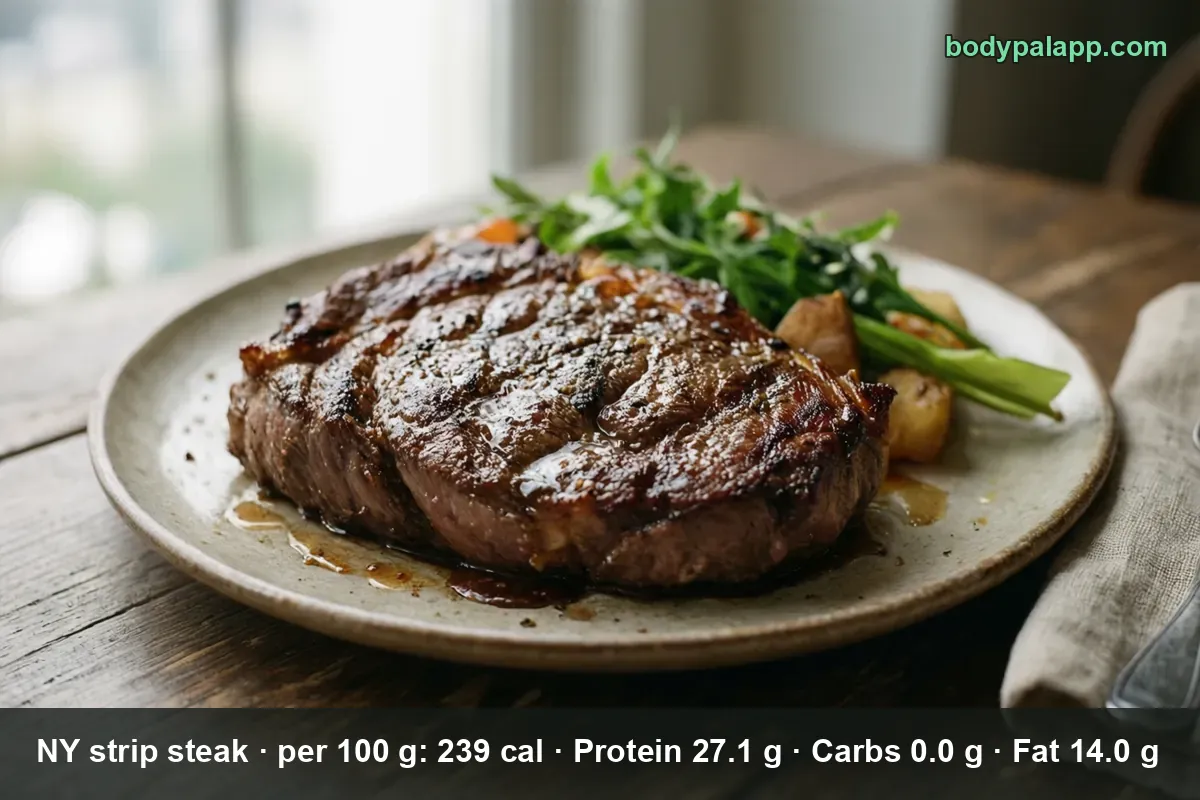
A regular cooked NY strip steak weighs 240 g and carries 574 calories. Per 100 g the cooked meat runs 239 calories, with 27.14 g of protein and 13.98 g of fat. Trim the fat cap onto the plate instead of eating it and the same steak drops to 518.
On this page
- NY strip steak quick facts
- US servings from one ounce to a thick steak
- The fat cap is worth 111 calories
- Raw cooked and grass-fed strip steak
- Protein and saturated fat are the rows to watch
- How does NY strip steak compare?
- Most popular ny strip steak brands
- FAQ
NY strip steak quick facts
The steak most people are logging is one that has already been cooked, salted and put on a plate, and almost nobody weighs how much of the outer fat strip they actually ate. That is exactly what the USDA record FNDDS 2705835, "Beef, steak, strip, NS as to fat eaten" describes: a cooked strip steak, not specified as to how much fat was eaten. It sits between the trimmed and untrimmed versions, which is where the average dinner really lands.
Numbers below are for the cooked steak. If you weigh your meat raw, skip ahead — that is a different record with a different density, and mixing the two is the most common mistake on this cut.
| Nutrient | Per 100 g | Per 1 regular steak (240 g) | % Daily Value |
|---|---|---|---|
| Calories | 239 | 574 | — |
| Total fat | 13.98 g | 33.6 g | 43% |
| Saturated fat | 5.45 g | 13.1 g | 65% |
| Carbohydrate | 0 g | 0 g | 0% |
| Dietary fiber | 0 g | 0 g | 0% |
| Total sugars | 0 g | 0 g | — |
| Protein | 27.14 g | 65.1 g | 130% |
| Sodium | 361 mg | 866 mg | 38% |
| Cholesterol | 85 mg | 204 mg | 68% |
| Potassium | 315 mg | 756 mg | 16% |
% Daily Value is based on a 2,000-calorie diet.
Verified nutrition data
Numbers on this page come from USDA FoodData Central, the U.S. Department of Agriculture’s food composition database, and from manufacturer labels where a branded product is named. Last verified September 2026. How we verify our data →
There is no added sugars row and no trans fat row here, because the USDA does not publish those values for this unpackaged meat record. Beef has no added sugar to declare in any case, and the total sugars line is a flat zero.
US servings from one ounce to a thick steak
| Serving | Weight | Calories |
|---|---|---|
| 1 oz | 28 g | 67 kcal |
| 4 oz cooked | 113 g | 270 kcal |
| 8 oz cooked | 227 g | 543 kcal |
| One thin steak | 180 g | 430 kcal |
| One regular steak | 240 g | 574 kcal |
| One thick steak | 360 g | 860 kcal |
| Per 100 g | 100 g | 239 kcal |
The three steak sizes — thin, regular and thick — are USDA household measures for this record, so those are the numbers to lean on when you did not weigh anything. The ounce rows and the 8 oz row are our own arithmetic from the USDA 100 g figure, not USDA servings, because this record has no ounce-based portion of its own.
That 8 oz row hides the biggest trap on the whole page. A steakhouse "8 oz New York strip" is a raw weight, printed before the meat loses water on the grill. Eight ounces weighed off your own cutting board after cooking is 543 calories; eight ounces weighed raw is closer to 431, again our own arithmetic, this time from the raw USDA record. Pick one side of the grill and stay there.
The fat cap is worth 111 calories
Strip steak comes with a band of fat down one edge, and whether you eat it or leave it is the single biggest variable on the plate — bigger than the sear, bigger than the butter question, bigger than grill versus pan.
| Version | USDA record | Per 100 g | One regular steak (240 g) |
|---|---|---|---|
| Lean only, fat cut off | FNDDS 2705837 | 216 kcal | 518 kcal |
| Not specified, the average dinner | FNDDS 2705835 | 239 kcal | 574 kcal |
| Lean and fat both eaten | FNDDS 2705836 | 262 kcal | 629 kcal |
The spread is 46 calories per 100 g, or 111 calories across one 240 g steak. Saturated fat moves with it, from 4.35 g per 100 g trimmed to 6.56 g untrimmed. Protein barely notices: 28.05 g trimmed against 26.23 g with the fat, so cutting the cap off costs you almost nothing you were eating steak for.
Sodium does not move at all. All three records sit at 361 mg per 100 g, because the salt goes on the surface either way.
Raw cooked and grass-fed strip steak
| Version | USDA record | Per 100 g | Typical serving | Calories |
|---|---|---|---|---|
| Cooked strip steak | FNDDS 2705835 | 239 kcal | 1 regular steak (240 g) | 574 kcal |
| Raw NY strip, short loin | Foundation 2727572 | 190 kcal | 4 oz (113 g) | 215 kcal |
| Grass-fed strip, lean, raw | SR Legacy 169429 | 117 kcal | 4 oz (113 g) | 132 kcal |
| Grass-fed whole strip steak, raw | SR Legacy 169429 | 117 kcal | 1 steak (214 g) | 250 kcal |
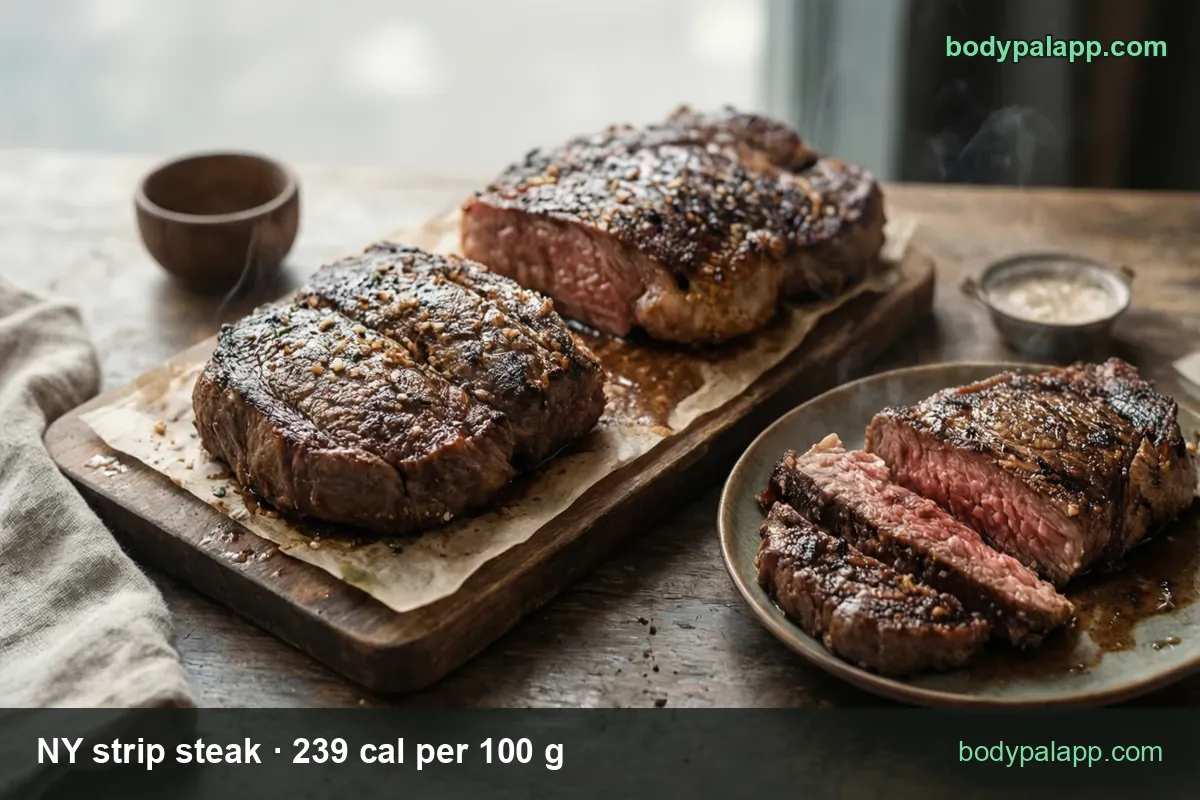
Cooking adds no calories. It removes water, and that makes what is left denser: 190 calories per 100 g raw becomes 239 cooked, about 26% more energy in every gram you put on the scale. The same steak, the same dinner, two legitimate numbers depending on when you weighed it.
Sodium tells the same story in reverse. The raw short loin record carries 43 mg per 100 g. The cooked record carries 361 mg. Nothing about the beef changed — that is the salt you put on it, and it is the only ingredient here you fully control.
The grass-fed row is the outlier, and it is worth reading carefully: 117 calories per 100 g is a fully trimmed, lean-only, raw cut, so it is the leanest possible reading of this steak rather than a typical one. Supermarket packages agree that the range is wide. Store-brand grass-fed NY strip labels run as low as 168 calories per 100 g, while an organic grass-fed brand declares 259, which on a 4 oz label serving is the difference between 190 and 290 calories. If your package has a Nutrition Facts panel, trust it over any average.
Protein and saturated fat are the rows to watch
One regular steak delivers 65.1 g of protein, 130% of the FDA Daily Value of 50 g, from a single item on the plate. Very few foods do that, and it is the honest reason this cut belongs in a calorie-controlled week rather than outside it. MyPlate counts one ounce of cooked meat as one ounce-equivalent of protein foods, so a 240 g steak is roughly eight and a half of them in one sitting.
The other side of the same steak is 13.1 g of saturated fat, 65% of the FDA Daily Value of 20 g, and the Dietary Guidelines for Americans recommend keeping saturated fat under 10% of daily calories. Trimming the cap brings that row down to 10.4 g. Ordering the 4 oz cut instead brings it to 6.2 g, 31% of the Daily Value.
Then there is the salt. At 866 mg, one steak is 38% of the 2,300 mg Daily Value for sodium — roughly a third of a teaspoon of table salt, most of it applied in the last two minutes of cooking. Season the meat and skip the sauce and you keep the number where it is; do both and steak quietly becomes a high-sodium meal.
Cholesterol lands at 204 mg per steak, 68% of the Daily Value, and potassium at 756 mg, 16%.
How does NY strip steak compare?
The neighboring USDA records for other steaks are raw, so the fair comparison is raw against raw. Here is NY strip short loin next to the three cuts people actually choose between at the counter.
| Steak, raw | Per 100 g | US serving | Calories |
|---|---|---|---|
| NY strip, short loin | 190 kcal | 4 oz (113 g) | 215 kcal |
| Ribeye, boneless, choice | 254 kcal | 4 oz (113 g) | 287 kcal |
| Tenderloin | 143 kcal | 4 oz (113 g) | 162 kcal |
| Top sirloin | 140 kcal | 4 oz (113 g) | 158 kcal |
Our take: if the goal is the lowest calorie count, top sirloin wins by a clear margin — 140 calories per 100 g against 190 for strip, and it is the lightest of the four. NY strip is the middle choice, 64 calories per 100 g below ribeye and 47 above tenderloin, which is a reasonable place to be for a steak that tastes like a steak. Ribeye is the one to think twice about: at 20.04 g of fat per 100 g raw it is a fattier animal part, not just a bigger cut. And if satiety per calorie is what you are after, strip steak trimmed lean, at 216 calories and 28.05 g of protein per 100 g cooked, is the best trade on this page.
Most popular ny strip steak brands in the United States
Ranked by how widely each product appears among foods sold in the United States, from the BodyPal food database of over 3.3 million products. Calories are the figures printed on each Nutrition Facts label, checked against USDA FoodData Central.
| Product | Calories (per 100 g) |
|---|---|
| Steakhouse Organics 100% Organic Beef NY Strip Steak | 196 cal |
| Star Markets Boneless Angus Beef NY Strip Steak | 212 cal |
| Foodcomm Organic Beef Grass Fed NY Strip Steak | 259 cal |
| Star Markets Grass Fed Organic Beef Boneless NY Strip Steak | 168 cal |
Brand popularity: BodyPal food database. Nutrition: manufacturer labels / USDA FoodData Central.
NY strip steak FAQs
How many calories are in a NY strip steak?
A regular cooked NY strip steak of 240 g holds 574 calories, based on the USDA FNDDS record for strip steak eaten as served. A thin 180 g steak is 430 and a thick 360 g cut is 860. Per 100 g the cooked meat is 239 calories.
How many calories are in an 8 oz New York strip?
An 8 oz portion weighed after cooking is 227 g and 543 calories, our own arithmetic from the USDA 100 g figure rather than a USDA serving. If the 8 oz printed on the menu is the raw weight, the raw record puts that same steak nearer 431 calories.
How much protein is in a NY strip steak?
A 240 g cooked NY strip carries 65.1 g of protein, 130% of the FDA Daily Value of 50 g. Four ounces cooked gives 30.7 g. Trimmed lean meat is slightly denser in protein, 28.05 g per 100 g against 27.14 g for the steak eaten as served.
Is NY strip leaner than ribeye?
Yes — raw, NY strip short loin is 190 calories per 100 g against 254 for boneless choice ribeye, a gap of 64 calories per 100 g. Over a 4 oz serving that is 215 against 287. Tenderloin and top sirloin are leaner still, at 143 and 140 per 100 g.
How many calories are in 4 oz of NY strip steak?
Four ounces of cooked NY strip is 113 g and 270 calories, our own arithmetic from the USDA 100 g figure. It brings 30.7 g of protein, 6.2 g of saturated fat, which is 31% of the Daily Value, and 408 mg of sodium, 18% of the Daily Value.
Does grilling add calories to a steak?
Grilling adds nothing, but it concentrates: raw short loin is 190 calories per 100 g and cooked strip steak is 239, about 26% denser, because heat drives off water rather than energy. Weigh the steak raw or weigh it cooked, just never mix the two records in one entry.
How many calories are in a raw New York strip?
Raw NY strip from the short loin is 190 calories per 100 g, so a 4 oz raw portion is 215 calories and 24.1 g of protein. Sodium is only 43 mg per 100 g raw, against 361 mg once the steak has been cooked and salted on the surface.
Is NY strip steak good for weight loss?
One 240 g steak is 574 calories with 65.1 g of protein, so it fits a calorie target better than its reputation suggests when it is the center of the meal rather than an extra. Trimming the fat cap saves 111 calories. Four ounces at 270 is the easier fit.
Similar foods
- Steak — 368 cal per regular steak
- Eggnog — 112 cal for 1/2 cup
- Protein Shake — 156 cal per cup
- Bubble Tea — 239 cal per drink
- Apple cider — 114 cal per cup
- Root beer — 152 cal for 12 fl oz glass
Count it without the math
Point the camera at the plate and BodyPal counts the steak for you, fat cap and all.


How long does it take to burn off 574 kcal of NY strip steak?
One regular steak (240 g) is 574 kcal. Enter your weight and the amount you ate to see how long it takes you to burn that off:
lb
| Activity | Time to burn 574 kcal |
|---|---|
| Walking, brisk | 1 hr 55 min |
| Cycling, moderate | 1 hr 12 min |
| Swimming, moderate | 1 hr 22 min |
| Jogging | 1 hr 8 min |
| Weight training, moderate | 2 hr 8 min |
Times are for a 155 lb adult at a steady pace; change the weight to see yours. The amount is set to the portion in the text (240 g); change it to what you actually ate. BodyPal works this out from your steps automatically.
Burning it off is one side of it. The other is knowing your number: work out how many calories you need a day, with macros and a goal date.