
How Many Calories in Root Beer?
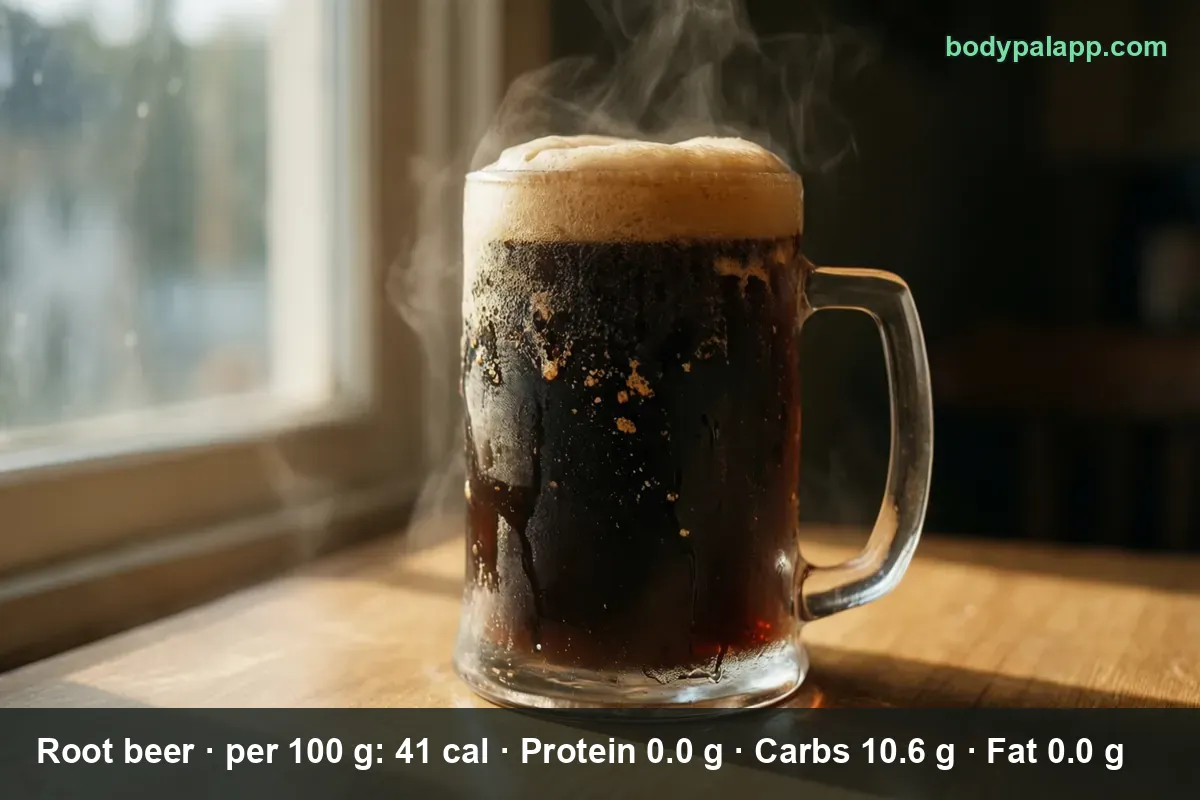
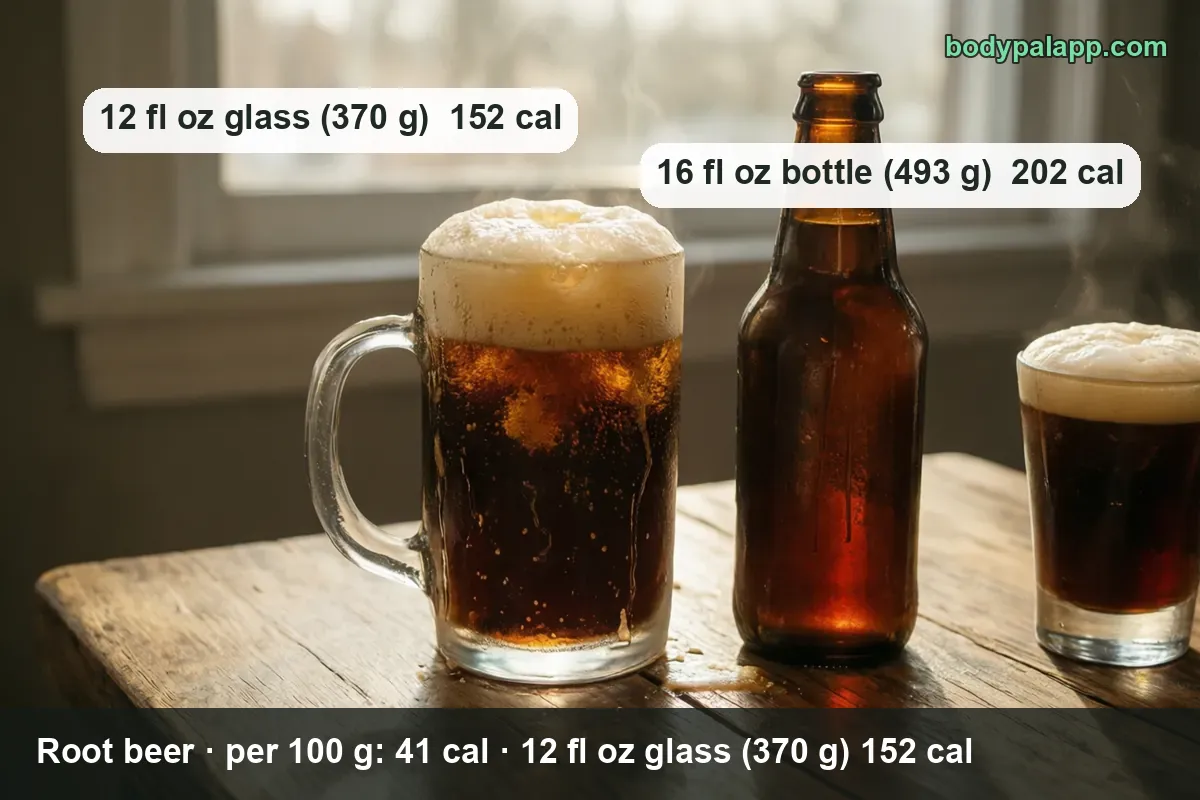
A 12 fl oz can or bottle of root beer is 152 calories, which works out to 41 calories per 100 g. Pour the same soda into a 16 fl oz bottle and you are at 202. The calories in root beer barely move between brands; the container you drink it from moves them a lot.
On this page
- Root beer quick facts
- Every calorie here is sugar
- Can, bottle and 20 oz: what each one costs
- The fountain cup is the trap
- What the ice takes out
- Diet root beer changes everything but the taste
- Brand to brand, and the caffeine question
- How does root beer compare?
- Most popular root beer brands
- FAQ
Root beer quick facts
The reference entry is USDA's Beverages, carbonated, root beer (fdc_id 171871). The serving below is the one most people are holding: a standard 12 fl oz can or bottle, which weighs 370 g.
| Nutrient | Per 100 g | Per 1 can or bottle, 12 fl oz (370 g) | % Daily Value |
|---|---|---|---|
| Calories | 41 kcal | 152 kcal | — |
| Total fat | 0 g | 0 g | 0% |
| Saturated fat | 0 g | 0 g | 0% |
| Carbohydrate | 10.6 g | 39.2 g | 14% |
| Dietary fiber | 0 g | 0 g | 0% |
| Total sugars | 10.6 g | 39.2 g | — |
| Protein | 0 g | 0 g | 0% |
| Sodium | 13 mg | 48 mg | 2% |
% Daily Value is based on a 2,000-calorie diet.
Verified nutrition data
Numbers on this page come from USDA FoodData Central, the U.S. Department of Agriculture’s food composition database, and from manufacturer labels where a branded product is named. Last verified September 2026. How we verify our data →
Two of those rows are worth reading twice. Sodium is a non-event: 48 mg against the FDA Daily Value of 2,300 mg is 2% of the day, so root beer is not a salt problem no matter what the foam suggests. Carbohydrate is the row that carries the whole can.
There is no added sugars line in the table, and that is deliberate. The USDA entry does not publish one, and neither do the survey records for the same drink, so putting a number there would mean inventing it.
Every calorie here is sugar
Look at the two middle rows again. Carbohydrate is 10.6 g per 100 g. Total sugars are also 10.6 g. They are the same figure because there is nothing else in the glass: no starch, no fiber, no protein, no fat.
That makes root beer unusually simple to log. One can holds 39.2 g of sugar and 152 calories, and 39.2 g of sugar at 4 calories a gram is essentially the entire 152. Nothing in the drink comes from the sassafras, the vanilla or the spices; those are flavor at zero cost.
For scale, the FDA sets the Daily Value for added sugars at 50 g. Root beer contains no naturally occurring sugar the way milk or juice does, so a single can sits at about four-fifths of a full day's allowance. The Dietary Guidelines for Americans put the recommendation differently, at under 10% of daily calories from added sugars, which on a 2,000-calorie day is the same 50 g.
Drink two cans and you are past it, on a beverage that leaves you exactly as hungry as before.
Can, bottle and 20 oz: what each one costs
Root beer is sold in more sizes than almost anything else in the cooler, and the calorie count follows the container exactly, since the liquid never changes.
| Portion | Weight | Calories |
|---|---|---|
| 1 fl oz (a taste) | 30.8 g | 13 cal |
| 1 can or bottle, 12 fl oz | 370 g | 152 cal |
| 1 bottle, 16 fl oz | 493 g | 202 cal |
| 1 bottle, 16.9 fl oz (500 ml) | 524 g | 215 cal |
| 1 bottle, 20 fl oz | 620 g | 254 cal |
The 20 fl oz bottle is the one to watch, because it is the default single-serve size at most gas stations and vending machines. It is the same soda as the can, from the same tap, and it costs 67% more calories — 254 against 152. Nobody decided to drink two-thirds more root beer. The cooler decided it for them.
The 16.9 fl oz bottle is the sneakiest of the set. It looks like a small bottle of water and lands at 215 calories, more than a 12 oz can and a 1 fl oz taste combined.
The fountain cup is the trap
Self-serve fountains are where root beer stops being a 150-calorie drink. USDA's survey record for the same soda, Soft drink, root beer (fdc_id 2710557), lists the actual cup weights restaurants pour.
| Fountain size | Weight | Calories |
|---|---|---|
| Child or senior drink | 279 g | 114 cal |
| Small drink | 372 g | 153 cal |
| Medium drink | 512 g | 210 cal |
| Large drink | 744 g | 305 cal |
| Extra large drink | 1023 g | 419 cal |
A small fountain root beer is a can: 153 calories against 152. Everything above that is a different order of drink. The extra large is 419 calories, close to three cans in a single cup, and it usually arrives alongside a meal that was already counted.
The step from medium to large is the expensive one — 95 calories for a cup that costs a few cents more. Free refills are not in this table at all, and they should be. A large plus one refill is 610 calories of root beer, more than most sandwiches.
If you order fountain drinks, the single most useful habit is to know your restaurant's cup sizes by ounces rather than by the words small, medium and large. Those words are set by marketing; the ounces are set by the cup.
What the ice takes out
Ice is the one thing that works in your favor here, and it is worth a number.
In the same USDA survey record, 1 fl oz of poured root beer weighs 31 g without ice and 23 g with it. In other words, a cup filled with ice holds about a quarter less soda than the same cup filled without. On a 12 oz fountain cup, that is roughly 38 calories that never make it into the cup — our own arithmetic from those two USDA weights, not a USDA portion.
That is the honest version of a piece of advice usually given the other way around. Ice does not dilute the drink or make it lower in calories per ounce. It just means fewer ounces of root beer fit, so the volume you paid for is partly frozen water.
Two practical consequences. If you log a fountain drink by cup size, you are probably overcounting by 20 to 25% when the cup was iced. And if you ask for light ice, you are ordering more root beer than the person next to you holding the identical cup.
Diet root beer changes everything but the taste
Diet root beer is Soft drink, root beer, diet (fdc_id 2710558) in USDA's records, and its line is short: 0 calories per 100 g, 0 g of carbohydrate, 0 g of sugar. A 12 fl oz can is 0 calories. A 20 fl oz bottle is also 0.
| Version | Per 100 g | 12 fl oz can | Sugar per can |
|---|---|---|---|
| Root beer | 41 cal | 152 cal | 39.2 g |
| Diet root beer | 0 cal | 0 cal | 0 g |
The only nutrient that survives the switch is sodium, at 6 mg per 100 g, or 22 mg in a can — less than half the regular version's 48 mg, and both are trivial against a 2,300 mg Daily Value.
This is the cleanest swap in the soda aisle, and it is worth stating plainly: the flavor of root beer, the wintergreen and vanilla and sassafras notes people actually want, costs nothing. Every one of the 152 calories comes from the sweetener. Replace the sweetener and the drink survives intact. There is no equivalent trade in a milkshake or a beer, where removing the calories removes most of what you came for. The CDC's nutrition guidance and MyPlate both put water first among drinks; if you are not going to drink water, a zero-calorie soda is the smaller change to make.
Brand to brand, and the caffeine question
Root beer brands are closer together than most soda categories. Across the labels we track, the range runs from 42 calories per 100 g at the low end to 51 at the high end — a spread of about 21% per can, or 149 calories against 181. A dessert-style bottled root beer with caramel added sits at the top; a classic bottled brand sits at the bottom.
That is small enough to ignore for practical logging. If you know you drank a 12 oz root beer and you do not know the brand, 152 calories is within 30 either way of whatever it actually was. Compare that with beer or ice cream, where brand choice can double the number.
Caffeine is the exception that trips people up. Traditional root beer is caffeine-free, which is why it became the default kids' soda at drive-ins and why it is still the soda most people will order at dinner. Barq's is the well-known exception, and it says so on the can. USDA's entry for root beer carries no caffeine value at all, so there is no honest figure to quote here — check the label if it matters to you, because the category cannot answer the question on its own.
How does root beer compare?
All five rows below are USDA soft drink entries at the same 12 fl oz serving.
| Soda | Per 100 g | 12 fl oz serving | Calories | Sugars |
|---|---|---|---|---|
| Root beer | 41 cal | 370 g | 152 cal | 39.2 g |
| Cola | 42 cal | 372 g | 156 cal | 38.5 g |
| Pepper-type soda | 42 cal | 372 g | 156 cal | 38.5 g |
| Fruit-flavored, caffeine free | 40 cal | 372 g | 149 cal | 37.7 g |
| Diet root beer | 0 cal | 360 g | 0 cal | 0 g |
Our take: switching from cola to root beer is not a calorie decision. The gap is 4 calories a can, which is noise, and anyone making that swap to cut calories has done nothing at all. The only row in this table that changes your day is the last one.
For the record, the sweetened sodas are within 7 calories of each other across the whole group. That is the real finding of the comparison — regular soda is regular soda, at roughly 150 calories per 12 oz whatever the flavor on the front, and the decisions that matter are size and sweetener, in that order.
Most popular root beer brands in the United States
Ranked by how widely each product appears among foods sold in the United States, from the BodyPal food database of over 3.3 million products. Calories are the figures printed on each Nutrition Facts label, checked against USDA FoodData Central.
| Product | Calories (per 100 g) |
|---|---|
| Mug Root Beer | 45 cal |
| IBC Root Beer | 44 cal |
| Cicero Beverage Co. Root Beer Salted Caramel | 51 cal |
| Great Value Root Beer | 50 cal |
| Stewart's Original Root Beer | 42 cal |
| Virgil's Handcrafted Root Beer | 45 cal |
Brand popularity: BodyPal food database. Nutrition: manufacturer labels / USDA FoodData Central.
Root beer FAQs
How many calories are in root beer?
152 calories in a standard 12 fl oz can or bottle, which weighs 370 g, at 41 calories per 100 g. A 16 fl oz bottle is 202 calories and a 20 fl oz bottle is 254. All of it comes from sugar: 39.2 g in a can.
How many calories are in a 12 oz can of root beer?
152 calories. USDA weighs a 12 fl oz can at 370 g and puts the drink at 41 calories per 100 g. The same can holds 39.2 g of carbohydrate, every gram of it sugar, and 48 mg of sodium, which is 2% of the Daily Value.
How many calories are in a large fountain root beer?
305 calories for a large, which USDA weighs at 744 g. A medium is 210 calories, a small is 153 and an extra large at 1,023 g reaches 419 — close to three cans in one cup. Refills are not counted in any of those figures.
How many calories are in diet root beer?
0 calories, in a 12 fl oz can and in a 20 fl oz bottle alike. USDA's diet root beer entry lists 0 g of carbohydrate and 0 g of sugar, against 39.2 g of sugar in the regular version. Sodium drops from 48 mg a can to 22 mg.
How much sugar is in root beer?
39.2 g in a 12 fl oz can, at 10.6 g per 100 g. Carbohydrate and total sugars are the same number in USDA's entry because there is nothing else in the drink. The FDA Daily Value for added sugars is 50 g, so one can is close to the whole day.
Does root beer have fewer calories than cola?
By 4 calories a can, which is not a real difference. Root beer is 41 calories per 100 g and cola 42, so a 12 fl oz serving is 152 against 156. Pepper-type sodas match cola at 156, and a fruit-flavored soda is 149.
Does root beer have caffeine?
None in the classic versions, which is why it became the kids' soda at drive-ins; USDA's root beer entry, the one behind the 152 calories in a can, carries no caffeine value at all. Barq's is the well-known caffeinated exception and says so on the can. Read the label if it matters.
Is root beer bad for you?
One can is 152 calories and 39.2 g of sugar, close to the FDA's 50 g Daily Value for added sugars in a single drink. The Dietary Guidelines recommend keeping added sugars under 10% of daily calories. Sodium is not an issue at 48 mg, and the diet version is 0 calories.
Similar foods
- Budweiser Beer — 146 cal per can
- Budweiser — 146 cal for 12 fl oz can
- Heineken — 142 cal per bottle
- Beer — 155 cal for 12 fl oz can
- Beer (Lager) — 153 cal per can
- Corona Beer — 153 cal per bottle
Count it without the math
Point the camera at the can or the cup and BodyPal works out which size you actually drank, from a taste to an extra large.


How long does it take to burn off root beer?
A 12 fl oz can (370 g) is 152 kcal. Enter your weight and the amount you ate to see how long it takes you to burn that off:
lb
| Activity | Time to burn 152 kcal |
|---|---|
| Walking, brisk | 30 min |
| Cycling, moderate | 19 min |
| Swimming, moderate | 22 min |
| Jogging | 18 min |
| Weight training, moderate | 34 min |
Times are for a 155 lb adult at a steady pace; change the weight to see yours. The amount is set to the portion in the text (370 g); change it to what you actually ate. BodyPal works this out from your steps automatically.
This table assumes you know your daily total. If you do not, the daily calorie calculator works it out from five numbers.