
How Many Calories in Apple Cider?
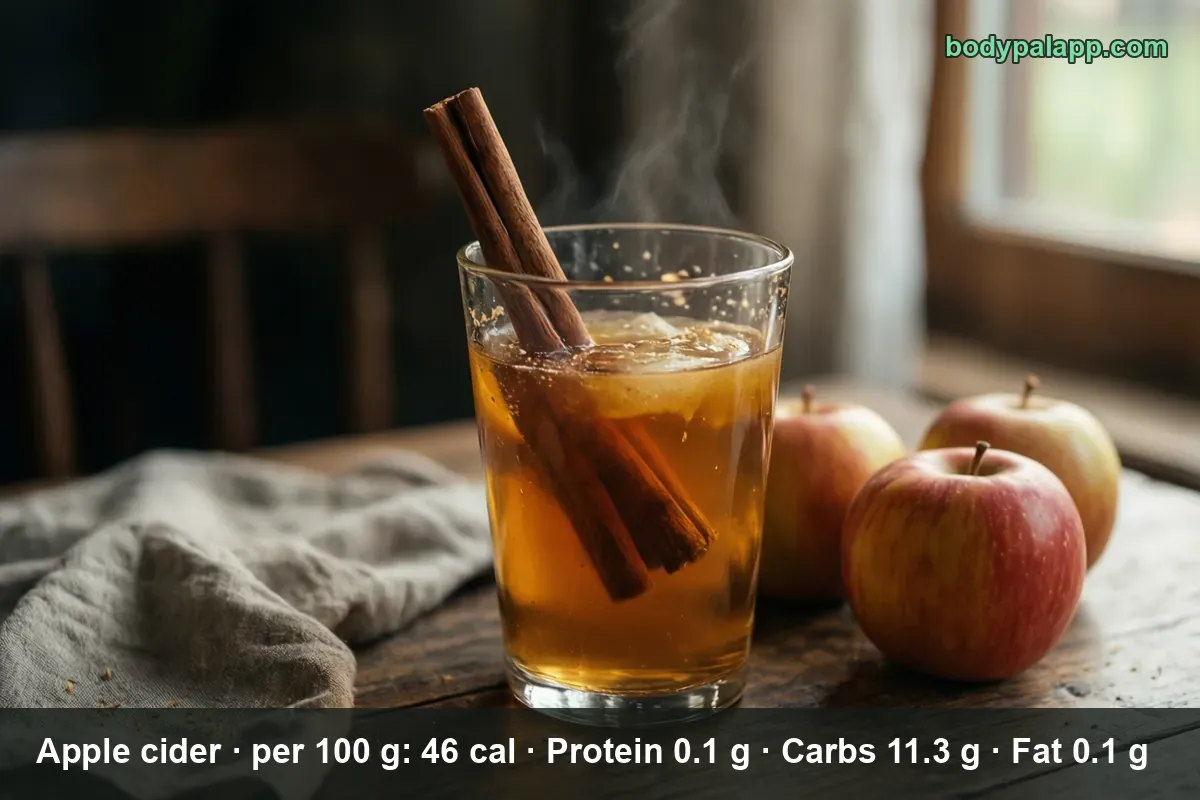
A 1-cup glass of apple cider, 8 fl oz and 248 g of it, is 114 calories, or 46 calories per 100 g. Pour the same cider into a 12 fl oz glass and you are at 171. Fill that 12 oz glass over ice instead and it lands at 127, because the cubes take up room the cider would have.
On this page
- Apple cider quick facts
- The sugar row with no percentage
- Every pour, from a taste to a 12 oz glass
- Ice takes a quarter of the glass
- Hot, sparkling and store-bought cider
- Cider or apple juice: two calories apart
- This page is not about hard cider
- How does apple cider compare?
- Most popular apple cider brands
- FAQ
Apple cider quick facts
The reference entry is USDA's Apple cider (fdc_id 2709319), the pressed, unfiltered, non-alcoholic drink. The serving below is the one most people are holding: a 1-cup glass of 8 fl oz, which USDA weighs at 248 g.
| Nutrient | Per 100 g | Per 1 cup, 8 fl oz (248 g) | % Daily Value |
|---|---|---|---|
| Calories | 46 kcal | 114 kcal | — |
| Total fat | 0.13 g | 0.3 g | 0% |
| Saturated fat | 0.02 g | 0.05 g | 0% |
| Carbohydrate | 11.3 g | 28.0 g | 10% |
| Dietary fiber | 0.2 g | 0.5 g | 2% |
| Total sugars | 9.62 g | 23.9 g | — |
| Protein | 0.1 g | 0.2 g | 0% |
| Sodium | 4 mg | 10 mg | 0% |
| Potassium | 101 mg | 250 mg | 5% |
% Daily Value is based on a 2,000-calorie diet.
Verified nutrition data
Numbers on this page come from USDA FoodData Central, the U.S. Department of Agriculture’s food composition database, and from manufacturer labels where a branded product is named. Last verified September 2026. How we verify our data →
Three of those rows carry the whole glass and the rest are rounding. Carbohydrate is 28.0 g, which is 10% of the day. Total sugars are 23.9 g of that 28.0 g, so almost nothing in cider is starch. The rest is a rounding error, apart from potassium at 250 mg: 0.3 g of fat, 0.2 g of protein and 10 mg of sodium in a full cup.
You will not find an added sugars line or a trans fat line in that table, and neither is an oversight. The USDA survey record for apple cider does not publish either value, so a number in those rows would be one we invented. The cholesterol figure it does publish is a real zero.
The sugar row with no percentage
Look at the table again and notice which row has a dash where the percentage should be. It is the biggest gram figure on the page.
Total sugars have no Daily Value. The FDA sets a Daily Value of 50 g for added sugars only, and cider's 23.9 g per cup is the apple's own sugar, pressed out of the fruit. So the row that would look alarming as a percentage never gets one.
That leaves three percentages above zero on a cup of cider, and they are all modest: 10% for carbohydrate, 5% for potassium and 2% for fiber, with fat, protein and sodium all sitting at 0%. Someone reading the label top to bottom comes away thinking cider barely registers, which is true of every line except the one printed without a percentage.
The practical version: log cider by its calories, not by its label percentages. A cup is 114 calories and 23.9 g of sugar, and no amount of the drink being fruit-derived changes either figure.
Every pour, from a taste to a 12 oz glass
Cider is sold by the half gallon and drunk by the mug, so the pour is the number that moves, not the liquid.
| Pour | Weight | Calories |
|---|---|---|
| 1 fl oz, a taste at the orchard | 31 g | 14 cal |
| 1 fl oz over ice | 23 g | 11 cal |
| 1 oz by weight | 28.35 g | 13 cal |
| 1 cup, 8 fl oz | 248 g | 114 cal |
| 12 fl oz glass | 372 g | 171 cal |
| 12 fl oz glass over ice | 276 g | 127 cal |
USDA publishes the cup and the per-fluid-ounce weights, 31 g neat and 23 g over ice; the two 12 fl oz rows are our own scaling of those, twelve ounces at a time.
Two rows in that list explain most of the bad logging. USDA weighs 1 fluid ounce of cider at 31 g, and 1 ounce by weight is 28.35 g, worth 13 calories. They are a calorie apart, which sounds trivial until you scale a fluid measure by a weight number across a 12 oz glass and lose a serving's worth of arithmetic.
The other trap is the cup itself. USDA counts an 8 fl oz cup as 248 g and calls it 114 calories. Bottle labels declare their serving as 236 to 250 mL, so the same nominal 8 oz comes out anywhere from 110 to 121 calories depending on whose jug you poured. Nobody is wrong. The cups are just different sizes with the same name on them.
If you want one number to carry around, use 114 for a cup and 171 for a tall glass. Both are within a few calories of every label on the shelf.
Ice takes a quarter of the glass
This is the one place where the container works in your favor, and USDA measured it.
A fluid ounce of cider poured neat weighs 31 g. The same fluid ounce poured over ice weighs 23 g, because roughly a quarter of the volume is now frozen water. Run that across a 12 fl oz glass and the difference is not subtle:
- 12 fl oz, no ice: 372 g of cider, 171 calories
- 12 fl oz, over ice: 276 g of cider, 127 calories
That is 44 calories removed from an identical-looking glass, without drinking any less of what is in front of you. Ice is not diluting the cider or lowering its density. It is occupying space the cider would otherwise fill.
Two things follow. If you log iced cider by the size of the cup, you are overcounting by about a quarter. And if you ask for light ice, you are quietly ordering more cider than the person holding the same glass beside you.
Hot, sparkling and store-bought cider
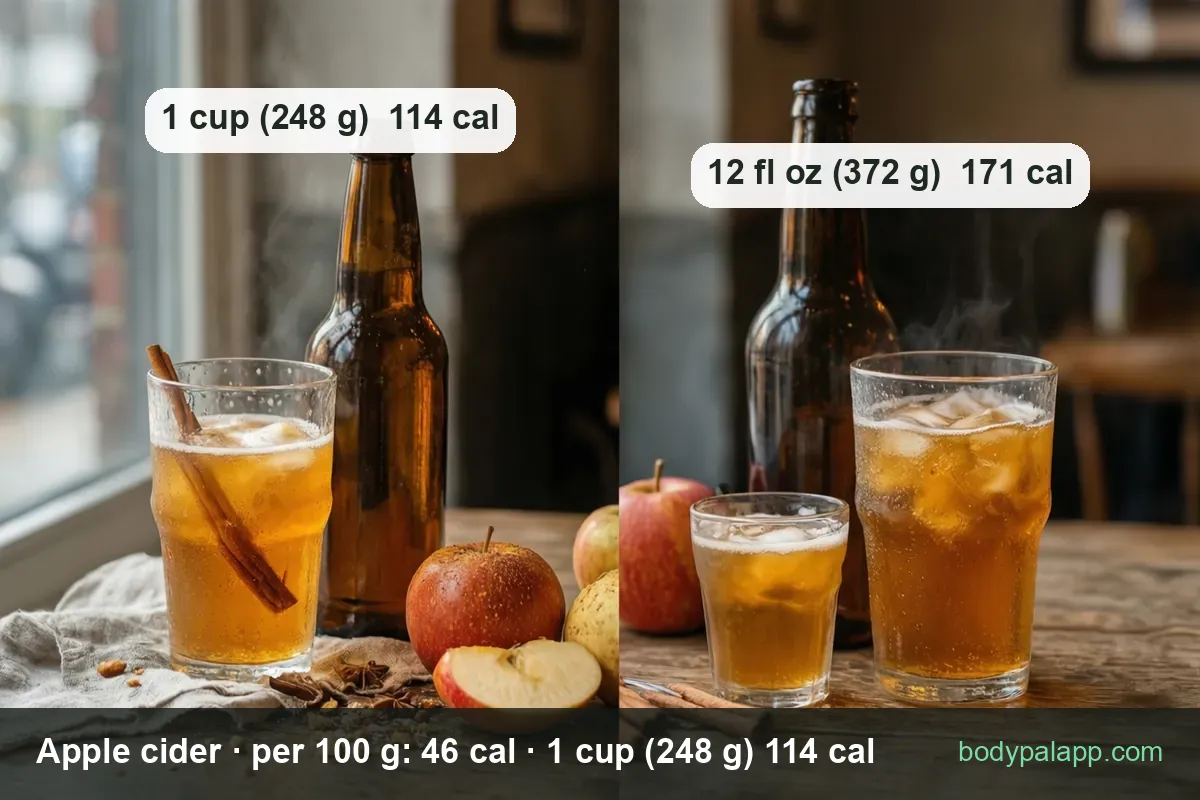
Every version below is the non-alcoholic pressed drink, bottled or poured from the jug; hard cider is a separate thing and it is covered further down.
| Version | Per 100 g | Serving | Calories |
|---|---|---|---|
| Fresh pressed cider | 46 cal | 1 cup (248 g) | 114 cal |
| Hot mulled cider, nothing added | 46 cal | 1 cup (248 g) | 114 cal |
| Iced cider | 46 cal | 12 fl oz (276 g) | 127 cal |
| Store-brand old-fashioned cider | 46 cal | 8 fl oz label | 110 cal |
| Sparkling cider, holiday bottle | 58 cal | 8 fl oz label | 139 cal |
Hot cider is the row people expect to be different and it is not. Heat the same cider with two cinnamon sticks and a star anise and it is still 46 calories per 100 g, 114 to the cup. Spices bring aroma at no cost. What changes the number is sugar or caramel stirred in afterwards, and the shelf versions that do it run about 51 calories per 100 g rather than 46.
One caveat on the stove. These figures assume you are warming cider, not reducing it. Simmer a pot uncovered for an hour and water leaves while the sugar stays, so the calories per 100 g climb even though the pot holds the same calories it started with.
Sparkling cider is the outlier at 58 calories per 100 g, or 139 for an 8 fl oz pour. That bottle is a more concentrated juice, not a different fruit, and it is also the one most likely to be poured into a small flute, which pulls the real serving back down.
Across the store-brand and national labels we track, apple cider runs from 46 to 58 calories per 100 g, or 110 to 139 per declared 8 fl oz serving. That is a narrow enough band that brand choice is not a decision worth agonizing over. Glass size still is.
Cider or apple juice: two calories apart
Here is the comparison that sends most people to a calorie page in the first place, and the answer is duller than it deserves to be.
Apple cider is 46 calories per 100 g. Apple juice, 100% (fdc_id 2709320) is 48. Across a 1-cup serving that is 114 against 119, a five-calorie gap between two records from the same USDA survey edition. The calcium-fortified juice is also 48, since minerals carry no calories.
What separates them is filtration. Cider is pressed apples with the cloud left in; juice is the same pressing put through a filter and usually pasteurized harder. It looks like a meaningful difference in the jug and it is a meaningful difference in taste. In the log, it is noise.
Carbohydrate tells the same story: 11.3 g per 100 g in cider, 11.34 g in juice. If you are switching from juice to cider to save calories, you have not saved any.
This page is not about hard cider
Every number above is for the non-alcoholic pressed drink sold in jugs and served hot at orchards. Hard cider is a fermented alcoholic drink, and its calories come from ethanol as well as sugar, so the two are not interchangeable in a log.
The USDA index behind this page carries no entry for hard cider, which means there is no honest figure to quote here. Rather than average a guess, the number is simply not given. If the bottle in your hand shows an ABV percentage, this page is not describing it.
Apple cider vinegar is a third thing again, and it turns up in the same search results constantly. It is a condiment, not a drink: a tablespoon of it declares 0 calories on the label. Nothing on this page applies to it.
How does apple cider compare?
All five rows are USDA survey entries at their own standard American serving.
| Item | Per 100 g | US serving | Calories | Carbs | Protein |
|---|---|---|---|---|---|
| Apple cider | 46 cal | 1 cup (248 g) | 114 cal | 28.0 g | 0.2 g |
| Apple juice, 100% | 48 cal | 1 cup (248 g) | 119 cal | 28.1 g | 0.2 g |
| Orange juice, 100% | 47 cal | 1 cup (248 g) | 117 cal | 25.2 g | 1.9 g |
| Apple, raw | 61 cal | 1 medium (200 g) | 122 cal | 29.6 g | 0.3 g |
| Applesauce, unsweetened | 52 cal | 1 cup (245 g) | 127 cal | 30.0 g | 0.7 g |
Our take: the three drinks at the top are the same thing wearing different labels, all landing between 114 and 119 calories a cup, and choosing among them on calories alone is wasted effort. Orange juice is the only one that brings anything extra, at 1.9 g of protein against 0.2 g.
The row that actually differs is the apple. A medium raw apple is 122 calories, eight more than a cup of cider, and it carries 4.2 g of fiber against the cider's 0.5 g. That is the whole trade in one line: pressing an apple removes the part of it that fills you up. MyPlate counts a cup of 100% juice toward the fruit group but advises making most of your fruit whole fruit, and the Dietary Guidelines for Americans say the same. The fiber column is why.
So: cider when you want cider, especially hot and spiced in October, at a genuine 114 calories a cup. An apple when you want the calories to do some work.
Most popular apple cider brands in the United States
Ranked by how widely each product appears among foods sold in the United States, from the BodyPal food database of over 3.3 million products. Calories are the figures printed on each Nutrition Facts label, checked against USDA FoodData Central.
| Product | Calories (per 100 g) |
|---|---|
| Hays Orchard Original Apple Cider | 48 cal |
| Mott's Fall Spice Apple Cider 100% Juice | 50 cal |
| Archer Farms Apple Cider Juice | 46 cal |
| Columbia Gorge Organic Apple Cider Juice | 47 cal |
| Signature Farms Old Fashioned Apple Cider | 46 cal |
| Langer Farms 100% Unfiltered Apple Cider | 51 cal |
Brand popularity: BodyPal food database. Nutrition: manufacturer labels / USDA FoodData Central.
Apple cider FAQs
How many calories are in apple cider?
114 calories in a 1-cup glass of 8 fl oz, which USDA weighs at 248 g, at 46 calories per 100 g. A 12 fl oz glass is 171 calories, and the same glass over ice is 127. A cup carries 23.9 g of sugar.
How many calories are in a cup of apple cider?
114 calories for 1 cup (248 g). That cup holds 28.0 g of carbohydrate, which is 10% of the Daily Value, 23.9 g of total sugars, 0.5 g of fiber and 10 mg of sodium. Protein and fat are both under half a gram.
How many calories are in 8 oz of apple cider?
114 calories, using USDA's weight of 248 g for 8 fl oz. Bottle labels declare their 8 oz serving as 236 to 250 mL, so brand to brand the same pour runs 110 to 121 calories. Note that 1 ounce by weight is 28.35 g and 13 calories, not the same as a fluid ounce.
Does apple cider have more calories than apple juice?
Fewer, by two calories per 100 g: cider is 46 and 100% apple juice is 48. Over a 1-cup serving that is 114 against 119. The difference between them is filtration and cloudiness rather than calories, and carbohydrate is 11.3 g against 11.34 g.
How many calories are in hot apple cider?
114 calories a cup, exactly the same as cold, because heat adds nothing. Cinnamon sticks and star anise are free. Sugar or caramel stirred in is not, and the flavored versions on the shelf run about 51 calories per 100 g against 46 for plain cider.
How much sugar is in apple cider?
23.9 g in a 1-cup serving, at 9.62 g per 100 g, which is most of the 28.0 g of carbohydrate in the glass. Total sugars carry no Daily Value on a US label, so there is no percentage beside that row. The FDA's 50 g Daily Value applies to added sugars only.
Does apple cider have fiber?
Almost none: 0.5 g in a 1-cup serving, or 2% of the Daily Value, at 0.2 g per 100 g. A medium raw apple has 4.2 g, roughly eight times as much for 122 calories against 114. Cloudy cider looks like it kept the fruit, but the pulp that carries fiber is what the press leaves behind.
Is apple cider healthy?
It is a 114-calorie cup of fruit sugar with 0.5 g of fiber and 250 mg of potassium, which is 5% of the Daily Value. MyPlate counts 100% juice toward the fruit group while advising that most fruit be eaten whole. Sodium is a non-issue at 10 mg a cup.
Similar foods
- Beer — 155 cal for 12 fl oz can
- Beer (Lager) — 153 cal per can
- Corona Beer — 153 cal per bottle
- Guinness Stout Beer — 153 cal per bottle
- Heineken Beer — 153 cal per bottle
- Beer Pint — 206 cal per pint
Count it without the math
Point the camera at the mug or the jug and BodyPal works out which pour you actually had, ice and all.


How long does it take to burn off apple cider?
A 1-cup (248 g) serving is 114 kcal. Enter your weight and the amount you ate to see how long it takes you to burn that off:
lb
| Activity | Time to burn 114 kcal |
|---|---|
| Walking, brisk | 23 min |
| Cycling, moderate | 14 min |
| Swimming, moderate | 16 min |
| Jogging | 13 min |
| Weight training, moderate | 25 min |
Times are for a 155 lb adult at a steady pace; change the weight to see yours. The amount is set to the portion in the text (248 g); change it to what you actually ate. BodyPal works this out from your steps automatically.
Burning it off is one side of it. The other is knowing your number: work out how many calories you need a day, with macros and a goal date.